Correlation of Theory and
            Practice

The practical syllogism is the specific feature
of practical wisdom which directly links theory
and practice in a way which maintains the
unity of the clinical experience.

                     -Lauder William -2004
MEANING OF THEORY AND
            PRACTICE

Theories are setup inter- related concept that give
the systematic view of phenomena that is
explanatory-predictive in nature.

Practice is a form of doing action in which practical
wisdom and a morally enlightened disposition are
the bases of professional actions.
Reflective Practice
• Integration refers to continuous, Intelligent and
  interactive adjusting
                                  - Hopkins
  The un-reflected life is not worth living

                                 - Plato
• Reflective practice is the cornerstone of uniting
  theory and practice in health promotion because
  the building together of the past and the present
  determines future health promotion actions.

                      -(Naidoo and wills-1998)
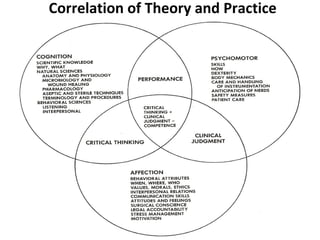
Domains Involved in Integrating Nursing
    Service and Nursing Education


Learning is a process of discovery and mastery of
skills. Performance based learning to function
competently in an environment takes place at three
levels.

   Cognitive domain – knowledge

   Affective domains – attitude

   Psychomotor domains – practice
Correlation of Theory and Practice
• (Reflective practice requires the teacher to
 facilitate the reasoning process to help students
 to recognize ambiguity and clarify in clinical
 settings.
• Integration is a state of wholeness, harmony and
 relatedness. It also a means to blend things
 together    into   a   harmonious   whole    and
 opportunities should be provided.
Why is reflective thinking / practice
              important?
• Modern society is becoming more complex
  information is becoming available and
  changing more rapidly prompting users to
  constantly rething, switch directions, and
  change problem solving strategies.
• To promote clinical reasoning and analytical
  evaluation abilities in students.
• To apply new knowledge to the complex situations in
  their day to day activities.
• To develop higher order thinking skills by prompting
  learners to
  A. relate new knowledge to prior        understanding
  B. think in both abstract and      conceptual terms.
  C. apply specific strategies in novel   tasks.
  D. Understand their own thinking and learning
  strategies.
USES OF REFLECTIVE PRACTICE

Reflective practice can facilitate and enhance
• Acceptance of, and increased confidence with, the
  essential complexity and uncertainty of professional
  life.
• Reflexive critical awareness of personal values,
  ethics, prejudices, assumptions of professional
  identity, decision-making processes
CONTD…
• Reflexive critical awareness of the
  professional milieu: its values, ethics,
  assumptions about roles and identity
• Acceptance of and willingness to explore, the
  interrelatedness of the professional and the
  personal
• Sensitive, fruitful review of forgotten areas of
  practice
• Analysis of hesitations, skill and knowledge
  gaps
• Constructive awareness of collegial relationships
• Relief of stress by facing problematic or
  painful episodes
• Identification of learning needs
• Dissemination of experience and expertise to
  and from colleagues
• Increased confidence in professional practice
How can I introduce reflective
 practice in to my teaching?
        Self and peer assessment
         Problem based learning
      Personal development planning
Self And Peer Assessment

• It’s the involvement of student in identifying
  standards or criteria to apply to their work and
  making judgment about the extent to which they
  have met this criteria and standards.

• Self assessment involves two clear stages.
      1. Learner understands standards of criteria.
     2 . The making of own judgment against those
      criteria
Contd….
• Peer assessment describes about making judgment
  about the quality of each other work in relation to
  agreed criteria.
• Peer assessment describes about making judgment
  about the quality of each other work in relation to
  agreed criteria.
Uses
• helps the learners to encourage to make
  qualitative commands about the work of peers
Problem based learning

• Problem based learning starts with problems
  and require the students to research, select,
  analyse and apply information and theories to
  solve it.
Uses
• Problem based learning helps to students to
  think on their feet and draw on previous
  experience to transfer in to new settings.
Personal development planning

• It’s a structured and supported process under
  taken by an individual to reflect upon their own
  learning, performance and achievement to plan
  for their personal educational and career
  development.

           - Quality assurance agency 2001
Uses of personal development
                planning
• Help students become more effective,
  independent and confident self directed
  learners.
• Understand how they are learning and relate
  their learning to a wider context.
• Improve their general skills for study and
  career management.
• Articulate their personal goals and evaluate
  progress towards their achievement.
• Encourage a positive attitude to learning
  throughout life.
• Improving and encouraging dialogue between
  learners and teachers
Reflective practice model
Schon identifies two kinds of reflection
• Reflection in action The person will reflect
                      action during an
                      event?(what can I do
                 now to improve?)
• Reflection on action This is retrospection
                            reflect on actions that
                            have already
                            occurred. (what can I
                      do next time to
                 improve things?)
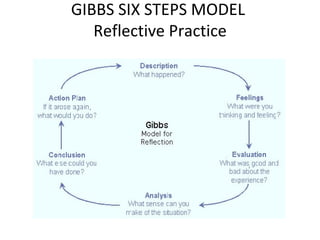
GIBBS SIX STEPS MODEL
   Reflective Practice
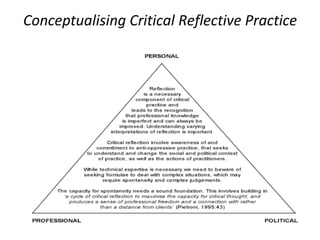
Conceptualising Critical Reflective Practice
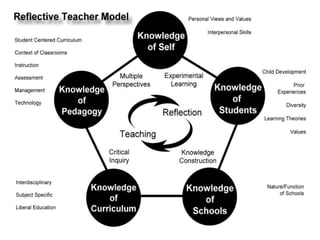
Reflective teacher model

• This model based upon a philosophy of active
  and experiential learning and critical inquiry in
  to underlying issues in education and society
  from multiple perspectives.
Academic Programs

• The reflective Teacher Model is an
  undergraduate teacher education program
  based upon philosophy of active and
  experiential learning and critical inquiry into
  underlying issues in education and society
  from multiple perspectives .
This philosophy emphasizes the development of
the pre-service teacher as a reflective
practitioner who exhibits the following
characteristics
• Reflective teacher are purposeful and active
• Reflective initiate instruction cognizant of the needs
  of the student as expressed through their
  experience
• Reflective teachers aim instruction towards actions
  or convictions that resolve the questions, tensions,
  and perplexities that imitated the student’s
  process of inquiry.
• Reflective teachers are open to the
  individuality of students
• Reflective teachers recognize that the social
  process of education is also personal, and that
  it cannot be coerced from others, but must be
  chosen by them.
• Reflective teachers are sympathetic to the interests,
  needs and insights of the students capacity as
  reflective thinkers
• Reflective teachers take seriously student’s
  problem. Hypotheses , and conclusions.
• Reflective teachers are patient
• Reflective teachers know that it takes time for ideas
  to be developed, delineated, and evaluated
• Reflective teachers are flexible.
• Reflective teachers allow for divergence and
  technological change. They seek to expand
  option rather than limit them. They consider
  alternative methods and points of view ,and they
  are willing to change their mind.
• Reflective teachers explore, investigate ,and
  grow. They are suspicious of their own
  conclusions because they know that they are
  learners.
• Reflective teachers are self –regarding
• Reflective teachers take their own reasoning
  processes as part of their field of inquiry. They
  are conscious of their assumptions, logic,
  choices, priorities, and conclusions
Conclusions
• Both theory and practice must supplement and
  support each other rather than come as two
  distinct and separate experiences. Nursing skill
  requires 3H.
• Head now needs to hold more, Hands must be
  ever sever and more skillful and Heart must
  open ever widest as the head and hands
  become busier.
• Integration of nursing education with nursing
  service is important to give a quality nursing
  care.

Theory and Practice

  • 1.
    Correlation of Theoryand Practice The practical syllogism is the specific feature of practical wisdom which directly links theory and practice in a way which maintains the unity of the clinical experience. -Lauder William -2004
  • 2.
    MEANING OF THEORYAND PRACTICE Theories are setup inter- related concept that give the systematic view of phenomena that is explanatory-predictive in nature. Practice is a form of doing action in which practical wisdom and a morally enlightened disposition are the bases of professional actions.
  • 3.
    Reflective Practice • Integrationrefers to continuous, Intelligent and interactive adjusting - Hopkins The un-reflected life is not worth living - Plato • Reflective practice is the cornerstone of uniting theory and practice in health promotion because the building together of the past and the present determines future health promotion actions. -(Naidoo and wills-1998)
  • 4.
    Domains Involved inIntegrating Nursing Service and Nursing Education Learning is a process of discovery and mastery of skills. Performance based learning to function competently in an environment takes place at three levels. Cognitive domain – knowledge Affective domains – attitude Psychomotor domains – practice
  • 5.
  • 6.
    • (Reflective practicerequires the teacher to facilitate the reasoning process to help students to recognize ambiguity and clarify in clinical settings. • Integration is a state of wholeness, harmony and relatedness. It also a means to blend things together into a harmonious whole and opportunities should be provided.
  • 7.
    Why is reflectivethinking / practice important? • Modern society is becoming more complex information is becoming available and changing more rapidly prompting users to constantly rething, switch directions, and change problem solving strategies. • To promote clinical reasoning and analytical evaluation abilities in students.
  • 8.
    • To applynew knowledge to the complex situations in their day to day activities. • To develop higher order thinking skills by prompting learners to A. relate new knowledge to prior understanding B. think in both abstract and conceptual terms. C. apply specific strategies in novel tasks. D. Understand their own thinking and learning strategies.
  • 9.
    USES OF REFLECTIVEPRACTICE Reflective practice can facilitate and enhance • Acceptance of, and increased confidence with, the essential complexity and uncertainty of professional life. • Reflexive critical awareness of personal values, ethics, prejudices, assumptions of professional identity, decision-making processes
  • 10.
    CONTD… • Reflexive criticalawareness of the professional milieu: its values, ethics, assumptions about roles and identity • Acceptance of and willingness to explore, the interrelatedness of the professional and the personal • Sensitive, fruitful review of forgotten areas of practice
  • 11.
    • Analysis ofhesitations, skill and knowledge gaps • Constructive awareness of collegial relationships • Relief of stress by facing problematic or painful episodes • Identification of learning needs • Dissemination of experience and expertise to and from colleagues • Increased confidence in professional practice
  • 12.
    How can Iintroduce reflective practice in to my teaching? Self and peer assessment Problem based learning Personal development planning
  • 13.
    Self And PeerAssessment • It’s the involvement of student in identifying standards or criteria to apply to their work and making judgment about the extent to which they have met this criteria and standards. • Self assessment involves two clear stages. 1. Learner understands standards of criteria. 2 . The making of own judgment against those criteria
  • 14.
    Contd…. • Peer assessmentdescribes about making judgment about the quality of each other work in relation to agreed criteria. • Peer assessment describes about making judgment about the quality of each other work in relation to agreed criteria. Uses • helps the learners to encourage to make qualitative commands about the work of peers
  • 15.
    Problem based learning •Problem based learning starts with problems and require the students to research, select, analyse and apply information and theories to solve it. Uses • Problem based learning helps to students to think on their feet and draw on previous experience to transfer in to new settings.
  • 16.
    Personal development planning •It’s a structured and supported process under taken by an individual to reflect upon their own learning, performance and achievement to plan for their personal educational and career development. - Quality assurance agency 2001
  • 17.
    Uses of personaldevelopment planning • Help students become more effective, independent and confident self directed learners. • Understand how they are learning and relate their learning to a wider context. • Improve their general skills for study and career management.
  • 18.
    • Articulate theirpersonal goals and evaluate progress towards their achievement. • Encourage a positive attitude to learning throughout life. • Improving and encouraging dialogue between learners and teachers
  • 19.
    Reflective practice model Schonidentifies two kinds of reflection • Reflection in action The person will reflect action during an event?(what can I do now to improve?) • Reflection on action This is retrospection reflect on actions that have already occurred. (what can I do next time to improve things?)
  • 20.
    GIBBS SIX STEPSMODEL Reflective Practice
  • 21.
  • 22.
    Reflective teacher model •This model based upon a philosophy of active and experiential learning and critical inquiry in to underlying issues in education and society from multiple perspectives.
  • 24.
    Academic Programs • Thereflective Teacher Model is an undergraduate teacher education program based upon philosophy of active and experiential learning and critical inquiry into underlying issues in education and society from multiple perspectives .
  • 25.
    This philosophy emphasizesthe development of the pre-service teacher as a reflective practitioner who exhibits the following characteristics • Reflective teacher are purposeful and active • Reflective initiate instruction cognizant of the needs of the student as expressed through their experience • Reflective teachers aim instruction towards actions or convictions that resolve the questions, tensions, and perplexities that imitated the student’s process of inquiry.
  • 26.
    • Reflective teachersare open to the individuality of students • Reflective teachers recognize that the social process of education is also personal, and that it cannot be coerced from others, but must be chosen by them.
  • 27.
    • Reflective teachersare sympathetic to the interests, needs and insights of the students capacity as reflective thinkers • Reflective teachers take seriously student’s problem. Hypotheses , and conclusions. • Reflective teachers are patient • Reflective teachers know that it takes time for ideas to be developed, delineated, and evaluated
  • 28.
    • Reflective teachersare flexible. • Reflective teachers allow for divergence and technological change. They seek to expand option rather than limit them. They consider alternative methods and points of view ,and they are willing to change their mind. • Reflective teachers explore, investigate ,and grow. They are suspicious of their own conclusions because they know that they are learners.
  • 29.
    • Reflective teachersare self –regarding • Reflective teachers take their own reasoning processes as part of their field of inquiry. They are conscious of their assumptions, logic, choices, priorities, and conclusions
  • 30.
    Conclusions • Both theoryand practice must supplement and support each other rather than come as two distinct and separate experiences. Nursing skill requires 3H. • Head now needs to hold more, Hands must be ever sever and more skillful and Heart must open ever widest as the head and hands become busier. • Integration of nursing education with nursing service is important to give a quality nursing care.