TEACHER AS A REFLECTIVE
PRACTITIONER
Dr SAJEENA S.
ICSSR Post Doctoral Research Fellow
SPS, MG University
• Reflection involves "a state of doubt, hesitation, perplexity, or mental
difficulty, in which thinking originates". This uncertainty is followed
by the act of searching to find materials that will resolve this doubt
and settle the perplexity (Dewey, 1933)
• Reflection is:
• • Self-awareness: thinking of yourself, your experiences and
your view of the world
• •Self-improvement: learning from experiences and wanting to
improve some area of your life
• •Empowerment: putting you in control of making changes and
behaving in a different way
• The Six Stages of Reflection are
• 1.The experience itself – learning…
• 2. The Description of the experience…
• 3. The Interpretation of the experience from which we draw
meaning…
• 4. Generalising from the experience…
• 5. Applying the lessons from the experience…
• 6. Presentation based on reflection
•Reflective practice: Reflective practice is understood as
the process of learning through and from experience
towards gaining new insights of self and/or practice.
•Purposes of reflection
Teacher’s self-reflection as a tool for self-knowledge
Reflection for professional development
Reflection to aid research on teaching
Reflection to enhance student learning experience
Reflection as a teaching and assessment tool (e.g. reflective
journal)
• Reflective Practitioner
• A reflective practitioner is a person who looks back at the work they
do, its process and how it can be improved at regular intervals. This
can also be referred to as a person who reflects on the work they have
done. They are not happy to carry on at the current standard, they
want to improve.
•Reflective practice is the act of thinking about our
experiences in order to learn from them for the future.
• Reflective practice is the ability to reflect on an action so as
to engage in a process of continuous learning.
•A key rationale for reflective practice is that experience alone
does not necessarily lead to learning; deliberate reflection on
experience is essential.
•Reflective practice is an important tool in practice-based
professional learning settings where people learn from their
own professional experiences, rather than from formal
learning or knowledge transfer.
•A person who reflects throughout his or her practice is not
just looking back on past actions and events, but is taking a
conscious look at emotions, experiences, actions, and
responses, and using that information to add to his or her
existing knowledge base and reach a higher level of
understanding.
• Reflection, in the words of a layman, “… simply means
thinking about something,” but for some, “it is a well-
defined and crafted practice that carries very specific
meaning and associated action” (Loughran, 2002).
•Reflective teaching, at a very general level involves ‘thinking
about one’s teaching’.
•Reflective teaching is a process where teachers think over their
teaching practices, analyze how something was taught and
how the practice might be improved or changed for better
learning outcomes.
•Some points of consideration in the reflection process might be
what is currently being done, why it's being done and how well
students are learning.
• By collecting information about what goes on in their classroom, and
by analyzing and evaluating this information, they identify and
explore their own practices and underlying beliefs. This may then lead
to changes and improvements in their teaching.
• Reflective teaching is a beneficial process in teacher professional
development, both for preservice and in-service teachers.
• Reflective teaching is a significant element in student teachers’ initial
training programme.
• Coaching and peer involvement are two aspects of reflective practices
seen most often at the pre-service level.
•The reflective practitioner seeks to integrate previously learned
information with the present experience in order to achieve
future results.
• quest is enhanced through collaborative efforts with
colleagues, other professionals and community resources.
•The first step towards the process of reflection is to gather
information about what happens in the class followed by
analysis of the data.
• Here are some different ways of doing this.
1.Reflective journal /diary
• This is the easiest way to begin a process of reflection since it is
purely personal. Student teachers encounter many issues in classroom
settings. After each activity/ practice lesson, the student teacher has to
write in a notebook about what happened. They can describe about
own reactions and feelings and those things which happened during
each sessions. Diary writing does require a certain discipline in taking
the time to do it on a regular basis.
2. Collaborative learning
•Collaboration with peer members increases the probability
that student teachers will be successfully reflective and more
confident in their professional development. While
discussing their experience with their peers, they can
describe their own experiences and check, reframe and
broaden their own theories of practice.
3. Recording Lessons
• Video or audio recordings of lessons can provide very useful information for
reflection.
• Through watching their own or other peer members’ audio and video recordings,
student teachers can develop their awareness of teaching.
• A teacher may do many things in class but may not be aware of many things
happening in the class which the teacher may not normally see. A classroom video
can vividly picture the whole process of teaching. It can trigger teachers’ reflective
thinking, reflect on their weaknesses and help them get some inspiration and ideas
for their teaching improvement. The recording can be audio or video.
4. Teacher Educator’s Feedback
• The feedback from the teacher educator can help the student teacher to
reflect upon their lesson or any activity conducted in the institution.
5. Peer Observation
• Observation is the most basic research technique that student teachers
employ in classrooms.
• The student teacher invites a peer member to observe his/her class to
collect information about the lesson.
• This may be with a simple observation task or through note taking.
• The student teacher can ask their peer member to focus on which
students contribute the most in the lesson, what different patterns of
interaction occur and his/her performance..
• For observation to be viewed as a positive rather than a negative
experience, the observer’s function should be limited to that of
gathering information.
• The observer should not be involved in evaluating a student teacher’s
lesson.
• Mutual observation of classes are really fruitful. Therefore,
observation is a good way for their professional development
6. Student Feedback
•The student teacher can ask their students about what goes
on in the classroom. Their opinions and perceptions can add
a different and valuable perspective. This can be done with
simple questionnaires.
7. Blogging
• Having a blog allows educators to share their thought process with
others and get feedback from similarly passionate educators.
Connecting with other great educators through blogging has made
learning and growing a collaborative effort.
8. Autobiographies
• These consist of small groups of around 12 student teachers who meet
for an hour each week.
• During this period of time each student words at creating a written
account of his or her educational experience and the weekly meetings
are used to enable each person to read a passage from his or her
autobiography so that it can be supported, by the peers and the
teacher.
•9. Action Research
•Action research is also a kind of reflective practices.
•It is a reflective process of progressive problem solving led by
teachers to understand their practice and improve the way
they address issues and solve problems.
•It helps student teachers to become aware of what’s happening
in the classroom by identifying common problems and
hypothesising about possible causes and solutions and
attempting to apply an action plan.
•Once the student teacher has some information recorded
about what goes on in their classroom, they must think, talk,
read and ask about the information they have collected.
•They can identify the patterns occurring in their teaching
through the observation.
• Then, he/she should find out the ways to overcome it. In this
research study, the student teachers adopted all the strategies
and reflected on their practices.
•The researchers could find a significant change in the
behaviour of the student teachers.
• Schon Reflective Model
• To become skilled at reflection, the practitioner should choose a
model (or models) that best reflect(s) their own needs and
capabilities.
• To provide a summary of Schon’s reflective model, it is important to
define what he meant by (1) Knowing in action (2) Reflection in
action, and (3) Reflection on action.
• The ‘knowing in action’ concept is a less commonly cited aspect of
Schon’s theory.
• When Schon talked about ‘knowing in action’, he was referring to
practitioner’s intuitive ability to know how to perform a task. For
example, the ability of a teacher to obtain the attention of a classroom.
• As Schon put it, “Our knowing is ordinarily tacit, implicit in our
patterns of action and in our feel for the stuff with which we are
dealing”. It seems right to say that our knowing is in our action
• It is helpful for practitioners to consider what they ‘know in
action’ not only to build their confidence and recognise their
strengths, but also to appreciate that the abilities they will
gain in the future are likely to come through action and
experience.
•Moreover, the reflections the practitioner engages in the
future may challenge the ‘knowledge’ the practitioner has
now, and this may therefore reshape their ‘knowledge’.
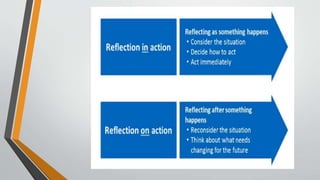
• Reflection-in-action is reflection during the ‘doing’ stage (that is,
reflecting on the incident while it can still benefit the learning).
• This is carried out during the lesson rather than reflecting on how
you would do things differently in the future.
• This is an extremely efficient method of reflection as it allows you to
react and change an event at the time it happens.
• For example, in the classroom you may be teaching a topic which
you can see the students are not understanding. Your reflection-in-
action allows you to understand why this has happened and how to
respond to overcome this situation.
• Reflection-in-action allows you to deal with surprising incidents that
may happen in a learning environment.
• It allows you to be responsible and resourceful, drawing on your own
knowledge and allowing you to apply it to new experiences.
• It also allows for personalised learning as, rather than using
preconceived ideas about what you should do in a particular situation,
you decide what works best at that time for that unique experience and
student.
• Reflection-on-action, on the other hand, involves reflecting on how
practice can be developed after the lesson has been taught. Schön
recognises the importance of reflecting back ‘in order to discover how
our knowing-in-action may have contributed to an unexpected
outcome’. Reflection-on-action means you reflect after the event on
how your knowledge of previous teaching may have directed you to
the experience you had.
• Reflection-on-action should encourage ideas on what you need to
change for the future.
• You carry out reflection-on-action outside the classroom, where you
consider the situation again.
• This requires deeper thought, for example, as to why the students did
not understand the topic.
• It encourages you to consider causes and options, which should be
informed by a wider network of understanding from research.
•When writing a reflection using Schon’s model, there are
three different tasks that the practitioner could complete.
•Firstly, it can be helpful to begin thinking about what one
‘knows in action’. This can help to boost confidence by
recognising one’s strengths. It can also help draw the
practitioner’s attention towards knowledge and skills they
‘take for granted’ as these skills or ways of doing things
may become later challenged through reflective practice.
• Secondly, as mentioned, one of the benefits of Schon’s model is that part of it can
be completed ‘in practice’, thus this stage of reflection would be acted out rather
than reported. Nevertheless, it can be helpful to write down the ‘reflection in
action’ after the event, to synthesise an appreciation of how the practitioner
reflected (acted) in practice.
• Finally, when carrying out the retrospective ‘reflection on practice’, it is
especially useful to write the reflection down. At this stage, the practitioner
should provide a clear description of what happened, their interpretation of the
event, and how they might change their behaviour in the future.
• Example of using Schön's model
• Reflection in action
● You are in a lecture and keep being distracted by thinking about what to have for
lunch!
● You want to get the most from the lecture so need to find a way to help you
focus.
● You decide to start making some notes of the key points.
• Reflection on action
● You notice that sometimes after a lecture you can’t remember what
was covered.
● You find out about the lecture topic in advance and write down some
questions you want answered.
● You make notes during the lecture to help you focus.
● You arrange to go for a coffee after the lecture and talk with your
peers about what was presented, to help you understand and form
your own opinions.
● You file your lecture notes and any handouts.
• Kolb’s Learning Cycle
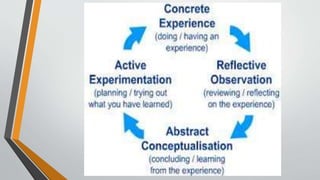
• David Kolb, educational researcher, developed a four-stage reflective model. Kolb’s
Learning Cycle (1984) highlights reflective practice as a tool to gain conclusions and
ideas from an experience. The aim is to take the learning into new experiences,
completing the cycle. Kolb's cycle follows four stages.
1.First, practitioners have a concrete experience. This means experiencing something
new for the first time in the classroom. The experience should be an active one, used
to test out new ideas and teaching methods.
2.After doing the observation of the concrete experience, then reflecting on the
experience. Here practitioners should consider the strengths of the experience and
areas of development. Practitioners need to form an understanding of what helped
students’ learning and what hindered it.
3. The formation of abstract concepts. The practitioner needs to make sense of
what has happened. They should do this through making links between what they
have done, what they already know and what they need to learn. The practitioner
should draw on ideas from research and textbooks to help support development and
understanding. They could also draw on support from other colleagues and their
previous knowledge. Practitioners should modify their ideas or devise new
approaches, based on what they have learnt from their observations and wider
research.
4. The practitioner considers how they are going to put what they have learnt into
practice. The practitioner’s abstract concepts are made concrete as they use these to test
ideas in future situations, resulting in new experiences. The ideas from the observations
and conceptualisations are made into active experimentation as they are implemented
into future teaching. The cycle is then repeated on this new method.
• Kolb’s model aims to draw on the importance of using both our own everyday
experiences and educational research to help us improve. It is not simply enough for
you to reflect. This reflection must drive a change which is rooted in educational
research.
References
• Akbari, R. (2007). Reflection on Reflection:A critical Appraisal of Reflective practice in l2
Teacher Education system, 35(2), pp 192-207.
• Dewey, J. (1933). HowWeThink. A Restatement of the Relation of ReflectiveThinking to the
Educative Process (Revised edn.), Boston: Heath Institute of Reflective Practice found at
http://www.reflectivepractices.co.uk.
• Jacobs,M .,Vakalisa, N.C.G., & Gawe, N . (2011). Teaching Learning Dynamics . CapeTown:
Pearson
• Kolb, D.A. (1984). Experiential Learning: Experience as the Source of Learning and Development.
New Jersey: EnglewoodCliffs, Prentice-Hall.
• Mathew, P., Mathew, P., & Peechattu, P. J. ( 2017). Reflective Practice: A Means toTeacher
Development. Asia PacificJournal of Contemporary Education andCommunicationTechnology, 3
(1), pp 126- 130.
• Schon, D. (1983). The Reflective Practioner- How ProfessionalsThink in Action. USA: Basic Books
• Sellars, M. (2012).Teachers and Change:The Role of Reflective Practice. Procedia- Social and
Behavioral sciences, 55, pp 461-469.

Teacher as a reflective practitioner

  • 1.
    TEACHER AS AREFLECTIVE PRACTITIONER Dr SAJEENA S. ICSSR Post Doctoral Research Fellow SPS, MG University
  • 2.
    • Reflection involves"a state of doubt, hesitation, perplexity, or mental difficulty, in which thinking originates". This uncertainty is followed by the act of searching to find materials that will resolve this doubt and settle the perplexity (Dewey, 1933)
  • 3.
    • Reflection is: •• Self-awareness: thinking of yourself, your experiences and your view of the world • •Self-improvement: learning from experiences and wanting to improve some area of your life • •Empowerment: putting you in control of making changes and behaving in a different way
  • 4.
    • The SixStages of Reflection are • 1.The experience itself – learning… • 2. The Description of the experience… • 3. The Interpretation of the experience from which we draw meaning… • 4. Generalising from the experience… • 5. Applying the lessons from the experience… • 6. Presentation based on reflection
  • 5.
    •Reflective practice: Reflectivepractice is understood as the process of learning through and from experience towards gaining new insights of self and/or practice.
  • 6.
    •Purposes of reflection Teacher’sself-reflection as a tool for self-knowledge Reflection for professional development Reflection to aid research on teaching Reflection to enhance student learning experience Reflection as a teaching and assessment tool (e.g. reflective journal)
  • 7.
    • Reflective Practitioner •A reflective practitioner is a person who looks back at the work they do, its process and how it can be improved at regular intervals. This can also be referred to as a person who reflects on the work they have done. They are not happy to carry on at the current standard, they want to improve.
  • 8.
    •Reflective practice isthe act of thinking about our experiences in order to learn from them for the future. • Reflective practice is the ability to reflect on an action so as to engage in a process of continuous learning. •A key rationale for reflective practice is that experience alone does not necessarily lead to learning; deliberate reflection on experience is essential. •Reflective practice is an important tool in practice-based professional learning settings where people learn from their own professional experiences, rather than from formal learning or knowledge transfer.
  • 9.
    •A person whoreflects throughout his or her practice is not just looking back on past actions and events, but is taking a conscious look at emotions, experiences, actions, and responses, and using that information to add to his or her existing knowledge base and reach a higher level of understanding. • Reflection, in the words of a layman, “… simply means thinking about something,” but for some, “it is a well- defined and crafted practice that carries very specific meaning and associated action” (Loughran, 2002).
  • 10.
    •Reflective teaching, ata very general level involves ‘thinking about one’s teaching’. •Reflective teaching is a process where teachers think over their teaching practices, analyze how something was taught and how the practice might be improved or changed for better learning outcomes. •Some points of consideration in the reflection process might be what is currently being done, why it's being done and how well students are learning.
  • 11.
    • By collectinginformation about what goes on in their classroom, and by analyzing and evaluating this information, they identify and explore their own practices and underlying beliefs. This may then lead to changes and improvements in their teaching. • Reflective teaching is a beneficial process in teacher professional development, both for preservice and in-service teachers. • Reflective teaching is a significant element in student teachers’ initial training programme. • Coaching and peer involvement are two aspects of reflective practices seen most often at the pre-service level.
  • 12.
    •The reflective practitionerseeks to integrate previously learned information with the present experience in order to achieve future results. • quest is enhanced through collaborative efforts with colleagues, other professionals and community resources. •The first step towards the process of reflection is to gather information about what happens in the class followed by analysis of the data.
  • 13.
    • Here aresome different ways of doing this. 1.Reflective journal /diary • This is the easiest way to begin a process of reflection since it is purely personal. Student teachers encounter many issues in classroom settings. After each activity/ practice lesson, the student teacher has to write in a notebook about what happened. They can describe about own reactions and feelings and those things which happened during each sessions. Diary writing does require a certain discipline in taking the time to do it on a regular basis.
  • 14.
    2. Collaborative learning •Collaborationwith peer members increases the probability that student teachers will be successfully reflective and more confident in their professional development. While discussing their experience with their peers, they can describe their own experiences and check, reframe and broaden their own theories of practice.
  • 15.
    3. Recording Lessons •Video or audio recordings of lessons can provide very useful information for reflection. • Through watching their own or other peer members’ audio and video recordings, student teachers can develop their awareness of teaching. • A teacher may do many things in class but may not be aware of many things happening in the class which the teacher may not normally see. A classroom video can vividly picture the whole process of teaching. It can trigger teachers’ reflective thinking, reflect on their weaknesses and help them get some inspiration and ideas for their teaching improvement. The recording can be audio or video.
  • 16.
    4. Teacher Educator’sFeedback • The feedback from the teacher educator can help the student teacher to reflect upon their lesson or any activity conducted in the institution.
  • 17.
    5. Peer Observation •Observation is the most basic research technique that student teachers employ in classrooms. • The student teacher invites a peer member to observe his/her class to collect information about the lesson. • This may be with a simple observation task or through note taking.
  • 18.
    • The studentteacher can ask their peer member to focus on which students contribute the most in the lesson, what different patterns of interaction occur and his/her performance.. • For observation to be viewed as a positive rather than a negative experience, the observer’s function should be limited to that of gathering information. • The observer should not be involved in evaluating a student teacher’s lesson. • Mutual observation of classes are really fruitful. Therefore, observation is a good way for their professional development
  • 19.
    6. Student Feedback •Thestudent teacher can ask their students about what goes on in the classroom. Their opinions and perceptions can add a different and valuable perspective. This can be done with simple questionnaires.
  • 20.
    7. Blogging • Havinga blog allows educators to share their thought process with others and get feedback from similarly passionate educators. Connecting with other great educators through blogging has made learning and growing a collaborative effort.
  • 21.
    8. Autobiographies • Theseconsist of small groups of around 12 student teachers who meet for an hour each week. • During this period of time each student words at creating a written account of his or her educational experience and the weekly meetings are used to enable each person to read a passage from his or her autobiography so that it can be supported, by the peers and the teacher.
  • 22.
    •9. Action Research •Actionresearch is also a kind of reflective practices. •It is a reflective process of progressive problem solving led by teachers to understand their practice and improve the way they address issues and solve problems. •It helps student teachers to become aware of what’s happening in the classroom by identifying common problems and hypothesising about possible causes and solutions and attempting to apply an action plan.
  • 23.
    •Once the studentteacher has some information recorded about what goes on in their classroom, they must think, talk, read and ask about the information they have collected. •They can identify the patterns occurring in their teaching through the observation. • Then, he/she should find out the ways to overcome it. In this research study, the student teachers adopted all the strategies and reflected on their practices. •The researchers could find a significant change in the behaviour of the student teachers.
  • 24.
    • Schon ReflectiveModel • To become skilled at reflection, the practitioner should choose a model (or models) that best reflect(s) their own needs and capabilities. • To provide a summary of Schon’s reflective model, it is important to define what he meant by (1) Knowing in action (2) Reflection in action, and (3) Reflection on action.
  • 25.
    • The ‘knowingin action’ concept is a less commonly cited aspect of Schon’s theory. • When Schon talked about ‘knowing in action’, he was referring to practitioner’s intuitive ability to know how to perform a task. For example, the ability of a teacher to obtain the attention of a classroom. • As Schon put it, “Our knowing is ordinarily tacit, implicit in our patterns of action and in our feel for the stuff with which we are dealing”. It seems right to say that our knowing is in our action
  • 26.
    • It ishelpful for practitioners to consider what they ‘know in action’ not only to build their confidence and recognise their strengths, but also to appreciate that the abilities they will gain in the future are likely to come through action and experience. •Moreover, the reflections the practitioner engages in the future may challenge the ‘knowledge’ the practitioner has now, and this may therefore reshape their ‘knowledge’.
  • 27.
    • Reflection-in-action isreflection during the ‘doing’ stage (that is, reflecting on the incident while it can still benefit the learning). • This is carried out during the lesson rather than reflecting on how you would do things differently in the future. • This is an extremely efficient method of reflection as it allows you to react and change an event at the time it happens. • For example, in the classroom you may be teaching a topic which you can see the students are not understanding. Your reflection-in- action allows you to understand why this has happened and how to respond to overcome this situation.
  • 28.
    • Reflection-in-action allowsyou to deal with surprising incidents that may happen in a learning environment. • It allows you to be responsible and resourceful, drawing on your own knowledge and allowing you to apply it to new experiences. • It also allows for personalised learning as, rather than using preconceived ideas about what you should do in a particular situation, you decide what works best at that time for that unique experience and student.
  • 29.
    • Reflection-on-action, onthe other hand, involves reflecting on how practice can be developed after the lesson has been taught. Schön recognises the importance of reflecting back ‘in order to discover how our knowing-in-action may have contributed to an unexpected outcome’. Reflection-on-action means you reflect after the event on how your knowledge of previous teaching may have directed you to the experience you had.
  • 30.
    • Reflection-on-action shouldencourage ideas on what you need to change for the future. • You carry out reflection-on-action outside the classroom, where you consider the situation again. • This requires deeper thought, for example, as to why the students did not understand the topic. • It encourages you to consider causes and options, which should be informed by a wider network of understanding from research.
  • 32.
    •When writing areflection using Schon’s model, there are three different tasks that the practitioner could complete. •Firstly, it can be helpful to begin thinking about what one ‘knows in action’. This can help to boost confidence by recognising one’s strengths. It can also help draw the practitioner’s attention towards knowledge and skills they ‘take for granted’ as these skills or ways of doing things may become later challenged through reflective practice.
  • 33.
    • Secondly, asmentioned, one of the benefits of Schon’s model is that part of it can be completed ‘in practice’, thus this stage of reflection would be acted out rather than reported. Nevertheless, it can be helpful to write down the ‘reflection in action’ after the event, to synthesise an appreciation of how the practitioner reflected (acted) in practice. • Finally, when carrying out the retrospective ‘reflection on practice’, it is especially useful to write the reflection down. At this stage, the practitioner should provide a clear description of what happened, their interpretation of the event, and how they might change their behaviour in the future.
  • 34.
    • Example ofusing Schön's model • Reflection in action ● You are in a lecture and keep being distracted by thinking about what to have for lunch! ● You want to get the most from the lecture so need to find a way to help you focus. ● You decide to start making some notes of the key points.
  • 35.
    • Reflection onaction ● You notice that sometimes after a lecture you can’t remember what was covered. ● You find out about the lecture topic in advance and write down some questions you want answered. ● You make notes during the lecture to help you focus. ● You arrange to go for a coffee after the lecture and talk with your peers about what was presented, to help you understand and form your own opinions. ● You file your lecture notes and any handouts.
  • 36.
    • Kolb’s LearningCycle • David Kolb, educational researcher, developed a four-stage reflective model. Kolb’s Learning Cycle (1984) highlights reflective practice as a tool to gain conclusions and ideas from an experience. The aim is to take the learning into new experiences, completing the cycle. Kolb's cycle follows four stages. 1.First, practitioners have a concrete experience. This means experiencing something new for the first time in the classroom. The experience should be an active one, used to test out new ideas and teaching methods. 2.After doing the observation of the concrete experience, then reflecting on the experience. Here practitioners should consider the strengths of the experience and areas of development. Practitioners need to form an understanding of what helped students’ learning and what hindered it.
  • 37.
    3. The formationof abstract concepts. The practitioner needs to make sense of what has happened. They should do this through making links between what they have done, what they already know and what they need to learn. The practitioner should draw on ideas from research and textbooks to help support development and understanding. They could also draw on support from other colleagues and their previous knowledge. Practitioners should modify their ideas or devise new approaches, based on what they have learnt from their observations and wider research.
  • 38.
    4. The practitionerconsiders how they are going to put what they have learnt into practice. The practitioner’s abstract concepts are made concrete as they use these to test ideas in future situations, resulting in new experiences. The ideas from the observations and conceptualisations are made into active experimentation as they are implemented into future teaching. The cycle is then repeated on this new method. • Kolb’s model aims to draw on the importance of using both our own everyday experiences and educational research to help us improve. It is not simply enough for you to reflect. This reflection must drive a change which is rooted in educational research.
  • 40.
    References • Akbari, R.(2007). Reflection on Reflection:A critical Appraisal of Reflective practice in l2 Teacher Education system, 35(2), pp 192-207. • Dewey, J. (1933). HowWeThink. A Restatement of the Relation of ReflectiveThinking to the Educative Process (Revised edn.), Boston: Heath Institute of Reflective Practice found at http://www.reflectivepractices.co.uk. • Jacobs,M .,Vakalisa, N.C.G., & Gawe, N . (2011). Teaching Learning Dynamics . CapeTown: Pearson • Kolb, D.A. (1984). Experiential Learning: Experience as the Source of Learning and Development. New Jersey: EnglewoodCliffs, Prentice-Hall. • Mathew, P., Mathew, P., & Peechattu, P. J. ( 2017). Reflective Practice: A Means toTeacher Development. Asia PacificJournal of Contemporary Education andCommunicationTechnology, 3 (1), pp 126- 130. • Schon, D. (1983). The Reflective Practioner- How ProfessionalsThink in Action. USA: Basic Books • Sellars, M. (2012).Teachers and Change:The Role of Reflective Practice. Procedia- Social and Behavioral sciences, 55, pp 461-469.