EDU 5356
CURRICULUM THEORY


            Wirda (GS31836)
                              1
“Curriculum Theory” by Beauchamp, G.A.
            Chapter 4 & Chapter 9
   Chapter 4 – Curriculum Theory

       Theory Processes in Curriculum
         H/O1 – “Curriculum Theory”, Curriculum: Foundations, Principles and Theory (2nd
          Edition), Ornstein A.C. & Hunkins F.P., USA (1993) ;page 183-208
         Article 1 – “Basic Components of a Curriculum Theory”, Beauchamp G.A.,
          Curriculum Theory Network, No. 10 (Autumn, 1972); page 16-22
         Article 2 – “Beauchamp’s ‘Basic Components of a Curriculum Theory’ – A
          Rejoinder, Posner, G.J., Curriculum Theory Network, Vol. 4 No. 1 (1973-1974);
          page 56-60

       Exemplars in Curriculum Thinking
         H/O2 - “The Field of Curriculum” & “Historical Foundations of Curriculum”,
          Curriculum: Foundations, Principles and Theory (5th Edition), Ornstein A.C. &
          Hunkins F.P., Pearson Boston (2009) ;page 18-21 & 63-102
         H/O3 - “Curriculum Theory”, Curriculum Design Techniques, Nelson, A., Wm. C.
          Brown Publishers Indiana (1990), page 1-21
         H/O1 – “Curriculum Theory”, Curriculum: Foundations, Principles and Theory (2nd
          Edition), Ornstein A.C. & Hunkins F.P., USA (1993) ;page 183-208


                                                                                            2
“Curriculum Theory” by Beauchamp, G.A.
            Chapter 4 & Chapter 9

     Emerging Status of Curriculum Theory
       H/O4 – “Curriculum Theorizing”, Curriculum: Alternative Approaches
        Ongoing Issues, Marsh C.J. & Willis G., Pearson New Jersey (2007),
        page 94-145
       H/O5 – “Curriculum Theorizing”, Key Concepts for Understanding
        Curriculum (4th Edition), Marsh C.J., Routledge New York (2009), page
        249-259


   Chapter 9 – The Nucleus of a Curriculum
     Basic Definitions


                                                                                3
Curriculum Theory

Hilda Taba                      George J. Posner
 “any enterprise as complex     “theoretical perspectives
  as curriculum requires          allow us to contemplate
  some kind of theoretical or     and ‘see’ educational
  conceptual framework of         landscapes in particular
                                  ways.”
  thinking to guide it.”


                                                      H/O 1
                                                              4
Curriculum Theory

Ornstein & Hunkins
 “Good curriculum theory          “However, it is impossible to
                                    fully predict educational
  describes and explains the        outcomes. Like other aspects
  concepts, principles, and         of education, curriculum
  relationships that exist          involves judgments, hunches,
                                    and insights that are not
  within the field. It also has     always conducive to laws,
  predictive values, rigorous       principles or generalizations.
  laws yield high probability       Often, a curriculum does not
                                    emerge as a tightly regulated,
  and control. Good theory          concise set of enterprises but
  also prescribes actions to        evolves as one action or
                                    choice that leads to another.”
  be taken.”

                                                                     5
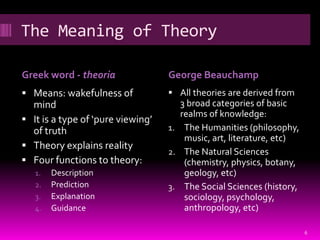
The Meaning of Theory

Greek word - theoria               George Beauchamp
 Means: wakefulness of             All theories are derived from
  mind                                3 broad categories of basic
                                      realms of knowledge:
 It is a type of ‘pure viewing’
  of truth                         1. The Humanities (philosophy,
                                       music, art, literature, etc)
 Theory explains reality
                                   2. The Natural Sciences
 Four functions to theory:            (chemistry, physics, botany,
   1.   Description                    geology, etc)
   2.   Prediction                 3. The Social Sciences (history,
   3.   Explanation                    sociology, psychology,
   4.   Guidance                       anthropology, etc)

                                                                      6
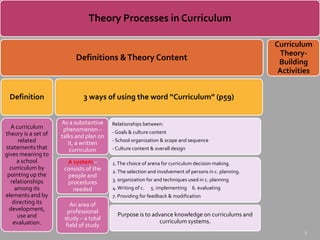
Theory Processes in Curriculum

                                                                                                       Curriculum
                                                                                                        Theory-
                          Definitions & Theory Content                                                  Building
                                                                                                        Activities


 Definition                  3 ways of using the word “Curriculum” (p59)


                     As a substantive    Relationships between:
  A curriculum        phenomenon –
theory is a set of                       - Goals & culture content
                     talks and plan on
      related           it, a written    - School organization & scope and sequence
statements that          curriculum      - Culture content & overall design
gives meaning to
     a school          A system –        1. The choice of arena for curriculum decision making.
  curriculum by       consists of the    2. The selection and involvement of persons in c. planning.
 pointing up the       people and
  relationships                          3. organization for and techniques used in c. planning
                       procedures
    among its            needed          4. Writing of c.   5. implementing 6. evaluating
elements and by                          7. Providing for feedback & modification
   directing its         An area of
 development,           professional
     use and                               Purpose is to advance knowledge on curriculums and
                      study – a total                      curriculum systems.
   evaluation.         field of study
                                                                                                               7
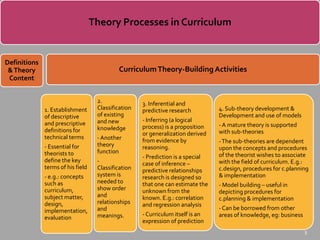
Theory Processes in Curriculum


Definitions
 & Theory                                   Curriculum Theory-Building Activities
 Content


                                    2.               3. Inferential and
              1. Establishment      Classification   predictive research         4. Sub-theory development &
              of descriptive        of existing                                  Development and use of models
                                    and new          - Inferring (a logical
              and prescriptive                                                   - A mature theory is supported
                                    knowledge        process) is a proposition
              definitions for                                                    with sub-theories
                                                     or generalization derived
              technical terms       - Another        from evidence by            - The sub-theories are dependent
              - Essential for       theory           reasoning.                  upon the concepts and procedures
              theorists to          function
                                                     - Prediction is a special   of the theorist wishes to associate
              define the key        -                                            with the field of curriculum. E.g.:
                                                     case of inference –
              terms of his field    Classification                               c.design, procedures for c.planning
                                                     predictive relationships
              - e.g.: concepts      system is        research is designed so     & implementation
              such as               needed to        that one can estimate the   - Model building – useful in
              curriculum,           show order       unknown from the            depicting procedures for
              subject matter,       and              known. E.g.: correlation    c.planning & implementation
              design,               relationships    and regression analysis
              implementation,       and                                          - Can be borrowed from other
                                    meanings.        - Curriculum itself is an   areas of knowledge, eg: business
              evaluation
                                                     expression of prediction
                                                                                                                    8
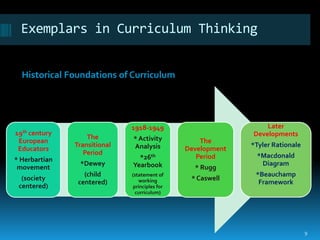
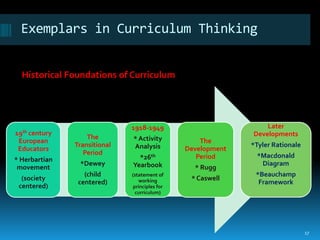
Exemplars in Curriculum Thinking


  Historical Foundations of Curriculum


                              1918-1949                           Later
19th century                                                  Developments
                   The        * Activity
 European                                           The
               Transitional   Analysis                        *Tyler Rationale
 Educators                                      Development
                  Period                                       *Macdonald
* Herbartian                    *26th              Period
                *Dewey        Yearbook                          Diagram
 movement                                         * Rugg
                  (child      (statement of                    *Beauchamp
  (society                       working         * Caswell
                centered)                                       Framework
 centered)                     principles for
                                curriculum)


                                                                                 9
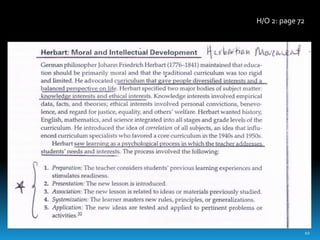
H/O 2: page 72


             10
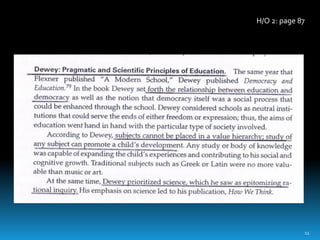
H/O 2: page 87


             11
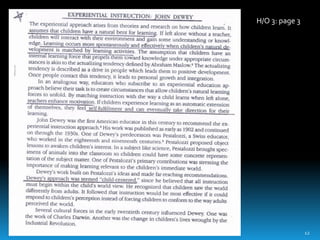
H/O 3: page 3


                12
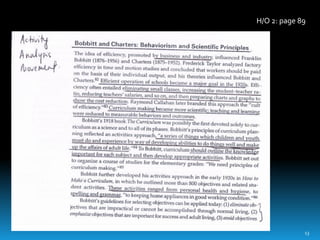
H/O 2: page 89


             13
H/O 2: page 90


             14
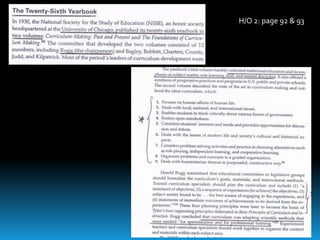
H/O 2: page 92 & 93


                      15
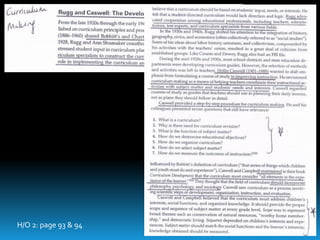
H/O 2: page 93 & 94
                      16
Exemplars in Curriculum Thinking


  Historical Foundations of Curriculum


                              1918-1949                           Later
19th century                                                  Developments
                   The        * Activity
 European                                           The
               Transitional   Analysis                        *Tyler Rationale
 Educators                                      Development
                  Period                                       *Macdonald
* Herbartian                    *26th              Period
                *Dewey        Yearbook                          Diagram
 movement                                         * Rugg
                  (child      (statement of                    *Beauchamp
  (society                       working         * Caswell
                centered)                                       Framework
 centered)                     principles for
                                curriculum)


                                                                                 17
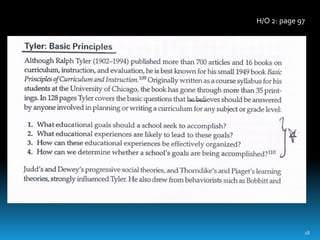
H/O 2: page 97


             18
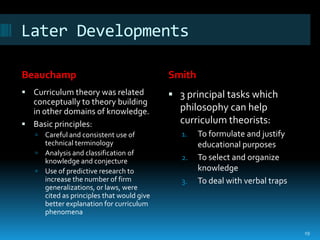
Later Developments

Beauchamp                                  Smith
 Curriculum theory was related             3 principal tasks which
  conceptually to theory building
  in other domains of knowledge.             philosophy can help
 Basic principles:                          curriculum theorists:
    Careful and consistent use of            1.   To formulate and justify
     technical terminology                         educational purposes
    Analysis and classification of
     knowledge and conjecture                 2.   To select and organize
    Use of predictive research to                 knowledge
     increase the number of firm              3.   To deal with verbal traps
     generalizations, or laws, were
     cited as principles that would give
     better explanation for curriculum
     phenomena

                                                                               19
20


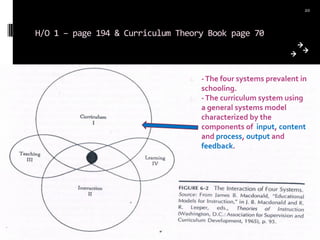
H/O 1 – page 194 & Curriculum Theory Book page 70


                                1. - The four systems prevalent in
                                   schooling.
                                2. - The curriculum system using
                                   a general systems model
                                   characterized by the
                                   components of input, content
                                   and process, output and
                                   feedback.
Later Development
Broudy, Smith & Burnett       Maccia
                               Page 73, CT book
 Page 72, CT book
                               4 types of curriculum theory:
 Curriculum is depicted as      1.   Curriculum theory (event theory)
  part of a total system of      -    Sorting out and characterizing
                                      of events and relating them
  influence directed at          2.   Formal curriculum theory
  students.                      -    Focussed on the structure of
                                      curriculum content
                                 3.   Valuational curriculum theory
                                 -    Concerned with the issue of
                                      what instructional content is the
                                      most valuable to present
                                 4.   Praxiological curriculum theory
                                 -    Speculation about appropriate
                                      curriculum means for reaching
                                      curriculum objectives
                                                                          21
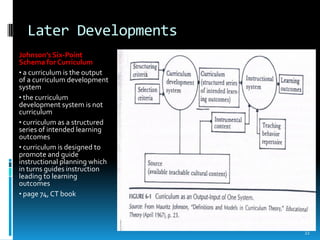
Later Developments
Johnson’s Six-Point
Schema for Curriculum
• a curriculum is the output
of a curriculum development
system
• the curriculum
development system is not
curriculum
• curriculum as a structured
series of intended learning
outcomes
• curriculum is designed to
promote and guide
instructional planning which
in turns guides instruction
leading to learning
outcomes
• page 74, CT book


                               22
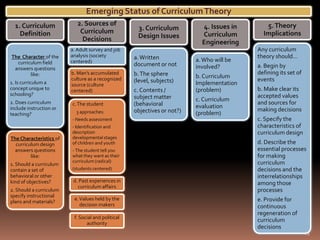
Emerging Status of Curriculum Theory
  1. Curriculum             2. Sources of                                   4. Issues in      5. Theory
                             Curriculum              3. Curriculum
    Definition                                       Design Issues          Curriculum       Implications
                              Decisions                                     Engineering
                         a. Adult survey and job                                           Any curriculum
The Character of the     analysis (society          a. Written                             theory should…
  curriculum field       centered)                                        a. Who will be
                                                    document or not       involved?        a. Begin by
 answers questions
        like:            b. Man’s accumulated       b. The sphere                          defining its set of
                         culture as a recognized                          b. Curriculum
1. Is curriculum a                                  (level, subjects)                      events
                         source (culture                                  Implementation
concept unique to        centered)                  c. Contents /         (problem)        b. Make clear its
schooling?                                                                                 accepted values
                                                    subject matter        c. Curriculum
2. Does curriculum       c. The student             (behavioral                            and sources for
include instruction or                                                    evaluation
                           3 approaches:            objectives or not?)                    making decisions
teaching?                                                                 (problem)
                         - Needs assessment                                                c. Specify the
                         - Identification and                                              characteristics of
                         description                                                       curriculum design
The Characteristics of   developmental stages
  curriculum design      of children and youth                                             d. Describe the
  answers questions      - The student tell you                                            essential processes
         like:           what they want as their                                           for making
                         curriculum (radical)                                              curriculum
1. Should a curriculum
contain a set of         (students centered)                                               decisions and the
behavioral or other                                                                        interrelationships
kind of objectives?       d. Past experiences in                                           among those
                            curriculum affairs
2. Should a curriculum                                                                     processes
specify instructional
                          e. Values held by the                                            e. Provide for
plans and materials?
                             decision makers                                               continuous
                                                                                           regeneration of
                          f. Social and political
                                authority
                                                                                           curriculum
                                                                                           decisions
                                                                                                                 23
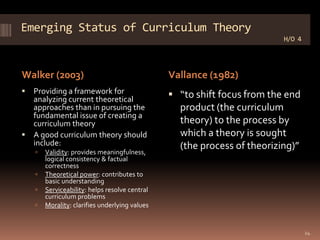
Emerging Status of Curriculum Theory
                                                                          H/O 4


Walker (2003)                                   Vallance (1982)
 Providing a framework for                      “to shift focus from the end
  analyzing current theoretical
  approaches than in pursuing the                 product (the curriculum
  fundamental issue of creating a
  curriculum theory                               theory) to the process by
 A good curriculum theory should                 which a theory is sought
  include:                                        (the process of theorizing)”
       Validity: provides meaningfulness,
        logical consistency & factual
        correctness
       Theoretical power: contributes to
        basic understanding
       Serviceability: helps resolve central
        curriculum problems
       Morality: clarifies underlying values


                                                                                  24
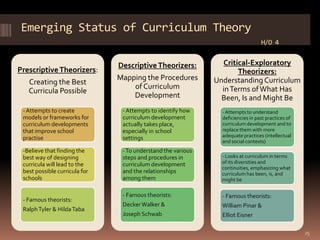
Emerging Status of Curriculum Theory
                                                                                  H/O 4


                               Descriptive Theorizers:          Critical-Exploratory
Prescriptive Theorizers:                                             Theorizers:
                               Mapping the Procedures         Understanding Curriculum
   Creating the Best
                                   of Curriculum                in Terms of What Has
   Curricula Possible
                                   Development                  Been, Is and Might Be
 - Attempts to create           - Attempts to identify how      - Attempts to understand
 models or frameworks for       curriculum development          deficiencies in past practices of
 curriculum developments        actually takes place,           curriculum development and to
 that improve school            especially in school            replace them with more
 practise                       settings                        adequate practices (intellectual
                                                                and social contexts)
 -Believe that finding the      - To understand the various
 best way of designing          steps and procedures in         - Looks at curriculum in terms
 curricula will lead to the     curriculum development          of its diversities and
                                                                continuities, emphasizing what
 best possible curricula for    and the relationships           curriculum has been, is, and
 schools                        among them                      might be

                                - Famous theorists:             - Famous theorists:
 - Famous theorists:
                                Decker Walker &                 William Pinar &
 Ralph Tyler & Hilda Taba
                                Joseph Schwab                   Elliot Eisner

                                                                                                    25
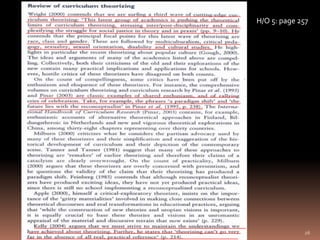
H/O 5: page 257


             26
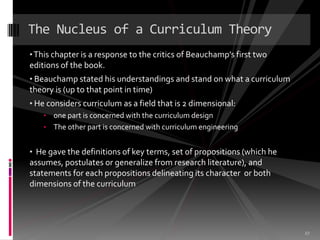
The Nucleus of a Curriculum Theory
• This chapter is a response to the critics of Beauchamp’s first two
editions of the book.
• Beauchamp stated his understandings and stand on what a curriculum
theory is (up to that point in time)
• He considers curriculum as a field that is 2 dimensional:
    • one part is concerned with the curriculum design
    • The other part is concerned with curriculum engineering


• He gave the definitions of key terms, set of propositions (which he
assumes, postulates or generalize from research literature), and
statements for each propositions delineating its character or both
dimensions of the curriculum


                                                                        27

Edu 5356 curriculum theory chapter 4 and 9

  • 1.
    EDU 5356 CURRICULUM THEORY Wirda (GS31836) 1
  • 2.
    “Curriculum Theory” byBeauchamp, G.A. Chapter 4 & Chapter 9  Chapter 4 – Curriculum Theory  Theory Processes in Curriculum  H/O1 – “Curriculum Theory”, Curriculum: Foundations, Principles and Theory (2nd Edition), Ornstein A.C. & Hunkins F.P., USA (1993) ;page 183-208  Article 1 – “Basic Components of a Curriculum Theory”, Beauchamp G.A., Curriculum Theory Network, No. 10 (Autumn, 1972); page 16-22  Article 2 – “Beauchamp’s ‘Basic Components of a Curriculum Theory’ – A Rejoinder, Posner, G.J., Curriculum Theory Network, Vol. 4 No. 1 (1973-1974); page 56-60  Exemplars in Curriculum Thinking  H/O2 - “The Field of Curriculum” & “Historical Foundations of Curriculum”, Curriculum: Foundations, Principles and Theory (5th Edition), Ornstein A.C. & Hunkins F.P., Pearson Boston (2009) ;page 18-21 & 63-102  H/O3 - “Curriculum Theory”, Curriculum Design Techniques, Nelson, A., Wm. C. Brown Publishers Indiana (1990), page 1-21  H/O1 – “Curriculum Theory”, Curriculum: Foundations, Principles and Theory (2nd Edition), Ornstein A.C. & Hunkins F.P., USA (1993) ;page 183-208 2
  • 3.
    “Curriculum Theory” byBeauchamp, G.A. Chapter 4 & Chapter 9  Emerging Status of Curriculum Theory  H/O4 – “Curriculum Theorizing”, Curriculum: Alternative Approaches Ongoing Issues, Marsh C.J. & Willis G., Pearson New Jersey (2007), page 94-145  H/O5 – “Curriculum Theorizing”, Key Concepts for Understanding Curriculum (4th Edition), Marsh C.J., Routledge New York (2009), page 249-259  Chapter 9 – The Nucleus of a Curriculum  Basic Definitions 3
  • 4.
    Curriculum Theory Hilda Taba George J. Posner  “any enterprise as complex  “theoretical perspectives as curriculum requires allow us to contemplate some kind of theoretical or and ‘see’ educational conceptual framework of landscapes in particular ways.” thinking to guide it.” H/O 1 4
  • 5.
    Curriculum Theory Ornstein &Hunkins  “Good curriculum theory  “However, it is impossible to fully predict educational describes and explains the outcomes. Like other aspects concepts, principles, and of education, curriculum relationships that exist involves judgments, hunches, and insights that are not within the field. It also has always conducive to laws, predictive values, rigorous principles or generalizations. laws yield high probability Often, a curriculum does not emerge as a tightly regulated, and control. Good theory concise set of enterprises but also prescribes actions to evolves as one action or choice that leads to another.” be taken.” 5
  • 6.
    The Meaning ofTheory Greek word - theoria George Beauchamp  Means: wakefulness of  All theories are derived from mind 3 broad categories of basic realms of knowledge:  It is a type of ‘pure viewing’ of truth 1. The Humanities (philosophy, music, art, literature, etc)  Theory explains reality 2. The Natural Sciences  Four functions to theory: (chemistry, physics, botany, 1. Description geology, etc) 2. Prediction 3. The Social Sciences (history, 3. Explanation sociology, psychology, 4. Guidance anthropology, etc) 6
  • 7.
    Theory Processes inCurriculum Curriculum Theory- Definitions & Theory Content Building Activities Definition 3 ways of using the word “Curriculum” (p59) As a substantive Relationships between: A curriculum phenomenon – theory is a set of - Goals & culture content talks and plan on related it, a written - School organization & scope and sequence statements that curriculum - Culture content & overall design gives meaning to a school A system – 1. The choice of arena for curriculum decision making. curriculum by consists of the 2. The selection and involvement of persons in c. planning. pointing up the people and relationships 3. organization for and techniques used in c. planning procedures among its needed 4. Writing of c. 5. implementing 6. evaluating elements and by 7. Providing for feedback & modification directing its An area of development, professional use and Purpose is to advance knowledge on curriculums and study – a total curriculum systems. evaluation. field of study 7
  • 8.
    Theory Processes inCurriculum Definitions & Theory Curriculum Theory-Building Activities Content 2. 3. Inferential and 1. Establishment Classification predictive research 4. Sub-theory development & of descriptive of existing Development and use of models and new - Inferring (a logical and prescriptive - A mature theory is supported knowledge process) is a proposition definitions for with sub-theories or generalization derived technical terms - Another from evidence by - The sub-theories are dependent - Essential for theory reasoning. upon the concepts and procedures theorists to function - Prediction is a special of the theorist wishes to associate define the key - with the field of curriculum. E.g.: case of inference – terms of his field Classification c.design, procedures for c.planning predictive relationships - e.g.: concepts system is research is designed so & implementation such as needed to that one can estimate the - Model building – useful in curriculum, show order unknown from the depicting procedures for subject matter, and known. E.g.: correlation c.planning & implementation design, relationships and regression analysis implementation, and - Can be borrowed from other meanings. - Curriculum itself is an areas of knowledge, eg: business evaluation expression of prediction 8
  • 9.
    Exemplars in CurriculumThinking Historical Foundations of Curriculum 1918-1949 Later 19th century Developments The * Activity European The Transitional Analysis *Tyler Rationale Educators Development Period *Macdonald * Herbartian *26th Period *Dewey Yearbook Diagram movement * Rugg (child (statement of *Beauchamp (society working * Caswell centered) Framework centered) principles for curriculum) 9
  • 10.
  • 11.
  • 12.
  • 13.
  • 14.
  • 15.
    H/O 2: page92 & 93 15
  • 16.
    H/O 2: page93 & 94 16
  • 17.
    Exemplars in CurriculumThinking Historical Foundations of Curriculum 1918-1949 Later 19th century Developments The * Activity European The Transitional Analysis *Tyler Rationale Educators Development Period *Macdonald * Herbartian *26th Period *Dewey Yearbook Diagram movement * Rugg (child (statement of *Beauchamp (society working * Caswell centered) Framework centered) principles for curriculum) 17
  • 18.
  • 19.
    Later Developments Beauchamp Smith  Curriculum theory was related  3 principal tasks which conceptually to theory building in other domains of knowledge. philosophy can help  Basic principles: curriculum theorists:  Careful and consistent use of 1. To formulate and justify technical terminology educational purposes  Analysis and classification of knowledge and conjecture 2. To select and organize  Use of predictive research to knowledge increase the number of firm 3. To deal with verbal traps generalizations, or laws, were cited as principles that would give better explanation for curriculum phenomena 19
  • 20.
    20 H/O 1 –page 194 & Curriculum Theory Book page 70 1. - The four systems prevalent in schooling. 2. - The curriculum system using a general systems model characterized by the components of input, content and process, output and feedback.
  • 21.
    Later Development Broudy, Smith& Burnett Maccia  Page 73, CT book  Page 72, CT book  4 types of curriculum theory:  Curriculum is depicted as 1. Curriculum theory (event theory) part of a total system of - Sorting out and characterizing of events and relating them influence directed at 2. Formal curriculum theory students. - Focussed on the structure of curriculum content 3. Valuational curriculum theory - Concerned with the issue of what instructional content is the most valuable to present 4. Praxiological curriculum theory - Speculation about appropriate curriculum means for reaching curriculum objectives 21
  • 22.
    Later Developments Johnson’s Six-Point Schemafor Curriculum • a curriculum is the output of a curriculum development system • the curriculum development system is not curriculum • curriculum as a structured series of intended learning outcomes • curriculum is designed to promote and guide instructional planning which in turns guides instruction leading to learning outcomes • page 74, CT book 22
  • 23.
    Emerging Status ofCurriculum Theory 1. Curriculum 2. Sources of 4. Issues in 5. Theory Curriculum 3. Curriculum Definition Design Issues Curriculum Implications Decisions Engineering a. Adult survey and job Any curriculum The Character of the analysis (society a. Written theory should… curriculum field centered) a. Who will be document or not involved? a. Begin by answers questions like: b. Man’s accumulated b. The sphere defining its set of culture as a recognized b. Curriculum 1. Is curriculum a (level, subjects) events source (culture Implementation concept unique to centered) c. Contents / (problem) b. Make clear its schooling? accepted values subject matter c. Curriculum 2. Does curriculum c. The student (behavioral and sources for include instruction or evaluation 3 approaches: objectives or not?) making decisions teaching? (problem) - Needs assessment c. Specify the - Identification and characteristics of description curriculum design The Characteristics of developmental stages curriculum design of children and youth d. Describe the answers questions - The student tell you essential processes like: what they want as their for making curriculum (radical) curriculum 1. Should a curriculum contain a set of (students centered) decisions and the behavioral or other interrelationships kind of objectives? d. Past experiences in among those curriculum affairs 2. Should a curriculum processes specify instructional e. Values held by the e. Provide for plans and materials? decision makers continuous regeneration of f. Social and political authority curriculum decisions 23
  • 24.
    Emerging Status ofCurriculum Theory H/O 4 Walker (2003) Vallance (1982)  Providing a framework for  “to shift focus from the end analyzing current theoretical approaches than in pursuing the product (the curriculum fundamental issue of creating a curriculum theory theory) to the process by  A good curriculum theory should which a theory is sought include: (the process of theorizing)”  Validity: provides meaningfulness, logical consistency & factual correctness  Theoretical power: contributes to basic understanding  Serviceability: helps resolve central curriculum problems  Morality: clarifies underlying values 24
  • 25.
    Emerging Status ofCurriculum Theory H/O 4 Descriptive Theorizers: Critical-Exploratory Prescriptive Theorizers: Theorizers: Mapping the Procedures Understanding Curriculum Creating the Best of Curriculum in Terms of What Has Curricula Possible Development Been, Is and Might Be - Attempts to create - Attempts to identify how - Attempts to understand models or frameworks for curriculum development deficiencies in past practices of curriculum developments actually takes place, curriculum development and to that improve school especially in school replace them with more practise settings adequate practices (intellectual and social contexts) -Believe that finding the - To understand the various best way of designing steps and procedures in - Looks at curriculum in terms curricula will lead to the curriculum development of its diversities and continuities, emphasizing what best possible curricula for and the relationships curriculum has been, is, and schools among them might be - Famous theorists: - Famous theorists: - Famous theorists: Decker Walker & William Pinar & Ralph Tyler & Hilda Taba Joseph Schwab Elliot Eisner 25
  • 26.
  • 27.
    The Nucleus ofa Curriculum Theory • This chapter is a response to the critics of Beauchamp’s first two editions of the book. • Beauchamp stated his understandings and stand on what a curriculum theory is (up to that point in time) • He considers curriculum as a field that is 2 dimensional: • one part is concerned with the curriculum design • The other part is concerned with curriculum engineering • He gave the definitions of key terms, set of propositions (which he assumes, postulates or generalize from research literature), and statements for each propositions delineating its character or both dimensions of the curriculum 27