Quantum free electron theory(Sommerfield)
• Particles of micro dimension like the electrons are studied under
quantum physics
• moving electrons inside a solid material can be associated with
waves with a wave function ψ(x) in one dimension (ψ(r) in 3D)
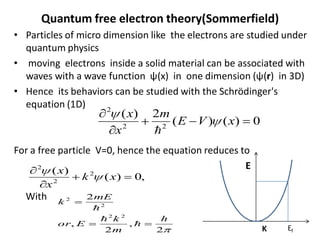
• Hence its behaviors can be studied with the Schrödinger's
equation (1D)
For a free particle V=0, hence the equation reduces to
E
With
0)()(
2)(
22
2
xVE
m
x
x

,0)(
)( 2
2
2
xk
x
x
2
,
2
,
2
22
2
2
h
m
k
Eor
mE
k



K Ef
Sommerfield’s model
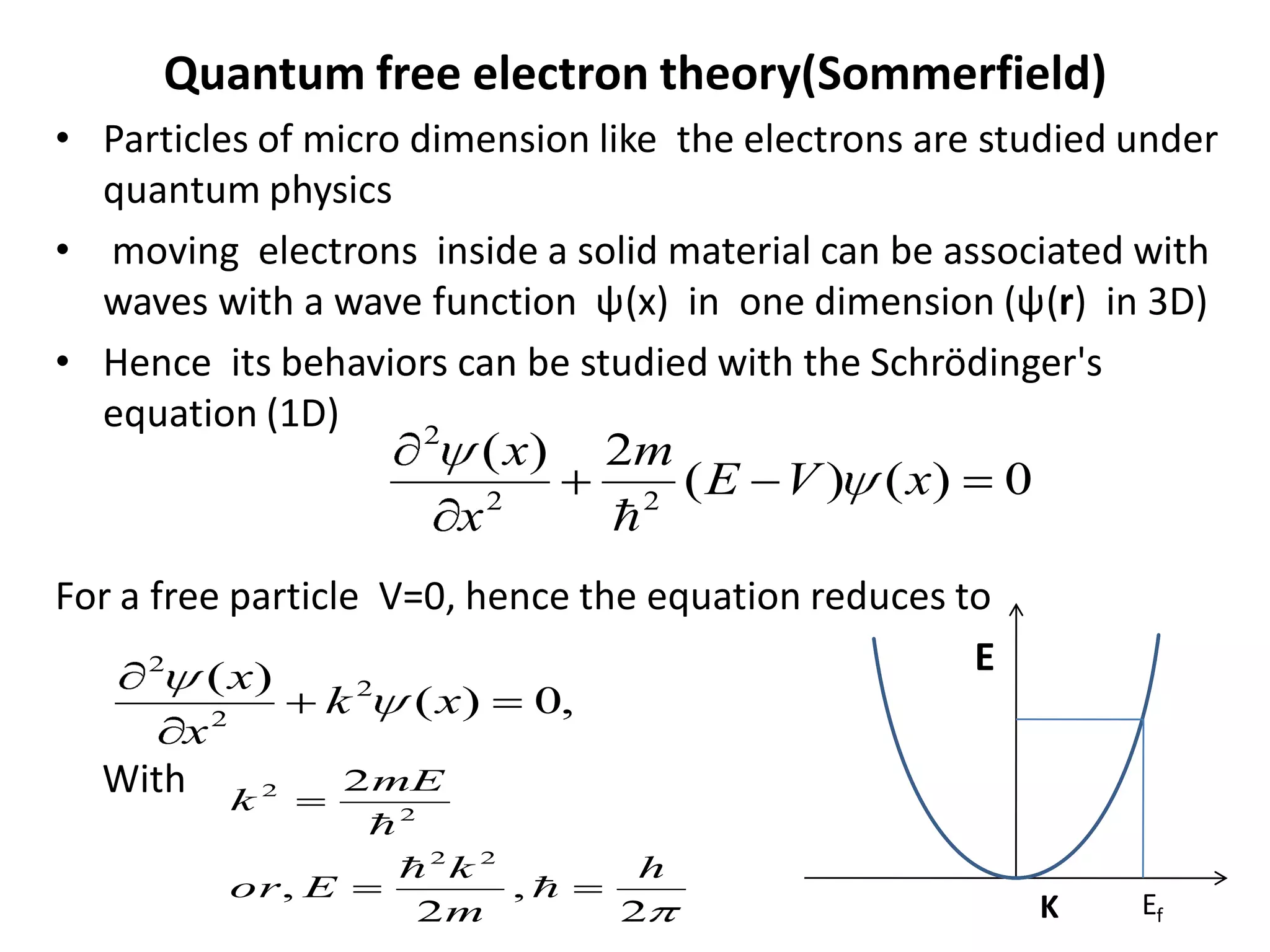
• As the freely moving electrons can not escape the surface of the
material, they may be treated as particles confined (trapped)in a
box
• Hence, V(x) =0, for 0<x<L . e-
= ∞, for x=0 & x=L V(x)
0 L x
Sch’s equation ,
Solution of the equation can be obtained as
ψ(x) = A sin kx + B cos kx
From boundary conditions , at x=o & x=L , ψ(x)=0,
we can get B=0 and k= ± nπ / L ,
Putting the normalization condition we get A=
0)(
2)(
22
2
x
mE
x
x

P= 0
Ψ= 0
P= 0
Ψ= 0
L
2
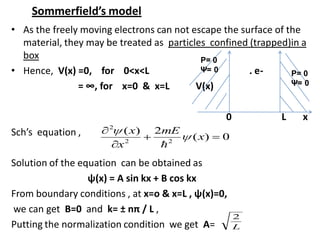
• Substituting all the values
• Ψn (x) = (√ 2/L) sin nπx /L
• & En (x) = ħ2 k2 / 2m = ħ2π2n2 / 2m L2 = h2n2/ 8mL2
This shows that energy of the electrons inside the material is quantized and hence
is discrete
ψ3 n=3 E3
ψ2 n=2 E2
ψ1 n=1 E1
In 3D, Ψn (r) = (√ 8/L3) sin nxπx /L sin nyπy /L sin nzπz /L
& En (r) = ħ2 k2 / 2m = (nx
2+ny
2+nz
2) ħ2π2 / 2m L2
Fermi Level and Fermi Energy:
• Electrons are fermions or Fermi particles, which obey Pauli’s
exclusion principle
• At 0K temperature the highest filled energy level is called the
“Fermi Level” & the energy possessed by the electrons in that
level is “Fermi Energy”
• Ef = ħ2 kf
2 / 2m or kf = (2mEf / ħ2 )1/2
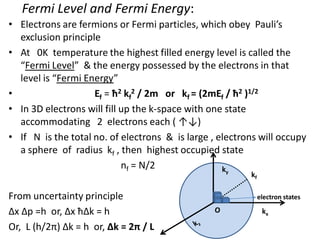
• In 3D electrons will fill up the k-space with one state
accommodating 2 electrons each ( ↑↓)
• If N is the total no. of electrons & is large , electrons will occupy
a sphere of radius kf , then highest occupied state
nf = N/2
From uncertainty principle electron states
∆x ∆p =h or, ∆x ħ∆k = h
Or, L (h/2π) ∆k = h or, ∆k = 2π / L
kx
ky
kf
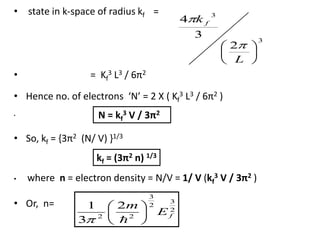
• state in k-space of radius kf =
• = Kf
3 L3 / 6π2
• Hence no. of electrons ‘N’ = 2 X ( Kf
3 L3 / 6π2 )
•
• So, kf = {3π2 (N/ V) }1/3
• where n = electron density = N/V = 1/ V (kf
3 V / 3π2 )
• Or, n=
3
3
2
3
4
L
k f
N = kf
3 V / 3π2
kf = (3π2 n) 1/3
2
3
2
3
22
2
3
1
fE
m

• at 0 K, the fermi energy
• Ef (0) = ħ2 kf
2 / 2m
• = ħ2 / 2m ( 3π2n)2/3
• Ef(0) = h2/ 8m (3n/ π ) 2/3
• Fermi velocity vf = ħkf / m = ħ /m (3π2n) 1/3
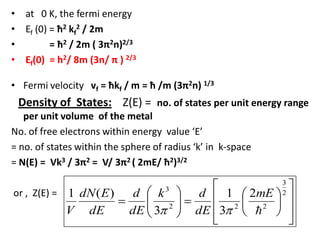
Density of States: Z(E) = no. of states per unit energy range
per unit volume of the metal
No. of free electrons within energy value ‘E’
= no. of states within the sphere of radius ‘k’ in k-space
= N(E) = Vk3 / 3π2 = V/ 3π2 ( 2mE/ ħ2)3/2
or , Z(E) = 2
3
222
3
2
3
1
3
)(1

mE
dE
dk
dE
d
dE
EdN
V
=
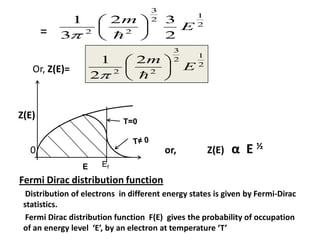
Or, Z(E)=
Z(E)
0 or, Z(E) α E ½
Fermi Dirac distribution function
Distribution of electrons in different energy states is given by Fermi-Dirac
statistics.
Fermi Dirac distribution function F(E) gives the probability of occupation
of an energy level ‘E’, by an electron at temperature ‘T’
2
1
2
3
22
2
32
3
1
E
m

2
1
2
3
22
2
2
1
E
m

E
T=0
Ef
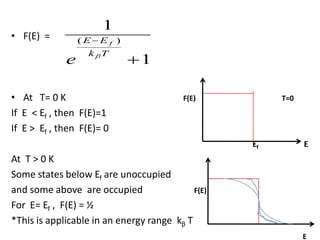
• F(E) =
• At T= 0 K F(E) T=0
If E < Ef , then F(E)=1
If E > Ef , then F(E)= 0
Ef E
At T > 0 K
Some states below Ef are unoccupied
and some above are occupied F(E)
For E= Ef , F(E) = ½
*This is applicable in an energy range kβ T
E
1
1
)(
Tk
EE f
e
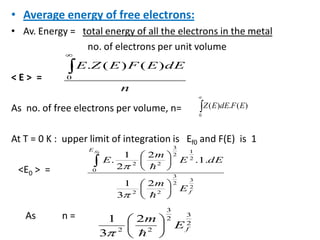
• Average energy of free electrons:
• Av. Energy = total energy of all the electrons in the metal
no. of electrons per unit volume
< E > =
As no. of free electrons per volume, n=
At T = 0 K : upper limit of integration is Ef0 and F(E) is 1
<E0 > =
As n =
n
dEEFEZE
0
)()(.
2
3
2
3
22
0
2
1
2
3
22
2
3
1
.1.
2
2
1
.
0
f
E
E
m
dEE
m
E
f


2
3
2
3
22
2
3
1
fE
m

0
)(.)( EFdEEZ
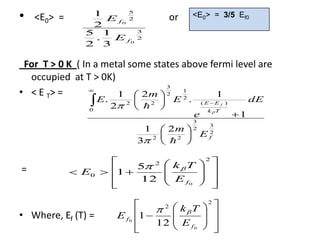
• <E0> = or
For T > 0 K ( In a metal some states above fermi level are
occupied at T > 0K)
• < E T> =
=
• Where, Ef (T) =
2
3
2
5
0
0
3
1
.
2
5
2
1
f
f
E
E <E0> = 3/5 Ef0
2
3
2
3
22
0
)(
2
1
2
3
22
2
3
1
1
1
.
2
2
1
.
f
Tk
EE
E
m
dE
e
E
m
E f


2
2
0
0
12
5
1
fE
Tk
E
2
2
0
0
12
1
f
f
E
Tk
E
Specific heat in quantum free electron theory
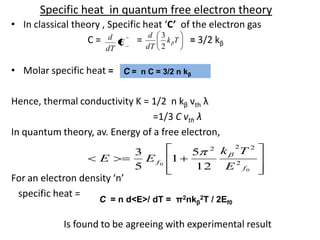
• In classical theory , Specific heat ‘C’ of the electron gas
C = = = 3/2 kβ
• Molar specific heat =
Hence, thermal conductivity K = 1/2 n kβ vth λ
=1/3 C vth λ
In quantum theory, av. Energy of a free electron,
For an electron density ‘n’
specific heat =
Is found to be agreeing with experimental result
C = n C = 3/2 n kβ
0
0 2
222
12
5
1
5
3
f
f
E
Tk
EE
C = n d<E>/ dT = π2nkβ
2T / 2Ef0
Tk
dT
d
2
3
E
dT
d
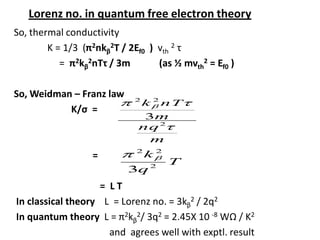
Lorenz no. in quantum free electron theory
So, thermal conductivity
K = 1/3 (π2nkβ
2T / 2Ef0 ) vth
2 τ
= π2kβ
2nTτ / 3m (as ½ mvth
2 = Ef0 )
So, Weidman – Franz law
K/σ =
=
= L T
In classical theory L = Lorenz no. = 3kβ
2 / 2q2
In quantum theory L = π2kβ
2/ 3q2 = 2.45X 10 -8 WΩ / K2
and agrees well with exptl. result
m
nq
m
nTk
2
22
3
T
q
k
2
22
3

Quantum free electron_theory_001

  • 1.
    Quantum free electrontheory(Sommerfield) • Particles of micro dimension like the electrons are studied under quantum physics • moving electrons inside a solid material can be associated with waves with a wave function ψ(x) in one dimension (ψ(r) in 3D) • Hence its behaviors can be studied with the Schrödinger's equation (1D) For a free particle V=0, hence the equation reduces to E With 0)()( 2)( 22 2 xVE m x x  ,0)( )( 2 2 2 xk x x 2 , 2 , 2 22 2 2 h m k Eor mE k    K Ef
  • 2.
    Sommerfield’s model • Asthe freely moving electrons can not escape the surface of the material, they may be treated as particles confined (trapped)in a box • Hence, V(x) =0, for 0<x<L . e- = ∞, for x=0 & x=L V(x) 0 L x Sch’s equation , Solution of the equation can be obtained as ψ(x) = A sin kx + B cos kx From boundary conditions , at x=o & x=L , ψ(x)=0, we can get B=0 and k= ± nπ / L , Putting the normalization condition we get A= 0)( 2)( 22 2 x mE x x  P= 0 Ψ= 0 P= 0 Ψ= 0 L 2
  • 3.
    • Substituting allthe values • Ψn (x) = (√ 2/L) sin nπx /L • & En (x) = ħ2 k2 / 2m = ħ2π2n2 / 2m L2 = h2n2/ 8mL2 This shows that energy of the electrons inside the material is quantized and hence is discrete ψ3 n=3 E3 ψ2 n=2 E2 ψ1 n=1 E1 In 3D, Ψn (r) = (√ 8/L3) sin nxπx /L sin nyπy /L sin nzπz /L & En (r) = ħ2 k2 / 2m = (nx 2+ny 2+nz 2) ħ2π2 / 2m L2
  • 4.
    Fermi Level andFermi Energy: • Electrons are fermions or Fermi particles, which obey Pauli’s exclusion principle • At 0K temperature the highest filled energy level is called the “Fermi Level” & the energy possessed by the electrons in that level is “Fermi Energy” • Ef = ħ2 kf 2 / 2m or kf = (2mEf / ħ2 )1/2 • In 3D electrons will fill up the k-space with one state accommodating 2 electrons each ( ↑↓) • If N is the total no. of electrons & is large , electrons will occupy a sphere of radius kf , then highest occupied state nf = N/2 From uncertainty principle electron states ∆x ∆p =h or, ∆x ħ∆k = h Or, L (h/2π) ∆k = h or, ∆k = 2π / L kx ky kf
  • 5.
    • state ink-space of radius kf = • = Kf 3 L3 / 6π2 • Hence no. of electrons ‘N’ = 2 X ( Kf 3 L3 / 6π2 ) • • So, kf = {3π2 (N/ V) }1/3 • where n = electron density = N/V = 1/ V (kf 3 V / 3π2 ) • Or, n= 3 3 2 3 4 L k f N = kf 3 V / 3π2 kf = (3π2 n) 1/3 2 3 2 3 22 2 3 1 fE m 
  • 6.
    • at 0K, the fermi energy • Ef (0) = ħ2 kf 2 / 2m • = ħ2 / 2m ( 3π2n)2/3 • Ef(0) = h2/ 8m (3n/ π ) 2/3 • Fermi velocity vf = ħkf / m = ħ /m (3π2n) 1/3 Density of States: Z(E) = no. of states per unit energy range per unit volume of the metal No. of free electrons within energy value ‘E’ = no. of states within the sphere of radius ‘k’ in k-space = N(E) = Vk3 / 3π2 = V/ 3π2 ( 2mE/ ħ2)3/2 or , Z(E) = 2 3 222 3 2 3 1 3 )(1  mE dE dk dE d dE EdN V
  • 7.
    = Or, Z(E)= Z(E) 0 or,Z(E) α E ½ Fermi Dirac distribution function Distribution of electrons in different energy states is given by Fermi-Dirac statistics. Fermi Dirac distribution function F(E) gives the probability of occupation of an energy level ‘E’, by an electron at temperature ‘T’ 2 1 2 3 22 2 32 3 1 E m  2 1 2 3 22 2 2 1 E m  E T=0 Ef
  • 8.
    • F(E) = •At T= 0 K F(E) T=0 If E < Ef , then F(E)=1 If E > Ef , then F(E)= 0 Ef E At T > 0 K Some states below Ef are unoccupied and some above are occupied F(E) For E= Ef , F(E) = ½ *This is applicable in an energy range kβ T E 1 1 )( Tk EE f e
  • 9.
    • Average energyof free electrons: • Av. Energy = total energy of all the electrons in the metal no. of electrons per unit volume < E > = As no. of free electrons per volume, n= At T = 0 K : upper limit of integration is Ef0 and F(E) is 1 <E0 > = As n = n dEEFEZE 0 )()(. 2 3 2 3 22 0 2 1 2 3 22 2 3 1 .1. 2 2 1 . 0 f E E m dEE m E f   2 3 2 3 22 2 3 1 fE m  0 )(.)( EFdEEZ
  • 10.
    • <E0> =or For T > 0 K ( In a metal some states above fermi level are occupied at T > 0K) • < E T> = = • Where, Ef (T) = 2 3 2 5 0 0 3 1 . 2 5 2 1 f f E E <E0> = 3/5 Ef0 2 3 2 3 22 0 )( 2 1 2 3 22 2 3 1 1 1 . 2 2 1 . f Tk EE E m dE e E m E f   2 2 0 0 12 5 1 fE Tk E 2 2 0 0 12 1 f f E Tk E
  • 11.
    Specific heat inquantum free electron theory • In classical theory , Specific heat ‘C’ of the electron gas C = = = 3/2 kβ • Molar specific heat = Hence, thermal conductivity K = 1/2 n kβ vth λ =1/3 C vth λ In quantum theory, av. Energy of a free electron, For an electron density ‘n’ specific heat = Is found to be agreeing with experimental result C = n C = 3/2 n kβ 0 0 2 222 12 5 1 5 3 f f E Tk EE C = n d<E>/ dT = π2nkβ 2T / 2Ef0 Tk dT d 2 3 E dT d
  • 12.
    Lorenz no. inquantum free electron theory So, thermal conductivity K = 1/3 (π2nkβ 2T / 2Ef0 ) vth 2 τ = π2kβ 2nTτ / 3m (as ½ mvth 2 = Ef0 ) So, Weidman – Franz law K/σ = = = L T In classical theory L = Lorenz no. = 3kβ 2 / 2q2 In quantum theory L = π2kβ 2/ 3q2 = 2.45X 10 -8 WΩ / K2 and agrees well with exptl. result m nq m nTk 2 22 3 T q k 2 22 3