Product Definition
Product Definition Basis:  Targeted market segment (phase of TALC) Technology Value Proposition Whole (Complete) Product Concept, including: Service & support Ancillary products Documentation Future Potential
Whole Product Concept Products are complex; they have many dimensions It is the totality of what a customer buys A product is the physical object (hardware, food, medicine), software or service from which customer gets direct utility plus a number of other factors, services and perceptions that make the product: Useful Desirable Convenient
Whole Product Concept Restaurant’s product is:  food + ambiance + service + cleanliness + other things   Definition of all the above depends on the market segment Supermarket’s canned soup is:  soup + the can’s label + store’s display + store’s cleanliness + the type of store (Safeway, gourmet food store, gas station convenient store,.)
Whole Product Concept Computer Operating System is:  software + development environment (hardware and software) + documentation to use it + training program + suppliers service & troubleshooting capabilities + availability of hardware drivers + suppliers enhancement plans  Example:  Linux Another SW examples:  SmallTalk, Java, ..
Whole Product Concept CVD product is:  Reactor/ technology + wafer transfer platform + system software + process control hardware & software + application recipe + system packaging + company’s service & spares capabilities + ability/desire to do continuous improvement + operation & maintenance manual + presale demo + post-sale installation and qualification + customer’s confidence in the supplier Example: Helicon plasma CVD equipment
Whole Product Concept Ascend (now part of Lucent) lost share due to poor marketing strategy Ascend has some of the best products in the industry  They introduce products as devices: “here is our sexy new box, rather than this is our strategy for “voice” communication” “ Customers did not understand the significance of a newly launched product”
Whole Product Concept A product, to the potential customer, is value satisfaction The generic “thing”  or “device” is not itself the product.  It is the minimum necessary to get into the “game” A product has meaning only from the viewpoint of the customer or the ultimate user.  Only the buyer or the user can assign value
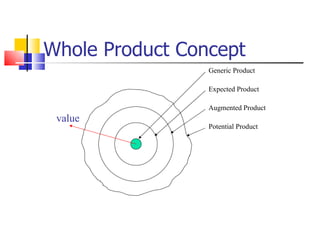
Whole Product Concept Generic Product Expected Product Augmented Product Potential Product value
The Generic Product The generic product is the rudimentary  “thing” without which there is no chance to participate in the market: for a bank:  loanable funds for a realtor:  “for sale” properties for a lawyer: the bar exam certificate for WebTV: the box for satellite TV: the antenna and receiver box
The Expected Product The expected product represents the customer’s minimal expectations Delivery conditions, installation services, post-sale services, spare parts, training, packaging conveniences the bank:  the loan officer who is cooperative  the realtor: who is on your side  the lawyer: who protects you the WebTV: that only connects to a few home shopping channels the Satellite TV retailer: that does not offer installation support to an old man
The Expected Product,  cont’d The expected attributes vary by customers and industries They could be sources of product differentiation depending on how well suppliers do them
The Augmented Product Customer may be offered more than what she thinks she needs or expects Computer that comes with “Office 2000” already installed Offer two year warranty for semiconductor process equipment where the “norm” is one year Optical store that replaces customer’s lost contact lenses nights & weekends and delivers them to customer’s home Augmentations are means of product differentiation They could also create customer dependency on the supplier
The Augmented Product Product augmentations can educate the customer about what is reasonable for him to expect  This raises the competitive bar; augmented benefits may turn into customer expectations (and move into the inner circle) Not all customers can be attracted to by an ever widening circle of augmented benefits They may prefer lower prices to more augmentation
The Potential Product The Potential Product consists of everything potentially feasible to get and keep customers what may remain to be done  what is possible in the future Suppliers, and customers, can compete more effectively with the Potential Product in the changed conditions of future
The Potential Product In high tech markets, customers desire extendibility for the product so that the platform and basic technology can last over several generations of technology progressions e.g. semiconductor technology cycles Product Roadmap is important
Product Definition High Tech markets are different than consumer markets, requiring different definition of the  whole product point of sale   (sold directly to customers by sales persons) function   (emphasized) pre-sale evaluation   (customers spend a lot of time, sometimes more than one year) post-sale support   (documentation, customer training, service) risk in purchasing decision   (is high) intangible factors   (trust, reputation,references) product/technology roadmap  (extendibility)
Whole Product Concept The cost of creating a complete product is often many times the cost of developing the generic product (hardware, or software, or drug)
Whole Product Concept If the product cannot be made to work by the customer, it is useless The reason may be It inherently does not work user is not adequately trained and does not know how to use it documentation telling the user how to install and operate the product is inaccurate product is not serviced & supported
Whole Product Concept Products are multidimensional A whole product is one that can be  functional (technology and design meeting spec) manufactured (materials & tools available, be manufacturable) serviced & supported (trained people, fast response, be serviceable) applied (documentation, process recipe)  sold (distribution channels, sales collateral)
Whole Product Concept Customers’  needs and wants  define products Depending on the targeted market segment, the definition of the product must change The product must be defined differently in different phases of the Technology Adoption Life Cycle
Whole Product Concept Innovators want to be part of the supplier’s product development, do not mind inadequate documentation or even not fully functioning product PC’s & application software in the hands of engineers in 1980 Late Majority on the other hand, are conservatives and for them cost of mistake is huge. They have no tolerance for malfunction or documentation error PC & application software in a travel agency in 1998
Whole Product Concept IBM PC’s dominated the market over Apple because: IBM label made it a “complete product” for  business  applications IBM PC’s open architecture allowed rapid development of a myriad of applications, that were missing on Apple (e.g. business application software) We saw examples of Ascend products:  now  the customers are requesting different “products” because they are CEO’s and VP’s of muti-billion dollar companies (GTE, Deutsche Telekom)
Whole Product Concept When you are positioning yourself against competition, it is important to compare complete products not just devices A product will achieve a commanding position within a segment only if it is complete
Whole Product Concept Marketing organization is responsible to  ensure that products are complete for the targeted market segment guarantee that the product remains complete as the customer base evolves and competition sets new standards for completeness
Product Definition Products are  marketing inventions Product invention / definition is a continuous process Starts at the intersection of new technology capability and perceived market opportunity Continues during the  market research and definition of Market Requirements Specification (MRS) device development and demonstration product launch
Product Definition Continues past product introduction thru discovery of new applications (not envisioned by the original developers) Continues further as product marches down the Technology Adoption Life Cycle and product is redefined for new groups of customers as the company diversifies into new market segments to capture more market share
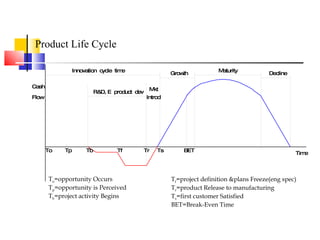
Product Life Cycle T o =opportunity Occurs T p =opportunity is Perceived T b =project activity Begins T f =project definition &plans Freeze(eng spec) T r =product Release to manufacturing T s =first customer Satisfied BET=Break-Even Time
Product Costs In High Tech, cost of marketing, selling (distribution) and supporting the product is often more than the cost of manufacturing the product Manufacturing cost (Software products cost almost nothing to make) Support cost R&D cost amortized over life of product  Marketing, sales and distribution costs Successful companies get products to customers in the most cost-effective fashion(not necessarily lowest price!)
Whole Product Development for Competitive Advantage Segmenting the market and inventing complete products enable you to gain superiority in the market place The device a company sells may not be particularly superior to the competition’s (PC v.s. Mac), but if the whole product is better overall, no competitor can effectively challenge it

Product Definition

  • 1.
  • 2.
    Product Definition Basis: Targeted market segment (phase of TALC) Technology Value Proposition Whole (Complete) Product Concept, including: Service & support Ancillary products Documentation Future Potential
  • 3.
    Whole Product ConceptProducts are complex; they have many dimensions It is the totality of what a customer buys A product is the physical object (hardware, food, medicine), software or service from which customer gets direct utility plus a number of other factors, services and perceptions that make the product: Useful Desirable Convenient
  • 4.
    Whole Product ConceptRestaurant’s product is: food + ambiance + service + cleanliness + other things Definition of all the above depends on the market segment Supermarket’s canned soup is: soup + the can’s label + store’s display + store’s cleanliness + the type of store (Safeway, gourmet food store, gas station convenient store,.)
  • 5.
    Whole Product ConceptComputer Operating System is: software + development environment (hardware and software) + documentation to use it + training program + suppliers service & troubleshooting capabilities + availability of hardware drivers + suppliers enhancement plans Example: Linux Another SW examples: SmallTalk, Java, ..
  • 6.
    Whole Product ConceptCVD product is: Reactor/ technology + wafer transfer platform + system software + process control hardware & software + application recipe + system packaging + company’s service & spares capabilities + ability/desire to do continuous improvement + operation & maintenance manual + presale demo + post-sale installation and qualification + customer’s confidence in the supplier Example: Helicon plasma CVD equipment
  • 7.
    Whole Product ConceptAscend (now part of Lucent) lost share due to poor marketing strategy Ascend has some of the best products in the industry They introduce products as devices: “here is our sexy new box, rather than this is our strategy for “voice” communication” “ Customers did not understand the significance of a newly launched product”
  • 8.
    Whole Product ConceptA product, to the potential customer, is value satisfaction The generic “thing” or “device” is not itself the product. It is the minimum necessary to get into the “game” A product has meaning only from the viewpoint of the customer or the ultimate user. Only the buyer or the user can assign value
  • 9.
    Whole Product ConceptGeneric Product Expected Product Augmented Product Potential Product value
  • 10.
    The Generic ProductThe generic product is the rudimentary “thing” without which there is no chance to participate in the market: for a bank: loanable funds for a realtor: “for sale” properties for a lawyer: the bar exam certificate for WebTV: the box for satellite TV: the antenna and receiver box
  • 11.
    The Expected ProductThe expected product represents the customer’s minimal expectations Delivery conditions, installation services, post-sale services, spare parts, training, packaging conveniences the bank: the loan officer who is cooperative the realtor: who is on your side the lawyer: who protects you the WebTV: that only connects to a few home shopping channels the Satellite TV retailer: that does not offer installation support to an old man
  • 12.
    The Expected Product, cont’d The expected attributes vary by customers and industries They could be sources of product differentiation depending on how well suppliers do them
  • 13.
    The Augmented ProductCustomer may be offered more than what she thinks she needs or expects Computer that comes with “Office 2000” already installed Offer two year warranty for semiconductor process equipment where the “norm” is one year Optical store that replaces customer’s lost contact lenses nights & weekends and delivers them to customer’s home Augmentations are means of product differentiation They could also create customer dependency on the supplier
  • 14.
    The Augmented ProductProduct augmentations can educate the customer about what is reasonable for him to expect This raises the competitive bar; augmented benefits may turn into customer expectations (and move into the inner circle) Not all customers can be attracted to by an ever widening circle of augmented benefits They may prefer lower prices to more augmentation
  • 15.
    The Potential ProductThe Potential Product consists of everything potentially feasible to get and keep customers what may remain to be done what is possible in the future Suppliers, and customers, can compete more effectively with the Potential Product in the changed conditions of future
  • 16.
    The Potential ProductIn high tech markets, customers desire extendibility for the product so that the platform and basic technology can last over several generations of technology progressions e.g. semiconductor technology cycles Product Roadmap is important
  • 17.
    Product Definition HighTech markets are different than consumer markets, requiring different definition of the whole product point of sale (sold directly to customers by sales persons) function (emphasized) pre-sale evaluation (customers spend a lot of time, sometimes more than one year) post-sale support (documentation, customer training, service) risk in purchasing decision (is high) intangible factors (trust, reputation,references) product/technology roadmap (extendibility)
  • 18.
    Whole Product ConceptThe cost of creating a complete product is often many times the cost of developing the generic product (hardware, or software, or drug)
  • 19.
    Whole Product ConceptIf the product cannot be made to work by the customer, it is useless The reason may be It inherently does not work user is not adequately trained and does not know how to use it documentation telling the user how to install and operate the product is inaccurate product is not serviced & supported
  • 20.
    Whole Product ConceptProducts are multidimensional A whole product is one that can be functional (technology and design meeting spec) manufactured (materials & tools available, be manufacturable) serviced & supported (trained people, fast response, be serviceable) applied (documentation, process recipe) sold (distribution channels, sales collateral)
  • 21.
    Whole Product ConceptCustomers’ needs and wants define products Depending on the targeted market segment, the definition of the product must change The product must be defined differently in different phases of the Technology Adoption Life Cycle
  • 22.
    Whole Product ConceptInnovators want to be part of the supplier’s product development, do not mind inadequate documentation or even not fully functioning product PC’s & application software in the hands of engineers in 1980 Late Majority on the other hand, are conservatives and for them cost of mistake is huge. They have no tolerance for malfunction or documentation error PC & application software in a travel agency in 1998
  • 23.
    Whole Product ConceptIBM PC’s dominated the market over Apple because: IBM label made it a “complete product” for business applications IBM PC’s open architecture allowed rapid development of a myriad of applications, that were missing on Apple (e.g. business application software) We saw examples of Ascend products: now the customers are requesting different “products” because they are CEO’s and VP’s of muti-billion dollar companies (GTE, Deutsche Telekom)
  • 24.
    Whole Product ConceptWhen you are positioning yourself against competition, it is important to compare complete products not just devices A product will achieve a commanding position within a segment only if it is complete
  • 25.
    Whole Product ConceptMarketing organization is responsible to ensure that products are complete for the targeted market segment guarantee that the product remains complete as the customer base evolves and competition sets new standards for completeness
  • 26.
    Product Definition Productsare marketing inventions Product invention / definition is a continuous process Starts at the intersection of new technology capability and perceived market opportunity Continues during the market research and definition of Market Requirements Specification (MRS) device development and demonstration product launch
  • 27.
    Product Definition Continuespast product introduction thru discovery of new applications (not envisioned by the original developers) Continues further as product marches down the Technology Adoption Life Cycle and product is redefined for new groups of customers as the company diversifies into new market segments to capture more market share
  • 28.
    Product Life CycleT o =opportunity Occurs T p =opportunity is Perceived T b =project activity Begins T f =project definition &plans Freeze(eng spec) T r =product Release to manufacturing T s =first customer Satisfied BET=Break-Even Time
  • 29.
    Product Costs InHigh Tech, cost of marketing, selling (distribution) and supporting the product is often more than the cost of manufacturing the product Manufacturing cost (Software products cost almost nothing to make) Support cost R&D cost amortized over life of product Marketing, sales and distribution costs Successful companies get products to customers in the most cost-effective fashion(not necessarily lowest price!)
  • 30.
    Whole Product Developmentfor Competitive Advantage Segmenting the market and inventing complete products enable you to gain superiority in the market place The device a company sells may not be particularly superior to the competition’s (PC v.s. Mac), but if the whole product is better overall, no competitor can effectively challenge it