
Positioning and  Differentiating Market Offerings  over the Life Cycle
Objectives Identify Differentiating Attributes Choosing & Communicating Effective Positioning Marketing Strategies Along the Product Life Cycle Marketing Strategy & Market Evolution
Differentiation
Product Differentiation Form Fea- tures Perfor- mance Quality Conform- ance Quality Dura- bility Relia- bility Repair- ability Style Design
Services Differentiation Delivery Ordering Ease Maintenance & Repair Customer Training Installation Customer Consulting Miscellaneous Services
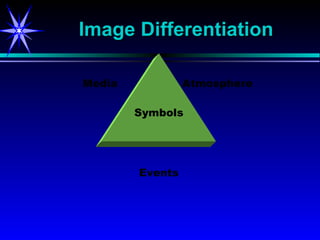
Image Differentiation Media Atmosphere Symbols Events
Differences Worth Establishing Affordable Superior Profitable Preemptive Distinctive Important
Positioning  is the act of designing the company’s offering and image to occupy a distinctive place in the the target market’s mind.
Perceptual Map 0.2  0.4  0.6  0.8  1.0  1.2  1.4  1.6  -1.6  -1.4  -1.2  -1.0  -0.8  -0.6  -0.4  -0.2  1.0 0.8 0.6 0.4 0.2 -0.2 -0.4 -0.6 -0.8 Magic Mountain Japanese Deer Park Busch Gardens Knott’s Berry Farm Lion Country Safari Marineland of the Pacific Disneyland Economical Fun rides Exercise Fantasy Good food Easy to reach Educational, animals Little waiting Live shows
Product Life Cycle
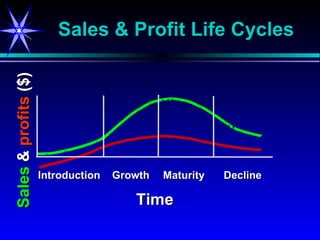
Sales & Profit Life Cycles Introduction Growth Maturity Decline Time Sales  &  profits  ($)
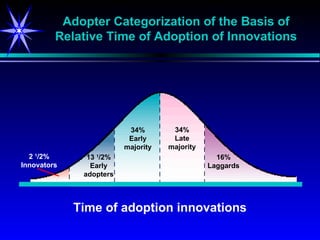
Time of adoption innovations Adopter Categorization of the Basis of Relative Time of Adoption of Innovations 2  1 /2% Innovators 13  1 /2% Early adopters 34% Early majority 34% Late majority 16% Laggards
Innovators:  Description 2.5% of population Venturesome Very eager to try new ideas Acceptable if risk is daring More cosmopolite social relationships Communicates with other innovators
Early Adopters:  Description 13.5% of population Respected More integrated into the local social system The persons to check with before adopting a new idea Category contains greatest number of opinion leaders Are role models
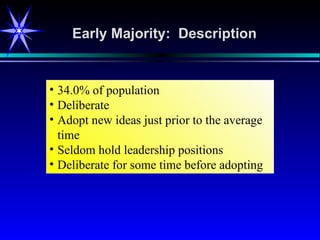
Early Majority:  Description 34.0% of population Deliberate Adopt new ideas just prior to the average time Seldom hold leadership positions Deliberate for some time before adopting
Late Majority:  Description 34% of population Skeptical Adopt new ideas just after the average time Adopting may be both an economic necessity and a reaction to peer pressures Innovations approached cautiously
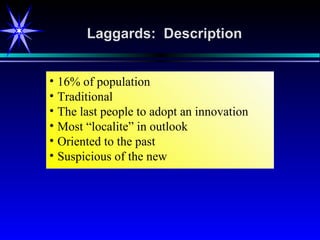
Laggards:  Description 16% of population Traditional The last people to adopt an innovation Most “localite” in outlook Oriented to the past Suspicious of the new
Four Introductory Marketing Strategies Rapid- skimming strategy Rapid- penetration strategy Slow- penetration strategy Slow- skimming strategy Price Low High Promotion High Low
Maturity Stage Market Modification Product Modification Marketing-Mix Modification
Decline Stage Increase investment Resolve uncertainties - stable investment Selective niches Harvesting Divesting
Market Evolution Emergence Growth Maturity Decline
Review Identify Differentiating Attributes Choosing & Communicating Effective Positioning Marketing Strategies Along the Product Life Cycle Marketing Strategy & Market Evolution

Product Positioning and Lifecycle

  • 1.
    Positioning and Differentiating Market Offerings over the Life Cycle
  • 2.
    Objectives Identify DifferentiatingAttributes Choosing & Communicating Effective Positioning Marketing Strategies Along the Product Life Cycle Marketing Strategy & Market Evolution
  • 3.
  • 4.
    Product Differentiation FormFea- tures Perfor- mance Quality Conform- ance Quality Dura- bility Relia- bility Repair- ability Style Design
  • 5.
    Services Differentiation DeliveryOrdering Ease Maintenance & Repair Customer Training Installation Customer Consulting Miscellaneous Services
  • 6.
    Image Differentiation MediaAtmosphere Symbols Events
  • 7.
    Differences Worth EstablishingAffordable Superior Profitable Preemptive Distinctive Important
  • 8.
    Positioning isthe act of designing the company’s offering and image to occupy a distinctive place in the the target market’s mind.
  • 9.
    Perceptual Map 0.2 0.4 0.6 0.8 1.0 1.2 1.4 1.6 -1.6 -1.4 -1.2 -1.0 -0.8 -0.6 -0.4 -0.2 1.0 0.8 0.6 0.4 0.2 -0.2 -0.4 -0.6 -0.8 Magic Mountain Japanese Deer Park Busch Gardens Knott’s Berry Farm Lion Country Safari Marineland of the Pacific Disneyland Economical Fun rides Exercise Fantasy Good food Easy to reach Educational, animals Little waiting Live shows
  • 10.
  • 11.
    Sales & ProfitLife Cycles Introduction Growth Maturity Decline Time Sales & profits ($)
  • 12.
    Time of adoptioninnovations Adopter Categorization of the Basis of Relative Time of Adoption of Innovations 2 1 /2% Innovators 13 1 /2% Early adopters 34% Early majority 34% Late majority 16% Laggards
  • 13.
    Innovators: Description2.5% of population Venturesome Very eager to try new ideas Acceptable if risk is daring More cosmopolite social relationships Communicates with other innovators
  • 14.
    Early Adopters: Description 13.5% of population Respected More integrated into the local social system The persons to check with before adopting a new idea Category contains greatest number of opinion leaders Are role models
  • 15.
    Early Majority: Description 34.0% of population Deliberate Adopt new ideas just prior to the average time Seldom hold leadership positions Deliberate for some time before adopting
  • 16.
    Late Majority: Description 34% of population Skeptical Adopt new ideas just after the average time Adopting may be both an economic necessity and a reaction to peer pressures Innovations approached cautiously
  • 17.
    Laggards: Description16% of population Traditional The last people to adopt an innovation Most “localite” in outlook Oriented to the past Suspicious of the new
  • 18.
    Four Introductory MarketingStrategies Rapid- skimming strategy Rapid- penetration strategy Slow- penetration strategy Slow- skimming strategy Price Low High Promotion High Low
  • 19.
    Maturity Stage MarketModification Product Modification Marketing-Mix Modification
  • 20.
    Decline Stage Increaseinvestment Resolve uncertainties - stable investment Selective niches Harvesting Divesting
  • 21.
    Market Evolution EmergenceGrowth Maturity Decline
  • 22.
    Review Identify DifferentiatingAttributes Choosing & Communicating Effective Positioning Marketing Strategies Along the Product Life Cycle Marketing Strategy & Market Evolution