Create the Product
What is a Product? Physical Objects Services Events Persons Places Organizations Ideas Combinations of above Anything that can be acquired, used, consumed, adopted or enjoyed to satisfy a want or need The starting point of the Marketing Mix
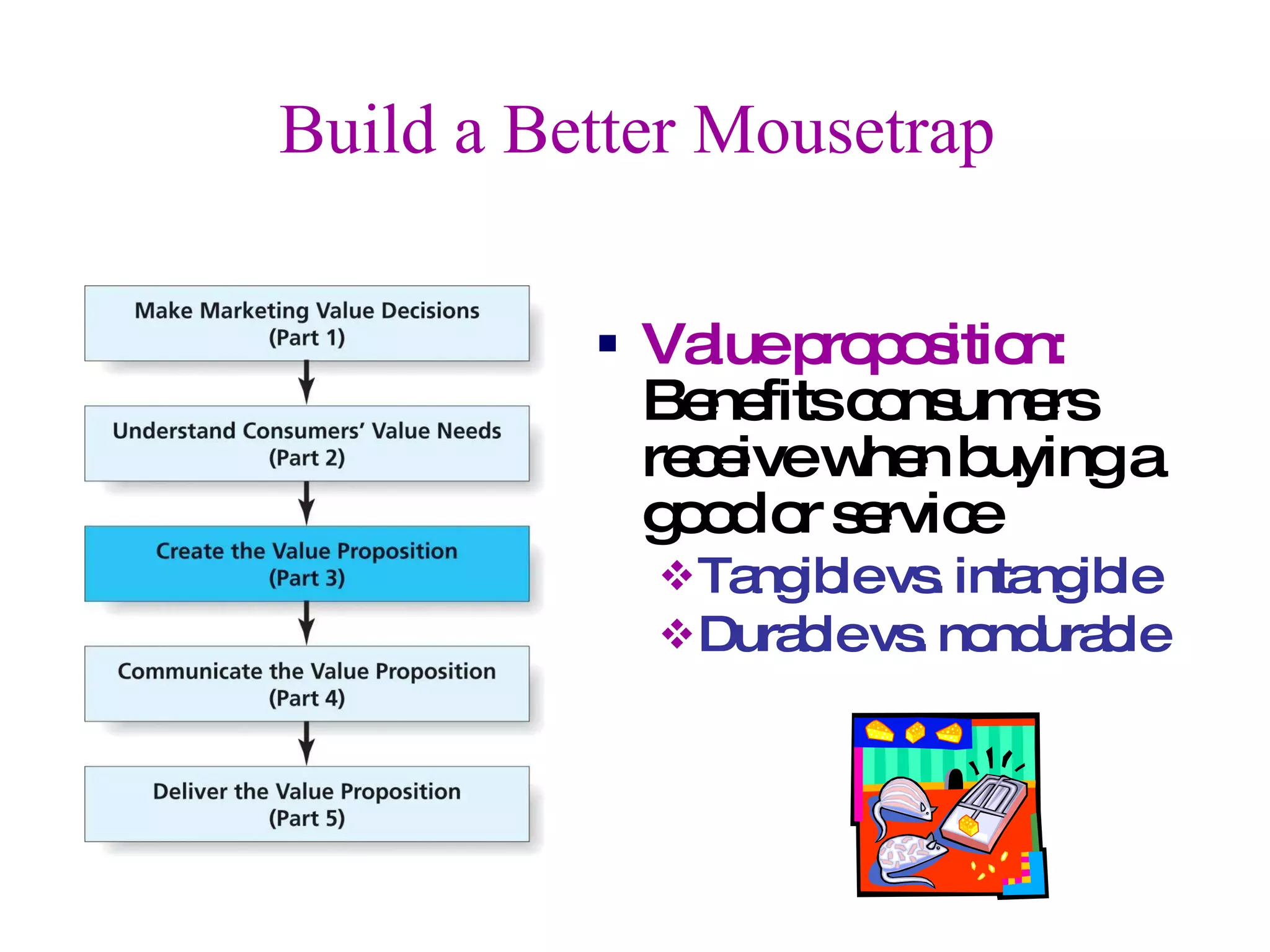
Build a Better Mousetrap  Value proposition:  Benefits consumers receive when buying a good or service Tangible vs. intangible Durable vs. nondurable
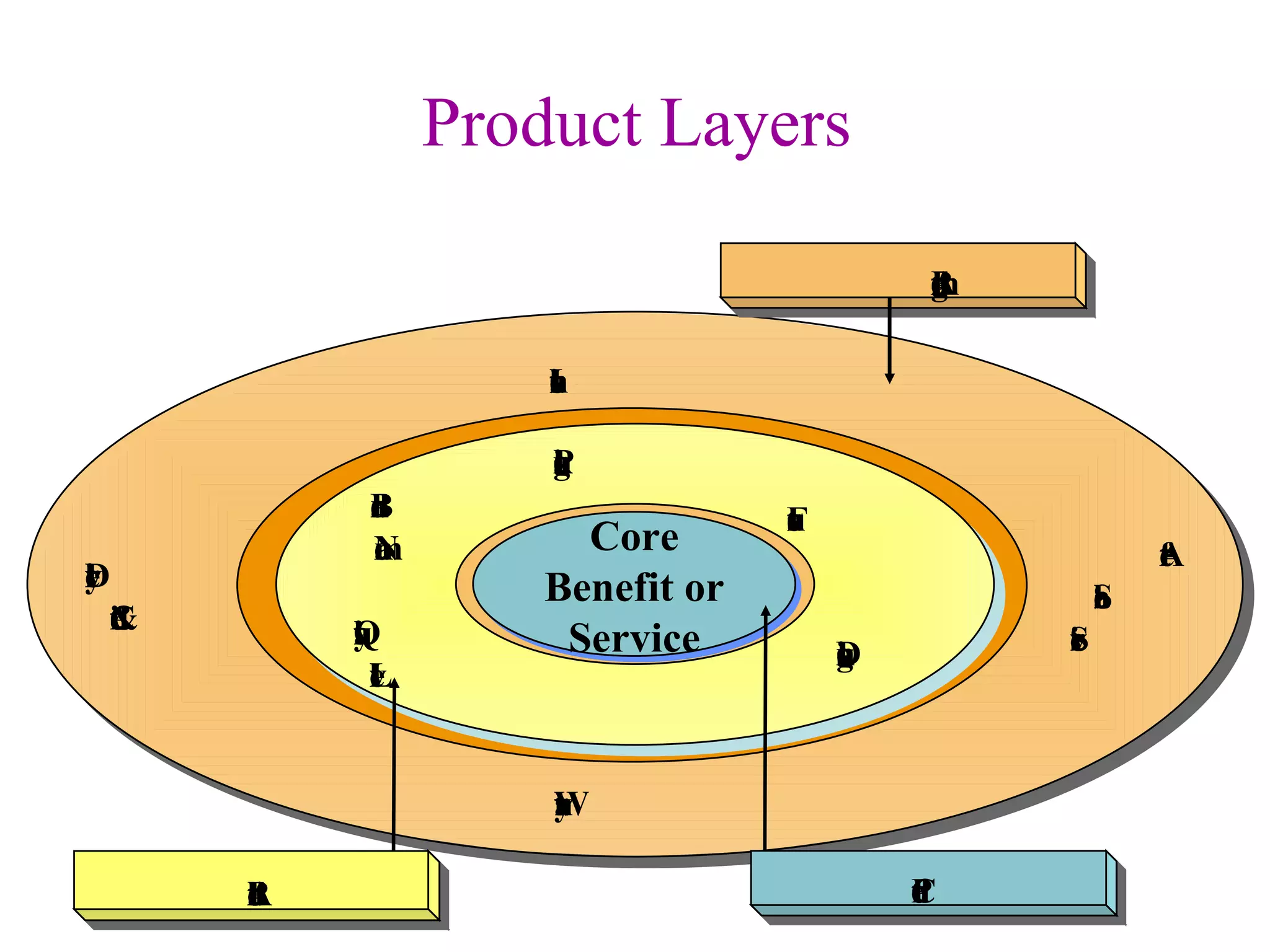
Product Layers Brand Name Quality Level Packaging Design Features Delivery & Credit Installation Warranty After- Sale Service Core Benefit or Service Actual Product Core Product Augmented Product
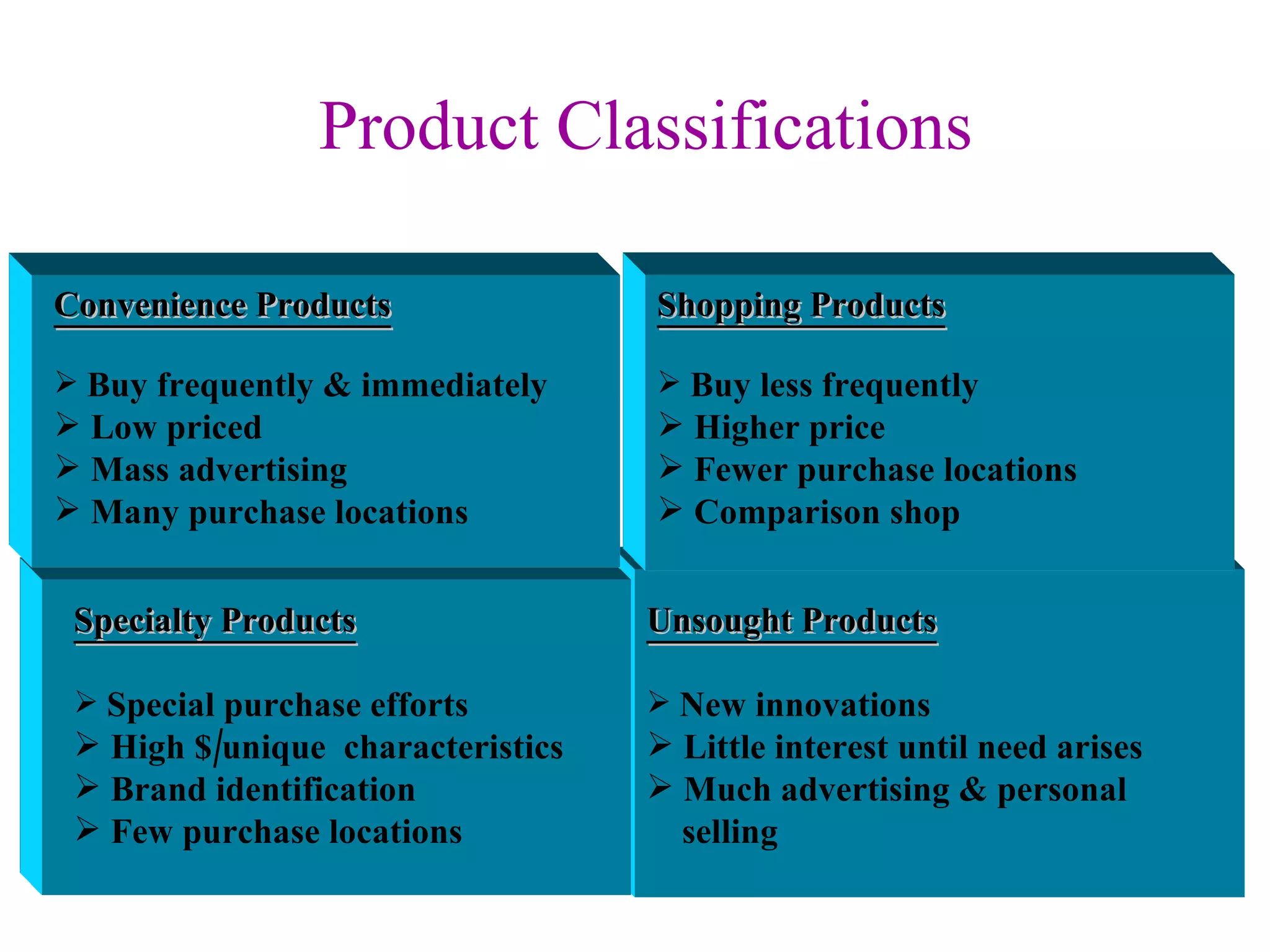
Product Classifications Unsought Products New innovations Little interest until need arises Much advertising & personal  selling Specialty Products Special purchase efforts High $/unique  characteristics Brand identification Few purchase locations Shopping Products Buy less frequently Higher price Fewer purchase locations Comparison shop  Convenience Products Buy frequently & immediately Low priced Mass advertising Many purchase locations
Product Group Activity Unsought products often call to mind situations that a consumer would like to ignore.  Break into small groups and select an example of an unsought product. Suggest a Marketing approach to get consumers interested in, and ultimately purchase, such a product? How does ethics factor in to promoting this product?
Business-to-Business Produc ts Classified by how organizations use them Equipment Maintenance, repair & operating (MRO) Raw materials Processed materials Specialized services Component parts
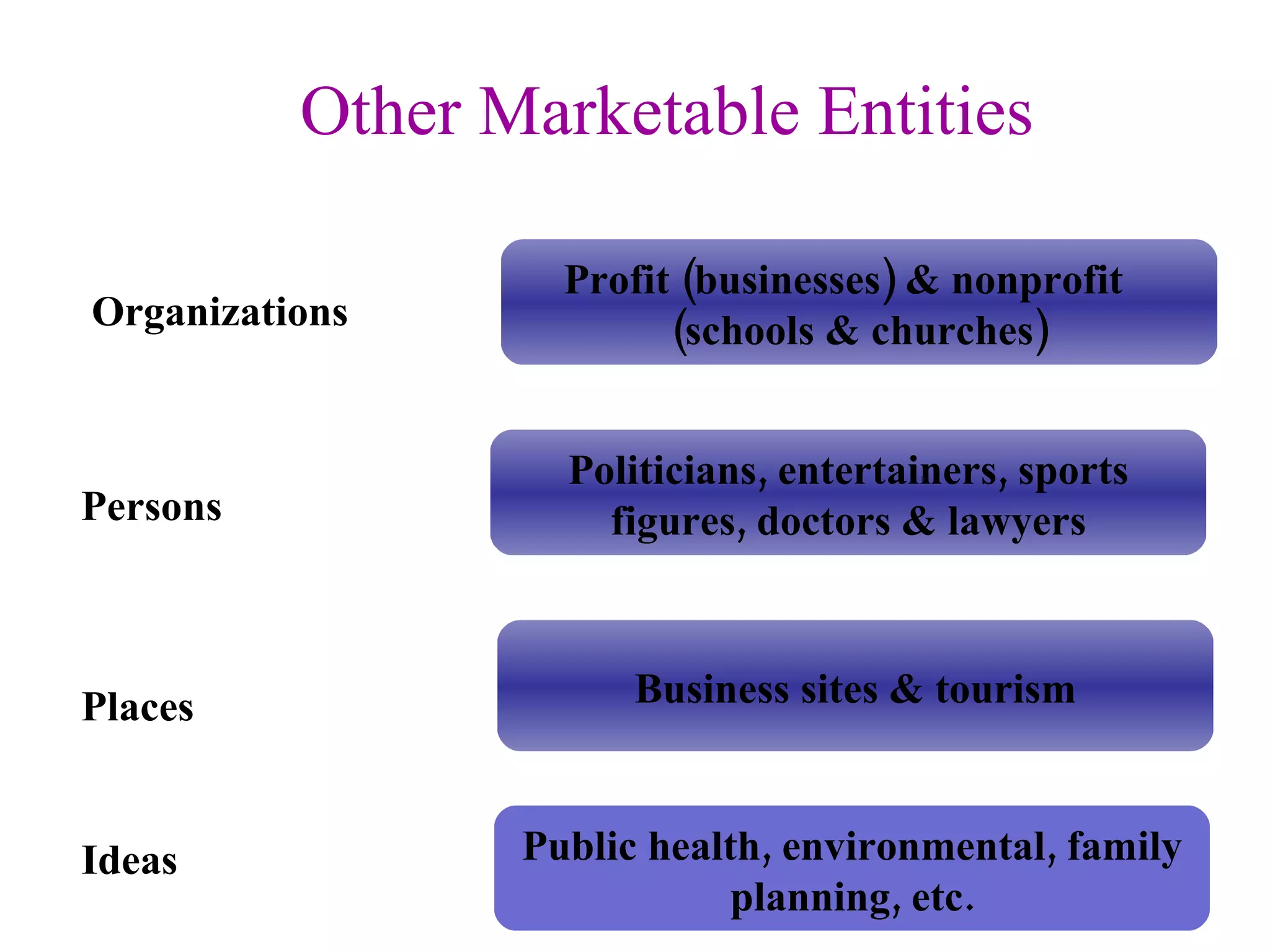
Other Marketable Entities Profit (businesses) & nonprofit  (schools & churches) Public health, environmental, family planning, etc. Politicians, entertainers, sports figures, doctors & lawyers Organizations Persons Places Business sites & tourism Ideas
“ New and Improved” Innovation:  A product that customers perceive to be new & different from existing products The Federal Trade Commission says: A product must be entirely new or changed significantly to be called “new” and May be called “new” for only  six  months New products are expensive to develop & even more costly if they fail
Causes of New Product Failures As many as 80% of new consumer products fail Only 40% are around 5 years after introduction Why? Overestimation of market size Product design problems Product incorrectly positioned, priced, advertised Launched despite poor M/R findings Competitive actions
Continuous Innovation A modification to an existing product Most common form of innovation Learning & change are minimal  Examples: brand extensions, line extensions  Knockoffs copy (with slight modification) the design of an original product
Dynamically Continuous Innovation A pronounced modification to an existing product  Requires a modest amount of learning or behavior change  Convergence:  The coming together of 2 or more technologies to create a new system with greater benefits than its parts
Discontinuous Innovation A totally new product Creates major changes in the way we live Significant new learning required Examples: microwave ovens, cell phones
Innovation Individual Activity Think about 5 new products introduced over the last year. Classify each as a continuous, dynamically continuous or discontinuous innovation. Why did you select those classifications?
New Product Development Continuous search for entirely new products or ways to make existing products better Successfully new product introduction is becoming more difficult R&D costs are enormous Products become obsolete faster Slotting fees are high
Product Development Phases Phase 1: Idea generation  Brainstorm about & systematically search for new products compatible with the firm’s mission  Phase 2: Concept development & screening Test ideas for technical & commercial success  Choose one(s) with strongest appeal & potential Phase 3: Marketing strategy development Objectives & tactics
Product Development Phases Phase 4: Business analysis Assess the product’s commercial viability Phase 5: Technical development  Refine & perfect the new product Design prototypes or test versions of the proposed product
Product Development Phases Phase 6: Test marketing Test marketing mix in a small geographic area Phase 7: Commercialization  Launch the new product Begin full-scale production, distribution, advertising & sales promotion
Adoption & Diffusion Product adoption Consumers or businesses begin to buy & use a new product Diffusion Product use spreads throughout a population The tipping point
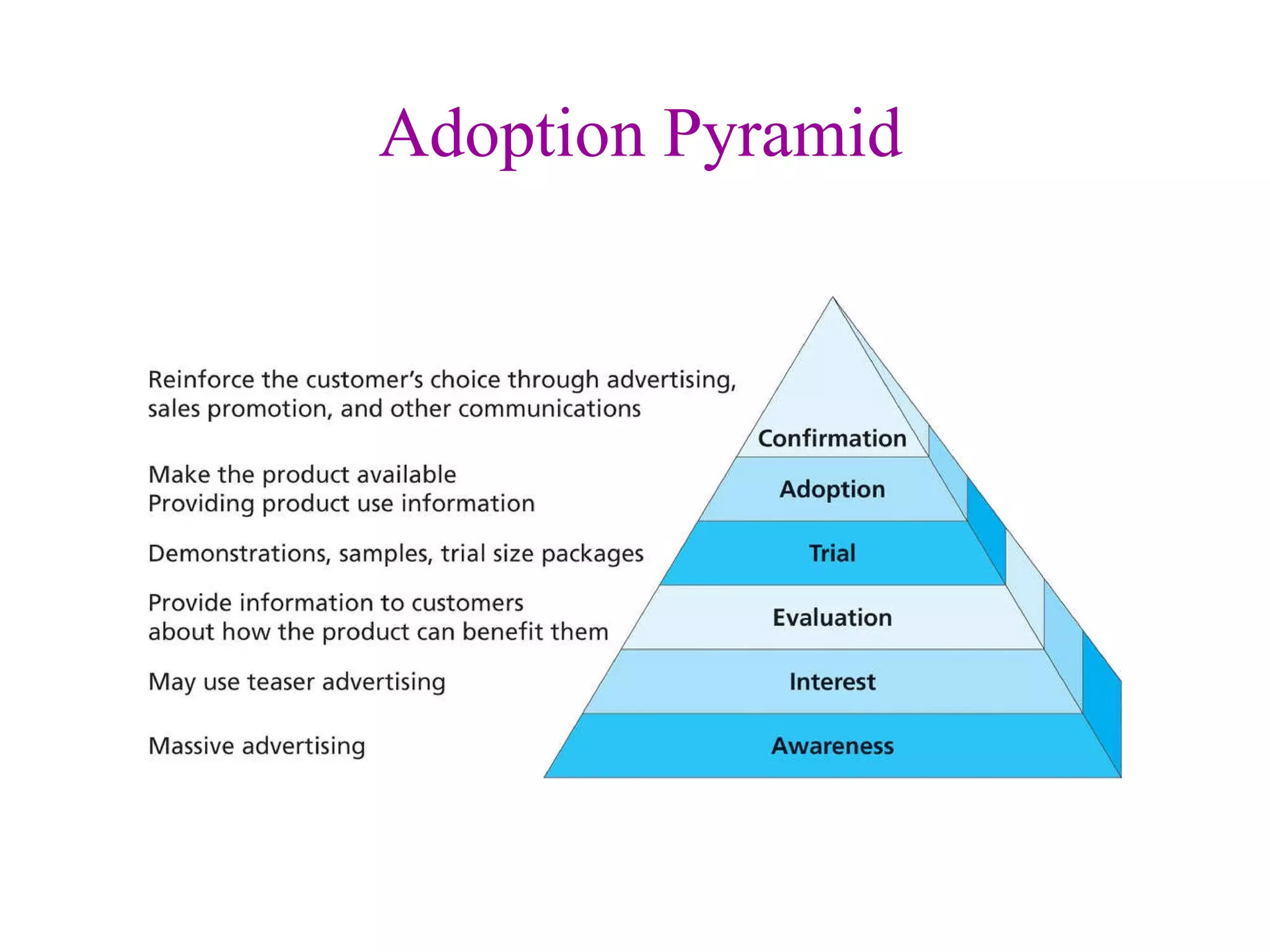
Adoption Pyramid
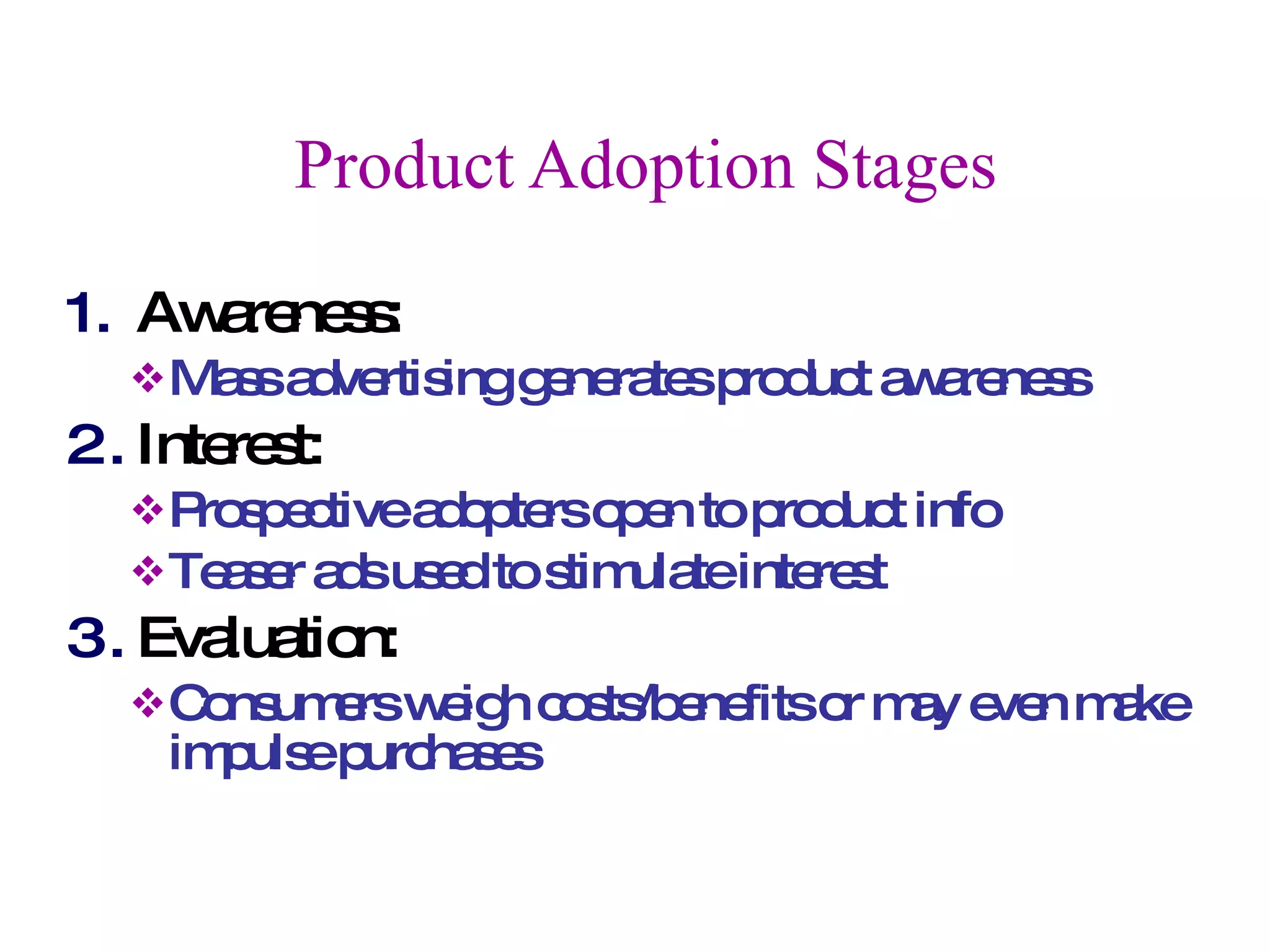
Product Adoption Stages Awareness:  Mass advertising generates product awareness Interest:  Prospective adopters open to product info Teaser ads used to stimulate interest Evaluation:  Consumers weigh costs/benefits or may even make impulse purchases
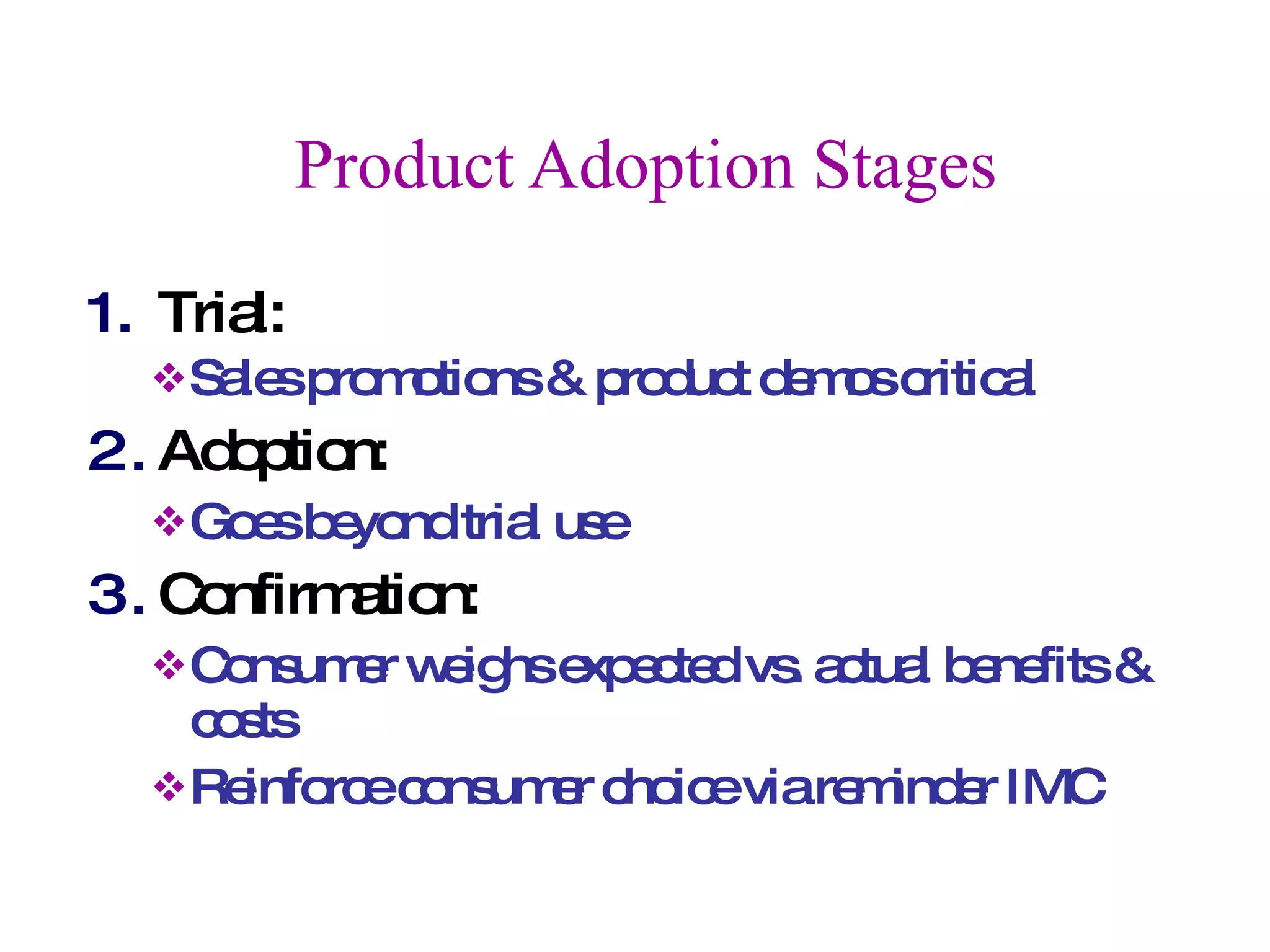
Product Adoption Stages Trial:  Sales promotions & product demos critical Adoption:  Goes beyond trial use Confirmation:  Consumer weighs expected vs. actual benefits & costs Reinforce consumer choice via reminder IMC
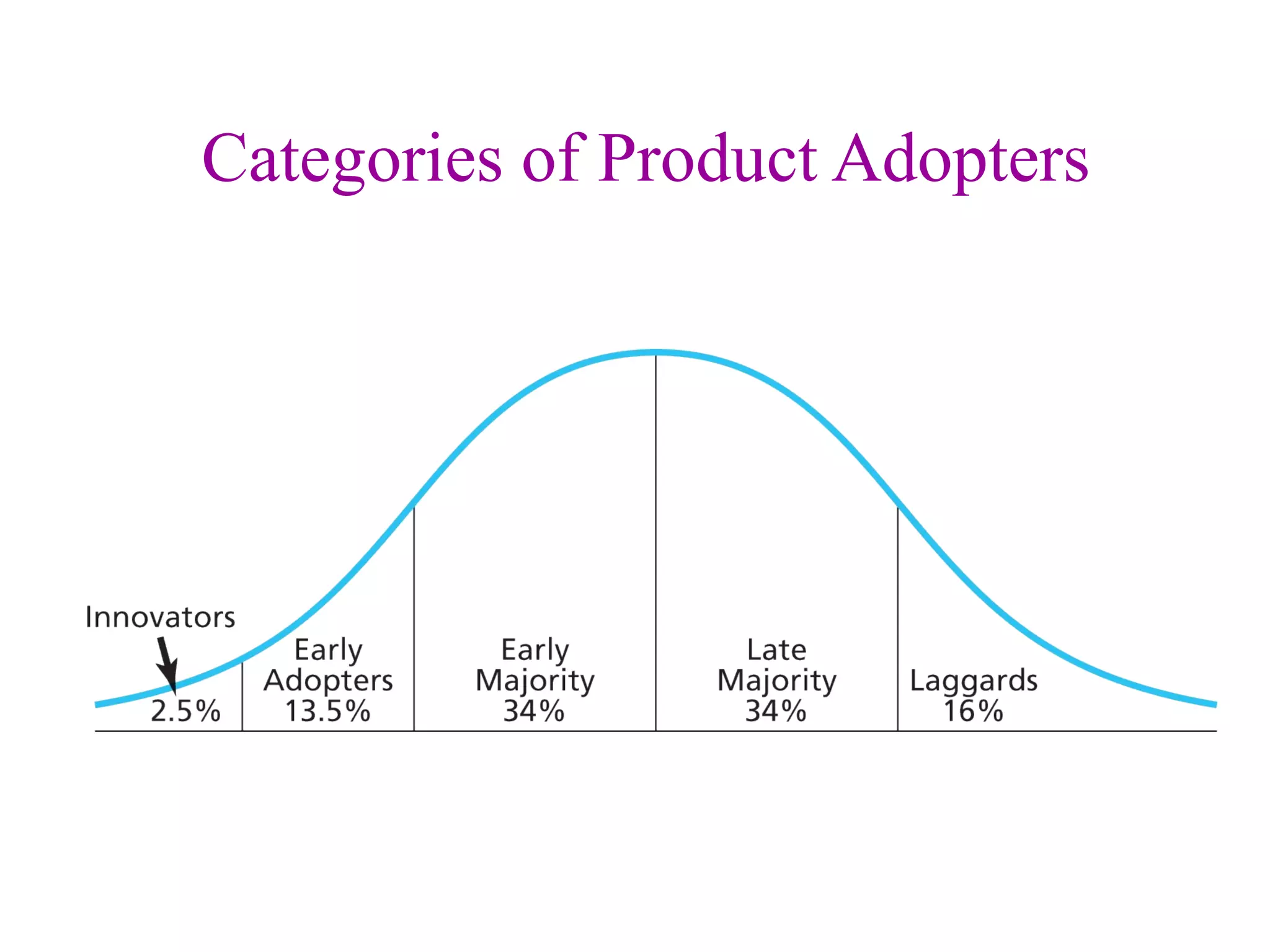
Categories of Product Adopters
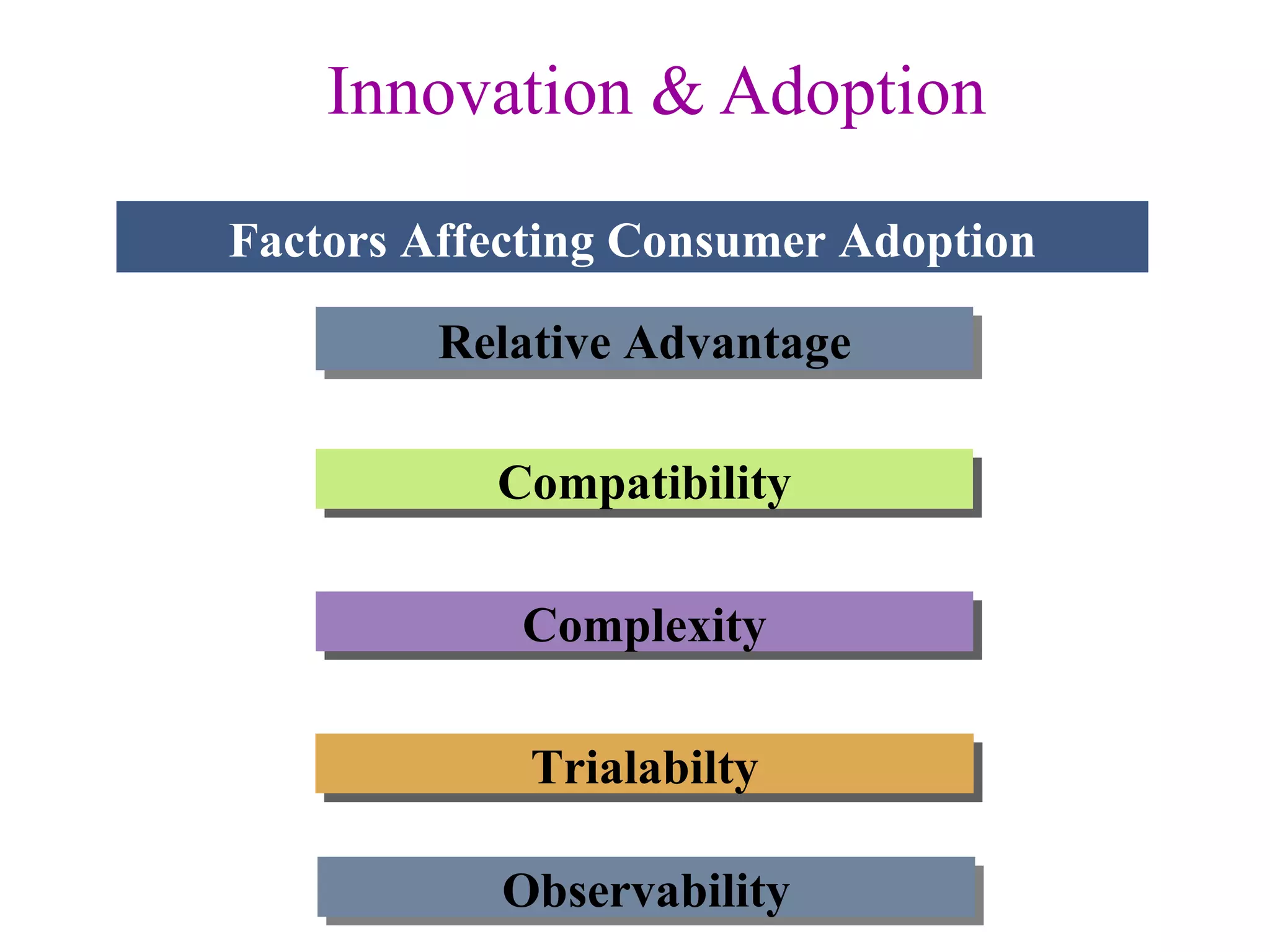
Innovation & Adoption Observability Relative Advantage Compatibility Complexity Trialabilty Factors Affecting Consumer Adoption
B2B Product Adoption Innovators New, smaller or younger firms Early-adopter firms Market-share leaders Late-majority firms Prefer status quo & have large investments in existing production technology Laggard firms Already losing money
Improving New Product Success A successful new product should offer: A superior product (one with higher quality, features & value in use) A well-defined concept (an identified target market, product requirements & benefits)
New Product Class Discussion Not all new products are perceived to benefit consumers or society. What are some examples of new products that have made our lives better?  Why? Give some examples of products that are harmful to consumers or society.  Why? Should there be a way to monitor or police new products that may be harmful?
Key Concepts Review Product Core Product Actual Product Augmented product Convenience Product Shopping Product Specialty Product Unsought Product “ New” Product Types of Innovations Product Adoption Product Diffusion Adoption Categories Test Marketing

Mkt08

  • 1.
  • 2.
    What is aProduct? Physical Objects Services Events Persons Places Organizations Ideas Combinations of above Anything that can be acquired, used, consumed, adopted or enjoyed to satisfy a want or need The starting point of the Marketing Mix
  • 3.
    Build a BetterMousetrap Value proposition: Benefits consumers receive when buying a good or service Tangible vs. intangible Durable vs. nondurable
  • 4.
    Product Layers BrandName Quality Level Packaging Design Features Delivery & Credit Installation Warranty After- Sale Service Core Benefit or Service Actual Product Core Product Augmented Product
  • 5.
    Product Classifications UnsoughtProducts New innovations Little interest until need arises Much advertising & personal selling Specialty Products Special purchase efforts High $/unique characteristics Brand identification Few purchase locations Shopping Products Buy less frequently Higher price Fewer purchase locations Comparison shop Convenience Products Buy frequently & immediately Low priced Mass advertising Many purchase locations
  • 6.
    Product Group ActivityUnsought products often call to mind situations that a consumer would like to ignore. Break into small groups and select an example of an unsought product. Suggest a Marketing approach to get consumers interested in, and ultimately purchase, such a product? How does ethics factor in to promoting this product?
  • 7.
    Business-to-Business Produc tsClassified by how organizations use them Equipment Maintenance, repair & operating (MRO) Raw materials Processed materials Specialized services Component parts
  • 8.
    Other Marketable EntitiesProfit (businesses) & nonprofit (schools & churches) Public health, environmental, family planning, etc. Politicians, entertainers, sports figures, doctors & lawyers Organizations Persons Places Business sites & tourism Ideas
  • 9.
    “ New andImproved” Innovation: A product that customers perceive to be new & different from existing products The Federal Trade Commission says: A product must be entirely new or changed significantly to be called “new” and May be called “new” for only six months New products are expensive to develop & even more costly if they fail
  • 10.
    Causes of NewProduct Failures As many as 80% of new consumer products fail Only 40% are around 5 years after introduction Why? Overestimation of market size Product design problems Product incorrectly positioned, priced, advertised Launched despite poor M/R findings Competitive actions
  • 11.
    Continuous Innovation Amodification to an existing product Most common form of innovation Learning & change are minimal Examples: brand extensions, line extensions Knockoffs copy (with slight modification) the design of an original product
  • 12.
    Dynamically Continuous InnovationA pronounced modification to an existing product Requires a modest amount of learning or behavior change Convergence: The coming together of 2 or more technologies to create a new system with greater benefits than its parts
  • 13.
    Discontinuous Innovation Atotally new product Creates major changes in the way we live Significant new learning required Examples: microwave ovens, cell phones
  • 14.
    Innovation Individual ActivityThink about 5 new products introduced over the last year. Classify each as a continuous, dynamically continuous or discontinuous innovation. Why did you select those classifications?
  • 15.
    New Product DevelopmentContinuous search for entirely new products or ways to make existing products better Successfully new product introduction is becoming more difficult R&D costs are enormous Products become obsolete faster Slotting fees are high
  • 16.
    Product Development PhasesPhase 1: Idea generation Brainstorm about & systematically search for new products compatible with the firm’s mission Phase 2: Concept development & screening Test ideas for technical & commercial success Choose one(s) with strongest appeal & potential Phase 3: Marketing strategy development Objectives & tactics
  • 17.
    Product Development PhasesPhase 4: Business analysis Assess the product’s commercial viability Phase 5: Technical development Refine & perfect the new product Design prototypes or test versions of the proposed product
  • 18.
    Product Development PhasesPhase 6: Test marketing Test marketing mix in a small geographic area Phase 7: Commercialization Launch the new product Begin full-scale production, distribution, advertising & sales promotion
  • 19.
    Adoption & DiffusionProduct adoption Consumers or businesses begin to buy & use a new product Diffusion Product use spreads throughout a population The tipping point
  • 20.
  • 21.
    Product Adoption StagesAwareness: Mass advertising generates product awareness Interest: Prospective adopters open to product info Teaser ads used to stimulate interest Evaluation: Consumers weigh costs/benefits or may even make impulse purchases
  • 22.
    Product Adoption StagesTrial: Sales promotions & product demos critical Adoption: Goes beyond trial use Confirmation: Consumer weighs expected vs. actual benefits & costs Reinforce consumer choice via reminder IMC
  • 23.
  • 24.
    Innovation & AdoptionObservability Relative Advantage Compatibility Complexity Trialabilty Factors Affecting Consumer Adoption
  • 25.
    B2B Product AdoptionInnovators New, smaller or younger firms Early-adopter firms Market-share leaders Late-majority firms Prefer status quo & have large investments in existing production technology Laggard firms Already losing money
  • 26.
    Improving New ProductSuccess A successful new product should offer: A superior product (one with higher quality, features & value in use) A well-defined concept (an identified target market, product requirements & benefits)
  • 27.
    New Product ClassDiscussion Not all new products are perceived to benefit consumers or society. What are some examples of new products that have made our lives better? Why? Give some examples of products that are harmful to consumers or society. Why? Should there be a way to monitor or police new products that may be harmful?
  • 28.
    Key Concepts ReviewProduct Core Product Actual Product Augmented product Convenience Product Shopping Product Specialty Product Unsought Product “ New” Product Types of Innovations Product Adoption Product Diffusion Adoption Categories Test Marketing

Editor's Notes

  • #25 Chapter 11 Developing and Managing Products