Category Management
Group 1
Akshatha Neeraje
Juhi Chandwani
MVL Manikantan
Naren Shetty
Nancy Negi
Rohan Bharaj
Ronak Sharma
Saksham Yadav
Vibhu Gauba
What is Category Management
Category management is a retailing concept in which the range of
products purchased by a business organization or sold by a retailer
is broken down into discrete groups of similar or related products;
these groups are known as product categories. It is a systematic,
disciplined approach to managing a product category as a strategic
business unit.
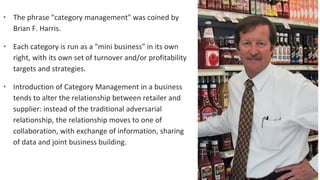
• The phrase "category management" was coined by
Brian F. Harris.
• Each category is run as a "mini business" in its own
right, with its own set of turnover and/or profitability
targets and strategies.
• Introduction of Category Management in a business
tends to alter the relationship between retailer and
supplier: instead of the traditional adversarial
relationship, the relationship moves to one of
collaboration, with exchange of information, sharing
of data and joint business building.
Rationale for CM
•Retailers' desire for suppliers to add value to their (i.e. the
retailer's) business rather than just the supplier's own
•The classification of products into separate category benefits the
customers and makes their shopping a pleasurable experience.
•The customers as per their interest, pocket and need can walk up
to the respective categories, check out the various options and
decide what to buy and what not to buy.
Category Captain
• Closest and most regular contact with the retailer
• Forms an alliance with the retailer to help them develop consumer
• insight, so they can satisfy shopper needs, improve performance and
increase profit.
• Expected to invest time, effort and often financial assets into development
of the category.
• In return, the supplier will gain a more influential voice with the retailer
Role of Category Management
•Capture customer’s focus
•Define category roles
–Destination
–Preferred
–Occasional
–Convenience
•Monitor competition and suppliers
•Strengthen operations and performance
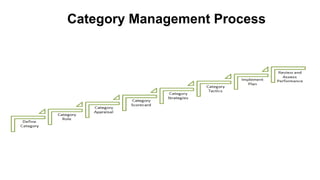
Category Management Process
•Define Category: This step helps define the category, the consumer decision tree identifies the choices and the
order of decisions customers make when they shop the category. Do they choose brand, sub-brand, quality,
flavor/scent, packing, etc.?
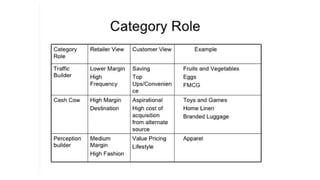
•Category Role: Role identifies the importance of the category to the retailer. This is the role the retailer wants
the category to play within their store. A category can be used to bring consumers into the store, increase foot
traffic, support routine shopping needs, be a destination for seasonal/occasional purchases, a one-stop-shop or
for convenience.
•Category appraisal: Knowing how the category performs at the retailer, within the market and across different
outlets is the next step. This should include a pricing, promotion, placement and product assortment assessment.
•Category scorecard: Scorecard is the strategic allocation of work to be performed to reach the category goals
and objectives. It is a summary of observations and analysis to help develop goals and targets for the category.
•Category strategies: Category strategies are designed to grow market share, increase sales, increase foot traffic,
improve gross margin, increase return on investment, increase shopping basket size and gain customer
satisfaction.
•Category tactics: Tactics include specific actions to be taken to achieve chosen category strategies. Promoting
top brands on a front end cap three times a quarter at a hot price point with a feature is just one example.
•Implement plan: This is the action step that brings your strategies and tactics to life, where the proverbial
rubber meets the road. The degree to which you accurately implement the plan will dictate its success.
•Review and assess performance: Analyze, measure and review the results. This should be ongoing and used to
help you refocus and make changes if necessary.
Classification
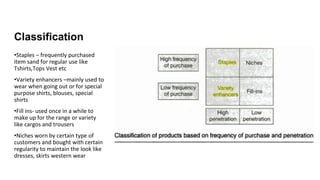
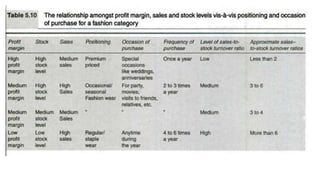
•Staples – frequently purchased
item sand for regular use like
Tshirts,Tops Vest etc
•Variety enhancers –mainly used to
wear when going out or for special
purpose shirts, blouses, special
shirts
•Fill ins- used once in a while to
make up for the range or variety
like cargos and trousers
•Niches worn by certain type of
customers and bought with certain
regularity to maintain the look like
dresses, skirts western wear
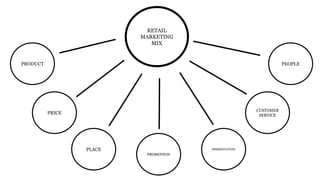
RETAIL
MARKETING
MIX
PRODUCT
PRICE
PEOPLE
PLACE PRESENTATION
CUSTOMER
SERVICE
PROMOTION
Category Management in Apparel Store
Space planning- Consideration for layout decision
 Latest collection to be placed in the front shelves
 Seasonal needs to be considered in a dedicated aisles
 high margin apparels to be placed in high traffic area
 Shopping behaviour and operational considerations should be recognised
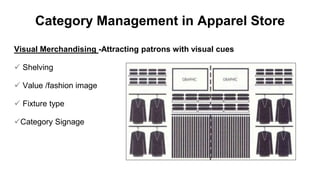
Category Management in Apparel Store
Visual Merchandising -Attracting patrons with visual cues
 Shelving
 Value /fashion image
 Fixture type
Category Signage
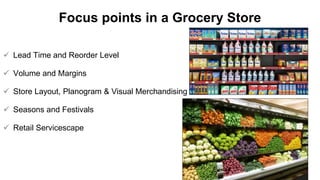
Focus points in a Grocery Store
 Lead Time and Reorder Level
 Volume and Margins
 Store Layout, Planogram & Visual Merchandising
 Seasons and Festivals
 Retail Servicescape
Meeting Consumer Needs
Maximizing the value of retail shelf space
Last words…
Thanks!

Category Management | Retail Management

  • 1.
    Category Management Group 1 AkshathaNeeraje Juhi Chandwani MVL Manikantan Naren Shetty Nancy Negi Rohan Bharaj Ronak Sharma Saksham Yadav Vibhu Gauba
  • 2.
    What is CategoryManagement Category management is a retailing concept in which the range of products purchased by a business organization or sold by a retailer is broken down into discrete groups of similar or related products; these groups are known as product categories. It is a systematic, disciplined approach to managing a product category as a strategic business unit.
  • 3.
    • The phrase"category management" was coined by Brian F. Harris. • Each category is run as a "mini business" in its own right, with its own set of turnover and/or profitability targets and strategies. • Introduction of Category Management in a business tends to alter the relationship between retailer and supplier: instead of the traditional adversarial relationship, the relationship moves to one of collaboration, with exchange of information, sharing of data and joint business building.
  • 4.
    Rationale for CM •Retailers'desire for suppliers to add value to their (i.e. the retailer's) business rather than just the supplier's own •The classification of products into separate category benefits the customers and makes their shopping a pleasurable experience. •The customers as per their interest, pocket and need can walk up to the respective categories, check out the various options and decide what to buy and what not to buy.
  • 5.
    Category Captain • Closestand most regular contact with the retailer • Forms an alliance with the retailer to help them develop consumer • insight, so they can satisfy shopper needs, improve performance and increase profit. • Expected to invest time, effort and often financial assets into development of the category. • In return, the supplier will gain a more influential voice with the retailer
  • 6.
    Role of CategoryManagement •Capture customer’s focus •Define category roles –Destination –Preferred –Occasional –Convenience •Monitor competition and suppliers •Strengthen operations and performance
  • 7.
  • 8.
    •Define Category: Thisstep helps define the category, the consumer decision tree identifies the choices and the order of decisions customers make when they shop the category. Do they choose brand, sub-brand, quality, flavor/scent, packing, etc.? •Category Role: Role identifies the importance of the category to the retailer. This is the role the retailer wants the category to play within their store. A category can be used to bring consumers into the store, increase foot traffic, support routine shopping needs, be a destination for seasonal/occasional purchases, a one-stop-shop or for convenience. •Category appraisal: Knowing how the category performs at the retailer, within the market and across different outlets is the next step. This should include a pricing, promotion, placement and product assortment assessment. •Category scorecard: Scorecard is the strategic allocation of work to be performed to reach the category goals and objectives. It is a summary of observations and analysis to help develop goals and targets for the category.
  • 9.
    •Category strategies: Categorystrategies are designed to grow market share, increase sales, increase foot traffic, improve gross margin, increase return on investment, increase shopping basket size and gain customer satisfaction. •Category tactics: Tactics include specific actions to be taken to achieve chosen category strategies. Promoting top brands on a front end cap three times a quarter at a hot price point with a feature is just one example. •Implement plan: This is the action step that brings your strategies and tactics to life, where the proverbial rubber meets the road. The degree to which you accurately implement the plan will dictate its success. •Review and assess performance: Analyze, measure and review the results. This should be ongoing and used to help you refocus and make changes if necessary.
  • 11.
    Classification •Staples – frequentlypurchased item sand for regular use like Tshirts,Tops Vest etc •Variety enhancers –mainly used to wear when going out or for special purpose shirts, blouses, special shirts •Fill ins- used once in a while to make up for the range or variety like cargos and trousers •Niches worn by certain type of customers and bought with certain regularity to maintain the look like dresses, skirts western wear
  • 13.
  • 14.
    Category Management inApparel Store Space planning- Consideration for layout decision  Latest collection to be placed in the front shelves  Seasonal needs to be considered in a dedicated aisles  high margin apparels to be placed in high traffic area  Shopping behaviour and operational considerations should be recognised
  • 15.
    Category Management inApparel Store Visual Merchandising -Attracting patrons with visual cues  Shelving  Value /fashion image  Fixture type Category Signage
  • 16.
    Focus points ina Grocery Store  Lead Time and Reorder Level  Volume and Margins  Store Layout, Planogram & Visual Merchandising  Seasons and Festivals  Retail Servicescape
  • 17.
    Meeting Consumer Needs Maximizingthe value of retail shelf space Last words…
  • 18.