Marketing Research and Information Systems
The Importance of Information Companies need information about their: Marketing environment Competition Customer needs Managers don’t need more information, they need better information.
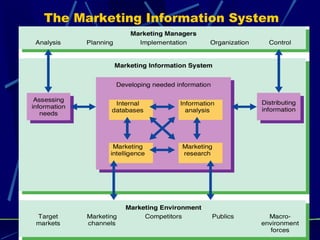
What is a Marketing  Information System?  A MIS consists of people, equipment, and procedures to gather, sort, analyze, evaluate and distribute needed, timely, and accurate information to marketing decision makers. The MIS helps managers to:  Assess Information Needs, Develop Needed Information, Distribute Information.
The Marketing Information System
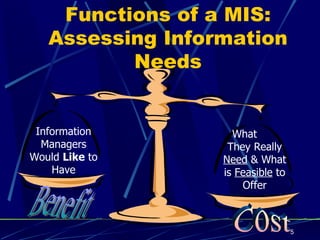
Functions of a MIS: Assessing Information Needs Benefit Cost Information Managers Would  Like  to Have What  They Really  Need  & What is  Feasible  to Offer
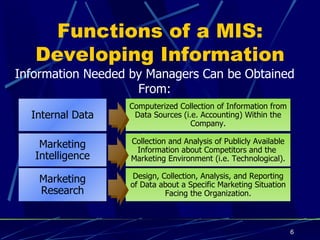
Functions of a MIS: Developing Information Information Needed by Managers Can be Obtained From: Internal Data Computerized Collection of Information from Data Sources (i.e. Accounting) Within the Company. Marketing Research Design, Collection, Analysis, and Reporting of Data about a Specific Marketing Situation Facing the Organization. Marketing Intelligence Collection and Analysis of Publicly Available Information about Competitors and the  Marketing Environment (i.e. Technological).
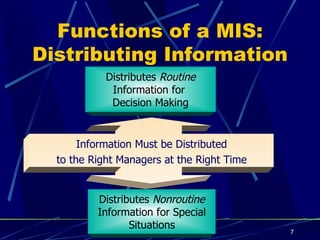
Functions of a MIS: Distributing Information Information Must be Distributed  to the Right Managers at the Right Time . Distributes  Nonroutine Information for Special Situations Distributes  Routine  Information for  Decision Making
Discussion Connections What is the overall goal of a Marketing Information System (MIS)?
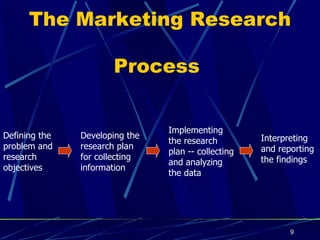
The Marketing Research  Process  Defining the  problem and research  objectives Developing the research plan for collecting information Implementing the research  plan -- collecting  and analyzing  the data Interpreting  and reporting  the findings
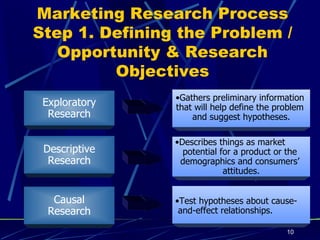
Marketing Research Process Step 1. Defining the Problem /Opportunity & Research Objectives Exploratory Research Descriptive Research Causal Research Test hypotheses about cause- and-effect relationships. Tests hypotheses about cause-  and-effect relationships. Gathers preliminary information  that will help define the problem  and suggest hypotheses. Describes things as market  potential for a product or the  demographics and consumers’  attitudes.
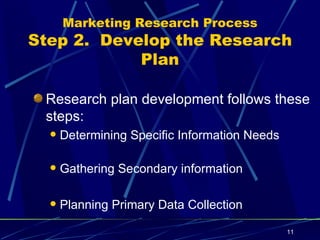
Marketing Research Process Step 2.  Develop the Research Plan Research plan development follows these steps: Determining Specific Information Needs Gathering Secondary information Planning Primary Data Collection
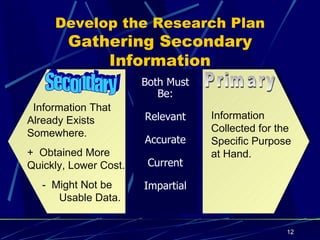
Develop the Research Plan Gathering Secondary Information Information That Already Exists Somewhere. +  Obtained More Quickly, Lower Cost. -  Might Not be  Usable Data.  Secondary Both Must Be: Relevant Accurate Current Impartial Information Collected for the Specific Purpose at Hand. Primary
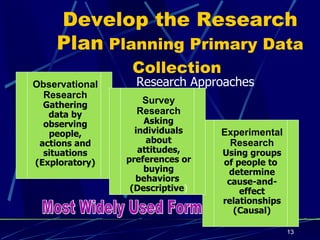
Develop the Research Plan  Planning Primary Data Collection   Research Approaches Observational Research Gathering data by observing people, actions and situations (Exploratory) Experimental Research Using groups of people to  determine cause-and-effect relationships (Causal) Survey Research Asking individuals about attitudes, preferences or  buying behaviors  (Descriptive ) Most Widely Used Form
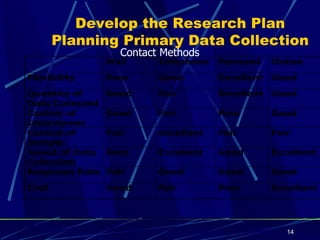
Develop the Research Plan Planning Primary Data Collection Contact Methods
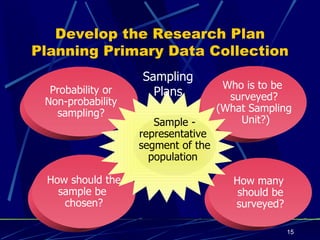
Develop the Research Plan Planning Primary Data Collection Who is to be  surveyed? (What Sampling Unit?) How many  should be surveyed? How should the sample be  chosen? Probability or Non-probability sampling? Sample - representative  segment of the population  Sampling Plans
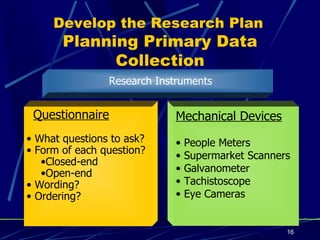
Develop the Research Plan   Planning Primary Data Collection Mechanical Devices People Meters Supermarket Scanners Galvanometer Tachistoscope Eye Cameras Questionnaire What questions to ask? Form of each question? Closed-end Open-end Wording? Ordering? Research Instruments
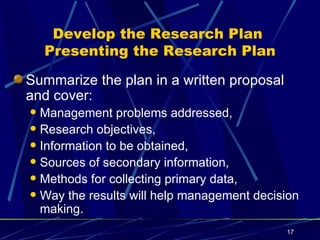
Develop the Research Plan  Presenting the Research Plan Summarize the plan in a written proposal and cover: Management problems addressed, Research objectives, Information to be obtained, Sources of secondary information, Methods for collecting primary data, Way the results will help management decision making.
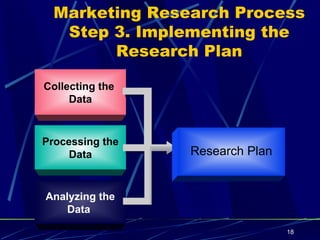
Marketing Research Process Step 3. Implementing the Research Plan Collecting the  Data Processing the Data Analyzing the Data   Research Plan
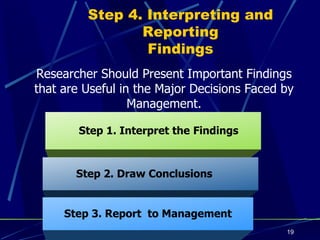
Step 4. Interpreting and Reporting Findings Researcher Should Present Important Findings that are Useful in the Major Decisions Faced by Management. Step 1. Interpret the   Findings Step 2. Draw Conclusions Step 3. Report  to Management
Review of Concept Connections Importance of information to the company. Marketing information system and discuss  its parts. Steps in the marketing research process. Advantages and disadvantages of various methods of collecting information.

Research

  • 1.
    Marketing Research andInformation Systems
  • 2.
    The Importance ofInformation Companies need information about their: Marketing environment Competition Customer needs Managers don’t need more information, they need better information.
  • 3.
    What is aMarketing Information System? A MIS consists of people, equipment, and procedures to gather, sort, analyze, evaluate and distribute needed, timely, and accurate information to marketing decision makers. The MIS helps managers to: Assess Information Needs, Develop Needed Information, Distribute Information.
  • 4.
  • 5.
    Functions of aMIS: Assessing Information Needs Benefit Cost Information Managers Would Like to Have What They Really Need & What is Feasible to Offer
  • 6.
    Functions of aMIS: Developing Information Information Needed by Managers Can be Obtained From: Internal Data Computerized Collection of Information from Data Sources (i.e. Accounting) Within the Company. Marketing Research Design, Collection, Analysis, and Reporting of Data about a Specific Marketing Situation Facing the Organization. Marketing Intelligence Collection and Analysis of Publicly Available Information about Competitors and the Marketing Environment (i.e. Technological).
  • 7.
    Functions of aMIS: Distributing Information Information Must be Distributed to the Right Managers at the Right Time . Distributes Nonroutine Information for Special Situations Distributes Routine Information for Decision Making
  • 8.
    Discussion Connections Whatis the overall goal of a Marketing Information System (MIS)?
  • 9.
    The Marketing Research Process Defining the problem and research objectives Developing the research plan for collecting information Implementing the research plan -- collecting and analyzing the data Interpreting and reporting the findings
  • 10.
    Marketing Research ProcessStep 1. Defining the Problem /Opportunity & Research Objectives Exploratory Research Descriptive Research Causal Research Test hypotheses about cause- and-effect relationships. Tests hypotheses about cause- and-effect relationships. Gathers preliminary information that will help define the problem and suggest hypotheses. Describes things as market potential for a product or the demographics and consumers’ attitudes.
  • 11.
    Marketing Research ProcessStep 2. Develop the Research Plan Research plan development follows these steps: Determining Specific Information Needs Gathering Secondary information Planning Primary Data Collection
  • 12.
    Develop the ResearchPlan Gathering Secondary Information Information That Already Exists Somewhere. + Obtained More Quickly, Lower Cost. - Might Not be Usable Data. Secondary Both Must Be: Relevant Accurate Current Impartial Information Collected for the Specific Purpose at Hand. Primary
  • 13.
    Develop the ResearchPlan Planning Primary Data Collection Research Approaches Observational Research Gathering data by observing people, actions and situations (Exploratory) Experimental Research Using groups of people to determine cause-and-effect relationships (Causal) Survey Research Asking individuals about attitudes, preferences or buying behaviors (Descriptive ) Most Widely Used Form
  • 14.
    Develop the ResearchPlan Planning Primary Data Collection Contact Methods
  • 15.
    Develop the ResearchPlan Planning Primary Data Collection Who is to be surveyed? (What Sampling Unit?) How many should be surveyed? How should the sample be chosen? Probability or Non-probability sampling? Sample - representative segment of the population Sampling Plans
  • 16.
    Develop the ResearchPlan Planning Primary Data Collection Mechanical Devices People Meters Supermarket Scanners Galvanometer Tachistoscope Eye Cameras Questionnaire What questions to ask? Form of each question? Closed-end Open-end Wording? Ordering? Research Instruments
  • 17.
    Develop the ResearchPlan Presenting the Research Plan Summarize the plan in a written proposal and cover: Management problems addressed, Research objectives, Information to be obtained, Sources of secondary information, Methods for collecting primary data, Way the results will help management decision making.
  • 18.
    Marketing Research ProcessStep 3. Implementing the Research Plan Collecting the Data Processing the Data Analyzing the Data Research Plan
  • 19.
    Step 4. Interpretingand Reporting Findings Researcher Should Present Important Findings that are Useful in the Major Decisions Faced by Management. Step 1. Interpret the Findings Step 2. Draw Conclusions Step 3. Report to Management
  • 20.
    Review of ConceptConnections Importance of information to the company. Marketing information system and discuss its parts. Steps in the marketing research process. Advantages and disadvantages of various methods of collecting information.