Product Management 
Lessons from the other side
About Me 
 ~15 years | ~12 products | Various roles 
Name Gaurav Marwaha 
What I do at 
Nucleus 
I have engineering ownership of product development for loan 
origination product. Additionally own technology teams which deliver a 
re-usable development framework. 
Passionate 
about 
I am passionate about products, technology and usability. I also enjoy 
working with product teams and have helped to groom and mentor 
multiple teams. 
Technology Java/ big-data/ analytics/ Spring/ ESB (Camel)/ Mobile/ Social 
LinkedIn http://in.linkedin.com/in/gauravmarwaha/ 
2
Introduction 
Having worked with multiple software products I had the 
opportunity to interact with many product managers and 
owners. This is an attempt to bring out some of the things 
I learnt by observation. 
Working on products across business domains and brilliant 
people from different geographies gave a unique 
opportunity to observe and learn. 
This is not an attempt to bring out theoretical concepts of 
product management. 
3
Table of contents 
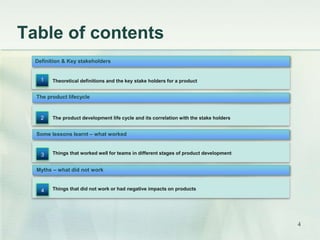
Definition & Key stakeholders 
Theoretical definitions and the key stake holders for a product 
The product lifecycle 
The product development life cycle and its correlation with the stake holders 
Some lessons learnt – what worked 
Things that worked well for teams in different stages of product development 
1 
2 
3 
Myths – what did not work 
Things that did not work or had negative impacts on products 
4 
4
Definition & Key stakeholders 
Theoretical definitions and the key stake holders for a product 
1 
5
Definition 
Product Management 
It is much more about the “product” than “management”. Hence managing 
a product without knowing what it does is a big NO. 
As defined by Wikipedia: 
is the process of managing software that is built and implemented as a 
product, taking into account life-cycle considerations and generally with 
a wide audience. It is the discipline and business process which 
governs a product from its inception to the market or customer delivery 
and service in order to generate biggest possible value to the business. 
6
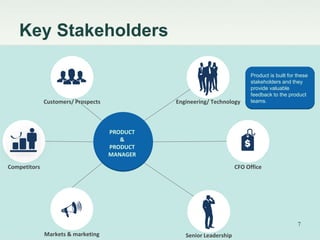
Key Stakeholders 
Customers/ Prospects Engineering/ Technology 
PRODUCT 
& 
PRODUCT 
MANAGER 
Competitors CFO Office 
Senior Leadership 
Markets & marketing 
Product is built for these 
stakeholders and they 
provide valuable 
feedback to the product 
teams. 
7
Stakeholder Feedback 
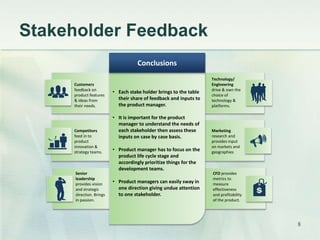
Customers 
feedback on 
product features 
& ideas from 
their needs. 
Technology/ 
Engineering 
drive & own the 
choice of 
technology & 
platforms. 
Competitors 
feed in to 
product 
innovation & 
strategy teams. 
Marketing 
research and 
provides input 
on markets and 
geographies 
Senior 
leadership 
provides vision 
and strategic 
direction. Brings 
in passion. 
CFO provides 
metrics to 
measure 
effectiveness 
and profitability 
of the product. 
Conclusions 
• Each stake holder brings to the table 
their share of feedback and inputs to 
the product manager. 
• It is important for the product 
manager to understand the needs of 
each stakeholder then assess these 
inputs on case by case basis. 
• Product manager has to focus on the 
product life cycle stage and 
accordingly prioritize things for the 
development teams. 
• Product managers can easily sway in 
one direction giving undue attention 
to one stakeholder. 
8
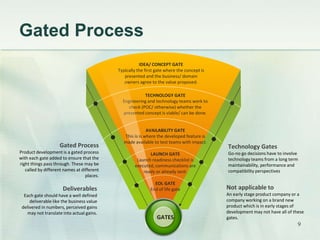
Gated Process 
IDEA/ CONCEPT GATE 
Typically the first gate where the concept is 
presented and the business/ domain 
owners agree to the value proposed. 
TECHNOLOGY GATE 
Engineering and technology teams work to 
check (POC/ otherwise) whether the 
presented concept is viable/ can be done. 
AVAILABILITY GATE 
This is is where the developed feature is 
made available to test teams with impact. 
LAUNCH GATE 
Launch readiness checklist is 
executed, communications are 
ready or already sent. 
GATES 
Technology Gates 
Go-no go decisions have to involve 
technology teams from a long term 
maintainability, performance and 
compatibility perspectives 
Not applicable to 
An early stage product company or a 
company working on a brand new 
product which is in early stages of 
development may not have all of these 
gates. 
Gated Process 
Product development is a gated process 
with each gate added to ensure that the 
right things pass through. These may be 
called by different names at different 
places. 
Deliverables 
Each gate should have a well defined 
deliverable like the business value 
delivered in numbers, perceived gains 
may not translate into actual gains. 
EOL GATE 
End of life gate 
9
The product lifecycle 
The product development life cycle and its correlation with the stake holders 
2 
10
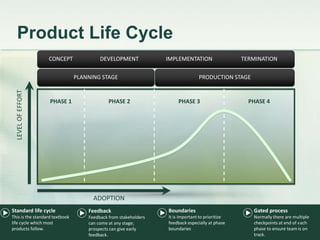
Product Life Cycle 
CONCEPT DEVELOPMENT IMPLEMENTATION TERMINATION 
LEVEL OF EFFORT 
PLANNING STAGE PRODUCTION STAGE 
PHASE 1 PHASE 2 PHASE 3 PHASE 4 
Standard life cycle 
This is the standard textbook 
life cycle which most 
products follow. 
Boundaries 
It is important to prioritize 
feedback especially at phase 
boundaries 
Gated process 
Normally there are multiple 
checkpoints at end of each 
phase to ensure team is on 
track. 
ADOPTION 
Feedback 
Feedback from stakeholders 
can come at any stage; 
prospects can give early 
feedback. 
11
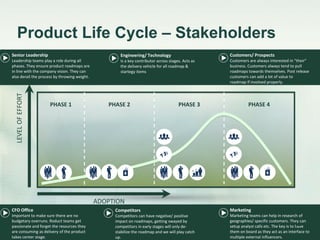
Product Life Cycle – Stakeholders 
LEVEL OF EFFORT 
PHASE 1 PHASE 2 PHASE 3 PHASE 4 
CFO Office 
Important to make sure there are no 
budgetary overruns. Roduct teams get 
passionate and forget the resources they 
are consuming as delivery of the product 
takes center stage. 
ADOPTION 
Competitors 
Competitors can have negative/ positive 
impact on roadmaps, getting swayed by 
competitors in early stages will only de-stabilize 
the roadmap and we will play catch 
up. 
Senior Leadership 
Leadership teams play a role during all 
phases. They ensure product roadmaps are 
in line with the company vision. They can 
also derail the process by throwing weight. 
Customers/ Prospects 
Customers are always interested in “their” 
business. Customers always tend to pull 
roadmaps towards themselves. Post release 
customers can add a lot of value to 
roadmap if involved properly. 
Marketing 
Marketing teams can help in research of 
geographies/ specific customers. They can 
setup analyst calls etc. The key is to have 
them on board as they act as an interface to 
multiple external influencers. 
Engineering/ Technology 
Is a key contributor across stages. Acts as 
the delivery vehicle for all roadmap & 
startegy items 
12
Remember 
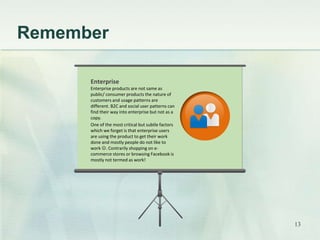
Enterprise 
Enterprise products are not same as 
public/ consumer products the nature of 
customers and usage patterns are 
different. B2C and social user patterns can 
find their way into enterprise but not as a 
copy. 
One of the most critical but subtle factors 
which we forget is that enterprise users 
are using the product to get their work 
done and mostly people do not like to 
work . Contrarily shopping on e-commerce 
stores or browsing Facebook is 
mostly not termed as work! 
13
Some lessons learnt – what worked 
Things that worked well for teams in different stages of product development 
3 
Myths – what did not work 
Things that did not work or had negative impacts on products 
4 
14
Know the product 
A new senior member once suggested 
that a product built over JNLP used by 
doctors to study radiology images should 
be rather built as a web/ browser 
application. 
The person never bothered to see the size 
of data being transferred, the kind of 
rendering precision and the operations 
the doctor performs on the rendered 
image. 
I understand thee not. 
The first and foremost that 
each product manager 
must ensure is that he/ she 
understands what the 
product does. Each product 
is different and comparison 
of features can be done 
only after having a good 
command over the 
features. 
15
Know the customers 
While working on a geo-risk 
measurement product it was assumed 
that customers from the BFSI industry will 
be willing to key in the details of assets 
like flats/ houses and see a geo-risk score. 
This would become cumbersome and 
operational costs will increase as a single 
application may have multiple such 
assets. Integrating the geo-risk score with 
other scores as part of workflow was so 
much more easier for the customer. 
Customers 
Who are the customers, in 
enterprise world they are 
the ones who pay license, 
support and change money. 
Product managers should 
know them like the back of 
their hands. 
16
Know the market 
The USA mandates the preserving of 
medical records for number of years 
which has allowed many software 
companies to provide solutions on 
archiving, storage and retrieval of these 
records. 
In India on the contrary no such law exists 
and selling a data archival solution to a 
hospital which is trying to break even 
after large CAPEX; did not work. As this 
cost cannot be transferred to the end 
customer by the hospital. 
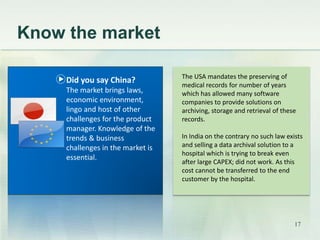
Did you say China? 
The market brings laws, 
economic environment, 
lingo and host of other 
challenges for the product 
manager. Knowledge of the 
trends & business 
challenges in the market is 
essential. 
17
Bigger picture 
While working to re-vitalize a desktop 
based web mapping product we 
mistakenly assumed Google maps to be a 
competitor, whereas we were not even in 
the space of consumer mapping. With 
focus on the web needs of the customers 
of this product we could launch a web 
front in much less time than earlier 
planned. 
Being able to build the right feature at the 
right time and translate that into returns 
is a niche skill. 
Assemble the jigsaw 
Being at the center of all 
communications that 
happen with key 
stakeholders of the product 
one of the most important 
ability is the ability to piece 
things together, prioritize 
them so that expectations 
are met. 
18
Priorities 
Working on a product team we soon 
realized that each new sales demo 
brought in some superficial features 
which were put in to win deals as part of 
an exercise to showcase the product to 
prospects. If even 50% of such deals 
materialize then imagine the impact on 
the roadmap. 
Customers at a large bank wanted 
everything to be built as part of product 
so that their customization costs are low 
and they get features directly from 
product teams rather than PS. 
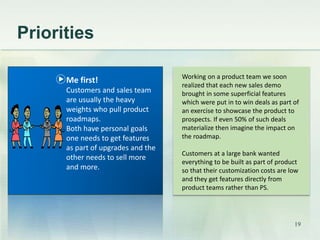
Me first! 
Customers and sales team 
are usually the heavy 
weights who pull product 
roadmaps. 
Both have personal goals 
one needs to get features 
as part of upgrades and the 
other needs to sell more 
and more. 
19
Technology 
While talking about workflows a senior 
product person was perplexed when the 
customer’s IT team went into activities, 
sub-flows and the new process definition 
standards. 
In another instance I saw a product 
manager commit on ready to use services 
without getting to know the security, 
audit ability and concurrency aspects of 
these services and overall impact on OLTP 
transactions over the web. 
Drives business? 
The separation between 
technical and functional 
features is getting very thin; 
I have seen product 
managers averse to 
learning technology 
whereas it is a handy tool 
on their belt. 
20
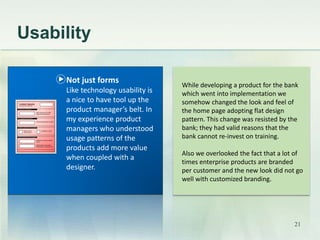
Usability 
While developing a product for the bank 
which went into implementation we 
somehow changed the look and feel of 
the home page adopting flat design 
pattern. This change was resisted by the 
bank; they had valid reasons that the 
bank cannot re-invest on training. 
Also we overlooked the fact that a lot of 
times enterprise products are branded 
per customer and the new look did not go 
well with customized branding. 
Not just forms 
Like technology usability is 
a nice to have tool up the 
product manager’s belt. In 
my experience product 
managers who understood 
usage patterns of the 
products add more value 
when coupled with a 
designer. 
21
Defects 
While working on a banking product 
which was tested by a sizeable quality 
team which included automated and 
manual execution of test cases we 
realized that the customer found issues 
were more than 50 in first round of UAT. 
Deeper scrutiny of the issue revealed that 
the internal team test cases were 
different from what customer was testing. 
Hate them? 
Defects are perception of a 
user on how system should 
behave versus how it is 
really behaving. A defect 
free system has to be 
looked at in context of the 
customer always. 
22
Performance 
While working on a banking product 
senior product managers compared 
performance and page load times with 
social media applications. This is done 
without understanding the infrastructure 
which goes behind each data center that 
likes of Facebook run. 
At a bank when users complained of 
slowness we analyzed and asked the bank 
to add cores/ CPU; the system slowness 
became acceptable. In the enterprise if 
there is one thing which people hate is 
adding to the cost. 
Vroom 
Product managers need to 
understand performance 
involves CAPEX, hence like 
defects acceptable 
performance may vary from 
customer to customer. 
Performance is also a 
feature and should be 
tracked like one. 
23
Hype versus reality 
Analytic, big data and cloud are terms 
that probably even your milkman would 
have heard. 
I have seen very senior product managers 
talk about analytic without actually 
studying the quality of data. Statistic is as 
good as the data if New York is entered as 
a city in Abu Dhabi then on a map it will 
show there. 
Like wise adapting cloud without 
addressing data residency & security 
concerns is like a cupcake without icing. 
Cloudy? 
Product managers should 
not get swayed by hype 
cycles, especially when 
managing stable/ built 
products. Jumping the gun 
without due research can 
be expensive for product 
teams. 
24
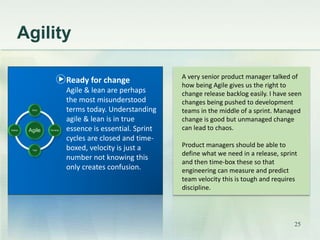
Agility 
A very senior product manager talked of 
how being Agile gives us the right to 
change release backlog easily. I have seen 
changes being pushed to development 
teams in the middle of a sprint. Managed 
change is good but unmanaged change 
can lead to chaos. 
Product managers should be able to 
define what we need in a release, sprint 
and then time-box these so that 
engineering can measure and predict 
team velocity this is tough and requires 
discipline. 
Ready for change 
Agile & lean are perhaps 
the most misunderstood 
terms today. Understanding 
agile & lean is in true 
essence is essential. Sprint 
cycles are closed and time-boxed, 
velocity is just a 
number not knowing this 
only creates confusion. 
Story 
Agile 
Develop 
Test 
Deploy 
25
Last but not the least 
REMEMBER 
Products are like babies who need customers to 
learn and grow mature and they need 
engineering and product management teams to 
nurture and guide them. To feed them with new 
features; just like babies are fed baby food 
initially. Products are fed on core features which 
may be simple but are essential the need to 
prioritize on features which are added to the 
product roadmaps is critical and very important. 
26
THANK YOU

Product management

  • 1.
    Product Management Lessonsfrom the other side
  • 2.
    About Me ~15 years | ~12 products | Various roles Name Gaurav Marwaha What I do at Nucleus I have engineering ownership of product development for loan origination product. Additionally own technology teams which deliver a re-usable development framework. Passionate about I am passionate about products, technology and usability. I also enjoy working with product teams and have helped to groom and mentor multiple teams. Technology Java/ big-data/ analytics/ Spring/ ESB (Camel)/ Mobile/ Social LinkedIn http://in.linkedin.com/in/gauravmarwaha/ 2
  • 3.
    Introduction Having workedwith multiple software products I had the opportunity to interact with many product managers and owners. This is an attempt to bring out some of the things I learnt by observation. Working on products across business domains and brilliant people from different geographies gave a unique opportunity to observe and learn. This is not an attempt to bring out theoretical concepts of product management. 3
  • 4.
    Table of contents Definition & Key stakeholders Theoretical definitions and the key stake holders for a product The product lifecycle The product development life cycle and its correlation with the stake holders Some lessons learnt – what worked Things that worked well for teams in different stages of product development 1 2 3 Myths – what did not work Things that did not work or had negative impacts on products 4 4
  • 5.
    Definition & Keystakeholders Theoretical definitions and the key stake holders for a product 1 5
  • 6.
    Definition Product Management It is much more about the “product” than “management”. Hence managing a product without knowing what it does is a big NO. As defined by Wikipedia: is the process of managing software that is built and implemented as a product, taking into account life-cycle considerations and generally with a wide audience. It is the discipline and business process which governs a product from its inception to the market or customer delivery and service in order to generate biggest possible value to the business. 6
  • 7.
    Key Stakeholders Customers/Prospects Engineering/ Technology PRODUCT & PRODUCT MANAGER Competitors CFO Office Senior Leadership Markets & marketing Product is built for these stakeholders and they provide valuable feedback to the product teams. 7
  • 8.
    Stakeholder Feedback Customers feedback on product features & ideas from their needs. Technology/ Engineering drive & own the choice of technology & platforms. Competitors feed in to product innovation & strategy teams. Marketing research and provides input on markets and geographies Senior leadership provides vision and strategic direction. Brings in passion. CFO provides metrics to measure effectiveness and profitability of the product. Conclusions • Each stake holder brings to the table their share of feedback and inputs to the product manager. • It is important for the product manager to understand the needs of each stakeholder then assess these inputs on case by case basis. • Product manager has to focus on the product life cycle stage and accordingly prioritize things for the development teams. • Product managers can easily sway in one direction giving undue attention to one stakeholder. 8
  • 9.
    Gated Process IDEA/CONCEPT GATE Typically the first gate where the concept is presented and the business/ domain owners agree to the value proposed. TECHNOLOGY GATE Engineering and technology teams work to check (POC/ otherwise) whether the presented concept is viable/ can be done. AVAILABILITY GATE This is is where the developed feature is made available to test teams with impact. LAUNCH GATE Launch readiness checklist is executed, communications are ready or already sent. GATES Technology Gates Go-no go decisions have to involve technology teams from a long term maintainability, performance and compatibility perspectives Not applicable to An early stage product company or a company working on a brand new product which is in early stages of development may not have all of these gates. Gated Process Product development is a gated process with each gate added to ensure that the right things pass through. These may be called by different names at different places. Deliverables Each gate should have a well defined deliverable like the business value delivered in numbers, perceived gains may not translate into actual gains. EOL GATE End of life gate 9
  • 10.
    The product lifecycle The product development life cycle and its correlation with the stake holders 2 10
  • 11.
    Product Life Cycle CONCEPT DEVELOPMENT IMPLEMENTATION TERMINATION LEVEL OF EFFORT PLANNING STAGE PRODUCTION STAGE PHASE 1 PHASE 2 PHASE 3 PHASE 4 Standard life cycle This is the standard textbook life cycle which most products follow. Boundaries It is important to prioritize feedback especially at phase boundaries Gated process Normally there are multiple checkpoints at end of each phase to ensure team is on track. ADOPTION Feedback Feedback from stakeholders can come at any stage; prospects can give early feedback. 11
  • 12.
    Product Life Cycle– Stakeholders LEVEL OF EFFORT PHASE 1 PHASE 2 PHASE 3 PHASE 4 CFO Office Important to make sure there are no budgetary overruns. Roduct teams get passionate and forget the resources they are consuming as delivery of the product takes center stage. ADOPTION Competitors Competitors can have negative/ positive impact on roadmaps, getting swayed by competitors in early stages will only de-stabilize the roadmap and we will play catch up. Senior Leadership Leadership teams play a role during all phases. They ensure product roadmaps are in line with the company vision. They can also derail the process by throwing weight. Customers/ Prospects Customers are always interested in “their” business. Customers always tend to pull roadmaps towards themselves. Post release customers can add a lot of value to roadmap if involved properly. Marketing Marketing teams can help in research of geographies/ specific customers. They can setup analyst calls etc. The key is to have them on board as they act as an interface to multiple external influencers. Engineering/ Technology Is a key contributor across stages. Acts as the delivery vehicle for all roadmap & startegy items 12
  • 13.
    Remember Enterprise Enterpriseproducts are not same as public/ consumer products the nature of customers and usage patterns are different. B2C and social user patterns can find their way into enterprise but not as a copy. One of the most critical but subtle factors which we forget is that enterprise users are using the product to get their work done and mostly people do not like to work . Contrarily shopping on e-commerce stores or browsing Facebook is mostly not termed as work! 13
  • 14.
    Some lessons learnt– what worked Things that worked well for teams in different stages of product development 3 Myths – what did not work Things that did not work or had negative impacts on products 4 14
  • 15.
    Know the product A new senior member once suggested that a product built over JNLP used by doctors to study radiology images should be rather built as a web/ browser application. The person never bothered to see the size of data being transferred, the kind of rendering precision and the operations the doctor performs on the rendered image. I understand thee not. The first and foremost that each product manager must ensure is that he/ she understands what the product does. Each product is different and comparison of features can be done only after having a good command over the features. 15
  • 16.
    Know the customers While working on a geo-risk measurement product it was assumed that customers from the BFSI industry will be willing to key in the details of assets like flats/ houses and see a geo-risk score. This would become cumbersome and operational costs will increase as a single application may have multiple such assets. Integrating the geo-risk score with other scores as part of workflow was so much more easier for the customer. Customers Who are the customers, in enterprise world they are the ones who pay license, support and change money. Product managers should know them like the back of their hands. 16
  • 17.
    Know the market The USA mandates the preserving of medical records for number of years which has allowed many software companies to provide solutions on archiving, storage and retrieval of these records. In India on the contrary no such law exists and selling a data archival solution to a hospital which is trying to break even after large CAPEX; did not work. As this cost cannot be transferred to the end customer by the hospital. Did you say China? The market brings laws, economic environment, lingo and host of other challenges for the product manager. Knowledge of the trends & business challenges in the market is essential. 17
  • 18.
    Bigger picture Whileworking to re-vitalize a desktop based web mapping product we mistakenly assumed Google maps to be a competitor, whereas we were not even in the space of consumer mapping. With focus on the web needs of the customers of this product we could launch a web front in much less time than earlier planned. Being able to build the right feature at the right time and translate that into returns is a niche skill. Assemble the jigsaw Being at the center of all communications that happen with key stakeholders of the product one of the most important ability is the ability to piece things together, prioritize them so that expectations are met. 18
  • 19.
    Priorities Working ona product team we soon realized that each new sales demo brought in some superficial features which were put in to win deals as part of an exercise to showcase the product to prospects. If even 50% of such deals materialize then imagine the impact on the roadmap. Customers at a large bank wanted everything to be built as part of product so that their customization costs are low and they get features directly from product teams rather than PS. Me first! Customers and sales team are usually the heavy weights who pull product roadmaps. Both have personal goals one needs to get features as part of upgrades and the other needs to sell more and more. 19
  • 20.
    Technology While talkingabout workflows a senior product person was perplexed when the customer’s IT team went into activities, sub-flows and the new process definition standards. In another instance I saw a product manager commit on ready to use services without getting to know the security, audit ability and concurrency aspects of these services and overall impact on OLTP transactions over the web. Drives business? The separation between technical and functional features is getting very thin; I have seen product managers averse to learning technology whereas it is a handy tool on their belt. 20
  • 21.
    Usability While developinga product for the bank which went into implementation we somehow changed the look and feel of the home page adopting flat design pattern. This change was resisted by the bank; they had valid reasons that the bank cannot re-invest on training. Also we overlooked the fact that a lot of times enterprise products are branded per customer and the new look did not go well with customized branding. Not just forms Like technology usability is a nice to have tool up the product manager’s belt. In my experience product managers who understood usage patterns of the products add more value when coupled with a designer. 21
  • 22.
    Defects While workingon a banking product which was tested by a sizeable quality team which included automated and manual execution of test cases we realized that the customer found issues were more than 50 in first round of UAT. Deeper scrutiny of the issue revealed that the internal team test cases were different from what customer was testing. Hate them? Defects are perception of a user on how system should behave versus how it is really behaving. A defect free system has to be looked at in context of the customer always. 22
  • 23.
    Performance While workingon a banking product senior product managers compared performance and page load times with social media applications. This is done without understanding the infrastructure which goes behind each data center that likes of Facebook run. At a bank when users complained of slowness we analyzed and asked the bank to add cores/ CPU; the system slowness became acceptable. In the enterprise if there is one thing which people hate is adding to the cost. Vroom Product managers need to understand performance involves CAPEX, hence like defects acceptable performance may vary from customer to customer. Performance is also a feature and should be tracked like one. 23
  • 24.
    Hype versus reality Analytic, big data and cloud are terms that probably even your milkman would have heard. I have seen very senior product managers talk about analytic without actually studying the quality of data. Statistic is as good as the data if New York is entered as a city in Abu Dhabi then on a map it will show there. Like wise adapting cloud without addressing data residency & security concerns is like a cupcake without icing. Cloudy? Product managers should not get swayed by hype cycles, especially when managing stable/ built products. Jumping the gun without due research can be expensive for product teams. 24
  • 25.
    Agility A verysenior product manager talked of how being Agile gives us the right to change release backlog easily. I have seen changes being pushed to development teams in the middle of a sprint. Managed change is good but unmanaged change can lead to chaos. Product managers should be able to define what we need in a release, sprint and then time-box these so that engineering can measure and predict team velocity this is tough and requires discipline. Ready for change Agile & lean are perhaps the most misunderstood terms today. Understanding agile & lean is in true essence is essential. Sprint cycles are closed and time-boxed, velocity is just a number not knowing this only creates confusion. Story Agile Develop Test Deploy 25
  • 26.
    Last but notthe least REMEMBER Products are like babies who need customers to learn and grow mature and they need engineering and product management teams to nurture and guide them. To feed them with new features; just like babies are fed baby food initially. Products are fed on core features which may be simple but are essential the need to prioritize on features which are added to the product roadmaps is critical and very important. 26
  • 27.