1.7 Continuous Random Variables
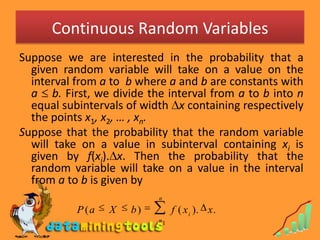
Continuous Random VariablesSuppose we are interested in the probability that a given random variable will take on a value on the interval from a to  b where a and b are constants with a  b. First, we divide the interval from a to b into n equal subintervals of width x containing respectively the points x1, x2, … , xn. Suppose that the probability that the random variable will take on a value in subinterval containing xi is given by f(xi)x. Then the probability that the random variable will take on a value in the interval from a to b is given by
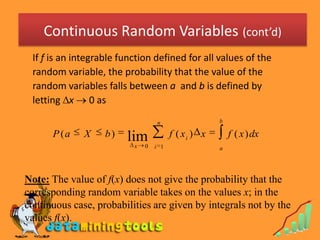
Continuous Random Variables(cont’d)If f is an integrable function defined for all values of therandom variable, the probability that the value of the       random variables falls between a  and b is defined by letting x  0 as Note: The value of f(x) does not give the probability that the corresponding random variable takes on the values x; in the continuous case, probabilities are given by integrals not by the values f(x).
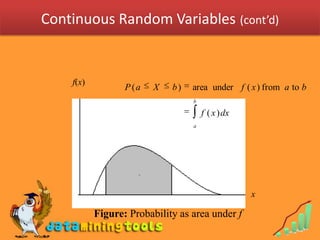
Continuous Random Variables(cont’d)f(x)P(a  X  b)abxFigure: Probability as area under f
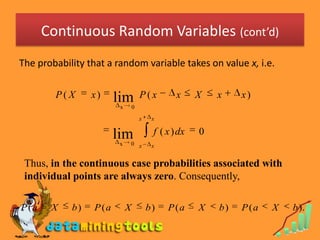
Continuous Random Variables(cont’d)The probability that a random variable takes on value x, i.e.Thus, in the continuous case probabilities associated with individual points are always zero. Consequently,
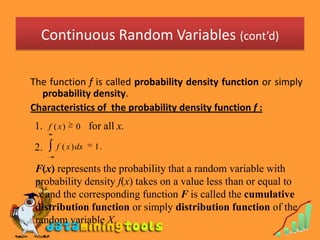
Continuous Random Variables(cont’d)The function f is called probability density function or simply probability density. Characteristics of  the probability density function f :1.for all x.2.F(x) represents the probability that a random variable with probability density f(x) takes on a value less than or equal tox and the corresponding function F is called the cumulativedistribution function or simply distribution function of the random variable X.
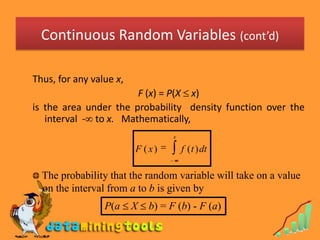
Continuous Random Variables(cont’d)Thus, for any value x, F (x) = P(X  x)is the area under the probability  density function over the interval  - to x.   Mathematically, The probability that the random variable will take on a value     on the interval from a to b is given byP(a  X  b) = F (b) - F (a)
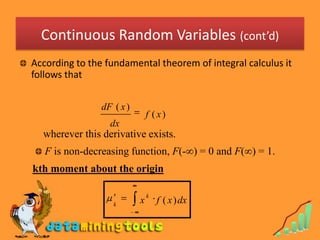
Continuous Random Variables(cont’d)According to the fundamental theorem of integral calculus it follows that wherever this derivative exists. F is non-decreasing function, F(-) = 0 and F() = 1.kth moment about the origin
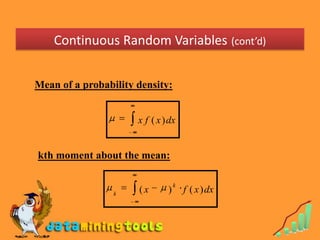
Continuous Random Variables(cont’d)Mean of a probability density:kth moment about the mean:
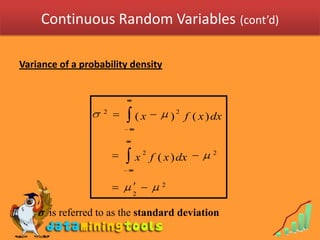
Continuous Random Variables(cont’d)Variance of a probability density  is referred to as the standard deviation

Continuous Random Variables

  • 1.
  • 2.
    Continuous Random VariablesSupposewe are interested in the probability that a given random variable will take on a value on the interval from a to b where a and b are constants with a  b. First, we divide the interval from a to b into n equal subintervals of width x containing respectively the points x1, x2, … , xn. Suppose that the probability that the random variable will take on a value in subinterval containing xi is given by f(xi)x. Then the probability that the random variable will take on a value in the interval from a to b is given by
  • 3.
    Continuous Random Variables(cont’d)Iff is an integrable function defined for all values of therandom variable, the probability that the value of the random variables falls between a and b is defined by letting x  0 as Note: The value of f(x) does not give the probability that the corresponding random variable takes on the values x; in the continuous case, probabilities are given by integrals not by the values f(x).
  • 4.
    Continuous Random Variables(cont’d)f(x)P(a X  b)abxFigure: Probability as area under f
  • 5.
    Continuous Random Variables(cont’d)Theprobability that a random variable takes on value x, i.e.Thus, in the continuous case probabilities associated with individual points are always zero. Consequently,
  • 6.
    Continuous Random Variables(cont’d)Thefunction f is called probability density function or simply probability density. Characteristics of the probability density function f :1.for all x.2.F(x) represents the probability that a random variable with probability density f(x) takes on a value less than or equal tox and the corresponding function F is called the cumulativedistribution function or simply distribution function of the random variable X.
  • 7.
    Continuous Random Variables(cont’d)Thus,for any value x, F (x) = P(X  x)is the area under the probability density function over the interval - to x. Mathematically, The probability that the random variable will take on a value on the interval from a to b is given byP(a  X  b) = F (b) - F (a)
  • 8.
    Continuous Random Variables(cont’d)Accordingto the fundamental theorem of integral calculus it follows that wherever this derivative exists. F is non-decreasing function, F(-) = 0 and F() = 1.kth moment about the origin
  • 9.
    Continuous Random Variables(cont’d)Meanof a probability density:kth moment about the mean:
  • 10.
    Continuous Random Variables(cont’d)Varianceof a probability density is referred to as the standard deviation