The Harvard framework
Human Resource Management
Prepared By
Kindly restrict the use of slides for personal purpose.
Please seek permission to reproduce the same in public forms and presentations.
Manu Melwin Joy
Assistant Professor
Ilahia School of Management Studies
Kerala, India.
Phone – 9744551114
Mail – manu_melwinjoy@yahoo.com
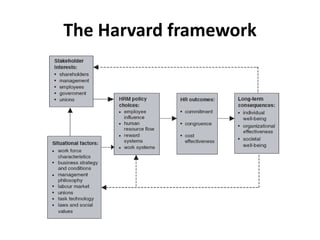
The Harvard framework
• The other founding fathers
of HRM were the Harvard
school of Beer et al (1984)
who developed what Boxall
(1992) calls the ‘Harvard
framework’.
The Harvard framework
• Beer and his colleagues
believed that ‘today, many
pressures are demanding a
broader, more comprehensive
and more strategic perspective
with regard to the
organization’s human
resources’. These pressures
have created a need for: ‘A
longer-term perspective in
managing people and
consideration of people as
potential assets rather than
merely a variable cost’. They
The Harvard framework
• The Harvard school suggested
that HRM had two characteristic
features:
– line managers accept more
responsibility for ensuring the
alignment of competitive
strategy and personnel
policies
– personnel has the mission of
setting policies that govern
how personnel activities are
developed and implemented
in ways that make them more
mutually reinforcing.
The Harvard framework
The harvard framework -  human resource management - Manu Melwin Joy

The harvard framework - human resource management - Manu Melwin Joy

  • 1.
    The Harvard framework HumanResource Management
  • 2.
    Prepared By Kindly restrictthe use of slides for personal purpose. Please seek permission to reproduce the same in public forms and presentations. Manu Melwin Joy Assistant Professor Ilahia School of Management Studies Kerala, India. Phone – 9744551114 Mail – manu_melwinjoy@yahoo.com
  • 3.
    The Harvard framework •The other founding fathers of HRM were the Harvard school of Beer et al (1984) who developed what Boxall (1992) calls the ‘Harvard framework’.
  • 4.
    The Harvard framework •Beer and his colleagues believed that ‘today, many pressures are demanding a broader, more comprehensive and more strategic perspective with regard to the organization’s human resources’. These pressures have created a need for: ‘A longer-term perspective in managing people and consideration of people as potential assets rather than merely a variable cost’. They
  • 5.
    The Harvard framework •The Harvard school suggested that HRM had two characteristic features: – line managers accept more responsibility for ensuring the alignment of competitive strategy and personnel policies – personnel has the mission of setting policies that govern how personnel activities are developed and implemented in ways that make them more mutually reinforcing.
  • 6.