GENDER ANALYSIS FRAMEWORK B R SIWAL NIPCCD  NEW DELHI E-mail br_siwal@yahoo.com
What Is Gender Analysis? An intrinsic dimension of policy analysis Identifies specifically how public policy affects women and men differently Demonstrates that policy and implementation cannot be gender neutral in gendered societies Is supported by specific analytic tools
What Competencies Are Required To Undertake Gender Analysis? Familiarity with main Gender Analysis Frameworks Ability to select the Framework most likely to yield solutions to the development problem to be addressed Able to interpret data Able to use strategic decision-making skills
GENDER ANALYSIS (GA) IS A PROCESS TO ASSESS THE  – Differential impact of proposed or existing policies, programmes, projects and legislation on women and men.  Gender analysis recognizes that realities of men’s and women’s lives are different and that equal opportunities does not necessarily men equal results. Gender analysis is a basis of all tools of gender mainstreaming.
GENDER ANALYSIS FRAMEWORK GA is practical tool for analysing the nature of gender differentiation.  It builds by asking questions who does what?  Where?  When?  And with what resources?
GA  basic questions : 1. Who does what? What is the actual division of labour between men and women in the project area? 2. Who has what? Who has access to and control over resources in the project area? 3. What influences to access and control of resources? What social, cultural, economic, political influence gender differentiable rights of access and control? 4. How are resources distributed and who gets what?
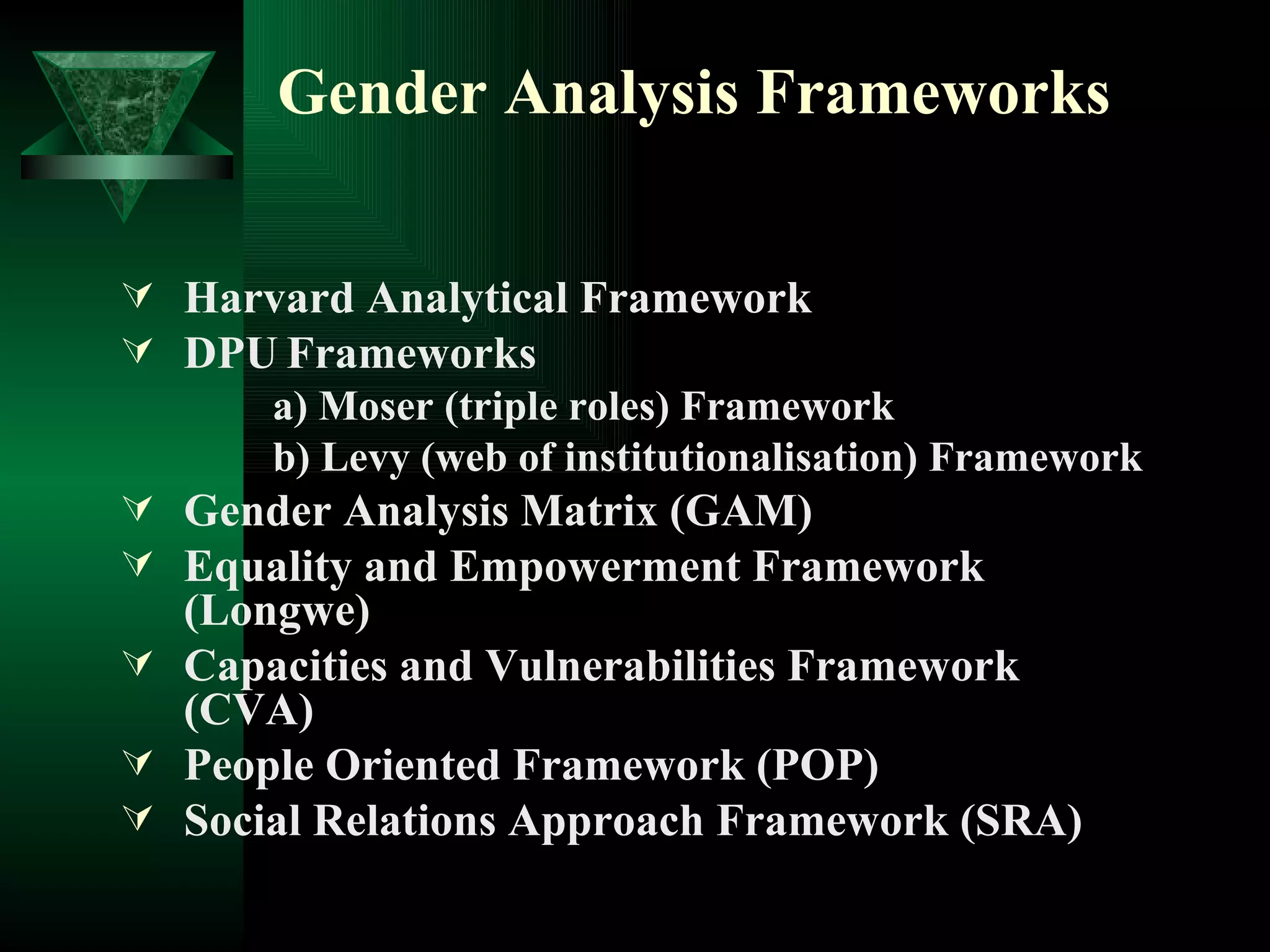
Gender Analysis Frameworks Harvard Analytical Framework  DPU   Frameworks a) Moser (triple roles) Framework b) Levy (web of institutionalisation) Framework Gender Analysis Matrix (GAM) Equality and Empowerment Framework (Longwe) Capacities and Vulnerabilities Framework (CVA) People Oriented Framework (POP) Social Relations Approach Framework (SRA)
HARVARD FRAMEWORK OF GENDER ANALYSIS 1. Activity profile - based on gender division of labour and delineates the economic activities of pop by sex, age and other factors and time spent on economic activities. 2. Access and control profile- which identify individuals by sex have access and control over resources, services and benefits.
3. Factors influencing access and control - factors affecting access and control e.G. Social, cultural, economic in relation to gender. 4. Project cycle analysis - examine a project proposal or area of intervention in the light of gender - disaggregated data, information and social change.
HARVARD METHOD OF PROJECT CYCLE   (CHECKLIST) I. PROJECT PLANNING Assessing women’s needs What needs and opportunities exist for increasing women’s participation and/or  Women’s access and control of resources, services and benefits?
How these needs and opportunities decrease the burden of work? Whether the women have been consulted in identification of needs and opportunities? Defining project objectives Whether objectives related to women’s needs?
Whether objectives adequately reflect women’s needs? II PROJECT IMPLEMENTATION Are project personnel sufficiently aware and sensitive towards women’s needs? Are women involved in delivery of goods and services?
Do personnel have specific skills? What training techniques will be used? Are there appropriate opportunities for women to participate in project management?
ORGANISATIONAL STRUCTURE DOES THE ORGANISATION Enhance women’s access and control of resources? Have adequate resources? Have capabilities to support and protect women during the process of change? Have delivery channel accessible?
Whether time and location suitable for women? Have management information system (MIS)? Have flexibility to meet changing requirements? Have women participated in setting objectives?
Is there any missed opportunity for women? Have there been earlier efforts and lesson learnt? Project impact on women How project affect women’s status responsibilities and role in society? Is planned change feasable and sustainable?
How will each project component affect women’s access and control of resources and benefits? How project design can be adjusted to increase positive effects and decrease negative effects?
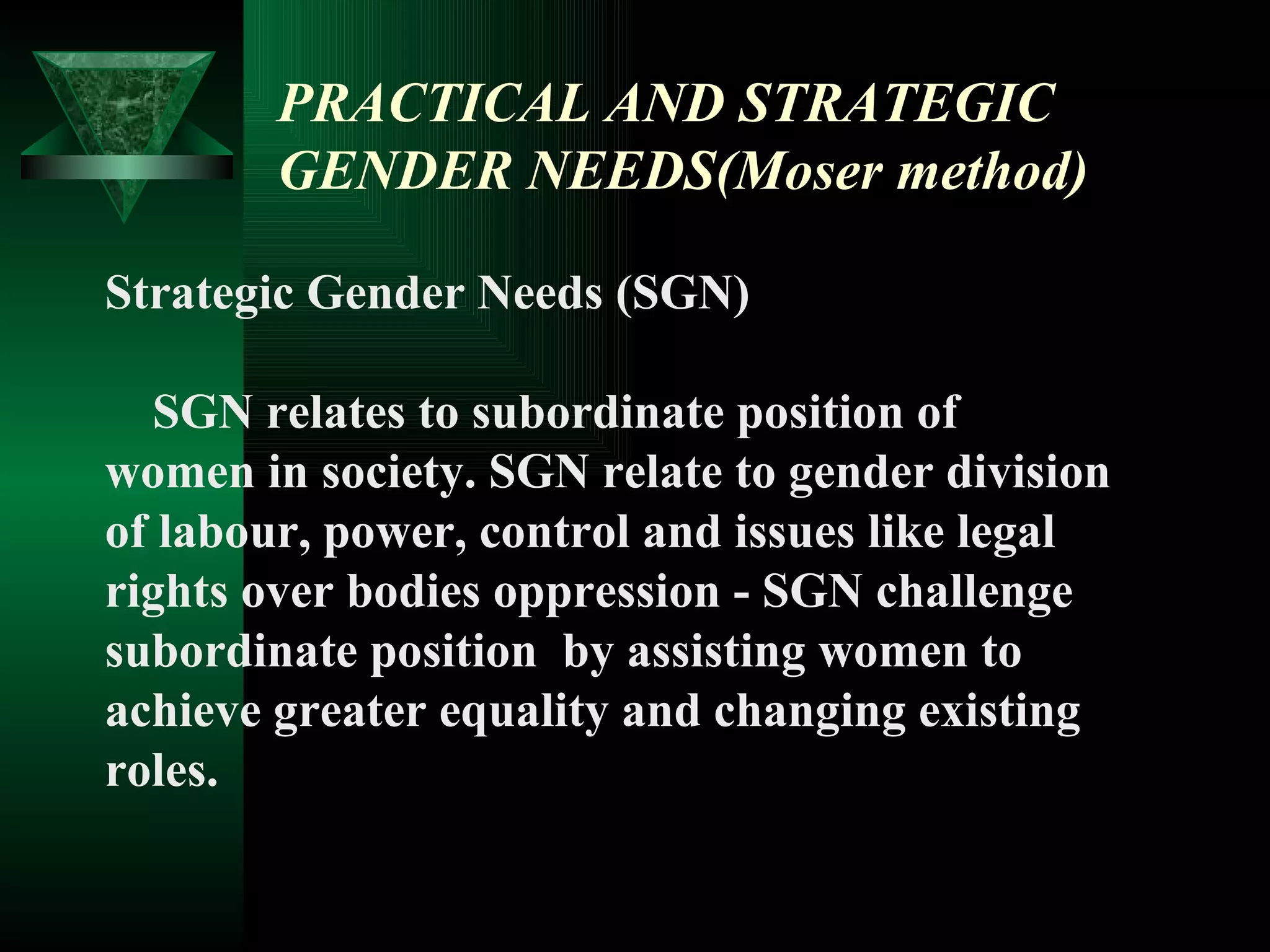
PRACTICAL AND STRATEGIC GENDER NEEDS(Moser method) Strategic Gender Needs (SGN) SGN relates to subordinate position of  women in society. SGN relate to gender division  of labour, power, control and issues like legal  rights over bodies oppression - SGN challenge  subordinate position  by assisting women to  achieve greater equality and changing existing  roles.
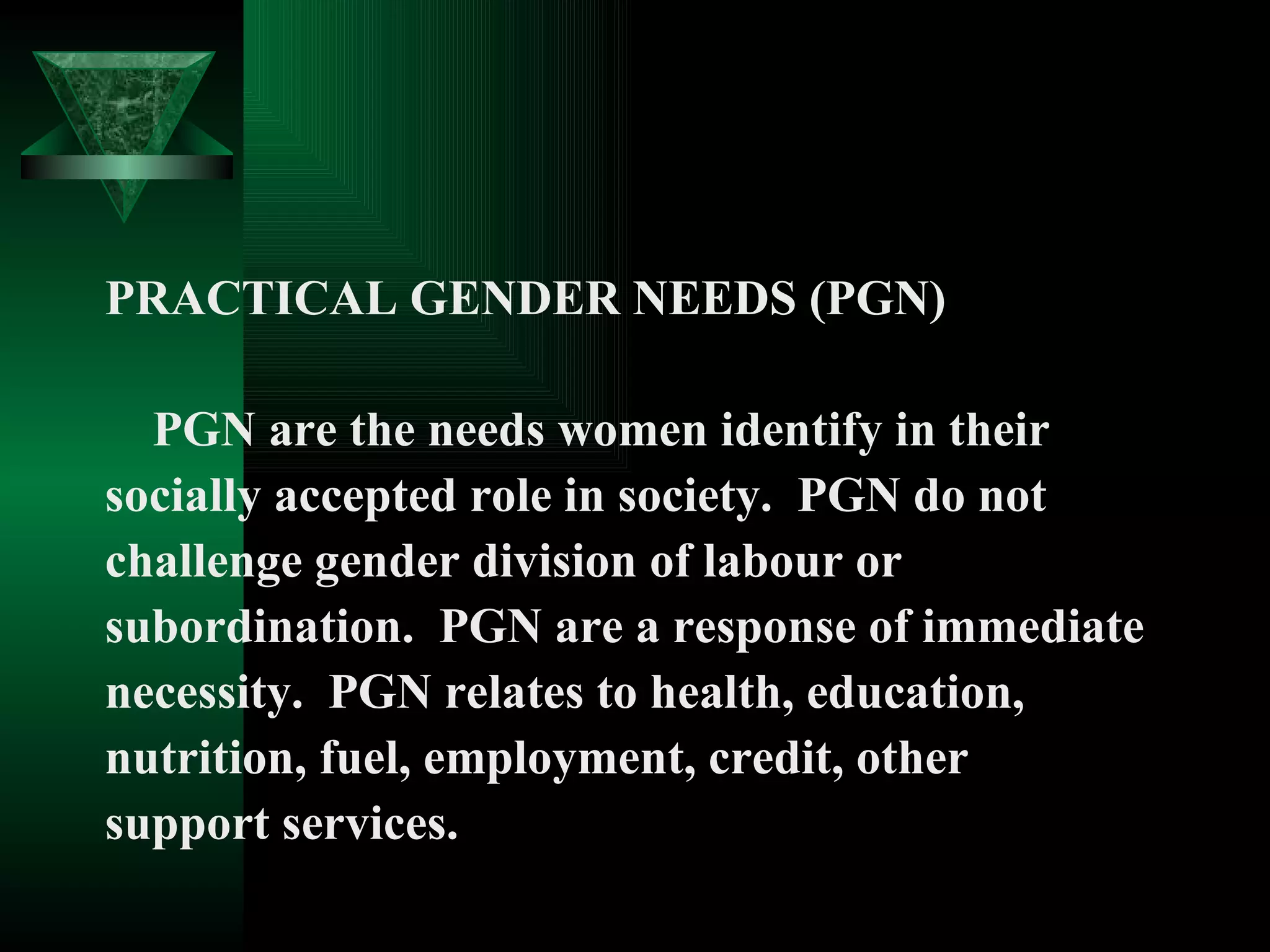
PRACTICAL GENDER NEEDS (PGN) PGN are the needs women identify in their  socially accepted role in society.  PGN do not  challenge gender division of labour or  subordination.  PGN are a response of immediate  necessity.  PGN relates to health, education,  nutrition, fuel, employment, credit, other  support services.
DETERMINANTS ANALYSIS Factors which determine or influence role, responsibilities, status, resource use and  access of women and men which therefore  influence outcome of project. These includes: - 1. General economic conditions - poverty, inflation, income distribution, employment, economic policy, infrastructure facilities
2. Institutional factors - government machinery, NGOs, government policies and programmes 3. Demographic factors - age and sex composition, sex ratio, fertility, mortality, morbidity, migration, education 4. Social cultural factors - casts, class, ethnicity, attitude, belief, social and religious institutions
5. Legal factors - constitutional provisions, legal safeguards, law enforcement agencies, legal awareness 6. Political factors - political will, ideology of parties, type of governance 7. Historical factors
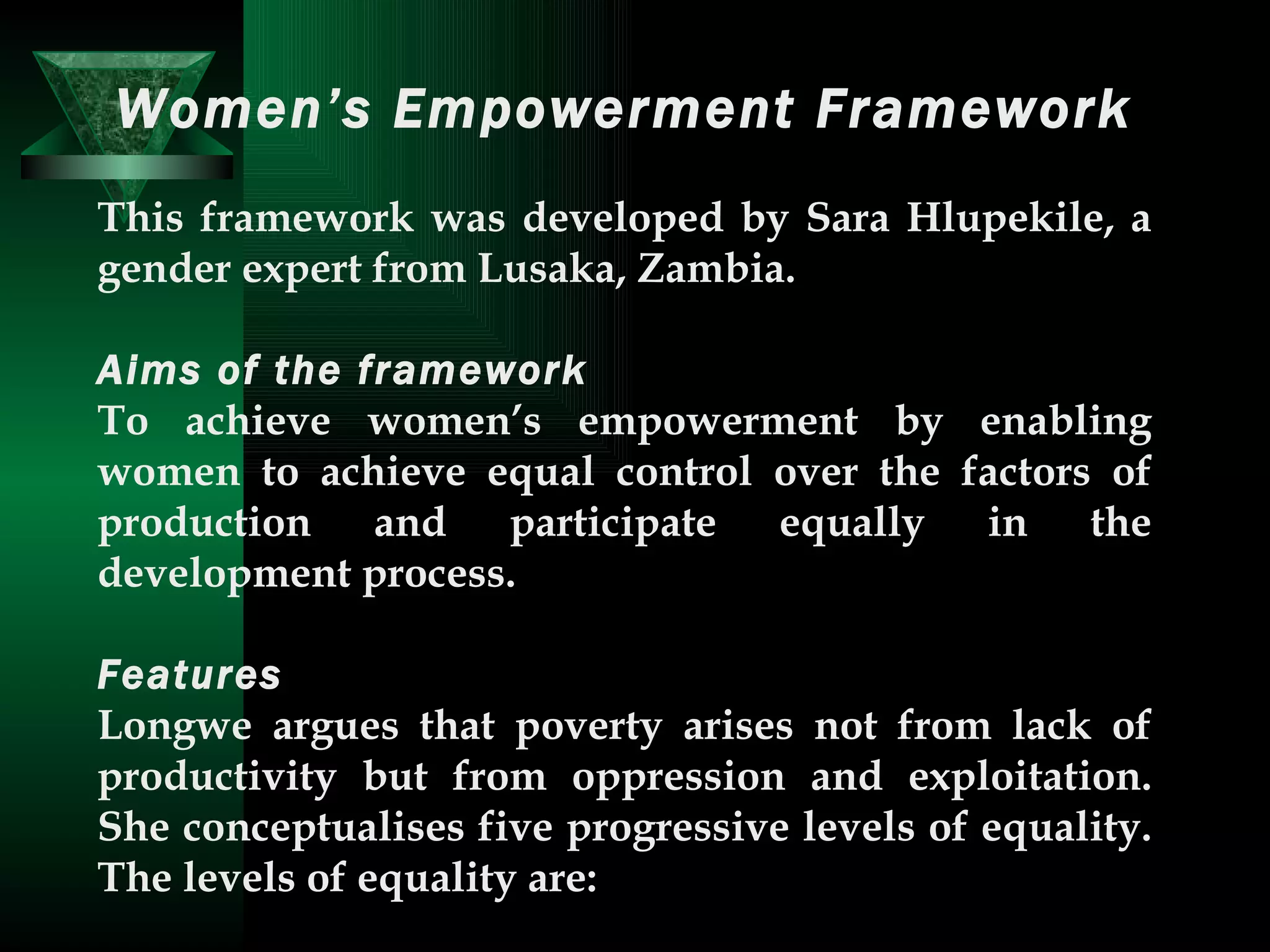
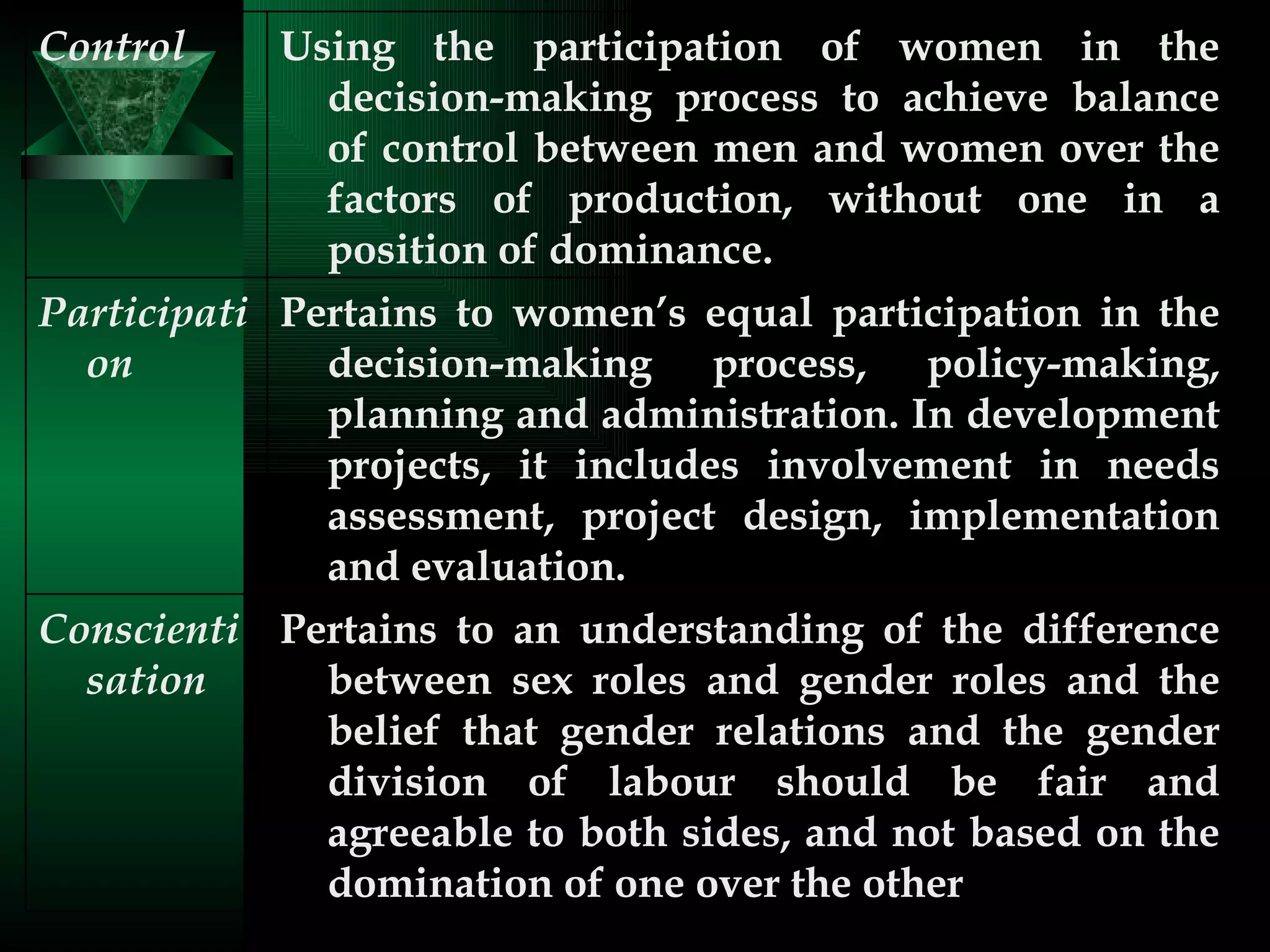
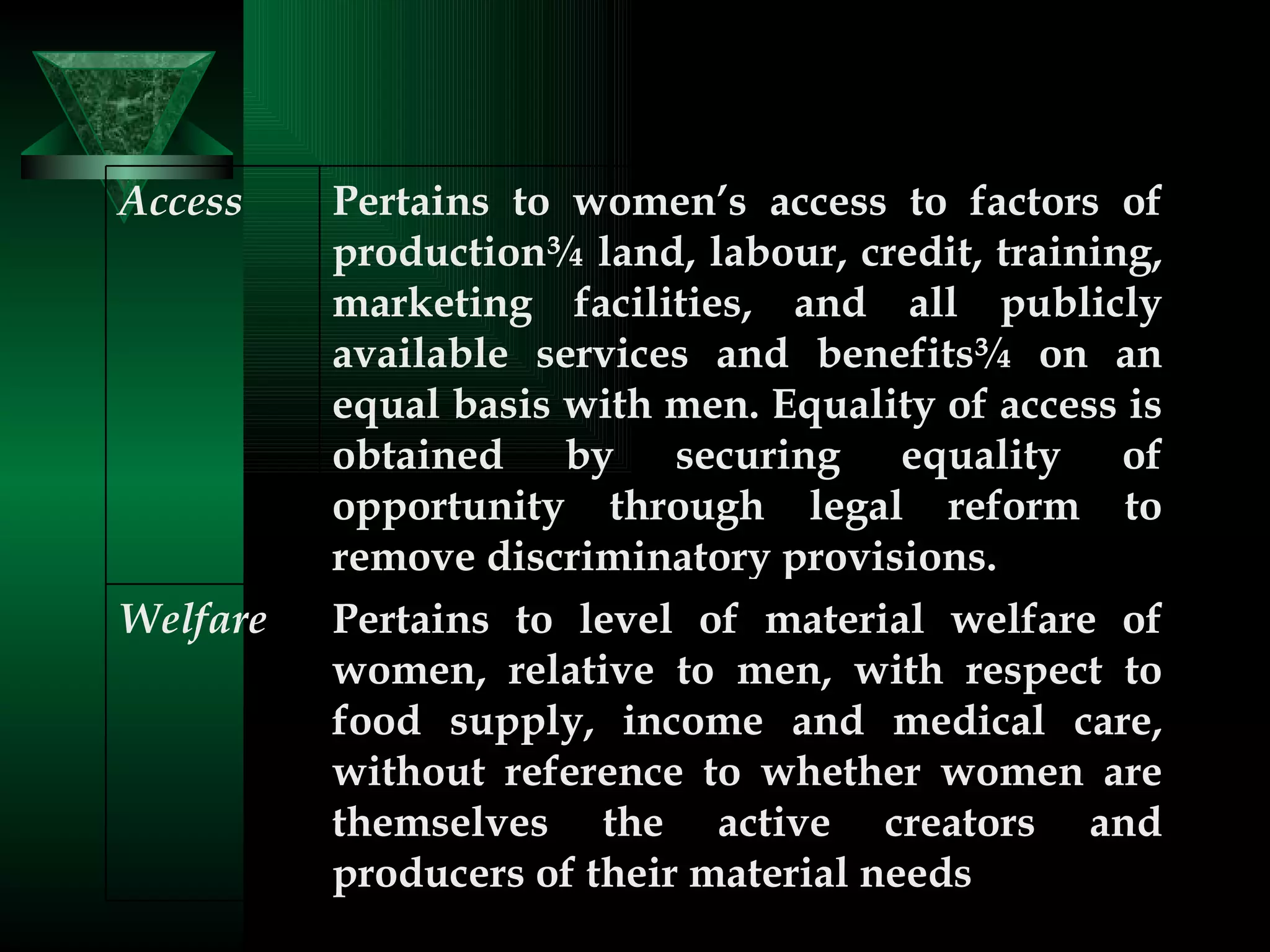
Women’s Empowerment Framework This framework was developed by Sara Hlupekile, a gender expert from Lusaka, Zambia.  Aims of the framework   To achieve women’s empowerment by enabling women to achieve equal control over the factors of production and participate equally in the development process.  Features   Longwe argues that poverty arises not from lack of productivity but from oppression and exploitation. She conceptualises five progressive levels of equality. The levels of equality are:
Pertains to an understanding of the difference between sex roles and gender roles and the belief that gender relations and the gender division of labour should be fair and agreeable to both sides, and not based on the domination of one over the other Conscientisation Pertains to women’s equal participation in the decision-making process, policy-making, planning and administration. In development projects, it includes involvement in needs assessment, project design, implementation and evaluation. Participation Using the participation of women in the decision-making process to achieve balance of control between men and women over the factors of production, without one in a position of dominance. Control
Pertains to level of material welfare of women, relative to men, with respect to food supply, income and medical care, without reference to whether women are themselves the active creators and producers of their material needs Welfare Pertains to women’s access to factors of production¾ land, labour, credit, training, marketing facilities, and all publicly available services and benefits¾ on an equal basis with men. Equality of access is obtained by securing equality of opportunity through legal reform to remove discriminatory provisions. Access
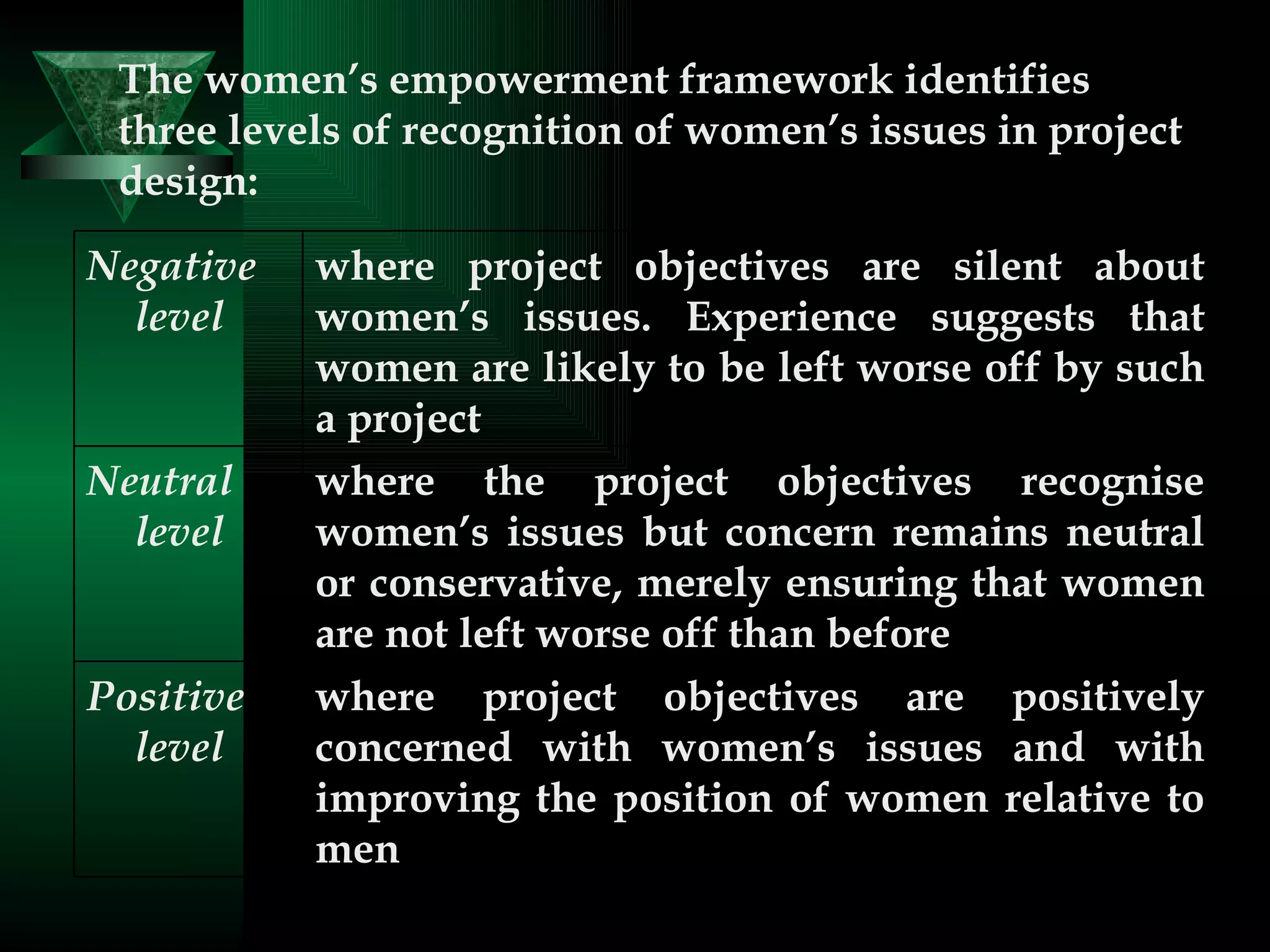
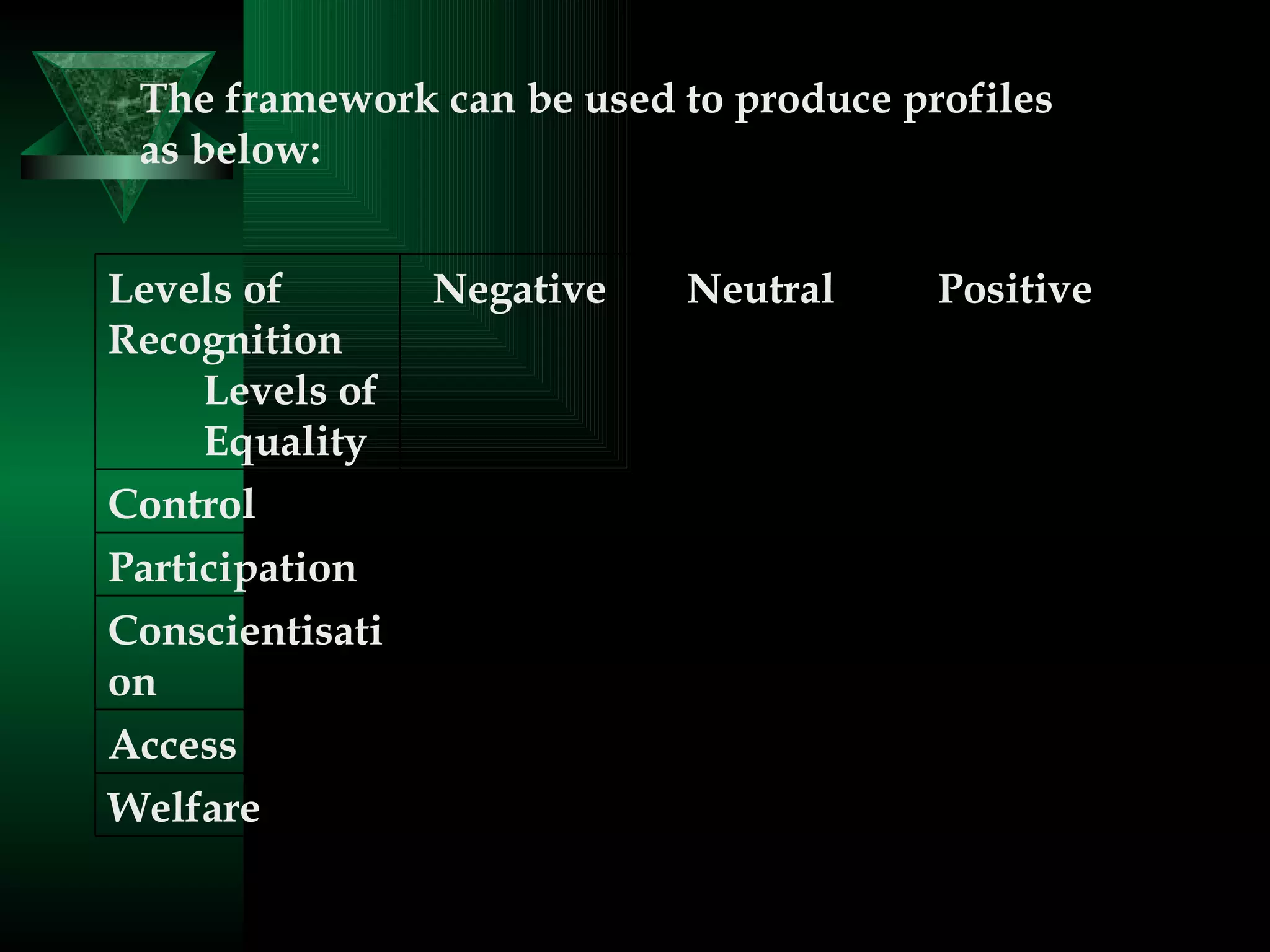
The women’s empowerment framework identifies three levels of recognition of women’s issues in project design:   where project objectives are positively concerned with women’s issues and with improving the position of women relative to men Positive level where the project objectives recognise women’s issues but concern remains neutral or conservative, merely ensuring that women are not left worse off than before Neutral level where project objectives are silent about women’s issues. Experience suggests that women are likely to be left worse off by such a project Negative level
The framework can be used to produce profiles as below:        Welfare       Access       Conscientisation       Participation       Control Positive Neutral Negative Levels of Recognition  Levels of Equality
Social Relations Framework The social relations framework originated by Naila Kabeer at the Institute of Development Studies at Sussex, UK.  Aims of the framework  To analyse existing gender inequalities in the distribution of  resources, responsibilities, and power  To analyse relationships between people, their relationship to resources and activities, and how they are reworked through institutions  To emphasise human well-being as the final goal of development
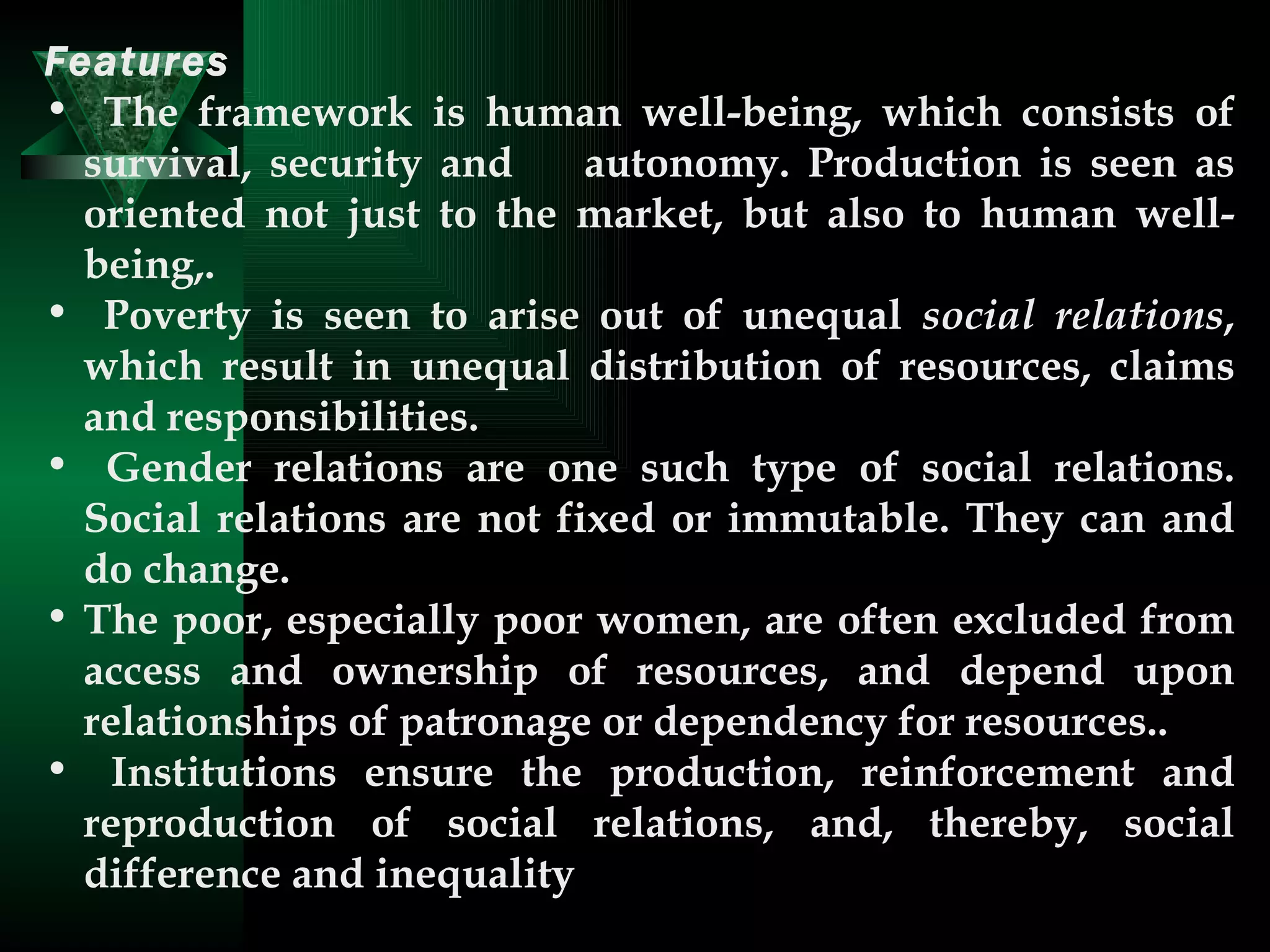
Features   The framework is human well-being, which consists of survival, security and  autonomy. Production is seen as oriented not just to the market, but also to human well-being,.  Poverty is seen to arise out of unequal  social relations , which result in unequal distribution of resources, claims and responsibilities.  Gender relations are one such type of social relations. Social relations are not fixed or immutable. They can and do change. The poor, especially poor women, are often excluded from access and ownership of resources, and depend upon relationships of patronage or dependency for resources..  Institutions ensure the production, reinforcement and reproduction of social relations, and, thereby, social difference and inequality
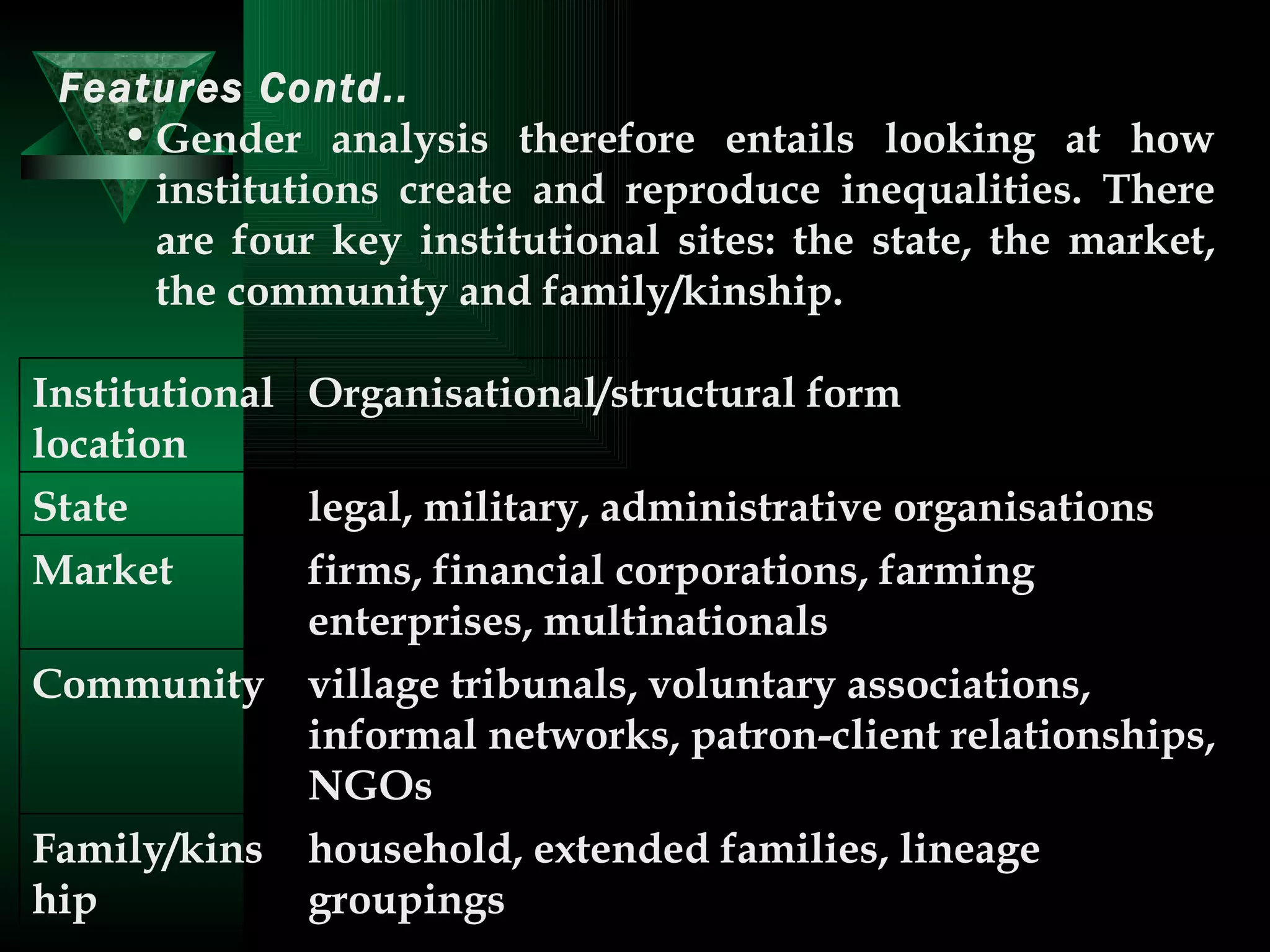
Features Contd.. Gender analysis therefore entails looking at how institutions create and reproduce inequalities. There are four key institutional sites: the state, the market, the community and family/kinship.  household, extended families, lineage groupings Family/kinship village tribunals, voluntary associations, informal networks, patron-client relationships, NGOs Community firms, financial corporations, farming enterprises, multinationals Market legal, military, administrative organisations State Organisational/structural form Institutional location
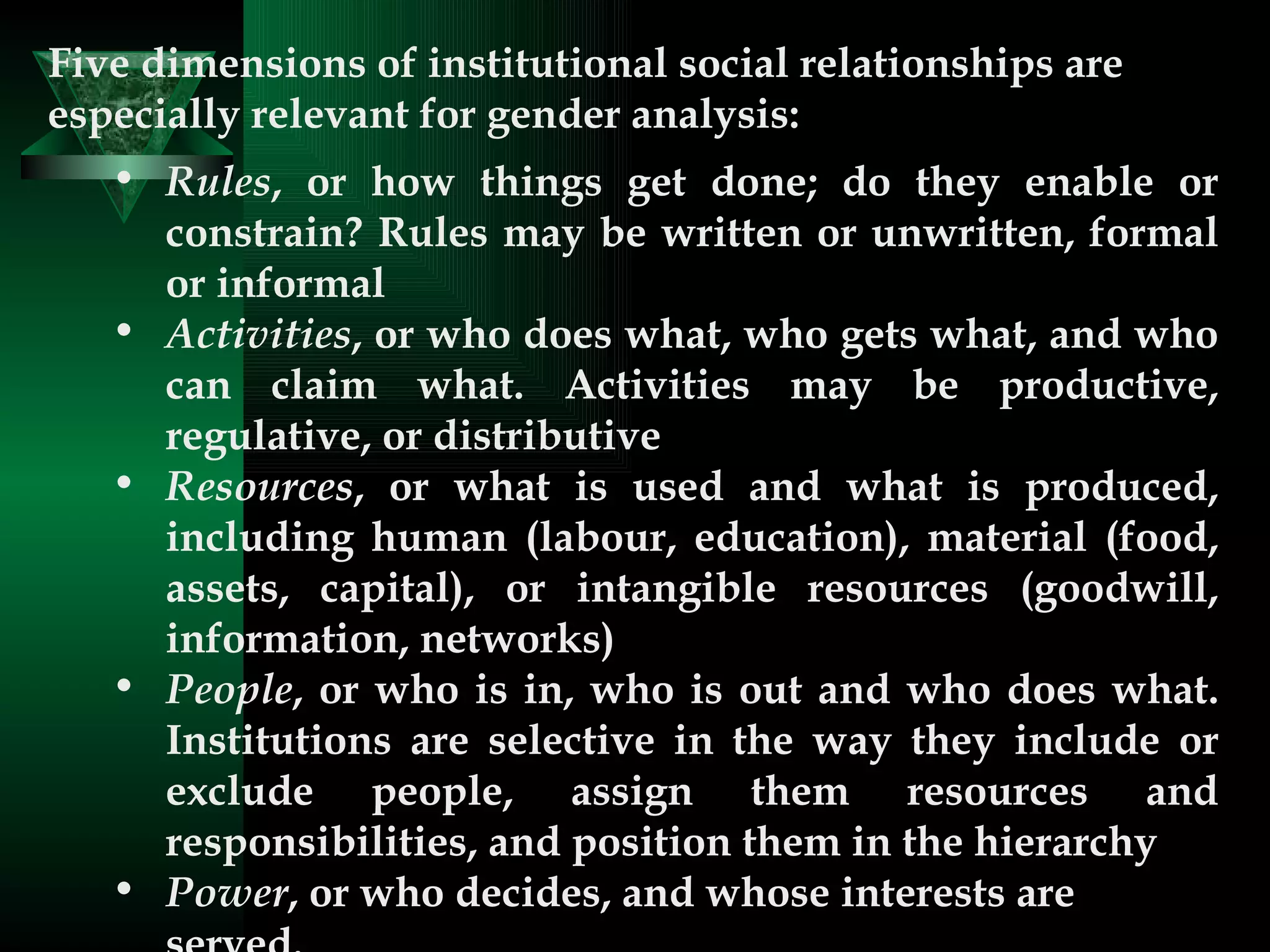
Five dimensions of institutional social relationships are especially relevant for gender analysis:  Rules , or how things get done; do they enable or constrain? Rules may be written or unwritten, formal or informal  Activities , or who does what, who gets what, and who can claim what. Activities may be productive, regulative, or distributive  Resources , or what is used and what is produced, including human (labour, education), material (food, assets, capital), or intangible resources (goodwill, information, networks)  People , or who is in, who is out and who does what. Institutions are selective in the way they include or exclude people, assign them resources and responsibilities, and position them in the hierarchy  Power , or who decides, and whose interests are served.
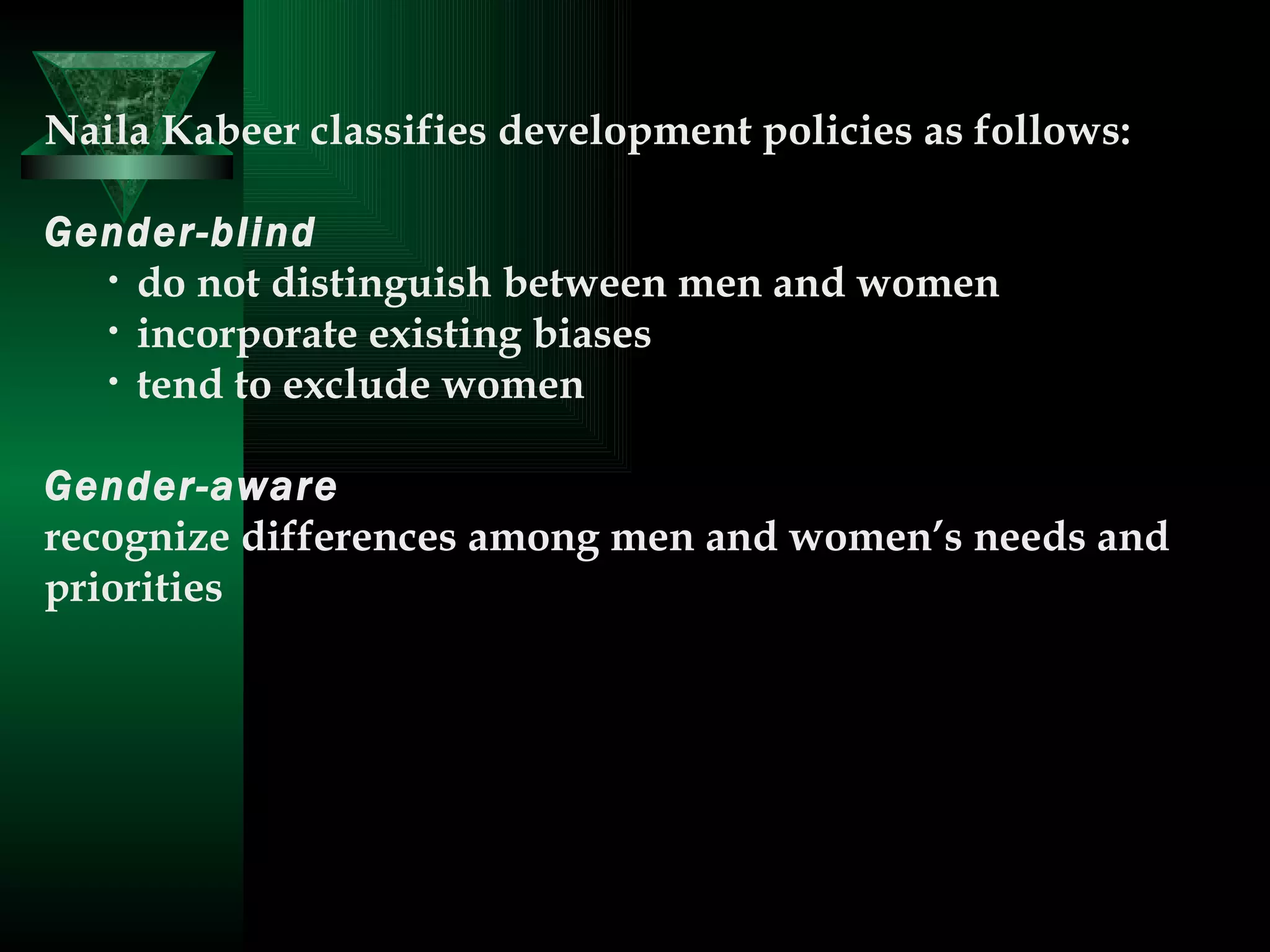
Naila Kabeer classifies development policies as follows:  Gender-blind  do not distinguish between men and women   incorporate existing biases   tend to exclude women  Gender-aware  recognize differences among men and women’s needs and priorities
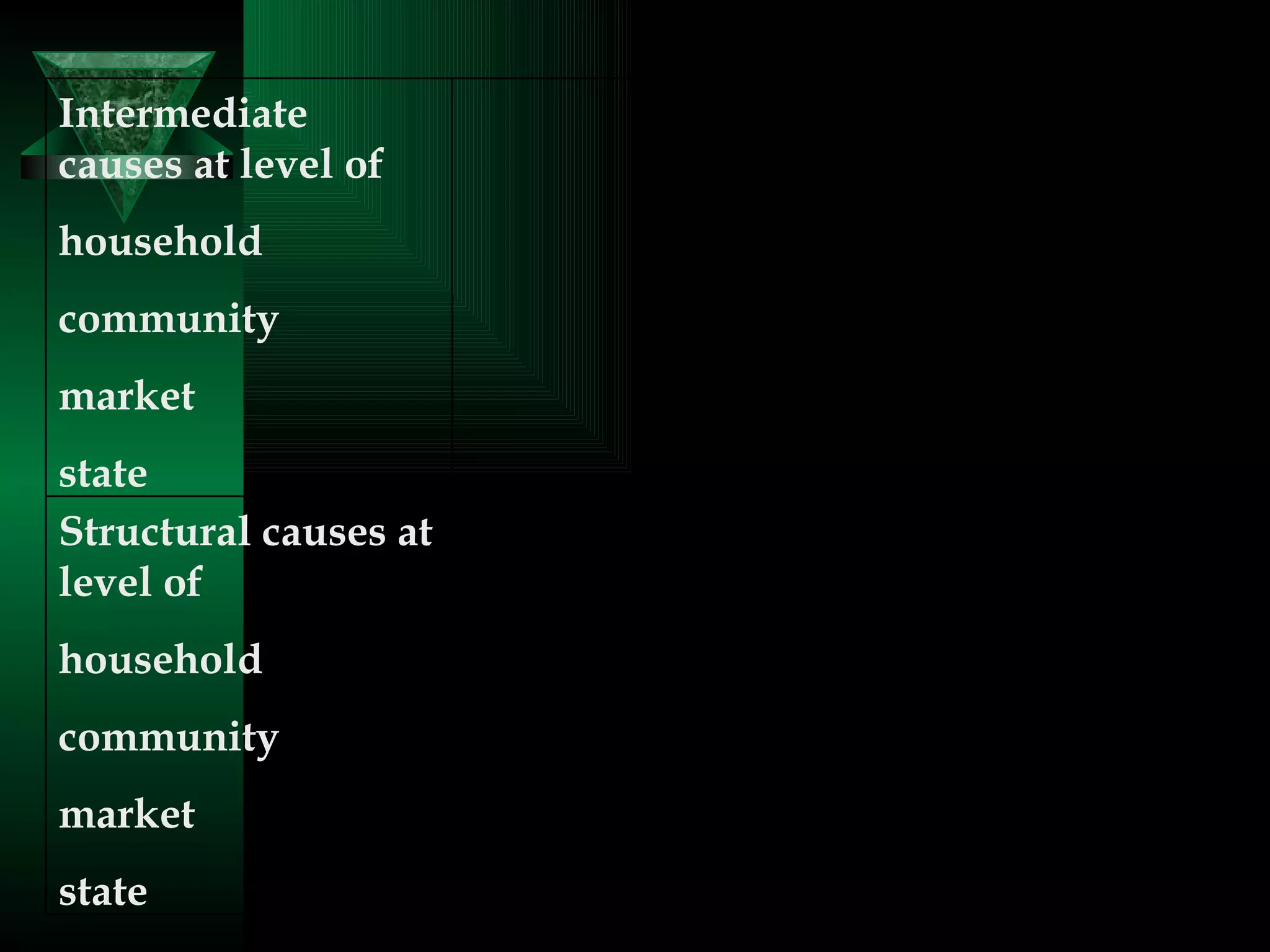
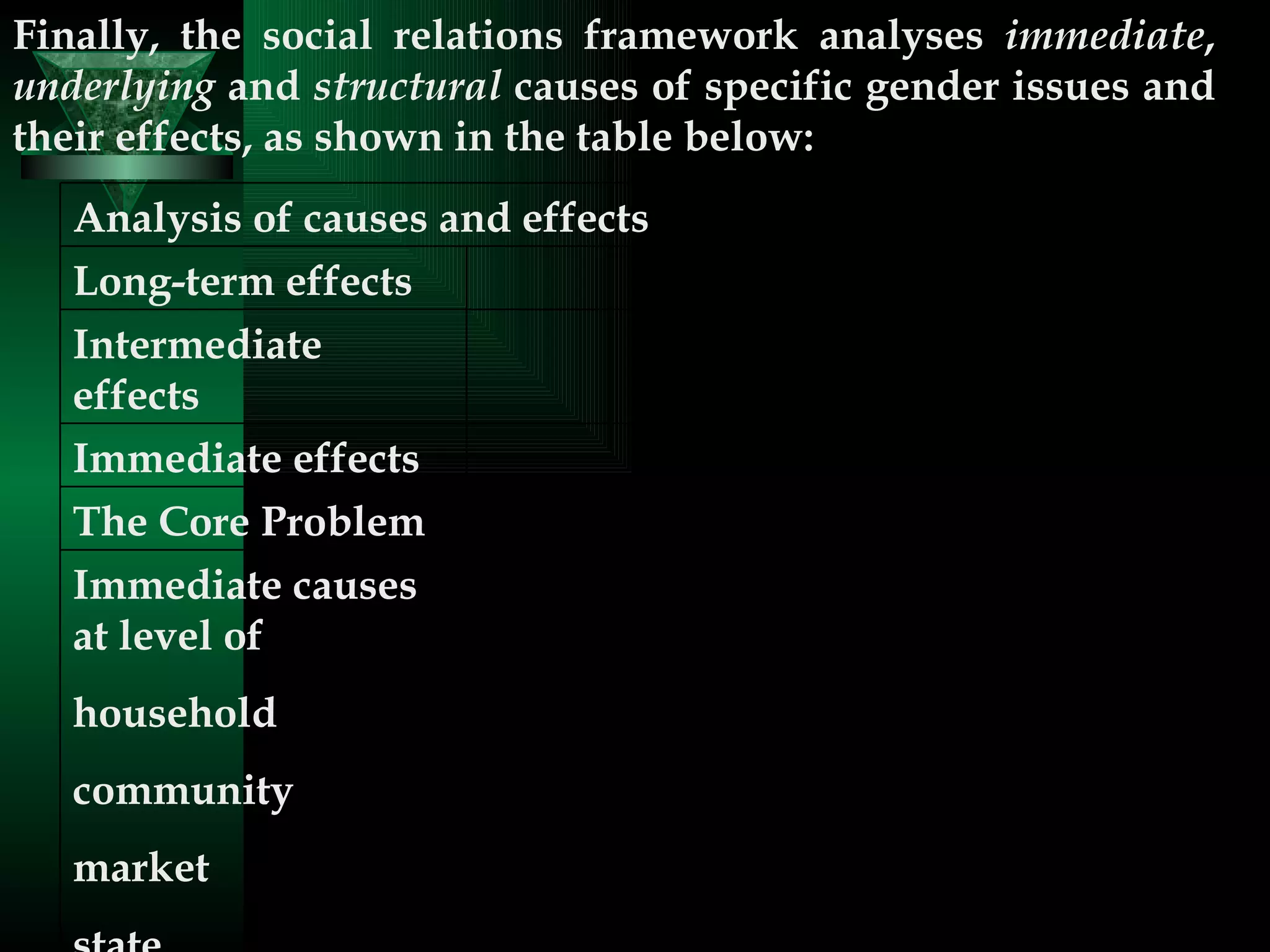
Finally, the social relations framework analyses  immediate ,  underlying  and  structural  causes of specific gender issues and their effects, as shown in the table below:    Immediate causes at level of  household  community  market  state    The Core Problem   Immediate effects   Intermediate effects   Long-term effects Analysis of causes and effects
  Structural causes at level of  household  community  market  state    Intermediate causes at level of  household  community  market  state
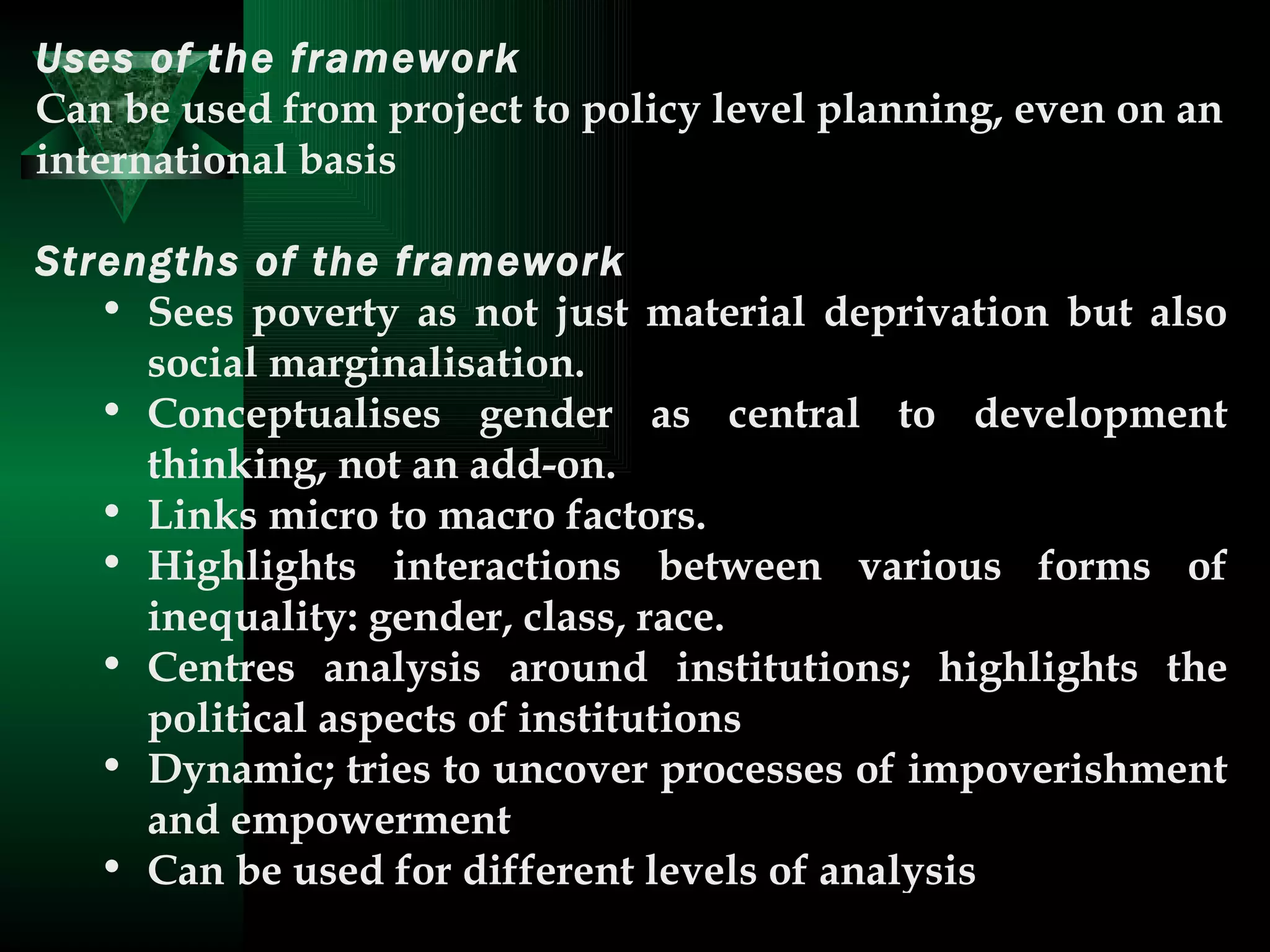
Uses of the framework   Can be used from project to policy level planning, even on an international basis  Strengths of the framework   Sees poverty as not just material deprivation but also social marginalisation.  Conceptualises gender as central to development thinking, not an add-on.  Links micro to macro factors.  Highlights interactions between various forms of inequality: gender, class, race.  Centres analysis around institutions; highlights the political aspects of institutions  Dynamic; tries to uncover processes of impoverishment and empowerment  Can be used for different levels of analysis
Potential limitations   Since it examine all cross-cutting inequalities, gender can get subsumed under other analytical categories  Can appear complicated, detailed and demanding  Uses of the framework:   Best suited for project planning, rather than programme or policy planning  As a gender-neutral entry point when raising gender issues with constituents resistant to considering gender relations and power dynamics  For baseline data collection  In conjunction with Moser’s framework, to draw in the idea of strategic gender needs
CAPACITIES AND VULNERABILITIES ANALYSIS Development is a process by which  vulnerabilities are reduced and capacities are increased. Capacities  - are the existing strength in  individuals and social group.  They are  released to people’s material and physical  resources.  Capacities determine people’s  abilities to cope with crisis and overcome from  it.
Vulnerabilities - are the long term factors which weaken the people’s ability to cope with sudden emergencies. Physical and material CAV- consists features of land, climate, environment where people live, their health, skills, housing technology, fuel, food supply their access to capital and other resources.
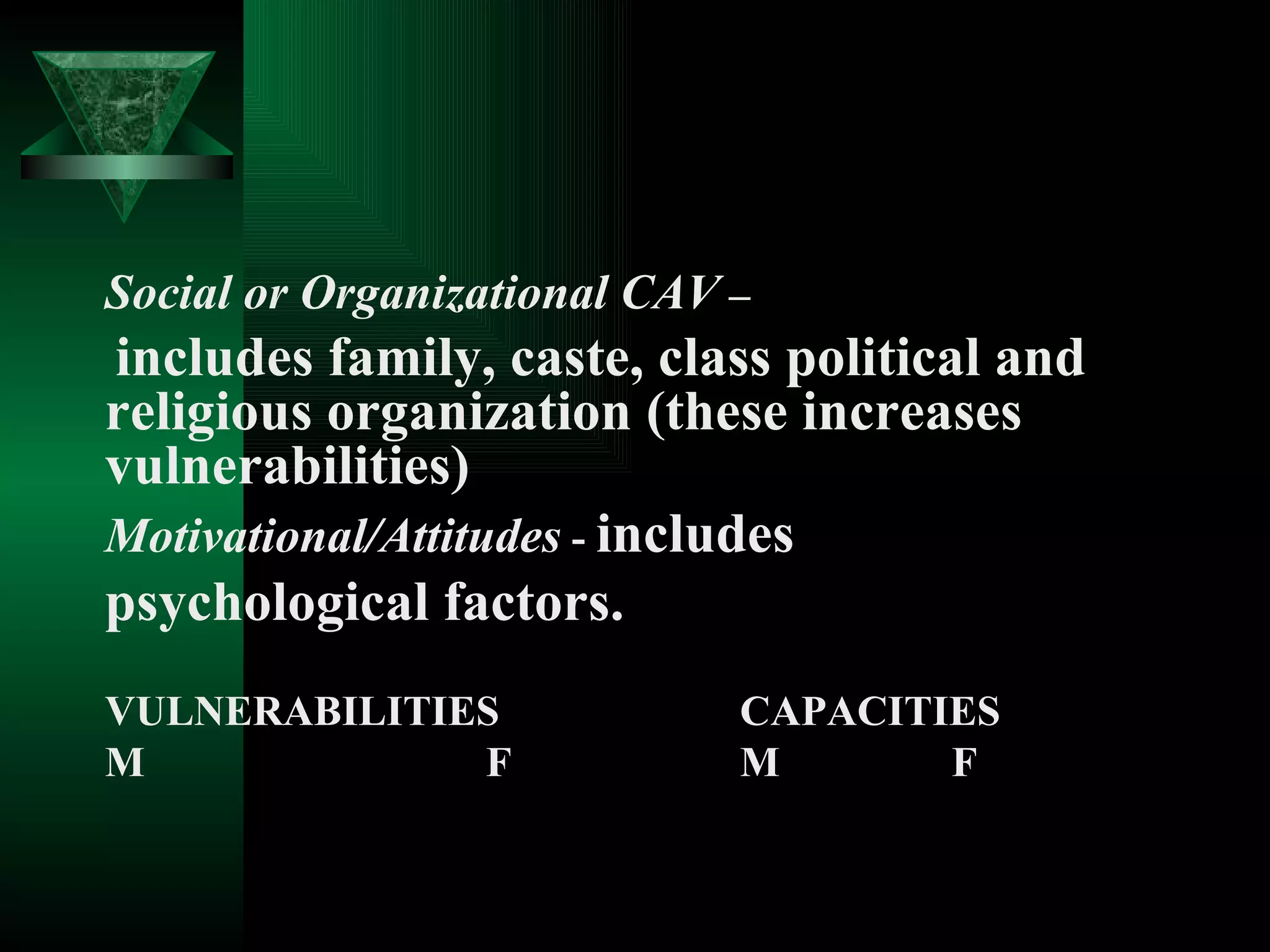
Social or Organizational CAV  – includes family, caste, class political and religious organization (these increases vulnerabilities) Motivational/Attitudes  -  includes  psychological factors. VULNERABILITIES CAPACITIES M F M   F
THANK  YOU

Gender Analysis Framework & Planning (B.R. Siwal)

  • 1.
    GENDER ANALYSIS FRAMEWORKB R SIWAL NIPCCD NEW DELHI E-mail br_siwal@yahoo.com
  • 2.
    What Is GenderAnalysis? An intrinsic dimension of policy analysis Identifies specifically how public policy affects women and men differently Demonstrates that policy and implementation cannot be gender neutral in gendered societies Is supported by specific analytic tools
  • 3.
    What Competencies AreRequired To Undertake Gender Analysis? Familiarity with main Gender Analysis Frameworks Ability to select the Framework most likely to yield solutions to the development problem to be addressed Able to interpret data Able to use strategic decision-making skills
  • 4.
    GENDER ANALYSIS (GA)IS A PROCESS TO ASSESS THE – Differential impact of proposed or existing policies, programmes, projects and legislation on women and men. Gender analysis recognizes that realities of men’s and women’s lives are different and that equal opportunities does not necessarily men equal results. Gender analysis is a basis of all tools of gender mainstreaming.
  • 5.
    GENDER ANALYSIS FRAMEWORKGA is practical tool for analysing the nature of gender differentiation. It builds by asking questions who does what? Where? When? And with what resources?
  • 6.
    GA basicquestions : 1. Who does what? What is the actual division of labour between men and women in the project area? 2. Who has what? Who has access to and control over resources in the project area? 3. What influences to access and control of resources? What social, cultural, economic, political influence gender differentiable rights of access and control? 4. How are resources distributed and who gets what?
  • 7.
    Gender Analysis FrameworksHarvard Analytical Framework DPU Frameworks a) Moser (triple roles) Framework b) Levy (web of institutionalisation) Framework Gender Analysis Matrix (GAM) Equality and Empowerment Framework (Longwe) Capacities and Vulnerabilities Framework (CVA) People Oriented Framework (POP) Social Relations Approach Framework (SRA)
  • 8.
    HARVARD FRAMEWORK OFGENDER ANALYSIS 1. Activity profile - based on gender division of labour and delineates the economic activities of pop by sex, age and other factors and time spent on economic activities. 2. Access and control profile- which identify individuals by sex have access and control over resources, services and benefits.
  • 9.
    3. Factors influencingaccess and control - factors affecting access and control e.G. Social, cultural, economic in relation to gender. 4. Project cycle analysis - examine a project proposal or area of intervention in the light of gender - disaggregated data, information and social change.
  • 10.
    HARVARD METHOD OFPROJECT CYCLE (CHECKLIST) I. PROJECT PLANNING Assessing women’s needs What needs and opportunities exist for increasing women’s participation and/or Women’s access and control of resources, services and benefits?
  • 11.
    How these needsand opportunities decrease the burden of work? Whether the women have been consulted in identification of needs and opportunities? Defining project objectives Whether objectives related to women’s needs?
  • 12.
    Whether objectives adequatelyreflect women’s needs? II PROJECT IMPLEMENTATION Are project personnel sufficiently aware and sensitive towards women’s needs? Are women involved in delivery of goods and services?
  • 13.
    Do personnel havespecific skills? What training techniques will be used? Are there appropriate opportunities for women to participate in project management?
  • 14.
    ORGANISATIONAL STRUCTURE DOESTHE ORGANISATION Enhance women’s access and control of resources? Have adequate resources? Have capabilities to support and protect women during the process of change? Have delivery channel accessible?
  • 15.
    Whether time andlocation suitable for women? Have management information system (MIS)? Have flexibility to meet changing requirements? Have women participated in setting objectives?
  • 16.
    Is there anymissed opportunity for women? Have there been earlier efforts and lesson learnt? Project impact on women How project affect women’s status responsibilities and role in society? Is planned change feasable and sustainable?
  • 17.
    How will eachproject component affect women’s access and control of resources and benefits? How project design can be adjusted to increase positive effects and decrease negative effects?
  • 18.
    PRACTICAL AND STRATEGICGENDER NEEDS(Moser method) Strategic Gender Needs (SGN) SGN relates to subordinate position of women in society. SGN relate to gender division of labour, power, control and issues like legal rights over bodies oppression - SGN challenge subordinate position by assisting women to achieve greater equality and changing existing roles.
  • 19.
    PRACTICAL GENDER NEEDS(PGN) PGN are the needs women identify in their socially accepted role in society. PGN do not challenge gender division of labour or subordination. PGN are a response of immediate necessity. PGN relates to health, education, nutrition, fuel, employment, credit, other support services.
  • 20.
    DETERMINANTS ANALYSIS Factorswhich determine or influence role, responsibilities, status, resource use and access of women and men which therefore influence outcome of project. These includes: - 1. General economic conditions - poverty, inflation, income distribution, employment, economic policy, infrastructure facilities
  • 21.
    2. Institutional factors- government machinery, NGOs, government policies and programmes 3. Demographic factors - age and sex composition, sex ratio, fertility, mortality, morbidity, migration, education 4. Social cultural factors - casts, class, ethnicity, attitude, belief, social and religious institutions
  • 22.
    5. Legal factors- constitutional provisions, legal safeguards, law enforcement agencies, legal awareness 6. Political factors - political will, ideology of parties, type of governance 7. Historical factors
  • 23.
    Women’s Empowerment FrameworkThis framework was developed by Sara Hlupekile, a gender expert from Lusaka, Zambia. Aims of the framework To achieve women’s empowerment by enabling women to achieve equal control over the factors of production and participate equally in the development process. Features Longwe argues that poverty arises not from lack of productivity but from oppression and exploitation. She conceptualises five progressive levels of equality. The levels of equality are:
  • 24.
    Pertains to anunderstanding of the difference between sex roles and gender roles and the belief that gender relations and the gender division of labour should be fair and agreeable to both sides, and not based on the domination of one over the other Conscientisation Pertains to women’s equal participation in the decision-making process, policy-making, planning and administration. In development projects, it includes involvement in needs assessment, project design, implementation and evaluation. Participation Using the participation of women in the decision-making process to achieve balance of control between men and women over the factors of production, without one in a position of dominance. Control
  • 25.
    Pertains to levelof material welfare of women, relative to men, with respect to food supply, income and medical care, without reference to whether women are themselves the active creators and producers of their material needs Welfare Pertains to women’s access to factors of production¾ land, labour, credit, training, marketing facilities, and all publicly available services and benefits¾ on an equal basis with men. Equality of access is obtained by securing equality of opportunity through legal reform to remove discriminatory provisions. Access
  • 26.
    The women’s empowermentframework identifies three levels of recognition of women’s issues in project design: where project objectives are positively concerned with women’s issues and with improving the position of women relative to men Positive level where the project objectives recognise women’s issues but concern remains neutral or conservative, merely ensuring that women are not left worse off than before Neutral level where project objectives are silent about women’s issues. Experience suggests that women are likely to be left worse off by such a project Negative level
  • 27.
    The framework canbe used to produce profiles as below:       Welfare       Access       Conscientisation       Participation       Control Positive Neutral Negative Levels of Recognition Levels of Equality
  • 28.
    Social Relations FrameworkThe social relations framework originated by Naila Kabeer at the Institute of Development Studies at Sussex, UK. Aims of the framework To analyse existing gender inequalities in the distribution of resources, responsibilities, and power To analyse relationships between people, their relationship to resources and activities, and how they are reworked through institutions To emphasise human well-being as the final goal of development
  • 29.
    Features The framework is human well-being, which consists of survival, security and autonomy. Production is seen as oriented not just to the market, but also to human well-being,. Poverty is seen to arise out of unequal social relations , which result in unequal distribution of resources, claims and responsibilities. Gender relations are one such type of social relations. Social relations are not fixed or immutable. They can and do change. The poor, especially poor women, are often excluded from access and ownership of resources, and depend upon relationships of patronage or dependency for resources.. Institutions ensure the production, reinforcement and reproduction of social relations, and, thereby, social difference and inequality
  • 30.
    Features Contd.. Genderanalysis therefore entails looking at how institutions create and reproduce inequalities. There are four key institutional sites: the state, the market, the community and family/kinship. household, extended families, lineage groupings Family/kinship village tribunals, voluntary associations, informal networks, patron-client relationships, NGOs Community firms, financial corporations, farming enterprises, multinationals Market legal, military, administrative organisations State Organisational/structural form Institutional location
  • 31.
    Five dimensions ofinstitutional social relationships are especially relevant for gender analysis: Rules , or how things get done; do they enable or constrain? Rules may be written or unwritten, formal or informal Activities , or who does what, who gets what, and who can claim what. Activities may be productive, regulative, or distributive Resources , or what is used and what is produced, including human (labour, education), material (food, assets, capital), or intangible resources (goodwill, information, networks) People , or who is in, who is out and who does what. Institutions are selective in the way they include or exclude people, assign them resources and responsibilities, and position them in the hierarchy Power , or who decides, and whose interests are served.
  • 32.
    Naila Kabeer classifiesdevelopment policies as follows: Gender-blind do not distinguish between men and women incorporate existing biases tend to exclude women Gender-aware recognize differences among men and women’s needs and priorities
  • 33.
    Finally, the socialrelations framework analyses immediate , underlying and structural causes of specific gender issues and their effects, as shown in the table below:   Immediate causes at level of household community market state   The Core Problem   Immediate effects   Intermediate effects   Long-term effects Analysis of causes and effects
  • 34.
      Structural causesat level of household community market state   Intermediate causes at level of household community market state
  • 35.
    Uses of theframework Can be used from project to policy level planning, even on an international basis Strengths of the framework Sees poverty as not just material deprivation but also social marginalisation. Conceptualises gender as central to development thinking, not an add-on. Links micro to macro factors. Highlights interactions between various forms of inequality: gender, class, race. Centres analysis around institutions; highlights the political aspects of institutions Dynamic; tries to uncover processes of impoverishment and empowerment Can be used for different levels of analysis
  • 36.
    Potential limitations Since it examine all cross-cutting inequalities, gender can get subsumed under other analytical categories Can appear complicated, detailed and demanding Uses of the framework: Best suited for project planning, rather than programme or policy planning As a gender-neutral entry point when raising gender issues with constituents resistant to considering gender relations and power dynamics For baseline data collection In conjunction with Moser’s framework, to draw in the idea of strategic gender needs
  • 37.
    CAPACITIES AND VULNERABILITIESANALYSIS Development is a process by which vulnerabilities are reduced and capacities are increased. Capacities - are the existing strength in individuals and social group. They are released to people’s material and physical resources. Capacities determine people’s abilities to cope with crisis and overcome from it.
  • 38.
    Vulnerabilities - arethe long term factors which weaken the people’s ability to cope with sudden emergencies. Physical and material CAV- consists features of land, climate, environment where people live, their health, skills, housing technology, fuel, food supply their access to capital and other resources.
  • 39.
    Social or OrganizationalCAV – includes family, caste, class political and religious organization (these increases vulnerabilities) Motivational/Attitudes - includes psychological factors. VULNERABILITIES CAPACITIES M F M F
  • 40.