Budgetary Control
Dr.R.VASANTHAGOPAL
Introduction
 For effective running of a business, management
must know how it intends to accomplish its
objectives.
 Budgetary control is the device that a company uses
for all these purposes.
Budget
 A budget is a plan expressed in quantitative, usually
monetary term, covering a specific period of time, usually
one year.
 A budget is ‘a quantitative or financial statement, that
contains the detailed plans and policies to be pursued
during a future accounting period’ (Collis and Hussey,
2007)
 In other words a budget is a systematic plan for the
utilization of manpower and material resources.
Purpose of Budget
 Communication: Budget enables to communicate plans
and to control information.
 Motivation: Budget seeks to motivate managers to
achieve objectives
 Performance Evaluation: Budget is used to evaluate the
capability of managers to achieve targets.
 Authorization: Budget is used to authorize expenditure
or to pursue certain initiatives once a budget is approved
Steps in the Preparation of
Budget
 Identify objectives
 Gather data about alternatives
 Select alternative courses of action
 Discuss the plans/activities and allocate the budget.
 Establish monitoring mechanisms.
 Respond to problems encountered in the previous
budget.
Budget-Sources of Information
Internal Source
 Production and operational
information
 Financial information
 Research and development
information
 Personnel information
 Expected outputs
 Performance targets
 Control and monitoring and
evaluation mechanisms
External Source
 Market and competitors
 Economic conditions
 Industrial structure
 Political factors
 Technological change
 Demographic trends and social
factors
 Government statistics,
commercial data, banks.
 Media coverage, business
trips, conferences.
Methods for Setting Budgets
 Incremental Budgeting
In incremental budgeting managers add a percentage to
the previous period’s budget to take account of expected
changes in price levels
 Zero Base budgeting
The zero base budgeting is not based on the incremental
approach and previous figures are not adopted as the
base.
Zero is taken as the base and a budget is developed on
the basis of likely activities for the future period.
Methods for Setting Budgets
 Functional Budgeting
Functional budgets are drawn up for each department or
function in the business by the specific functional manager
Eg: Cash budget, sales budget, production budget, etc.
 Master Budget
 It is summary budget which incorporates all the functional
budgets and is the final coordinated budget for the period.
 It is prepared in the form of projected profit and loss account
 It is always remains with the top level management
Methods for Setting Budgets
 Fixed Budget
This is defined as a budget which is designed to remain
unchanged irrespective of the volume of output or
turnover attained.
This budget will, therefore, be useful only when the
actual level of activity corresponds to the budgeted level
of activity.
 Flexible Budget
A flexible budget is designed to change with the level of
activity to reflect the different behaviour of fixed and
variable costs
Budgetary Control
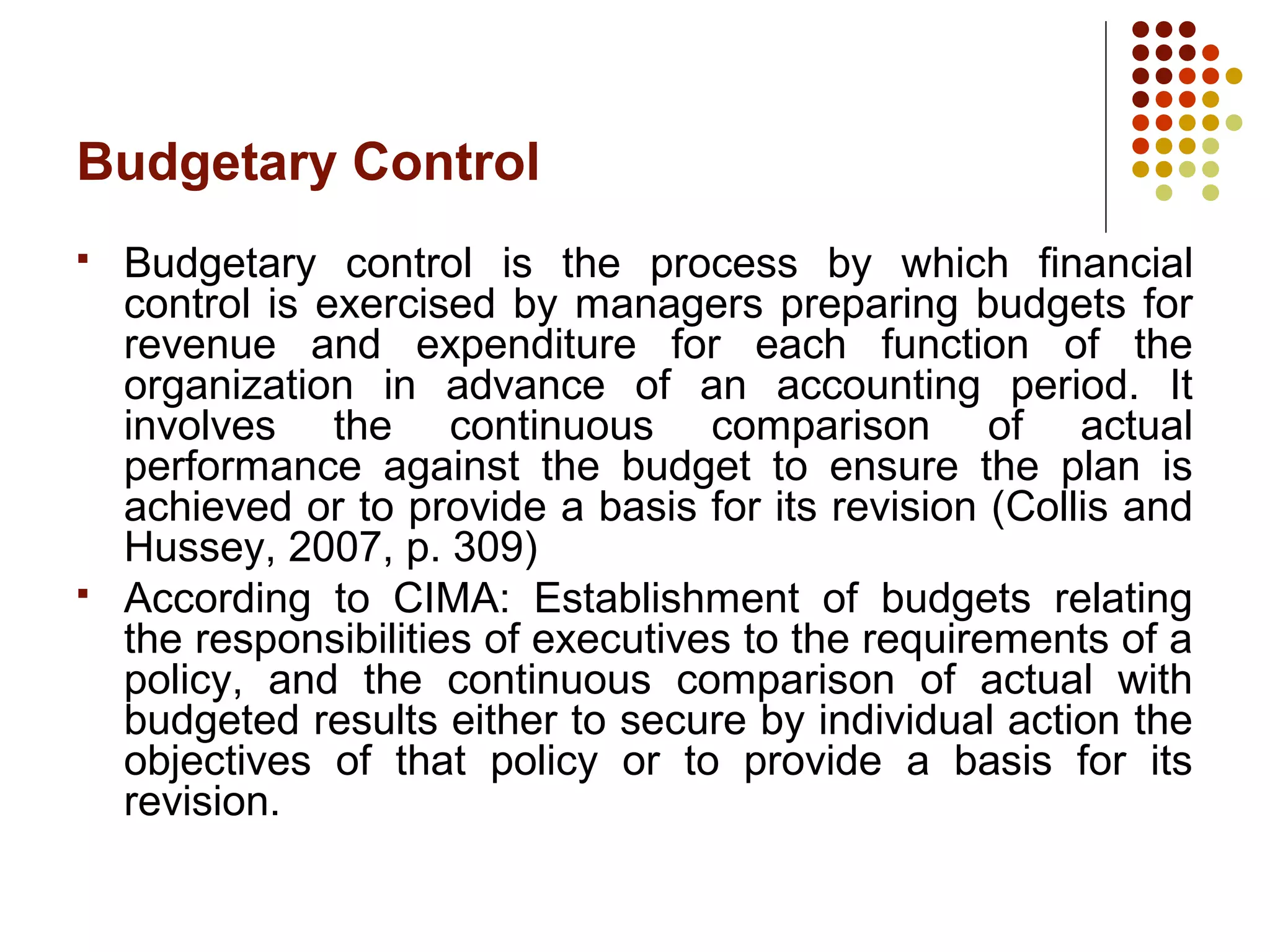
 Budgetary control is the process by which financial
control is exercised by managers preparing budgets for
revenue and expenditure for each function of the
organization in advance of an accounting period. It
involves the continuous comparison of actual
performance against the budget to ensure the plan is
achieved or to provide a basis for its revision (Collis and
Hussey, 2007, p. 309)
 According to CIMA: Establishment of budgets relating
the responsibilities of executives to the requirements of a
policy, and the continuous comparison of actual with
budgeted results either to secure by individual action the
objectives of that policy or to provide a basis for its
revision.
Elements of Budgetary Control
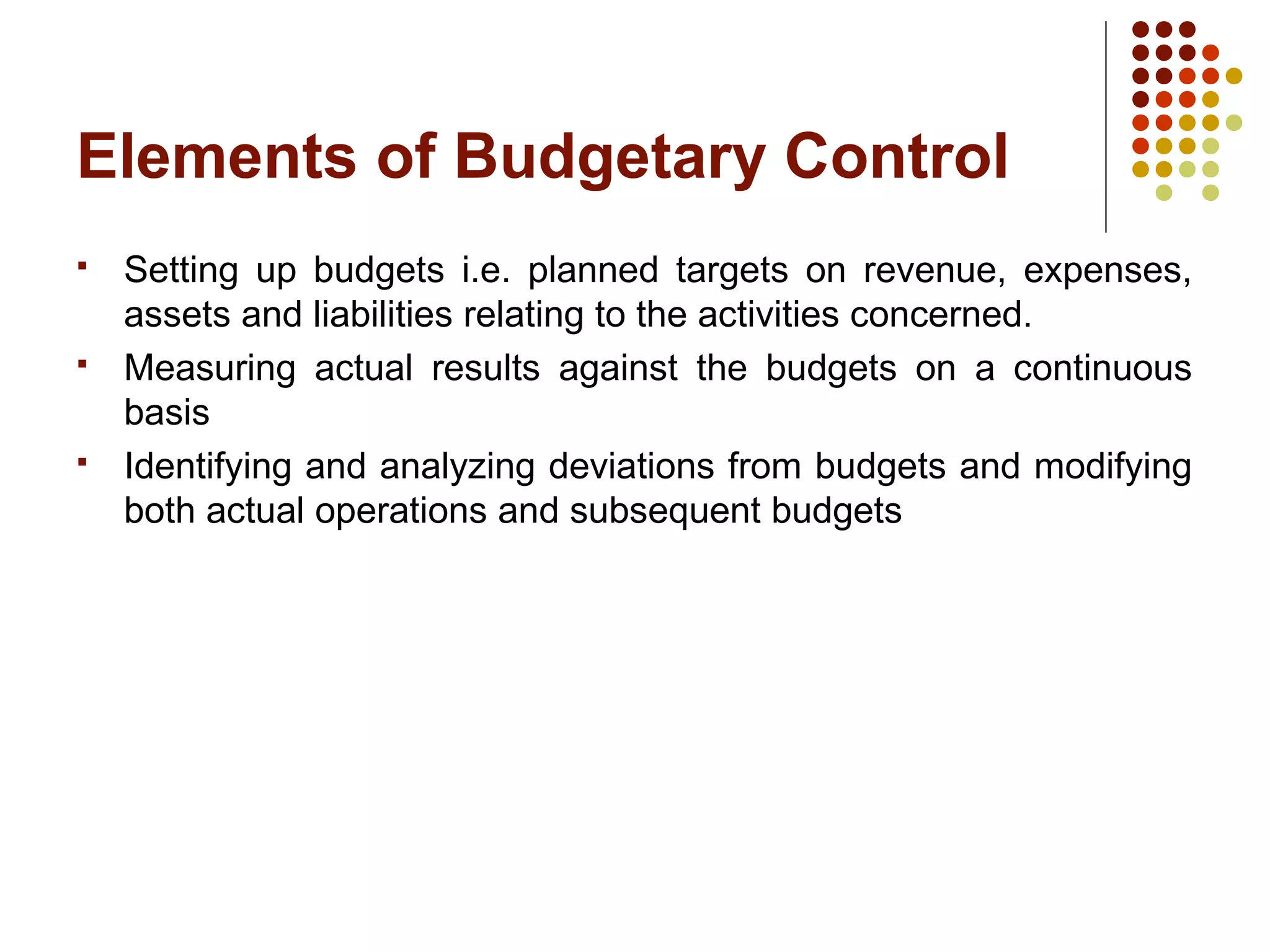
 Setting up budgets i.e. planned targets on revenue, expenses,
assets and liabilities relating to the activities concerned.
 Measuring actual results against the budgets on a continuous
basis
 Identifying and analyzing deviations from budgets and modifying
both actual operations and subsequent budgets
Stages in Budgetary Control
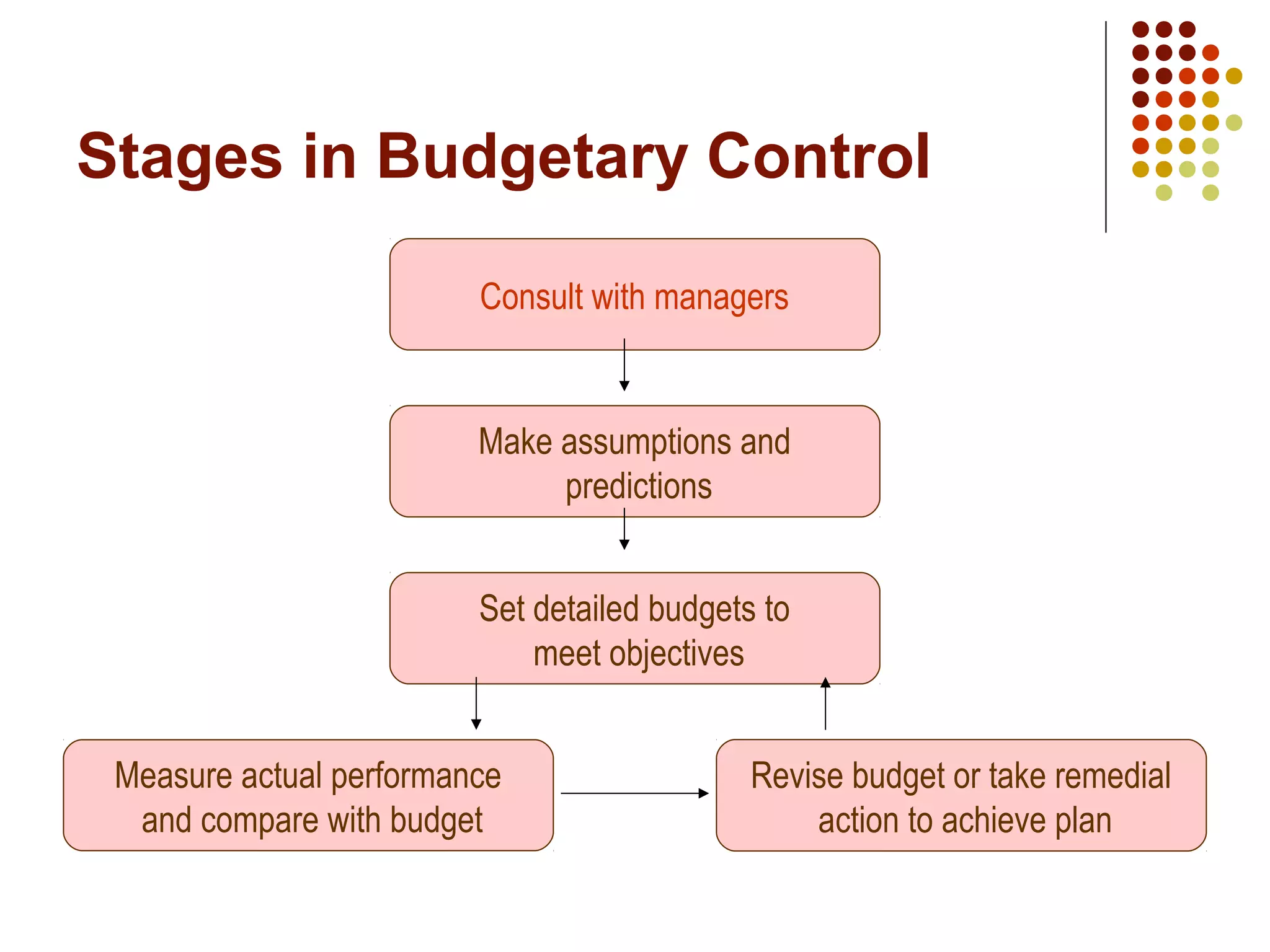
Consult with managers
Make assumptions and
predictions
Set detailed budgets to
meet objectives
Revise budget or take remedial
action to achieve plan
Measure actual performance
and compare with budget
Advantages of Budgetary Control
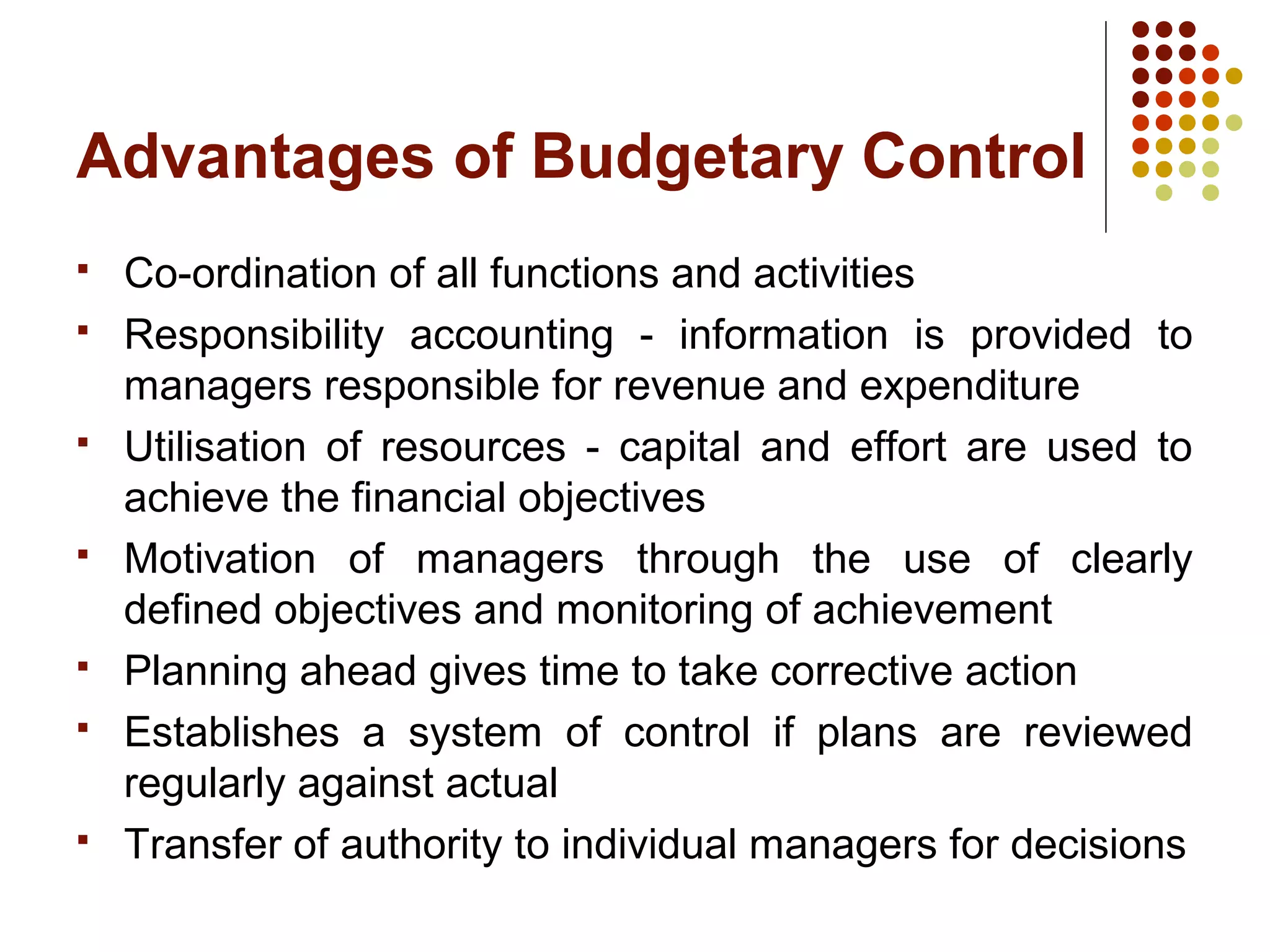
 Co-ordination of all functions and activities
 Responsibility accounting - information is provided to
managers responsible for revenue and expenditure
 Utilisation of resources - capital and effort are used to
achieve the financial objectives
 Motivation of managers through the use of clearly
defined objectives and monitoring of achievement
 Planning ahead gives time to take corrective action
 Establishes a system of control if plans are reviewed
regularly against actual
 Transfer of authority to individual managers for decisions
Disadvantages of Budgetary
Control
 Set in stone - managers may be constrained by the
original budget (eg make no attempt to spend less than
maximum or exceed target income)
 Time consuming process may deflect managers from
their prime responsibilities of running the business
 Unrealistic if fixed budgets are set and actual activity
level is not as planned
 Disillusioning for managers if fixed budgets are set and
not achieved merely due to changes in activity
 Demotivating for managers if budgets are imposed by
top management with no consultation
Conclusion
 Preparation of budgets is the first step in the budgetary
control system.
 Implementation of budgets is the second phase.
 But preparation and implementation of budgets alone will not
achieve much unless a comparison is made regularly
between the actual performance and the budgeted
performance.
 Continuous and proper reporting makes this possible.
 To ensure the success of budgetary control system, proper
follow up action has to be taken immediately for the reports
submitted.

Budgetary control

  • 1.
  • 2.
    Introduction  For effectiverunning of a business, management must know how it intends to accomplish its objectives.  Budgetary control is the device that a company uses for all these purposes.
  • 3.
    Budget  A budgetis a plan expressed in quantitative, usually monetary term, covering a specific period of time, usually one year.  A budget is ‘a quantitative or financial statement, that contains the detailed plans and policies to be pursued during a future accounting period’ (Collis and Hussey, 2007)  In other words a budget is a systematic plan for the utilization of manpower and material resources.
  • 4.
    Purpose of Budget Communication: Budget enables to communicate plans and to control information.  Motivation: Budget seeks to motivate managers to achieve objectives  Performance Evaluation: Budget is used to evaluate the capability of managers to achieve targets.  Authorization: Budget is used to authorize expenditure or to pursue certain initiatives once a budget is approved
  • 5.
    Steps in thePreparation of Budget  Identify objectives  Gather data about alternatives  Select alternative courses of action  Discuss the plans/activities and allocate the budget.  Establish monitoring mechanisms.  Respond to problems encountered in the previous budget.
  • 6.
    Budget-Sources of Information InternalSource  Production and operational information  Financial information  Research and development information  Personnel information  Expected outputs  Performance targets  Control and monitoring and evaluation mechanisms External Source  Market and competitors  Economic conditions  Industrial structure  Political factors  Technological change  Demographic trends and social factors  Government statistics, commercial data, banks.  Media coverage, business trips, conferences.
  • 7.
    Methods for SettingBudgets  Incremental Budgeting In incremental budgeting managers add a percentage to the previous period’s budget to take account of expected changes in price levels  Zero Base budgeting The zero base budgeting is not based on the incremental approach and previous figures are not adopted as the base. Zero is taken as the base and a budget is developed on the basis of likely activities for the future period.
  • 8.
    Methods for SettingBudgets  Functional Budgeting Functional budgets are drawn up for each department or function in the business by the specific functional manager Eg: Cash budget, sales budget, production budget, etc.  Master Budget  It is summary budget which incorporates all the functional budgets and is the final coordinated budget for the period.  It is prepared in the form of projected profit and loss account  It is always remains with the top level management
  • 9.
    Methods for SettingBudgets  Fixed Budget This is defined as a budget which is designed to remain unchanged irrespective of the volume of output or turnover attained. This budget will, therefore, be useful only when the actual level of activity corresponds to the budgeted level of activity.  Flexible Budget A flexible budget is designed to change with the level of activity to reflect the different behaviour of fixed and variable costs
  • 10.
    Budgetary Control  Budgetarycontrol is the process by which financial control is exercised by managers preparing budgets for revenue and expenditure for each function of the organization in advance of an accounting period. It involves the continuous comparison of actual performance against the budget to ensure the plan is achieved or to provide a basis for its revision (Collis and Hussey, 2007, p. 309)  According to CIMA: Establishment of budgets relating the responsibilities of executives to the requirements of a policy, and the continuous comparison of actual with budgeted results either to secure by individual action the objectives of that policy or to provide a basis for its revision.
  • 11.
    Elements of BudgetaryControl  Setting up budgets i.e. planned targets on revenue, expenses, assets and liabilities relating to the activities concerned.  Measuring actual results against the budgets on a continuous basis  Identifying and analyzing deviations from budgets and modifying both actual operations and subsequent budgets
  • 12.
    Stages in BudgetaryControl Consult with managers Make assumptions and predictions Set detailed budgets to meet objectives Revise budget or take remedial action to achieve plan Measure actual performance and compare with budget
  • 13.
    Advantages of BudgetaryControl  Co-ordination of all functions and activities  Responsibility accounting - information is provided to managers responsible for revenue and expenditure  Utilisation of resources - capital and effort are used to achieve the financial objectives  Motivation of managers through the use of clearly defined objectives and monitoring of achievement  Planning ahead gives time to take corrective action  Establishes a system of control if plans are reviewed regularly against actual  Transfer of authority to individual managers for decisions
  • 14.
    Disadvantages of Budgetary Control Set in stone - managers may be constrained by the original budget (eg make no attempt to spend less than maximum or exceed target income)  Time consuming process may deflect managers from their prime responsibilities of running the business  Unrealistic if fixed budgets are set and actual activity level is not as planned  Disillusioning for managers if fixed budgets are set and not achieved merely due to changes in activity  Demotivating for managers if budgets are imposed by top management with no consultation
  • 15.
    Conclusion  Preparation ofbudgets is the first step in the budgetary control system.  Implementation of budgets is the second phase.  But preparation and implementation of budgets alone will not achieve much unless a comparison is made regularly between the actual performance and the budgeted performance.  Continuous and proper reporting makes this possible.  To ensure the success of budgetary control system, proper follow up action has to be taken immediately for the reports submitted.