Meaning Of Budgetary Control 
The technique of managerial control by budget is 
known as budgetary control. It is applied in a firm 
to evaluate the performance in terms of budgeted 
goals
Definition Of Budgetary Control 
“Budgetary control is a system which uses budget as a 
mean of planning and controlling all aspects of 
producing and selling commodities or services” 
- J.Batty
Budgetary Control can be defined by the meaning of 
Budget:- 
“Budget is an estimate of future needs arranged 
according to an orderly basis covering some or all of 
the activities of an enterprise for a definite period of 
time” 
-George. R. Tesry
Characteristics Of Budgetary Control 
Planning 
Control 
Co-ordination 
Recording 
Appraisal and Follow up.
Requisites For Successful Budgetary Control 
System 
Clarifying Objectives 
Delegation of Authority and Responsibility 
Proper Communication System 
Budget Education 
Participation of all employees 
Flexibility
Objectives Of Budgeting & Budgetary Control 
To pre-determine in capital expenditure of a business 
To plan and control the income and expenditure of the 
firm. 
To operate various divisions units, dept.,and cost 
centre efficiently and economically. 
To smooth out seasonal variations in production by 
developing new product. 
To obtain a more economical use of capital.
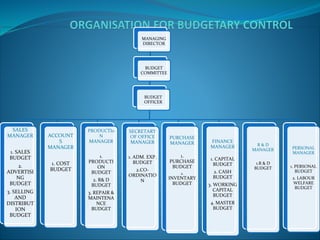
ORGANISATION CHART FOR 
BUDGETARY CONTROL
MANAGING 
DIRECTOR 
BUDGET 
COMMITTEE 
BUDGET 
OFFICER 
SALES 
MANAGER 
1. SALES 
BUDGET 
2. 
ADVERTISI 
NG 
BUDGET 
3. SELLING 
AND 
DISTRIBUT 
ION 
BUDGET 
ACCOUNT 
S 
MANAGER 
1. COST 
BUDGET 
PRODUCTI0 
N 
MANAGER 
1. 
PRODUCTI 
ON 
BUDGET 
2. R& D 
BUDGET 
3. REPAIR & 
MAINTENA 
NCE 
BUDGET 
SECRETARY 
OF OFFICE 
MANAGER 
1. ADM. EXP. 
BUDGET 
2.CO-ORDINATIO 
N 
PURCHASE 
MANAGER 
1. 
PURCHASE 
BUDGET 
2. 
INVENTARY 
BUDGET 
FINANCE 
MANAGER 
1. CAPITAL 
BUDGET 
2. CASH 
BUDGET 
3. WORKING 
CAPITAL 
BUDGET 
4. MASTER 
BUDGET 
R & D 
MANAGER 
1.R & D 
BUDGET 
PERSONAL 
MANAGER 
1. PERSONAL 
BUDGET 
2. LABOUR 
WELFARE 
BUDGET
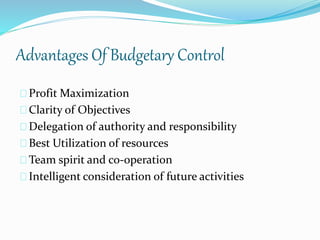
Advantages Of Budgetary Control 
Profit Maximization 
Clarity of Objectives 
Delegation of authority and responsibility 
Best Utilization of resources 
Team spirit and co-operation 
Intelligent consideration of future activities
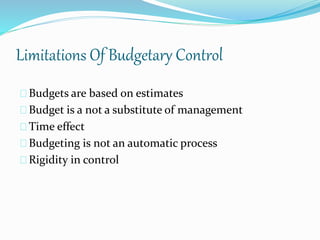
Limitations Of Budgetary Control 
Budgets are based on estimates 
Budget is a not a substitute of management 
Time effect 
Budgeting is not an automatic process 
Rigidity in control
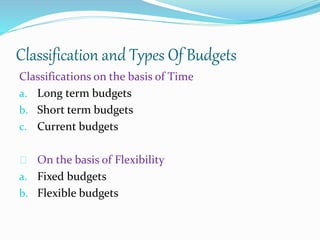
Classification and Types Of Budgets 
Classifications on the basis of Time 
a. Long term budgets 
b. Short term budgets 
c. Current budgets 
On the basis of Flexibility 
a. Fixed budgets 
b. Flexible budgets
On the basis of Function 
a. Operating budgets 
b. Financial budgets 
c. Master budgets
Some Typical Budgets 
Zero Based Budgeting 
“Zero based budgeting means budgeting all the 
activities of the org. from zero disregarding trends”
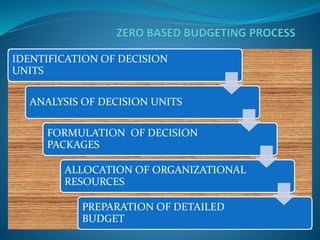
IDENTIFICATION OF DECISION 
UNITS 
ANALYSIS OF DECISION UNITS 
FORMULATION OF DECISION 
PACKAGES 
ALLOCATION OF ORGANIZATIONAL 
RESOURCES 
PREPARATION OF DETAILED 
BUDGET
MEANING OF PERFORMANCE 
BUDGETING 
Performance budgeting is an important tool of 
management to control the activities in various respect and 
to help specifically in the formulation of programmes 
objectives and their accomplishment. 
A budget which is based on the performance is called 
performance budgeting. It is a particular technique by 
which operations of an enterprise are to be presented in 
terms of function, programmes, activities and projects to 
be followed in a fixed period.
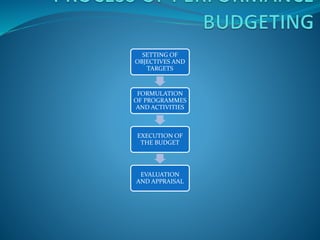
SETTING OF 
OBJECTIVES AND 
TARGETS 
FORMULATION 
OF PROGRAMMES 
AND ACTIVITIES 
EXECUTION OF 
THE BUDGET 
EVALUATION 
AND APPRAISAL

Budgetary control (2)

  • 2.
    Meaning Of BudgetaryControl The technique of managerial control by budget is known as budgetary control. It is applied in a firm to evaluate the performance in terms of budgeted goals
  • 3.
    Definition Of BudgetaryControl “Budgetary control is a system which uses budget as a mean of planning and controlling all aspects of producing and selling commodities or services” - J.Batty
  • 4.
    Budgetary Control canbe defined by the meaning of Budget:- “Budget is an estimate of future needs arranged according to an orderly basis covering some or all of the activities of an enterprise for a definite period of time” -George. R. Tesry
  • 5.
    Characteristics Of BudgetaryControl Planning Control Co-ordination Recording Appraisal and Follow up.
  • 6.
    Requisites For SuccessfulBudgetary Control System Clarifying Objectives Delegation of Authority and Responsibility Proper Communication System Budget Education Participation of all employees Flexibility
  • 7.
    Objectives Of Budgeting& Budgetary Control To pre-determine in capital expenditure of a business To plan and control the income and expenditure of the firm. To operate various divisions units, dept.,and cost centre efficiently and economically. To smooth out seasonal variations in production by developing new product. To obtain a more economical use of capital.
  • 8.
    ORGANISATION CHART FOR BUDGETARY CONTROL
  • 9.
    MANAGING DIRECTOR BUDGET COMMITTEE BUDGET OFFICER SALES MANAGER 1. SALES BUDGET 2. ADVERTISI NG BUDGET 3. SELLING AND DISTRIBUT ION BUDGET ACCOUNT S MANAGER 1. COST BUDGET PRODUCTI0 N MANAGER 1. PRODUCTI ON BUDGET 2. R& D BUDGET 3. REPAIR & MAINTENA NCE BUDGET SECRETARY OF OFFICE MANAGER 1. ADM. EXP. BUDGET 2.CO-ORDINATIO N PURCHASE MANAGER 1. PURCHASE BUDGET 2. INVENTARY BUDGET FINANCE MANAGER 1. CAPITAL BUDGET 2. CASH BUDGET 3. WORKING CAPITAL BUDGET 4. MASTER BUDGET R & D MANAGER 1.R & D BUDGET PERSONAL MANAGER 1. PERSONAL BUDGET 2. LABOUR WELFARE BUDGET
  • 10.
    Advantages Of BudgetaryControl Profit Maximization Clarity of Objectives Delegation of authority and responsibility Best Utilization of resources Team spirit and co-operation Intelligent consideration of future activities
  • 11.
    Limitations Of BudgetaryControl Budgets are based on estimates Budget is a not a substitute of management Time effect Budgeting is not an automatic process Rigidity in control
  • 12.
    Classification and TypesOf Budgets Classifications on the basis of Time a. Long term budgets b. Short term budgets c. Current budgets On the basis of Flexibility a. Fixed budgets b. Flexible budgets
  • 13.
    On the basisof Function a. Operating budgets b. Financial budgets c. Master budgets
  • 14.
    Some Typical Budgets Zero Based Budgeting “Zero based budgeting means budgeting all the activities of the org. from zero disregarding trends”
  • 15.
    IDENTIFICATION OF DECISION UNITS ANALYSIS OF DECISION UNITS FORMULATION OF DECISION PACKAGES ALLOCATION OF ORGANIZATIONAL RESOURCES PREPARATION OF DETAILED BUDGET
  • 16.
    MEANING OF PERFORMANCE BUDGETING Performance budgeting is an important tool of management to control the activities in various respect and to help specifically in the formulation of programmes objectives and their accomplishment. A budget which is based on the performance is called performance budgeting. It is a particular technique by which operations of an enterprise are to be presented in terms of function, programmes, activities and projects to be followed in a fixed period.
  • 17.
    SETTING OF OBJECTIVESAND TARGETS FORMULATION OF PROGRAMMES AND ACTIVITIES EXECUTION OF THE BUDGET EVALUATION AND APPRAISAL