PROBLEM BASED
LEARNING
.
BY
MS LISA CHADHA
F. Y MSC NURSING
BVCON, PUNE
INTRODUCTION:
O “Emphasis on meaning, not facts”
O Memorization- Traditional method.
O Problem based learning – engages
students in structuring real life
problems.
O Discovery method of teaching by
John Dewey 1930
O Refined by Jerome Burner and
Jean Piaget 1960.
History on PBL
O 1916--John Dewey’s progressive movement
belief that teachers should teach by appealing to
students natural instincts to investigate and
create.
O 1980--Howard Burrows, a physician and medical
educator, started using this approach to help
medical students better diagnose new illnesses
O 1985-High schools and Colleges start using this
approach
O 1990-1991, Schools began developing PBL
movements to improve student performance in
science and other disciplines 4
DEFINITION:
OBarrows defined problem based
learning as the individualized
learning that results from
process involved in working
towards the solution of the
problem.
OThe problem serves as the
stimulus, as well as search for
information.
PRINCIPLES:
OUnderstanding comes from our
interaction with the environment.
OCognitive conflicts stimulate
learning.
OKnowledge evolves through social
negotiation and evaluation of the
viability of individual understanding.
6
PURPOSES:
OTo gain an understanding of
principles that underline
phenomenon.
OAims at training problem analyzing
skills in particular professional
situation.
OTo exercise that students learn to
take decisions independently.
OTo activate prior knowledge and
integrate that knowledge.
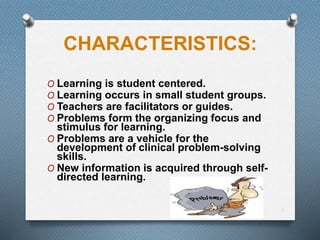
CHARACTERISTICS:
O Learning is student centered.
O Learning occurs in small student groups.
O Teachers are facilitators or guides.
O Problems form the organizing focus and
stimulus for learning.
O Problems are a vehicle for the
development of clinical problem-solving
skills.
O New information is acquired through self-
directed learning.
8
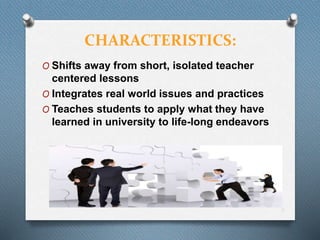
CHARACTERISTICS:
O Shifts away from short, isolated teacher
centered lessons
O Integrates real world issues and practices
O Teaches students to apply what they have
learned in university to life-long endeavors
9
Principles Behind PBL
OUnderstanding is built through what we
experience
OMeaning is created from efforts to answer
our own questions and solve our own
problems
OWe should appeal to students’ natural
instincts to investigate and create
OStudent-centered strategies build critical
thinking and reasoning skills and further
their creativity and independence 10
Role Changes
O In problem-based learning, the traditional
teacher and student roles change.
O The students assume increasing
responsibility for their learning, giving
them more motivation and more feelings of
accomplishment, setting the pattern for
them to become successful life-long
learners.
O The faculty in turn become resources,
tutors, and evaluators, guiding the
students in their problem solving efforts.11
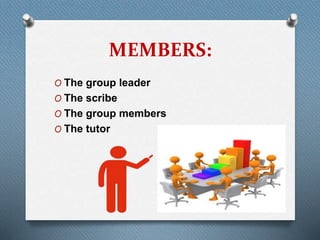
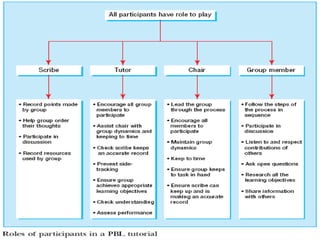
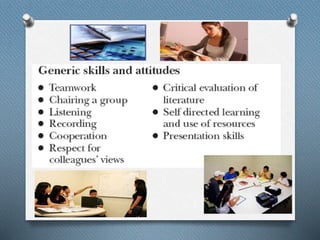
MEMBERS:
O The group leader
O The scribe
O The group members
O The tutor
Process of PBL
O Students confront a problem.
O In groups, students organize prior knowledge
and attempt to identify the nature of the problem.
O Students pose questions about what they do not
understand.
O Students design a plan to solve the problem and
identify the resources they need.
O Arrange possible explanations and working
hypotheses
O Students begin to gather information as they
work to solve the problem.
O Report back, synthesize explanations, and apply
newly acquired information to the problem 14
Characteristics of the PBL process
15
Usually based on clinical cases.
 Cases are characterized by “progressive
disclosure”
 Students come in “cold” to the first tutorial
 Students determine the learning issues
 Sessions are open-ended to allow learning.
 The tutor is a facilitator and not necessarily
an “expert”.
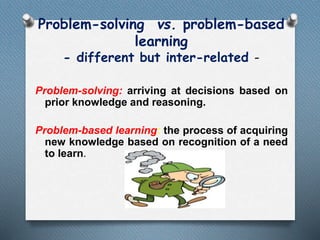
Problem-solving vs. problem-based
learning
- different but inter-related -
Problem-solving: arriving at decisions based on
prior knowledge and reasoning.
Problem-based learning: the process of acquiring
new knowledge based on recognition of a need
to learn.
17
18
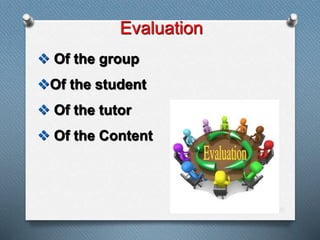
Evaluation
20
 Of the group
Of the student
 Of the tutor
 Of the Content
RECENT RESEARCH
STUDIES
1. IMPLEMENTATION OF PROBLEM
BASED LEARNING AMONG NURSING
STUDENTS
O International Education Studies; Vol. 7
O ISSN 1913-9020
O Online Published: June 26, 2014
21
22
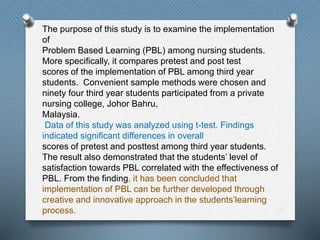
The purpose of this study is to examine the implementation
of
Problem Based Learning (PBL) among nursing students.
More specifically, it compares pretest and post test
scores of the implementation of PBL among third year
students. Convenient sample methods were chosen and
ninety four third year students participated from a private
nursing college, Johor Bahru,
Malaysia.
Data of this study was analyzed using t-test. Findings
indicated significant differences in overall
scores of pretest and posttest among third year students.
The result also demonstrated that the students’ level of
satisfaction towards PBL correlated with the effectiveness of
PBL. From the finding, it has been concluded that
implementation of PBL can be further developed through
creative and innovative approach in the students’learning
process.
23
2. Motivations for the Use of Problem-Based
Learning (PBL)for Preparation of
Undergraduate Nursing Students for
Professional Competences: A Literature
Review
International Journal of Nursing Science 2012,
ISSN NO : 20120205.02
24
The goal of this study was to examine the meaning and
application of problem-based learning
Asystematic investigation of available literature was conducted
in regard to the meaning and advantages of problem-based
learning as well as the role of both the facilitator and the
students regarding problem-based learning processinG health
education .
The target population for the concept “problem-based learning”
was the qualitative and quantitative studies on problem-based
learning in the field of education, health (medicine and nursing)
and psychology.
In the absence of local data on problem-based learning, a
series of searches of the EBSCO Host, and Medline data bases
were conducted. In addition, selected textbooks with definitions
and the uses for problem-based learning approached were
consulted. A purposeful sampling method was used.
25
Problem-Based Learning approach is worthy
implementing in undergraduate nursing
education.Problem-Based Learning approach
has proven to be an effective way of delivering
nursing education in a coherent, integrated way
and therefore offers more advantages over
traditional teaching methods
26
3.The problem-based learning
integrated with simulation to
improve nursing students’ self-
efficacy
Open Journal of Nursing, 2013, 3, 95-100
Published Online March 2013
27
The purposes of this study were to describe the simulation
integrated with problem-based learning (SIM-PBL) module to
educate the nursing process for clients with hypertension and to
evaluate its effectiveness on nursing students’ self-efficacy (SE).
Methods: This study was a one group pre- and post- test design.
Twenty five students received a 5-hour SIM-PBL program focused
on nursing care of clients with hypertension.
A newly developed self-report questionnaire was used to assess
SE in four areas of the nursing process with a scale of 0 (not at all
confi- dent) to 10 (totally confident)
The SIM-PBL module was effective in improv- ing the students’
self-efficacy in the nursing process for patients with hypertension.
Further studies are recommended in developing SIM-PBL modules
for diverse nursing topics and evaluating their effective- ness in
various aspects of students’ competence
ANY QUESTIONS????
28
BIBLIOGRAPHY:
O Devi Sanatombi Elsa, Manipal Manual of nursing
Education, 1st edition, CBS publishers and
distributers, New Delhi, 2012, chapter 6,pg no—
181 – 188.
O Baswanthappa B.T., Nursing Education, 2nd
edition, Jaypee medical publishers, New Delhi,
2009, chapter 2, pg no-310-317.
O Internet Source- www.pitt.edu/~super7/32011-
33001/32941.
O www.zums.ac.ir/files/education/Education.../prob
lem_based_learning. 29
30

Problem based learning

  • 1.
    PROBLEM BASED LEARNING . BY MS LISACHADHA F. Y MSC NURSING BVCON, PUNE
  • 3.
    INTRODUCTION: O “Emphasis onmeaning, not facts” O Memorization- Traditional method. O Problem based learning – engages students in structuring real life problems. O Discovery method of teaching by John Dewey 1930 O Refined by Jerome Burner and Jean Piaget 1960.
  • 4.
    History on PBL O1916--John Dewey’s progressive movement belief that teachers should teach by appealing to students natural instincts to investigate and create. O 1980--Howard Burrows, a physician and medical educator, started using this approach to help medical students better diagnose new illnesses O 1985-High schools and Colleges start using this approach O 1990-1991, Schools began developing PBL movements to improve student performance in science and other disciplines 4
  • 5.
    DEFINITION: OBarrows defined problembased learning as the individualized learning that results from process involved in working towards the solution of the problem. OThe problem serves as the stimulus, as well as search for information.
  • 6.
    PRINCIPLES: OUnderstanding comes fromour interaction with the environment. OCognitive conflicts stimulate learning. OKnowledge evolves through social negotiation and evaluation of the viability of individual understanding. 6
  • 7.
    PURPOSES: OTo gain anunderstanding of principles that underline phenomenon. OAims at training problem analyzing skills in particular professional situation. OTo exercise that students learn to take decisions independently. OTo activate prior knowledge and integrate that knowledge.
  • 8.
    CHARACTERISTICS: O Learning isstudent centered. O Learning occurs in small student groups. O Teachers are facilitators or guides. O Problems form the organizing focus and stimulus for learning. O Problems are a vehicle for the development of clinical problem-solving skills. O New information is acquired through self- directed learning. 8
  • 9.
    CHARACTERISTICS: O Shifts awayfrom short, isolated teacher centered lessons O Integrates real world issues and practices O Teaches students to apply what they have learned in university to life-long endeavors 9
  • 10.
    Principles Behind PBL OUnderstandingis built through what we experience OMeaning is created from efforts to answer our own questions and solve our own problems OWe should appeal to students’ natural instincts to investigate and create OStudent-centered strategies build critical thinking and reasoning skills and further their creativity and independence 10
  • 11.
    Role Changes O Inproblem-based learning, the traditional teacher and student roles change. O The students assume increasing responsibility for their learning, giving them more motivation and more feelings of accomplishment, setting the pattern for them to become successful life-long learners. O The faculty in turn become resources, tutors, and evaluators, guiding the students in their problem solving efforts.11
  • 12.
    MEMBERS: O The groupleader O The scribe O The group members O The tutor
  • 14.
    Process of PBL OStudents confront a problem. O In groups, students organize prior knowledge and attempt to identify the nature of the problem. O Students pose questions about what they do not understand. O Students design a plan to solve the problem and identify the resources they need. O Arrange possible explanations and working hypotheses O Students begin to gather information as they work to solve the problem. O Report back, synthesize explanations, and apply newly acquired information to the problem 14
  • 15.
    Characteristics of thePBL process 15 Usually based on clinical cases.  Cases are characterized by “progressive disclosure”  Students come in “cold” to the first tutorial  Students determine the learning issues  Sessions are open-ended to allow learning.  The tutor is a facilitator and not necessarily an “expert”.
  • 16.
    Problem-solving vs. problem-based learning -different but inter-related - Problem-solving: arriving at decisions based on prior knowledge and reasoning. Problem-based learning: the process of acquiring new knowledge based on recognition of a need to learn.
  • 17.
  • 18.
  • 20.
    Evaluation 20  Of thegroup Of the student  Of the tutor  Of the Content
  • 21.
    RECENT RESEARCH STUDIES 1. IMPLEMENTATIONOF PROBLEM BASED LEARNING AMONG NURSING STUDENTS O International Education Studies; Vol. 7 O ISSN 1913-9020 O Online Published: June 26, 2014 21
  • 22.
    22 The purpose ofthis study is to examine the implementation of Problem Based Learning (PBL) among nursing students. More specifically, it compares pretest and post test scores of the implementation of PBL among third year students. Convenient sample methods were chosen and ninety four third year students participated from a private nursing college, Johor Bahru, Malaysia. Data of this study was analyzed using t-test. Findings indicated significant differences in overall scores of pretest and posttest among third year students. The result also demonstrated that the students’ level of satisfaction towards PBL correlated with the effectiveness of PBL. From the finding, it has been concluded that implementation of PBL can be further developed through creative and innovative approach in the students’learning process.
  • 23.
    23 2. Motivations forthe Use of Problem-Based Learning (PBL)for Preparation of Undergraduate Nursing Students for Professional Competences: A Literature Review International Journal of Nursing Science 2012, ISSN NO : 20120205.02
  • 24.
    24 The goal ofthis study was to examine the meaning and application of problem-based learning Asystematic investigation of available literature was conducted in regard to the meaning and advantages of problem-based learning as well as the role of both the facilitator and the students regarding problem-based learning processinG health education . The target population for the concept “problem-based learning” was the qualitative and quantitative studies on problem-based learning in the field of education, health (medicine and nursing) and psychology. In the absence of local data on problem-based learning, a series of searches of the EBSCO Host, and Medline data bases were conducted. In addition, selected textbooks with definitions and the uses for problem-based learning approached were consulted. A purposeful sampling method was used.
  • 25.
    25 Problem-Based Learning approachis worthy implementing in undergraduate nursing education.Problem-Based Learning approach has proven to be an effective way of delivering nursing education in a coherent, integrated way and therefore offers more advantages over traditional teaching methods
  • 26.
    26 3.The problem-based learning integratedwith simulation to improve nursing students’ self- efficacy Open Journal of Nursing, 2013, 3, 95-100 Published Online March 2013
  • 27.
    27 The purposes ofthis study were to describe the simulation integrated with problem-based learning (SIM-PBL) module to educate the nursing process for clients with hypertension and to evaluate its effectiveness on nursing students’ self-efficacy (SE). Methods: This study was a one group pre- and post- test design. Twenty five students received a 5-hour SIM-PBL program focused on nursing care of clients with hypertension. A newly developed self-report questionnaire was used to assess SE in four areas of the nursing process with a scale of 0 (not at all confi- dent) to 10 (totally confident) The SIM-PBL module was effective in improv- ing the students’ self-efficacy in the nursing process for patients with hypertension. Further studies are recommended in developing SIM-PBL modules for diverse nursing topics and evaluating their effective- ness in various aspects of students’ competence
  • 28.
  • 29.
    BIBLIOGRAPHY: O Devi SanatombiElsa, Manipal Manual of nursing Education, 1st edition, CBS publishers and distributers, New Delhi, 2012, chapter 6,pg no— 181 – 188. O Baswanthappa B.T., Nursing Education, 2nd edition, Jaypee medical publishers, New Delhi, 2009, chapter 2, pg no-310-317. O Internet Source- www.pitt.edu/~super7/32011- 33001/32941. O www.zums.ac.ir/files/education/Education.../prob lem_based_learning. 29
  • 30.