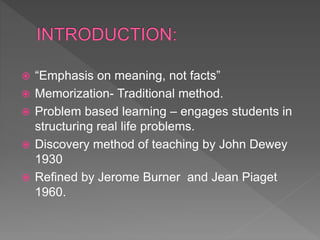
 “Emphasis on meaning, not facts”
 Memorization- Traditional method.
 Problem based learning – engages students in
structuring real life problems.
 Discovery method of teaching by John Dewey
1930
 Refined by Jerome Burner and Jean Piaget
1960.
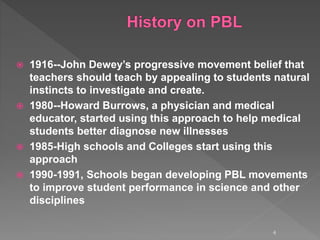
 1916--John Dewey’s progressive movement belief that
teachers should teach by appealing to students natural
instincts to investigate and create.
 1980--Howard Burrows, a physician and medical
educator, started using this approach to help medical
students better diagnose new illnesses
 1985-High schools and Colleges start using this
approach
 1990-1991, Schools began developing PBL movements
to improve student performance in science and other
disciplines
4
 Barrows defined problem based learning as
the individualized learning that results from
process involved in working towards the
solution of the problem.
 The problem serves as the stimulus, as well
as search for information.
 Understanding comes from our interaction
with the environment.
 Cognitive conflicts stimulate learning.
 Knowledge evolves through social
negotiation and evaluation of the viability of
individual understanding.
6
 To gain an understanding of principles that
underline phenomenon.
 Aims at training problem analyzing skills in
particular professional situation.
 To exercise that students learn to take decisions
independently.
 To activate prior knowledge and integrate that
knowledge.
 Learning is student centered.
 Learning occurs in small student groups.
 Teachers are facilitators or guides.
 Problems form the organizing focus and
stimulus for learning.
 Problems are a vehicle for the development of
clinical problem-solving skills.
 New information is acquired through self-
directed learning.
8
 Shifts away from short, isolated teacher
centered lessons
 Integrates real world issues and practices
 Teaches students to apply what they have
learned in university to life-long endeavors
9
 Understanding is built through what we
experience
 Meaning is created from efforts to answer
our own questions and solve our own
problems
 We should appeal to students’ natural
instincts to investigate and create
 Student-centered strategies build critical
thinking and reasoning skills and further their
creativity and independence
10
 In problem-based learning, the traditional
teacher and student roles change. The students
assume increasing responsibility for their
learning, giving them more motivation and
more feelings of accomplishment, setting the
pattern for them to become successful life-long
learners. The faculty in turn become resources,
tutors, and evaluators, guiding the students in
their problem solving efforts.
11
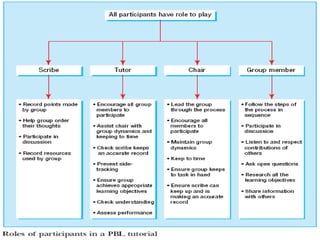
 The group leader
 The scribe
 The group members
 The tutor
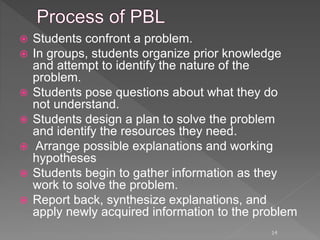
 Students confront a problem.
 In groups, students organize prior knowledge
and attempt to identify the nature of the
problem.
 Students pose questions about what they do
not understand.
 Students design a plan to solve the problem
and identify the resources they need.
 Arrange possible explanations and working
hypotheses
 Students begin to gather information as they
work to solve the problem.
 Report back, synthesize explanations, and
apply newly acquired information to the problem
14
15
 .
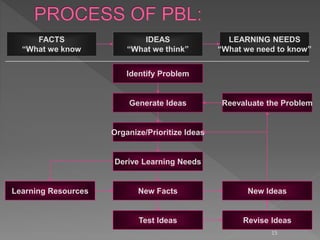
IDEAS
“What we think”
Identify Problem
Generate Ideas
Organize/Prioritize Ideas
Derive Learning Needs
New Facts
Test Ideas
LEARNING NEEDS
“What we need to know”
FACTS
“What we know
Learning Resources New Ideas
Revise Ideas
Reevaluate the Problem
16
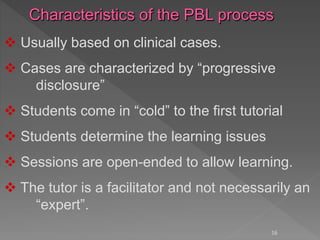
 Usually based on clinical cases.
 Cases are characterized by “progressive
disclosure”
 Students come in “cold” to the first tutorial
 Students determine the learning issues
 Sessions are open-ended to allow learning.
 The tutor is a facilitator and not necessarily an
“expert”.
Problem-solving: arriving at decisions based
on prior knowledge and reasoning.
Problem-based learning: the process of
acquiring new knowledge based on
recognition of a need to learn.
 Emphasis on Meaning, Not Facts
 Increased Self Direction
 Higher Comprehension and Better Skill
Development
 Interpersonal Skills and Teamwork
 Self-Motivated Attitude
 Facilitator-Student Relationship
 Level of Learning
18
 Demanding staff time.
 Stressful for staff and students.
 Students acquire less knowledge of basic
science.
 May be difficult to implement if class size is
large, or lack of enthusiasm.
20
21
 Of the group
Of the student
 Of the tutor
 Of the Content
22
 Devi Sanatombi Elsa, Manipal Manualof nursing
Education, 1st edition, CBS publishers and
distributoers, New Delhi, 2012, chapter 6,pg
no—181 – 188.
 Baswanthappa B.T., Nursing Education, 2nd
edition, Jaypee medical publishers, New Delhi,
2009, chapter 2, pg no-310-317.
 Internet Source- www.pitt.edu/~super7/32011-
33001/32941.
 www.zums.ac.ir/files/education/Education.../pro
blem_based_learning.
23
24

Problem based learning

  • 3.
     “Emphasis onmeaning, not facts”  Memorization- Traditional method.  Problem based learning – engages students in structuring real life problems.  Discovery method of teaching by John Dewey 1930  Refined by Jerome Burner and Jean Piaget 1960.
  • 4.
     1916--John Dewey’sprogressive movement belief that teachers should teach by appealing to students natural instincts to investigate and create.  1980--Howard Burrows, a physician and medical educator, started using this approach to help medical students better diagnose new illnesses  1985-High schools and Colleges start using this approach  1990-1991, Schools began developing PBL movements to improve student performance in science and other disciplines 4
  • 5.
     Barrows definedproblem based learning as the individualized learning that results from process involved in working towards the solution of the problem.  The problem serves as the stimulus, as well as search for information.
  • 6.
     Understanding comesfrom our interaction with the environment.  Cognitive conflicts stimulate learning.  Knowledge evolves through social negotiation and evaluation of the viability of individual understanding. 6
  • 7.
     To gainan understanding of principles that underline phenomenon.  Aims at training problem analyzing skills in particular professional situation.  To exercise that students learn to take decisions independently.  To activate prior knowledge and integrate that knowledge.
  • 8.
     Learning isstudent centered.  Learning occurs in small student groups.  Teachers are facilitators or guides.  Problems form the organizing focus and stimulus for learning.  Problems are a vehicle for the development of clinical problem-solving skills.  New information is acquired through self- directed learning. 8
  • 9.
     Shifts awayfrom short, isolated teacher centered lessons  Integrates real world issues and practices  Teaches students to apply what they have learned in university to life-long endeavors 9
  • 10.
     Understanding isbuilt through what we experience  Meaning is created from efforts to answer our own questions and solve our own problems  We should appeal to students’ natural instincts to investigate and create  Student-centered strategies build critical thinking and reasoning skills and further their creativity and independence 10
  • 11.
     In problem-basedlearning, the traditional teacher and student roles change. The students assume increasing responsibility for their learning, giving them more motivation and more feelings of accomplishment, setting the pattern for them to become successful life-long learners. The faculty in turn become resources, tutors, and evaluators, guiding the students in their problem solving efforts. 11
  • 12.
     The groupleader  The scribe  The group members  The tutor
  • 14.
     Students confronta problem.  In groups, students organize prior knowledge and attempt to identify the nature of the problem.  Students pose questions about what they do not understand.  Students design a plan to solve the problem and identify the resources they need.  Arrange possible explanations and working hypotheses  Students begin to gather information as they work to solve the problem.  Report back, synthesize explanations, and apply newly acquired information to the problem 14
  • 15.
    15  . IDEAS “What wethink” Identify Problem Generate Ideas Organize/Prioritize Ideas Derive Learning Needs New Facts Test Ideas LEARNING NEEDS “What we need to know” FACTS “What we know Learning Resources New Ideas Revise Ideas Reevaluate the Problem
  • 16.
    16  Usually basedon clinical cases.  Cases are characterized by “progressive disclosure”  Students come in “cold” to the first tutorial  Students determine the learning issues  Sessions are open-ended to allow learning.  The tutor is a facilitator and not necessarily an “expert”.
  • 17.
    Problem-solving: arriving atdecisions based on prior knowledge and reasoning. Problem-based learning: the process of acquiring new knowledge based on recognition of a need to learn.
  • 18.
     Emphasis onMeaning, Not Facts  Increased Self Direction  Higher Comprehension and Better Skill Development  Interpersonal Skills and Teamwork  Self-Motivated Attitude  Facilitator-Student Relationship  Level of Learning 18
  • 20.
     Demanding stafftime.  Stressful for staff and students.  Students acquire less knowledge of basic science.  May be difficult to implement if class size is large, or lack of enthusiasm. 20
  • 21.
    21  Of thegroup Of the student  Of the tutor  Of the Content
  • 22.
  • 23.
     Devi SanatombiElsa, Manipal Manualof nursing Education, 1st edition, CBS publishers and distributoers, New Delhi, 2012, chapter 6,pg no—181 – 188.  Baswanthappa B.T., Nursing Education, 2nd edition, Jaypee medical publishers, New Delhi, 2009, chapter 2, pg no-310-317.  Internet Source- www.pitt.edu/~super7/32011- 33001/32941.  www.zums.ac.ir/files/education/Education.../pro blem_based_learning. 23
  • 24.