

PROBLEM BASED
LEARNING (PBL)
Ms. Mamta Bisht
Assistant Professor
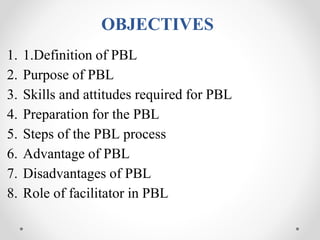
OBJECTIVES
1. 1.Definition of PBL
2. Purpose of PBL
3. Skills and attitudes required for PBL
4. Preparation for the PBL
5. Steps of the PBL process
6. Advantage of PBL
7. Disadvantages of PBL
8. Role of facilitator in PBL
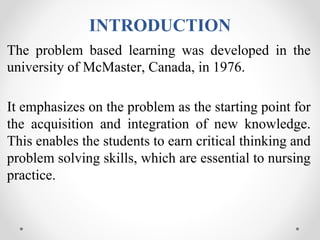
INTRODUCTION
The problem based learning was developed in the
university of McMaster, Canada, in 1976.
It emphasizes on the problem as the starting point for
the acquisition and integration of new knowledge.
This enables the students to earn critical thinking and
problem solving skills, which are essential to nursing
practice.
DEFINITION
Problem based learning is a curriculum development
and instructional method that places the student in an
active role as a problem solver confronted with ill-
structured, real –life problems. this method is
commonly characterized by five facts:
1. Ill- structured problem
2. Real life significance
3. Student-led
4. Instructor facilitated
5. Community focussed
PURPOSE OF PBL
1. Acquires necessary knowledge and skills.
2. Increases the knowledge and skills of students
with PBL instructions.
3. Changes the student learning behaviour.
4. Makes them more likely to use versatile and
meaningful approaches to study, use textbooks
and other books.
5. Learn how to apply this method.
6. Students become a lifelong learners.
SKILLS AND ATTITUDES REQUIRED
FOR PBL
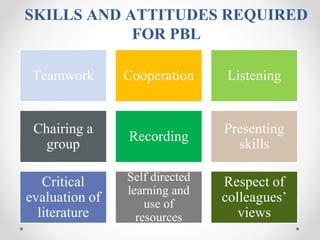
Teamwork Cooperation Listening
Chairing a
group
Recording
Presenting
skills
Critical
evaluation of
literature
Self directed
learning and
use of
resources
Respect of
colleagues’
views
PREPARATION AND CONDUCT OF
PBL
• A PBL session consists of a group of students
(usually 8-10) and the teacher as the facilitator.
• The length of time (number of sessions ) depends
on the situation
• Students elect a chair for each PBL scenario and a
‘recorder’ to record/note the discussion
• Suitable flip charts or a white board should be
used for recording the proceedings.
Contd….
• At the start of a session, depending on the trigger
material. Either the student chair reads out the
scenario or all the students study the material.
• If the trigger is a real patient in a ward, clinic, or
community, the student may be asked to take
down the clinical history, or identify the abnormal
physical signs before the group moves to a ward
teaching room.
• At the end, facilitator gives feedback to the group
and obtains feedback from the group using a
format.
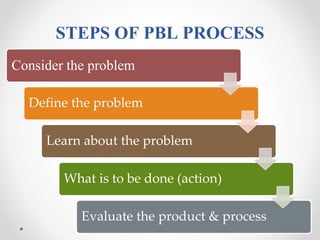
STEPS OF PBL PROCESS
Consider the problem
Define the problem
Learn about the problem
What is to be done (action)
Evaluate the product & process
ADVANTAGES OF PBL
1. It develops complex problem solving abilities and
increases creative thinking.
2. It inculcates critical thinking and clinical
reasoning.
3. It makes learning enjoyable and promotes close,
friendly, more equal student-teacher
relationships.
4. The learners ‘communication skills, self
expression, and presentation skills are improved.
5. Helps to make learning more permanent.
ADVANTAGES contd….
6. Promotes student centred learning.
7. Participating in this method creates interest and
motivation in students.
8. It helps the students apply the learned knowledge
to practice.
9. It encourages self-learning and promotes better
lifelong learning.
10. Secure participation of all students of the group
and helps in building team spirit and collaboration.
DISADVANTAGES OF PBL
1. It demands significant time and the team’s
dedicated effort to design effective PBL.
2. The process requires more contact hours on the
part of the teacher.
3. All teachers may not be good facilitators, they
need to be dedicated and trained.
4. It reduces specific content knowledge and is more
suitable for subjects that do not depend too much
on prior content knowledge.
DISADVANTAGES OF PBL contd…
5. There is difficulty in assessing students in group
work, as recognising both individual output and
teamwork are important.
6. Acting as facilitators may appear difficult and
frustrating for teachers who enjoy passing on their
own knowledge and understanding.
7. There may be a lack of clarity among students
about how much self-directed study to do and what
information is relevant and useful.
ROLE OF THE FACILITATATOR IN
PBL
1. The facilitator helps the student engage in
reflective thinking.
1. The facilitator may question the students to help
them understand what they do not know about the
problem, as well as the question about decisions
they have made regarding the problem.
ROLE OF THE FACILITATATOR
contd…
3. Facilitate the proceedings and ensure that the
group achieves appropriate learning objectives.
4. Ensure that all the students have done the
appropriate work.
5. Check the students understanding of the material.
SUMMARY
PBL builds on the students backgrounds,
expectations and interests. It is common for students
to be motivated to work much harder with the PBL
Model than with the traditional teaching methods. As
an important student-centred method of teaching,
PBL can also support other conventional methods of
teaching. This approach strengthens self-learning
skills, enhances, accessing of learning resources, and
improves lifelong learning.
BIBLIOGRAPHY
1. K.P.Neerja, “Textbook Of Nursing Education”,
Jaypee Publications,2nd Edition,pg No.283-295.
2. R.Sudha, “Nursing Education Principles &
Concepts, Jaypee Publications 1st Edition,pg
No.91-113.
3. B.T.Basvanthappa, “Textbook Of Nursing
Education”, Jaypee Publications,2nd Edition,pg
No.392-412.
4. S.K.Kochhar, “Methods & Techniques Of
Teaching”,sterling Publications,1st Edition,pg
No.53-68
Problem based Learning  (PBL) .pptx

Problem based Learning (PBL) .pptx

  • 1.
    PROBLEM BASED LEARNING (PBL) Ms.Mamta Bisht Assistant Professor
  • 2.
    OBJECTIVES 1. 1.Definition ofPBL 2. Purpose of PBL 3. Skills and attitudes required for PBL 4. Preparation for the PBL 5. Steps of the PBL process 6. Advantage of PBL 7. Disadvantages of PBL 8. Role of facilitator in PBL
  • 3.
    INTRODUCTION The problem basedlearning was developed in the university of McMaster, Canada, in 1976. It emphasizes on the problem as the starting point for the acquisition and integration of new knowledge. This enables the students to earn critical thinking and problem solving skills, which are essential to nursing practice.
  • 4.
    DEFINITION Problem based learningis a curriculum development and instructional method that places the student in an active role as a problem solver confronted with ill- structured, real –life problems. this method is commonly characterized by five facts: 1. Ill- structured problem 2. Real life significance 3. Student-led 4. Instructor facilitated 5. Community focussed
  • 5.
    PURPOSE OF PBL 1.Acquires necessary knowledge and skills. 2. Increases the knowledge and skills of students with PBL instructions. 3. Changes the student learning behaviour. 4. Makes them more likely to use versatile and meaningful approaches to study, use textbooks and other books. 5. Learn how to apply this method. 6. Students become a lifelong learners.
  • 6.
    SKILLS AND ATTITUDESREQUIRED FOR PBL Teamwork Cooperation Listening Chairing a group Recording Presenting skills Critical evaluation of literature Self directed learning and use of resources Respect of colleagues’ views
  • 7.
    PREPARATION AND CONDUCTOF PBL • A PBL session consists of a group of students (usually 8-10) and the teacher as the facilitator. • The length of time (number of sessions ) depends on the situation • Students elect a chair for each PBL scenario and a ‘recorder’ to record/note the discussion • Suitable flip charts or a white board should be used for recording the proceedings.
  • 8.
    Contd…. • At thestart of a session, depending on the trigger material. Either the student chair reads out the scenario or all the students study the material. • If the trigger is a real patient in a ward, clinic, or community, the student may be asked to take down the clinical history, or identify the abnormal physical signs before the group moves to a ward teaching room. • At the end, facilitator gives feedback to the group and obtains feedback from the group using a format.
  • 9.
    STEPS OF PBLPROCESS Consider the problem Define the problem Learn about the problem What is to be done (action) Evaluate the product & process
  • 10.
    ADVANTAGES OF PBL 1.It develops complex problem solving abilities and increases creative thinking. 2. It inculcates critical thinking and clinical reasoning. 3. It makes learning enjoyable and promotes close, friendly, more equal student-teacher relationships. 4. The learners ‘communication skills, self expression, and presentation skills are improved. 5. Helps to make learning more permanent.
  • 11.
    ADVANTAGES contd…. 6. Promotesstudent centred learning. 7. Participating in this method creates interest and motivation in students. 8. It helps the students apply the learned knowledge to practice. 9. It encourages self-learning and promotes better lifelong learning. 10. Secure participation of all students of the group and helps in building team spirit and collaboration.
  • 12.
    DISADVANTAGES OF PBL 1.It demands significant time and the team’s dedicated effort to design effective PBL. 2. The process requires more contact hours on the part of the teacher. 3. All teachers may not be good facilitators, they need to be dedicated and trained. 4. It reduces specific content knowledge and is more suitable for subjects that do not depend too much on prior content knowledge.
  • 13.
    DISADVANTAGES OF PBLcontd… 5. There is difficulty in assessing students in group work, as recognising both individual output and teamwork are important. 6. Acting as facilitators may appear difficult and frustrating for teachers who enjoy passing on their own knowledge and understanding. 7. There may be a lack of clarity among students about how much self-directed study to do and what information is relevant and useful.
  • 14.
    ROLE OF THEFACILITATATOR IN PBL 1. The facilitator helps the student engage in reflective thinking. 1. The facilitator may question the students to help them understand what they do not know about the problem, as well as the question about decisions they have made regarding the problem.
  • 15.
    ROLE OF THEFACILITATATOR contd… 3. Facilitate the proceedings and ensure that the group achieves appropriate learning objectives. 4. Ensure that all the students have done the appropriate work. 5. Check the students understanding of the material.
  • 16.
    SUMMARY PBL builds onthe students backgrounds, expectations and interests. It is common for students to be motivated to work much harder with the PBL Model than with the traditional teaching methods. As an important student-centred method of teaching, PBL can also support other conventional methods of teaching. This approach strengthens self-learning skills, enhances, accessing of learning resources, and improves lifelong learning.
  • 17.
    BIBLIOGRAPHY 1. K.P.Neerja, “TextbookOf Nursing Education”, Jaypee Publications,2nd Edition,pg No.283-295. 2. R.Sudha, “Nursing Education Principles & Concepts, Jaypee Publications 1st Edition,pg No.91-113. 3. B.T.Basvanthappa, “Textbook Of Nursing Education”, Jaypee Publications,2nd Edition,pg No.392-412. 4. S.K.Kochhar, “Methods & Techniques Of Teaching”,sterling Publications,1st Edition,pg No.53-68