PRESENTEDBY:
Ms. Lisa. Chadha
S.Y.MSc. Nursing
B.V.CON
Pune
 DEFINITION OF ADMINISTRATION:
"Administration is the organization & direction of human
and material resources to achieve desired ends".
-Pfiffner and Presthus.
"Administration is the direction, coordination and control of
many persons to achieve same purposes or objective
- Nigro
ISSUES IN NURSING
ADMINISTRATION
MEETING THE CHALLENGES
 NURSING SCENARIO IN INDIA
• Many States in India face a shortage of nurses and
midwives. Most of the states have no system of re-
registration of nurses. About 13-28 lakh nurses and
6.18 lakh ANMs have been registered with the
various State Nursing Councils.
• However, only 40 percent of registered nurses in
India are in service, the said figure includes all the
nurses who have been trained since 1947
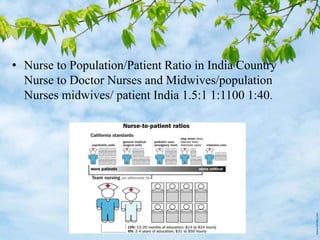
• Nurse to Population/Patient Ratio in India Country
Nurse to Doctor Nurses and Midwives/population
Nurses midwives/ patient India 1.5:1 1:1100 1:40.
VARIOUS CHALLENGES IN NURSING
ADMINISTRATION AND FACTORS TO
OVERCOME WITH THOSE
CHALLENGES
1. Nursing staffing and patient care
• Overworked and underpaid nursing staff member are
demotivated and dissatisfied and have impact on patient
safety issues; patient care suffers and lack of time can
lead to poor patient nurse communication. Quality of
care also suffers.
• Stress and burnout among nursing personnel
• Violations
• Have a significant impact on nosocomial infections
• Reduce time nurses have to help other nurses.
• Difficulty in training or supervision of new nurses.
2. Nursing structure at Ministry of Health and family
Welfare
• Nursing Cadre in Health care System.
• Nursing Education/Research system in India.
• Cadre in School and college of Nursing.
• Nursing faculty of all Colleges of Nursing should be
granted UGC Scales and nomenclatures.
• Cadre in Hospital Nursing Services.
3. Issues related to salary structure
• Nursing Allowance (NA)
• Non-Practicing Allowance (NPA)
• Qualification allowance such as Incentives for Ph.D and
M.Phil Qualification
• House Rent Allowance, Telephone/mobile/ internet
allowance ,Conveyance Allowance, Telephone/mobile/
internet allowance etc.
Recommendations for faculities
creche facility facility during night duty ,uniformity in
employment procedure , job description, working hours
4. Harassment of Nurses by others
There are some instances occurred in various
circumstances in different places, harassment of nurses
by clerical staff, it while taking their salaries and claiming
other arrears leave of their own credit and sometimes by
the administrators of the institution..
.
CURRENT TRENDS
IN NURSING
ADMINISTRATION
1. Changing demographics and increasing diversity
• Increase in the diversity of the population which
affects the nature and the prevalence of illness and
disease, requiring changes in practice that reflect and
respect diverse values and beliefs.
• Disparities in morbidity, mortality, and access to care
among population sectors have increased, even as
socioeconomic and other factors have led to
increased violence and substance abuse.
• Ethnic and racial diversity of nursing institutes
creating a rich cultural environment for learning.
2. The Technological Explosion
• There is reduction in distance through speedy
communication. Advances in digital technology have
increased the applications of tele-health and
telemedicine mobiles, e-line, video conferences,
bringing together patient and provider without physical
proximity.
• Nanotechnology is a new form of clinical diagnosis and
treatment, which is capable of detecting a wide range
of diseases from very minute specimens. There is
computerization for patient care management.
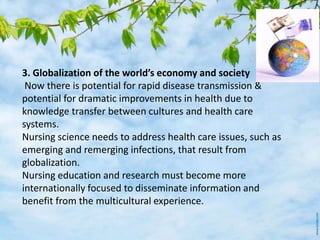
3. Globalization of the world’s economy and society
Now there is potential for rapid disease transmission &
potential for dramatic improvements in health due to
knowledge transfer between cultures and health care
systems.
Nursing science needs to address health care issues, such as
emerging and remerging infections, that result from
globalization.
Nursing education and research must become more
internationally focused to disseminate information and
benefit from the multicultural experience.
4. Quality assurance in Nursing care
• Public knows their rights, human rights, commissions ,
protection acts and process etc, are putting constant
pressures on the professionals to deliver their best.
• Professionals cannot ignore or be careless in
discharging duties especially when it concerns people
lives and health.
• Nurse managers have to ensure delivery of quality care
by practicing as per standards laid down by their
counsels and institutions.
5. Decentralised approach to care Management
• This makes each and every nurse responsible and accountable
for the care of assigned patients.
• patients satisfaction, quality care and smooth functioning of
the units.
• It focuses on problem solving on the spot with the joint
participation of the supervisee and supervisor.
6. continuing Nursing education
• It has become essential to keep up with the changing needs of
patient care.
• Nurses have to continuously update themselves with new and
innovative approaches in patient care management.
• For this they should enable themselves with workshops,
seminars, short term training programmes, attend conferences,
make use of library, subscribe and read periodicals and books.
• Discussion on bedside and supportive supervision helps to keep
abreast with newer techniques and information.
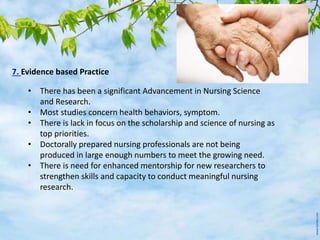
7. Evidence based Practice
• There has been a significant Advancement in Nursing Science
and Research.
• Most studies concern health behaviors, symptom.
• There is lack in focus on the scholarship and science of nursing as
top priorities.
• Doctorally prepared nursing professionals are not being
produced in large enough numbers to meet the growing need.
• There is need for enhanced mentorship for new researchers to
strengthen skills and capacity to conduct meaningful nursing
research.
8. Nursing audits
• Regular nursing audits promotes
ensures quality of care provided to the
the clients and upliftment of standards
of nursing care.
9. Collective bargaining
• Collective bargaining is the uniting of the employees for
the purpose of increasing their ability to influence their
employer and to improve the working conditions.
• Collective bargaining is based on the principle that there
is greater strength in large numbers.
10. Case management, disease management, and
tele health care expand:
• There is a demand to manage the care from a
distance, being more people at home and in
remote areas with chronic diseases and
complicated treatment regimens, through the
use of telephones, television monitors, and
telecommunication.
•
• Nursing education go online
• Various courses of nursing education will go online
in future.
• Wellness centers, Holistic and Alternative therapies
• There is a great focus on promoting health and
triggering the body’s natural healing powers through
holistic and alternative therapies (e.g exercise,
massage, acupuncture etc.)
CONCLUSION
• Nursing sisters are not adequately prepared and
oriented to carry out their role. Hospital
Administrators and Nursing administrators need
to organize orientation programmes and
inservice education programmes to orient and
update nursing sisters on management
techniques. Nursing sisters should utilize every
opportunity to empower them as a responsible
and accountable leader of her team in the ward
to provide quality health care to the patients.
RESEARCH STUDY
• Professional Nursing: Trends and
Adjustments
• JIMSA July-September 2012 Vol. 25 No. 3
conclusion
• Rapid change in the nursing and health care delivery
environment has created an irresolvable dilemma for the
nursing services.These changes include a major
reconfiguration of the health care delivery system,
unprecedented technological advances, and enormous
changes in the expectations of the
• health care consumer. Enormous advances in the use of
technology have been incorporated into the delivery of
health care services.
• With acceptance of the World Wide Web, many health care
organizations implemented mechanisms for using this
technology to enhance access to health care services
• and to provide more efficient care to those whose access to
the traditional system is limited by distance and other factors.
Bibliography
1. BT Basavanthappa Textbook of Nursing Services and Education, Jaypee
Brothers and Medical Publishers Private limited New Delhi First edition-2011.
2. Joginder Vati Principles and practice of Nursing Management and
Administration for Bsc and Msc Nursing Jaypee Brothers and Medical
Publishers Private limited New Delhi First edition-2013.
3. Clement I Management of nursing services and education , Elseiver
publishers.
4.https://nursingon.blogspot.in/2015/06/current-trentds-and-issues-in-
nursing.html.
5.http://nursingreviewers.forumotion.net/t205-man205-trends-issues-in-
nursing-administration
6.online.stmary.edu/msn/resources/trends-in-nursing.
7.ners.unair.ac.id/materikuliah/Rapport%20traduction%20ENG%20mars%200
6.pd
8. www.nursingcenter.com/journalarticle?Article_ID=532283
Current trends and issues in nsg

Current trends and issues in nsg

  • 1.
  • 2.
     DEFINITION OFADMINISTRATION: "Administration is the organization & direction of human and material resources to achieve desired ends". -Pfiffner and Presthus. "Administration is the direction, coordination and control of many persons to achieve same purposes or objective - Nigro
  • 3.
  • 4.
  • 5.
     NURSING SCENARIOIN INDIA • Many States in India face a shortage of nurses and midwives. Most of the states have no system of re- registration of nurses. About 13-28 lakh nurses and 6.18 lakh ANMs have been registered with the various State Nursing Councils. • However, only 40 percent of registered nurses in India are in service, the said figure includes all the nurses who have been trained since 1947
  • 6.
    • Nurse toPopulation/Patient Ratio in India Country Nurse to Doctor Nurses and Midwives/population Nurses midwives/ patient India 1.5:1 1:1100 1:40.
  • 7.
    VARIOUS CHALLENGES INNURSING ADMINISTRATION AND FACTORS TO OVERCOME WITH THOSE CHALLENGES
  • 8.
    1. Nursing staffingand patient care • Overworked and underpaid nursing staff member are demotivated and dissatisfied and have impact on patient safety issues; patient care suffers and lack of time can lead to poor patient nurse communication. Quality of care also suffers. • Stress and burnout among nursing personnel • Violations • Have a significant impact on nosocomial infections • Reduce time nurses have to help other nurses. • Difficulty in training or supervision of new nurses.
  • 9.
    2. Nursing structureat Ministry of Health and family Welfare • Nursing Cadre in Health care System. • Nursing Education/Research system in India. • Cadre in School and college of Nursing. • Nursing faculty of all Colleges of Nursing should be granted UGC Scales and nomenclatures. • Cadre in Hospital Nursing Services.
  • 10.
    3. Issues relatedto salary structure • Nursing Allowance (NA) • Non-Practicing Allowance (NPA) • Qualification allowance such as Incentives for Ph.D and M.Phil Qualification • House Rent Allowance, Telephone/mobile/ internet allowance ,Conveyance Allowance, Telephone/mobile/ internet allowance etc. Recommendations for faculities creche facility facility during night duty ,uniformity in employment procedure , job description, working hours
  • 11.
    4. Harassment ofNurses by others There are some instances occurred in various circumstances in different places, harassment of nurses by clerical staff, it while taking their salaries and claiming other arrears leave of their own credit and sometimes by the administrators of the institution.. .
  • 12.
  • 13.
    1. Changing demographicsand increasing diversity • Increase in the diversity of the population which affects the nature and the prevalence of illness and disease, requiring changes in practice that reflect and respect diverse values and beliefs. • Disparities in morbidity, mortality, and access to care among population sectors have increased, even as socioeconomic and other factors have led to increased violence and substance abuse. • Ethnic and racial diversity of nursing institutes creating a rich cultural environment for learning.
  • 14.
    2. The TechnologicalExplosion • There is reduction in distance through speedy communication. Advances in digital technology have increased the applications of tele-health and telemedicine mobiles, e-line, video conferences, bringing together patient and provider without physical proximity. • Nanotechnology is a new form of clinical diagnosis and treatment, which is capable of detecting a wide range of diseases from very minute specimens. There is computerization for patient care management.
  • 15.
    3. Globalization ofthe world’s economy and society Now there is potential for rapid disease transmission & potential for dramatic improvements in health due to knowledge transfer between cultures and health care systems. Nursing science needs to address health care issues, such as emerging and remerging infections, that result from globalization. Nursing education and research must become more internationally focused to disseminate information and benefit from the multicultural experience.
  • 16.
    4. Quality assurancein Nursing care • Public knows their rights, human rights, commissions , protection acts and process etc, are putting constant pressures on the professionals to deliver their best. • Professionals cannot ignore or be careless in discharging duties especially when it concerns people lives and health. • Nurse managers have to ensure delivery of quality care by practicing as per standards laid down by their counsels and institutions.
  • 17.
    5. Decentralised approachto care Management • This makes each and every nurse responsible and accountable for the care of assigned patients. • patients satisfaction, quality care and smooth functioning of the units. • It focuses on problem solving on the spot with the joint participation of the supervisee and supervisor.
  • 18.
    6. continuing Nursingeducation • It has become essential to keep up with the changing needs of patient care. • Nurses have to continuously update themselves with new and innovative approaches in patient care management. • For this they should enable themselves with workshops, seminars, short term training programmes, attend conferences, make use of library, subscribe and read periodicals and books. • Discussion on bedside and supportive supervision helps to keep abreast with newer techniques and information.
  • 19.
    7. Evidence basedPractice • There has been a significant Advancement in Nursing Science and Research. • Most studies concern health behaviors, symptom. • There is lack in focus on the scholarship and science of nursing as top priorities. • Doctorally prepared nursing professionals are not being produced in large enough numbers to meet the growing need. • There is need for enhanced mentorship for new researchers to strengthen skills and capacity to conduct meaningful nursing research.
  • 20.
    8. Nursing audits •Regular nursing audits promotes ensures quality of care provided to the the clients and upliftment of standards of nursing care.
  • 21.
    9. Collective bargaining •Collective bargaining is the uniting of the employees for the purpose of increasing their ability to influence their employer and to improve the working conditions. • Collective bargaining is based on the principle that there is greater strength in large numbers.
  • 22.
    10. Case management,disease management, and tele health care expand: • There is a demand to manage the care from a distance, being more people at home and in remote areas with chronic diseases and complicated treatment regimens, through the use of telephones, television monitors, and telecommunication. •
  • 23.
    • Nursing educationgo online • Various courses of nursing education will go online in future. • Wellness centers, Holistic and Alternative therapies • There is a great focus on promoting health and triggering the body’s natural healing powers through holistic and alternative therapies (e.g exercise, massage, acupuncture etc.)
  • 24.
    CONCLUSION • Nursing sistersare not adequately prepared and oriented to carry out their role. Hospital Administrators and Nursing administrators need to organize orientation programmes and inservice education programmes to orient and update nursing sisters on management techniques. Nursing sisters should utilize every opportunity to empower them as a responsible and accountable leader of her team in the ward to provide quality health care to the patients.
  • 25.
    RESEARCH STUDY • ProfessionalNursing: Trends and Adjustments • JIMSA July-September 2012 Vol. 25 No. 3
  • 26.
    conclusion • Rapid changein the nursing and health care delivery environment has created an irresolvable dilemma for the nursing services.These changes include a major reconfiguration of the health care delivery system, unprecedented technological advances, and enormous changes in the expectations of the • health care consumer. Enormous advances in the use of technology have been incorporated into the delivery of health care services. • With acceptance of the World Wide Web, many health care organizations implemented mechanisms for using this technology to enhance access to health care services • and to provide more efficient care to those whose access to the traditional system is limited by distance and other factors.
  • 27.
    Bibliography 1. BT BasavanthappaTextbook of Nursing Services and Education, Jaypee Brothers and Medical Publishers Private limited New Delhi First edition-2011. 2. Joginder Vati Principles and practice of Nursing Management and Administration for Bsc and Msc Nursing Jaypee Brothers and Medical Publishers Private limited New Delhi First edition-2013. 3. Clement I Management of nursing services and education , Elseiver publishers. 4.https://nursingon.blogspot.in/2015/06/current-trentds-and-issues-in- nursing.html. 5.http://nursingreviewers.forumotion.net/t205-man205-trends-issues-in- nursing-administration 6.online.stmary.edu/msn/resources/trends-in-nursing. 7.ners.unair.ac.id/materikuliah/Rapport%20traduction%20ENG%20mars%200 6.pd 8. www.nursingcenter.com/journalarticle?Article_ID=532283