PROBLEM/ ISSUE BASED
LEARNING
PRESENTED BY:
<DE JESUS, AIRA B.>
<PORTUGUEZ, MA. THERESA E.>
P
B
L
roblem
ased
earning
What is it??
PROBLEM/ ISSUE BASED LEARNING
• An educational approach that challenges
students to work cooperatively in groups
to seek solutions to real-world problems
and to develop skills to become self-
directed learners.
• A process of acquiring and understanding of
knowledge, skills in the context of an
unfamiliar situation and applying that
learning to the situation.
HISTORICAL BACKGROUND
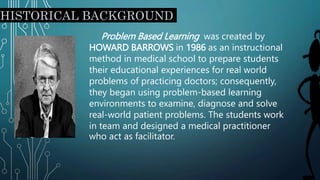
Problem Based Learning was created by
HOWARD BARROWS in 1986 as an instructional
method in medical school to prepare students
their educational experiences for real world
problems of practicing doctors; consequently,
they began using problem-based learning
environments to examine, diagnose and solve
real-world patient problems. The students work
in team and designed a medical practitioner
who act as facilitator.
CHARACTERISTICS:
 Learner-centered
 Learning occurs in a small student groups
 Teachers are facilitators or guides.
 Problems form the organizing focus and stimulus fo
learning
 New information is acquired through self-directed
learning.
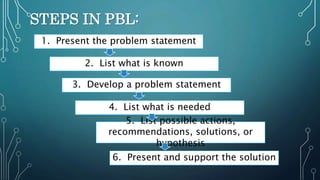
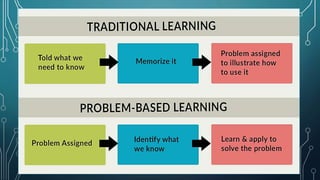
1. Present the problem statement
2. List what is known
3. Develop a problem statement
4. List what is needed
5. List possible actions,
recommendations, solutions, or
hypothesis
6. Present and support the solution
STEPS IN PBL:
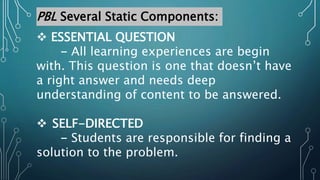
PBL Several Static Components:
 ESSENTIAL QUESTION
- All learning experiences are begin
with. This question is one that doesn’t have
a right answer and needs deep
understanding of content to be answered.
 SELF-DIRECTED
- Students are responsible for finding a
solution to the problem.
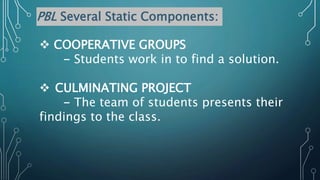
PBL Several Static Components:
 COOPERATIVE GROUPS
- Students work in to find a solution.
 CULMINATING PROJECT
- The team of students presents their
findings to the class.
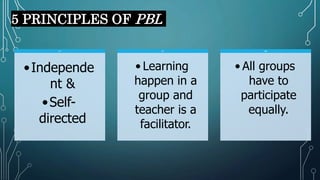
5 PRINCIPLES OF PBL
#1
•Independe
nt &
•Self-
directed
#2
• Learning
happen in a
group and
teacher is a
facilitator.
#3
• All groups
have to
participate
equally.
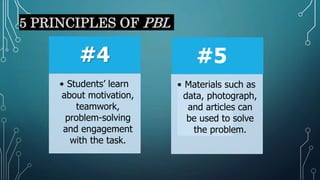
#4
• Students’ learn
about motivation,
teamwork,
problem-solving
and engagement
with the task.
#
#5
• Materials such as
data, photograph,
and articles can
be used to solve
the problem.
5 PRINCIPLES OF PBL
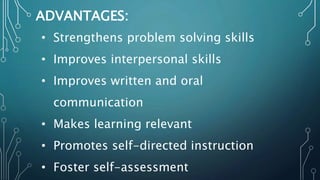
ADVANTAGES:
• Strengthens problem solving skills
• Improves interpersonal skills
• Improves written and oral
communication
• Makes learning relevant
• Promotes self-directed instruction
• Foster self-assessment
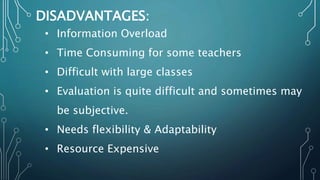
DISADVANTAGES:
• Information Overload
• Time Consuming for some teachers
• Difficult with large classes
• Evaluation is quite difficult and sometimes may
be subjective.
• Needs flexibility & Adaptability
• Resource Expensive
THANK YOU!

problem-Based learning approach in sciencepptx

  • 1.
    PROBLEM/ ISSUE BASED LEARNING PRESENTEDBY: <DE JESUS, AIRA B.> <PORTUGUEZ, MA. THERESA E.>
  • 2.
  • 3.
    PROBLEM/ ISSUE BASEDLEARNING • An educational approach that challenges students to work cooperatively in groups to seek solutions to real-world problems and to develop skills to become self- directed learners. • A process of acquiring and understanding of knowledge, skills in the context of an unfamiliar situation and applying that learning to the situation.
  • 4.
    HISTORICAL BACKGROUND Problem BasedLearning was created by HOWARD BARROWS in 1986 as an instructional method in medical school to prepare students their educational experiences for real world problems of practicing doctors; consequently, they began using problem-based learning environments to examine, diagnose and solve real-world patient problems. The students work in team and designed a medical practitioner who act as facilitator.
  • 5.
    CHARACTERISTICS:  Learner-centered  Learningoccurs in a small student groups  Teachers are facilitators or guides.  Problems form the organizing focus and stimulus fo learning  New information is acquired through self-directed learning.
  • 7.
    1. Present theproblem statement 2. List what is known 3. Develop a problem statement 4. List what is needed 5. List possible actions, recommendations, solutions, or hypothesis 6. Present and support the solution STEPS IN PBL:
  • 8.
    PBL Several StaticComponents:  ESSENTIAL QUESTION - All learning experiences are begin with. This question is one that doesn’t have a right answer and needs deep understanding of content to be answered.  SELF-DIRECTED - Students are responsible for finding a solution to the problem.
  • 9.
    PBL Several StaticComponents:  COOPERATIVE GROUPS - Students work in to find a solution.  CULMINATING PROJECT - The team of students presents their findings to the class.
  • 10.
    5 PRINCIPLES OFPBL #1 •Independe nt & •Self- directed #2 • Learning happen in a group and teacher is a facilitator. #3 • All groups have to participate equally.
  • 11.
    #4 • Students’ learn aboutmotivation, teamwork, problem-solving and engagement with the task. # #5 • Materials such as data, photograph, and articles can be used to solve the problem. 5 PRINCIPLES OF PBL
  • 12.
    ADVANTAGES: • Strengthens problemsolving skills • Improves interpersonal skills • Improves written and oral communication • Makes learning relevant • Promotes self-directed instruction • Foster self-assessment
  • 13.
    DISADVANTAGES: • Information Overload •Time Consuming for some teachers • Difficult with large classes • Evaluation is quite difficult and sometimes may be subjective. • Needs flexibility & Adaptability • Resource Expensive
  • 15.