Importance of channels in
communication and
types of channels
Contents
 Introduction
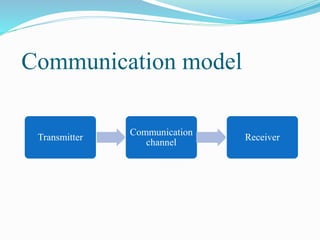
 Communication model
 Design factors
 Types of communication channels
 Guided(wired) channels
 Unguided(wireless) channels
 Conclusion
Introduction
 Communication channel is a connection between
transmitter and receiver through which Data can be
transmitted.
 Communication channel also called as communication
media or transmission media
Communication model
Transmitter
Communication
channel
Receiver
Design Factors
 Bandwidth
- Higher bandwidth gives higher data rate
 Transmission impairments
- eg. attenuation
 Interference
 Number of receivers in guided media
- More receivers introduces more attenuation
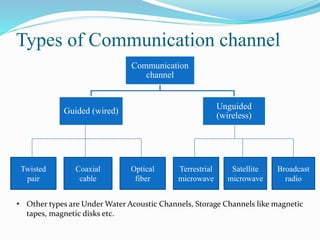
Types of Communication channel
Communication
channel
Guided (wired)
Unguided
(wireless)
Twisted
pair
Coaxial
cable
Optical
fiber
Satellite
microwave
Terrestrial
microwave
Broadcast
radio
• Other types are Under Water Acoustic Channels, Storage Channels like magnetic
tapes, magnetic disks etc.
Twisted-pair cable
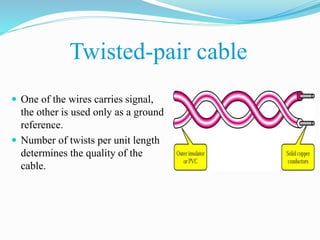
 One of the wires carries signal,
the other is used only as a ground
reference.
 Number of twists per unit length
determines the quality of the
cable.
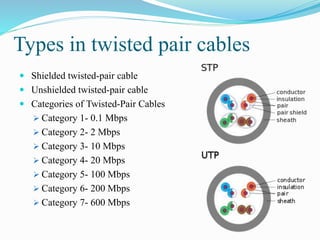
Types in twisted pair cables
 Shielded twisted-pair cable
 Unshielded twisted-pair cable
 Categories of Twisted-Pair Cables
 Category 1- 0.1 Mbps
 Category 2- 2 Mbps
 Category 3- 10 Mbps
 Category 4- 20 Mbps
 Category 5- 100 Mbps
 Category 6- 200 Mbps
 Category 7- 600 Mbps
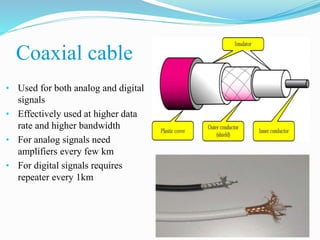
Coaxial cable
• Used for both analog and digital
signals
• Effectively used at higher data
rate and higher bandwidth
• For analog signals need
amplifiers every few km
• For digital signals requires
repeater every 1km
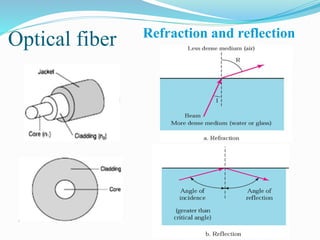
Optical fiber Refraction and reflection
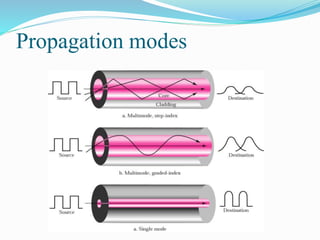
Propagation modes
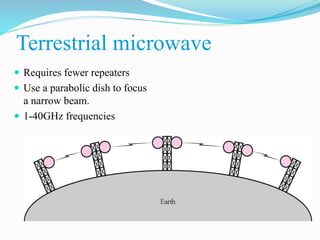
Terrestrial microwave
 Requires fewer repeaters
 Use a parabolic dish to focus
a narrow beam.
 1-40GHz frequencies
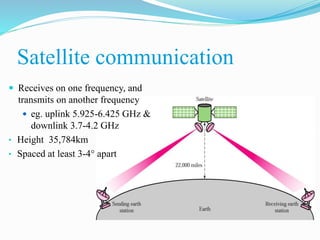
Satellite communication
 Receives on one frequency, and
transmits on another frequency
 eg. uplink 5.925-6.425 GHz &
downlink 3.7-4.2 GHz
• Height 35,784km
• Spaced at least 3-4° apart
Broadcast Radio
 Radio frequency range is 3kHz to 300GHz
 Use broadcast radio of 30MHz - 1GHz, for:
 FM radio
 UHF and VHF television
 Is a unidirectional
 Suffers from multipath interference
 Reflections from land, water, other objects
 Are used for multicasts communications, such as radio and
television, and paging system.
Conclusion
 Communication channel is essential for communication
systems. The transmission characteristics are important in
selecting channel because they directly affect the
communication quality.
 Different types of communication channels have different
transmission characteristics and costs, they are used in
different applications.
Thank you

communication channels and types

  • 1.
    Importance of channelsin communication and types of channels
  • 2.
    Contents  Introduction  Communicationmodel  Design factors  Types of communication channels  Guided(wired) channels  Unguided(wireless) channels  Conclusion
  • 3.
    Introduction  Communication channelis a connection between transmitter and receiver through which Data can be transmitted.  Communication channel also called as communication media or transmission media
  • 4.
  • 5.
    Design Factors  Bandwidth -Higher bandwidth gives higher data rate  Transmission impairments - eg. attenuation  Interference  Number of receivers in guided media - More receivers introduces more attenuation
  • 6.
    Types of Communicationchannel Communication channel Guided (wired) Unguided (wireless) Twisted pair Coaxial cable Optical fiber Satellite microwave Terrestrial microwave Broadcast radio • Other types are Under Water Acoustic Channels, Storage Channels like magnetic tapes, magnetic disks etc.
  • 7.
    Twisted-pair cable  Oneof the wires carries signal, the other is used only as a ground reference.  Number of twists per unit length determines the quality of the cable.
  • 8.
    Types in twistedpair cables  Shielded twisted-pair cable  Unshielded twisted-pair cable  Categories of Twisted-Pair Cables  Category 1- 0.1 Mbps  Category 2- 2 Mbps  Category 3- 10 Mbps  Category 4- 20 Mbps  Category 5- 100 Mbps  Category 6- 200 Mbps  Category 7- 600 Mbps
  • 9.
    Coaxial cable • Usedfor both analog and digital signals • Effectively used at higher data rate and higher bandwidth • For analog signals need amplifiers every few km • For digital signals requires repeater every 1km
  • 10.
  • 11.
  • 12.
    Terrestrial microwave  Requiresfewer repeaters  Use a parabolic dish to focus a narrow beam.  1-40GHz frequencies
  • 13.
    Satellite communication  Receiveson one frequency, and transmits on another frequency  eg. uplink 5.925-6.425 GHz & downlink 3.7-4.2 GHz • Height 35,784km • Spaced at least 3-4° apart
  • 14.
    Broadcast Radio  Radiofrequency range is 3kHz to 300GHz  Use broadcast radio of 30MHz - 1GHz, for:  FM radio  UHF and VHF television  Is a unidirectional  Suffers from multipath interference  Reflections from land, water, other objects  Are used for multicasts communications, such as radio and television, and paging system.
  • 15.
    Conclusion  Communication channelis essential for communication systems. The transmission characteristics are important in selecting channel because they directly affect the communication quality.  Different types of communication channels have different transmission characteristics and costs, they are used in different applications.
  • 16.