Basic Communication
Systems
MODULE 1
1
Introduction
• Main purpose of an electronic communications
system is to transfer information from one
place to another.
• Electronic communications can be viewed as
the transmission, reception and processing of
information between two or more locations
using electronic circuit/device.
2
Basic Components
3
Input Transducer: The message produced by a source
must be converted by a transducer to a form suitable for
the particular type of communication system.
Example: In electrical communications, speech waves
are converted by a microphone to voltage variation.
Transmitter: The transmitter processes the input signal
to produce a signal suits to the characteristics of the
transmission channel.
Signal processing for transmission almost always
involves modulation and may also include coding. In
addition to modulation, other functions performed by
the transmitter are amplification, filtering and
coupling the modulated signal to the channel.
4
Channel: The channel can have different forms: The
atmosphere (or free space), coaxial cable, fiber optic,
waveguide, etc.
The signal undergoes some amount of degradation from
noise, interference and distortion
Receiver: The receiver’s function is to extract the desired
signal from the received signal at the channel output and
to convert it to a form suitable for the output transducer.
Other functions performed by the receiver: amplification
(the received signal may be extremely weak),
demodulation and filtering.
Output Transducer: Converts the electric signal at its
input into the form desired by the system user.
Example: Loudspeaker, personal computer (PC), tape
recorders.
5
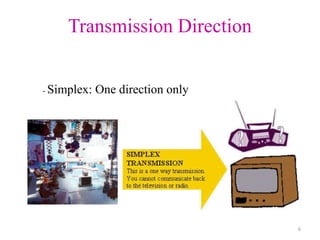
- Simplex: One direction only
Transmission Direction
6
Half Duplex Transmission
Half duplex: Both
directions but
only one
direction at a
time
7
Full Duplex Transmission
Full duplex:
send and
receive both
directions at
once
8
• Baseband and Passband Data Transmissions –
• Data are transmitted between two DTEs in
multiples of a fixed unit, typically of eight bits.
• Each character or byte is transmitted serially.
• Transmission modes:
• Characters;
• Octets (bytes).
9
• For the receiving device to decode and interpret
the bit string, it must be able to determine:
• the start of each bit cell – in order to sample the
incoming signal in the middle of the bit cell and to
determine what kind of bit it is: 0 or 1 bit (clock)
• Synchronization;
• the start and end of each element (character or
byte) character (byte) synchronization;
• the start and end of each complete message block
(called also frame) frame (block) synchronization
10
• There are two methods to accomplish these tasks,
each one determined by whether the transmitter
and receiver clocks are independent (asynchronous
transmission) or synchronized (synchronous
transmission).
• Asynchronous transmission
• Data to be transmitted are generated at random
intervals (from the keyboard, for example).
• The receiver must be able to detect the beginning of
each new character received each transmitted
character or byte is encapsulated (framed) between
two additional elements with different electrical
representation: a start bit and a stop element.
11
12
• Synchronous transmission
• Having breaks between characters for the
transmission of large blocks of data at higher bit
rates is not efficient to transmit the code
combinations that correspond to these characters
one at a time without breaks.
• The receiver must have a clock synchronized with
the transmitter clock. If it is not synchronized
there will be errors in the recovered data.
• Hence need for timing information (in the
transitions of the data signal, because the
intervals between the data signal transitions are
multiples of the bit intervals).
13
• Synchronous Transmission –
14
• Signalling rate
• At each instant the transmitted signal can be
in one state from a finite set of states (ex. In
the binary transmission, one of two states);
• The duration of the shortest state is named
elementary interval (T) the signaling rate is
defined as:
• Vs =1/T bauds.
15
• Baseband –
• the band of frequencies occupied by the (data)
signal before it modulates a carrier (or subcarrier)
frequency in order to form the transmitted line or
radio signal.
• The baseband, therefore, has a frequency content
extending into direct current region.
• Baseband data can be transmitted hundreds or
even thousands of meters (the transmission
distance is limited by several factors) and this is
commonly done on wire pair, which has a low-
pass frequency transfer characteristic so that it
permits data to be transmitted directly without
need for frequency translating.
16
• However, there is need for some line coding to ensure that
the transmitted signal has the following features:
• no d.c. component and low frequency components,
because the transmission equipment is connected to the
transmission line by transformers and these transformers
have large attenuation at small frequencies;
• small bandwidth, in order to use efficiently the useful
bandwidth of the transmission line and to avoid the large
attenuation of the line at high frequencies;
• a good protection against noise;
• presence of timing information (transitions), necessary to
synchronize the receiver clock with the transmitter clock;
• no necessity for the receiving device to determine the
absolute polarity of the data signal.
17
• Need of Modulation -
• In the process of modulation, the baseband
signal is ‘translated’ i.e. shifted from low
frequency to high frequency.
• Advantages –
• 1. Reduction in the size of antenna.
• 2. Avoids mixing of signals.
• 3. Increase the range of communication
• 4. Multiplexing is possible.
• 5. Improves quality of reception.
18
Communication Channels
• Guided transmission media: communications
signals guided along a solid medium
• Wireless media: communications signal
broadcast over airwaves as a form of
electromagnetic radiation
19
1.Twisted Wire— Most prevalent form of communication wiring, used for
most business telephone wiring, consists of strands of copper wire twisted in
pairs.
DIFFERENT TYPES OF COMMUNICATION
MEDIA (CHANNELS)
ADVANTAGES:
• LOW COST
• EASY TO WORK WITH
DISADVANTAGES:
• RELATIVELY SLOW
• SUBJECT TO INTERFERENCE
FROM OTHER ELECTRICAL
SOURCES 20
2. Coaxial cable—used for cable television, consists of insulated copper
wire.
ADVANTAGES:
• FASTER THAN TWISTED
WIRE
• LESS SUSCEPTIBLE TO
ELECTROMAGNETIC
INTERFERENCE
DISADVANTAGES:
• RELATIVELY EXPENSIVE
• SOMEWHAT DIFFICULT
TO WORK WITH
21
3. Fiber optic— Consists of clear glass fiber and transmits information in
the form of light waves, instead of electric current.
ADVANTAGES:
• CONSIDERABLY FAST
• SMALLER AND LIGHTER
THAN COAXIAL CABLES
DISADVANTAGES:
• EXPENSIVE
• HARD TO INSTALL AND
DIFFICULT TO WORK WITH
22
A. Microwave— are Widely Used For
• High-volume,
• Long Distance,
• Point-to-point Communication.
They Transmit High Frequency Radio Signals In The Atmosphere. Microwave
Signals Follow A Straight Line Between Rely Stations 30 Miles Apart (Do Not
Bend With Earth’s Curvature).
This Limitation Makes Microwave Systems More Expensive.
4. WIRELESS COMMUNICATIONS
23
B. Satellites — Transmits data using orbiting satellites.
• Satellites serve as rely stations for transmitting microwave signals over very long
distances.
• Satellites are efficient way of transmitting large amount of data over a very long
distance.
24
Guided Transmission Media Types
25
Wireless Technologies
26
1. 27
Frequencies for communication
1 Mm
300 Hz
10 km
30 kHz
100 m
3 MHz
1 m
300 MHz
10 mm
30 GHz
100 m
3 THz
1 m
300 THz
visible light
VLF LF MF HF VHF UHF SHF EHF infrared UV
optical transmission
coax cable
twisted
pair
 VLF = Very Low Frequency UHF = Ultra High Frequency
 LF = Low Frequency SHF = Super High Frequency
 MF = Medium Frequency EHF = Extra High Frequency
 HF = High Frequency UV = Ultraviolet Light
 VHF = Very High Frequency
 Frequency and wave length:  = c/f
where;
wavelength - ,
speed of light - c  3x10⁸m/s,
frequency f
Electromagnetic Frequency Spectrum
28
International Standards
• The spectrum is divided into bands, with each band having a different
name and boundary.
• The radio frequency band (30Hz ~300GHz) is divided into narrower band
as follow.
29
Wireless Communication Systems
30
Current Wireless Systems
• Cellular systems
• Wireless LANs
• Satellite Systems
• Paging Systems
• Bluetooth
• Ultrawideband Radios
• Zigbee Radios
31
Satellite Communication Systems
32
Communication Satellite Transponder
33
Optical fiber Communication Systems
34

Group 1 communication system.pptx

  • 1.
  • 2.
    Introduction • Main purposeof an electronic communications system is to transfer information from one place to another. • Electronic communications can be viewed as the transmission, reception and processing of information between two or more locations using electronic circuit/device. 2
  • 3.
  • 4.
    Input Transducer: Themessage produced by a source must be converted by a transducer to a form suitable for the particular type of communication system. Example: In electrical communications, speech waves are converted by a microphone to voltage variation. Transmitter: The transmitter processes the input signal to produce a signal suits to the characteristics of the transmission channel. Signal processing for transmission almost always involves modulation and may also include coding. In addition to modulation, other functions performed by the transmitter are amplification, filtering and coupling the modulated signal to the channel. 4
  • 5.
    Channel: The channelcan have different forms: The atmosphere (or free space), coaxial cable, fiber optic, waveguide, etc. The signal undergoes some amount of degradation from noise, interference and distortion Receiver: The receiver’s function is to extract the desired signal from the received signal at the channel output and to convert it to a form suitable for the output transducer. Other functions performed by the receiver: amplification (the received signal may be extremely weak), demodulation and filtering. Output Transducer: Converts the electric signal at its input into the form desired by the system user. Example: Loudspeaker, personal computer (PC), tape recorders. 5
  • 6.
    - Simplex: Onedirection only Transmission Direction 6
  • 7.
    Half Duplex Transmission Halfduplex: Both directions but only one direction at a time 7
  • 8.
    Full Duplex Transmission Fullduplex: send and receive both directions at once 8
  • 9.
    • Baseband andPassband Data Transmissions – • Data are transmitted between two DTEs in multiples of a fixed unit, typically of eight bits. • Each character or byte is transmitted serially. • Transmission modes: • Characters; • Octets (bytes). 9
  • 10.
    • For thereceiving device to decode and interpret the bit string, it must be able to determine: • the start of each bit cell – in order to sample the incoming signal in the middle of the bit cell and to determine what kind of bit it is: 0 or 1 bit (clock) • Synchronization; • the start and end of each element (character or byte) character (byte) synchronization; • the start and end of each complete message block (called also frame) frame (block) synchronization 10
  • 11.
    • There aretwo methods to accomplish these tasks, each one determined by whether the transmitter and receiver clocks are independent (asynchronous transmission) or synchronized (synchronous transmission). • Asynchronous transmission • Data to be transmitted are generated at random intervals (from the keyboard, for example). • The receiver must be able to detect the beginning of each new character received each transmitted character or byte is encapsulated (framed) between two additional elements with different electrical representation: a start bit and a stop element. 11
  • 12.
  • 13.
    • Synchronous transmission •Having breaks between characters for the transmission of large blocks of data at higher bit rates is not efficient to transmit the code combinations that correspond to these characters one at a time without breaks. • The receiver must have a clock synchronized with the transmitter clock. If it is not synchronized there will be errors in the recovered data. • Hence need for timing information (in the transitions of the data signal, because the intervals between the data signal transitions are multiples of the bit intervals). 13
  • 14.
  • 15.
    • Signalling rate •At each instant the transmitted signal can be in one state from a finite set of states (ex. In the binary transmission, one of two states); • The duration of the shortest state is named elementary interval (T) the signaling rate is defined as: • Vs =1/T bauds. 15
  • 16.
    • Baseband – •the band of frequencies occupied by the (data) signal before it modulates a carrier (or subcarrier) frequency in order to form the transmitted line or radio signal. • The baseband, therefore, has a frequency content extending into direct current region. • Baseband data can be transmitted hundreds or even thousands of meters (the transmission distance is limited by several factors) and this is commonly done on wire pair, which has a low- pass frequency transfer characteristic so that it permits data to be transmitted directly without need for frequency translating. 16
  • 17.
    • However, thereis need for some line coding to ensure that the transmitted signal has the following features: • no d.c. component and low frequency components, because the transmission equipment is connected to the transmission line by transformers and these transformers have large attenuation at small frequencies; • small bandwidth, in order to use efficiently the useful bandwidth of the transmission line and to avoid the large attenuation of the line at high frequencies; • a good protection against noise; • presence of timing information (transitions), necessary to synchronize the receiver clock with the transmitter clock; • no necessity for the receiving device to determine the absolute polarity of the data signal. 17
  • 18.
    • Need ofModulation - • In the process of modulation, the baseband signal is ‘translated’ i.e. shifted from low frequency to high frequency. • Advantages – • 1. Reduction in the size of antenna. • 2. Avoids mixing of signals. • 3. Increase the range of communication • 4. Multiplexing is possible. • 5. Improves quality of reception. 18
  • 19.
    Communication Channels • Guidedtransmission media: communications signals guided along a solid medium • Wireless media: communications signal broadcast over airwaves as a form of electromagnetic radiation 19
  • 20.
    1.Twisted Wire— Mostprevalent form of communication wiring, used for most business telephone wiring, consists of strands of copper wire twisted in pairs. DIFFERENT TYPES OF COMMUNICATION MEDIA (CHANNELS) ADVANTAGES: • LOW COST • EASY TO WORK WITH DISADVANTAGES: • RELATIVELY SLOW • SUBJECT TO INTERFERENCE FROM OTHER ELECTRICAL SOURCES 20
  • 21.
    2. Coaxial cable—usedfor cable television, consists of insulated copper wire. ADVANTAGES: • FASTER THAN TWISTED WIRE • LESS SUSCEPTIBLE TO ELECTROMAGNETIC INTERFERENCE DISADVANTAGES: • RELATIVELY EXPENSIVE • SOMEWHAT DIFFICULT TO WORK WITH 21
  • 22.
    3. Fiber optic—Consists of clear glass fiber and transmits information in the form of light waves, instead of electric current. ADVANTAGES: • CONSIDERABLY FAST • SMALLER AND LIGHTER THAN COAXIAL CABLES DISADVANTAGES: • EXPENSIVE • HARD TO INSTALL AND DIFFICULT TO WORK WITH 22
  • 23.
    A. Microwave— areWidely Used For • High-volume, • Long Distance, • Point-to-point Communication. They Transmit High Frequency Radio Signals In The Atmosphere. Microwave Signals Follow A Straight Line Between Rely Stations 30 Miles Apart (Do Not Bend With Earth’s Curvature). This Limitation Makes Microwave Systems More Expensive. 4. WIRELESS COMMUNICATIONS 23
  • 24.
    B. Satellites —Transmits data using orbiting satellites. • Satellites serve as rely stations for transmitting microwave signals over very long distances. • Satellites are efficient way of transmitting large amount of data over a very long distance. 24
  • 25.
  • 26.
  • 27.
    1. 27 Frequencies forcommunication 1 Mm 300 Hz 10 km 30 kHz 100 m 3 MHz 1 m 300 MHz 10 mm 30 GHz 100 m 3 THz 1 m 300 THz visible light VLF LF MF HF VHF UHF SHF EHF infrared UV optical transmission coax cable twisted pair  VLF = Very Low Frequency UHF = Ultra High Frequency  LF = Low Frequency SHF = Super High Frequency  MF = Medium Frequency EHF = Extra High Frequency  HF = High Frequency UV = Ultraviolet Light  VHF = Very High Frequency  Frequency and wave length:  = c/f where; wavelength - , speed of light - c  3x10⁸m/s, frequency f
  • 28.
  • 29.
    International Standards • Thespectrum is divided into bands, with each band having a different name and boundary. • The radio frequency band (30Hz ~300GHz) is divided into narrower band as follow. 29
  • 30.
  • 31.
    Current Wireless Systems •Cellular systems • Wireless LANs • Satellite Systems • Paging Systems • Bluetooth • Ultrawideband Radios • Zigbee Radios 31
  • 32.
  • 33.
  • 34.