Pulmonary Function Test 
Khagendra Jang Shah 
MD, Resident 
NAMS
Spirometry is a physiological test that measures 
how an individual inhales or exhales volumes of air 
as a function of time. The primary signal measured 
in spirometry may be volume or flow. 
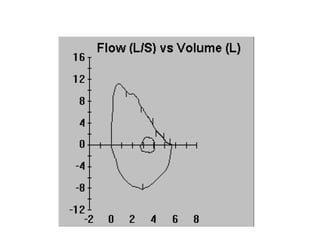
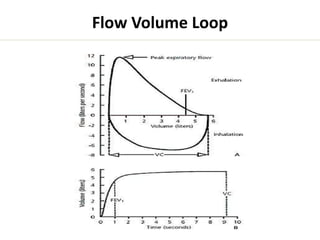
 The test effort can be presented as a ‘FLOW-VOLUME 
LOOP’ or as a ‘VOLUME-TIME CURVE’.
PRESENTATION PLAN 
• Acceptability and repeatabiltiy criteria 
• Reversibility criteria 
• Test result selection. Best curve 
• Reference values 
• Advantages of LLN over % predicted 
• Normal pattern 
• Obstructive pattern 
• Restrictive pattern
evaluating 
spirometric results 
• acceptability and repeatability criteria 
• reversibility criteria for bronchodilator test 
• information on reference values and 
comparing the results with normal values 
• normal, obstructive and restrictive patterns 
of spirometry 
• changes of spirometric indices over time
Spirometric results evaluation may be considered as a two-step process 
 acceptibility criteria: 
Expiratory effort show good 
start of test with flow volume loop and volume time curve showing 
rapid rise to PEF and good effort , 
end of test criteria met (plateau of volume for more than 1 sec is 
present in all attempts and all expiratory efforts are beyonds 6 secs. No 
coughing or closer of glottis seen no extra breath . 
Good spirometry implies that at least three acceptable manoeuvers 
should be recorded 
 reproducibility criteria: 
difference between the best and the second best value of FEV1 and FVC 
less than 150 ml.
• When doing a bronchodilator test, one should be aware that both 
spirometries (pre- and post- ) should be technically acceptable and 
the bronchodilating agent should be properly delivered. 
• pre and post values of FEV1 and FVC are analysed. A positive 
response is achieved 
• when the increase in postbronchodilator values is greater than 200 
ml and 12% of prebronchodilator value. 
• Recorded best values are compared with reference values, that are 
created using results obtained from the examination of a healthy 
subpopulation and have the form of equations relating respective 
parameters to sex, age, height and ethnic origin. 
• interpreting the results is to compare the measured value with the 
lower limit of normal (LLN) – which is set at the level of 5th percentile
• With spirometry obstructive defect can be stated when the FEV1/ 
(F)VC factor is below the lower limit of normal. 
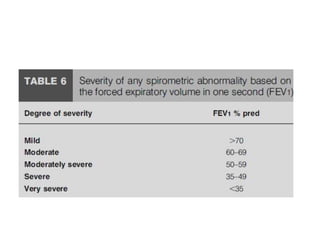
• The severity of obstruction is quantified using the value of FEV1 
expressed as a percentage of predicted. 
• When FEV1/ (F)VC remains within normal limits and FVC is below 
LLN a restrictive ventilator defect may be suspected, but confirmation 
of this requires the measurement of total lung capacity (TLC) done 
either by plethysmography or gas dilution method
 Actual measurement: 
 There are three important steps (FFF) the subject has to follow in 
spirometry: a) Full inspiration, b) Forceful expiration, c) Full 
expiration. 
 Quality control of spirometry includes 
 the assessment of acceptability (within-manoeuvre evaluation 
 and repeatability (between-manoeuvre evaluation) of the tests. 
 acceptability criteria 
1) There is a good start of the test, 
2) Spirogram is free from artefacts: continuous blow as fast and as 
hard as possible, without cough, variable effort, and early 
termination, etc 
3) There is a satisfactory exhalation.
The rapid start is defined as a back extrapolated volume of <5% of the FVC or less 
than 0.15 l, whichever is greater. 
The end of test criteria are: 
• -The subject cannot or should not continue further exhalation or 
• -The volume-time curve shows an obvious plateau (no change in volume: 0.025 l for >1 
second) or 
• -The subject has tried to exhale for at least 6 seconds (for at least 3 seconds in children < 
10 yrs)
• The repeatability criteria are used as a guide to whether more than 
three acceptable FVC manoeuvres are needed. 
• The following reproducibility criteria are applied after three 
acceptable spirograms have been obtained: 
• 1) The two largest values of FVC must be within 0.150 l of each other, 
• 2) The two largest values of FEV1 must be within 0.150 l of each 
other, 
• 3) If criteria 1 and 2 are not met, testing should be continued.
Interpretation of PFTs is usually based on comparisons of data 
measured in an individual patient or subject with reference 
(predicted) values based on healthy subjects. 
Predicted values should be obtained from studies of 
‘‘normal’’ or ‘‘healthy’’ subjects with the same 
anthropometric (e.g. sex, age and height) and, where 
relevant, ethnic characteristics of the patient being tested
Obstructive abnormalities 
An obstructive ventilatory defect is a disproportionate reduction 
of maximal airflow from the lung in relation to the 
maximal volume (i.e. VC) that can be displaced from the lung 
[45–47]. It implies airway narrowing during exhalation and is 
defined by a reduced FEV1/VC ratio below the 5th percentile 
of the predicted value. 
The earliest change associated with airflow obstruction in 
small airways is thought to be a slowing in the terminal 
portion of the spirogram, even when the initial part of the 
spirogram is barely affected
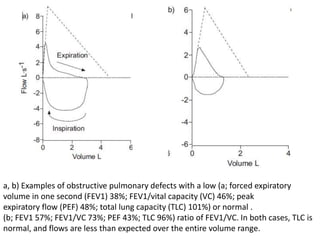
This slowing of expiratory flow is most obviously reflected in a concave 
shape on the flow–volume curve. 
As airway disease becomes more advanced and/or more central airways 
become involved, timed segments of the spirogram such as the FEV1 
will, in general, be reduced out of proportion to the reduction in VC.
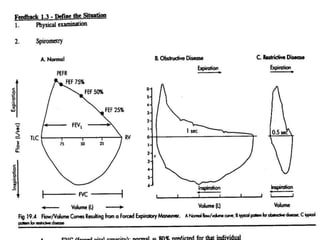
a, b) Examples of obstructive pulmonary defects with a low (a; forced expiratory 
volume in one second (FEV1) 38%; FEV1/vital capacity (VC) 46%; peak 
expiratory flow (PEF) 48%; total lung capacity (TLC) 101%) or normal . 
(b; FEV1 57%; FEV1/VC 73%; PEF 43%; TLC 96%) ratio of FEV1/VC. In both cases, TLC is 
normal, and flows are less than expected over the entire volume range.
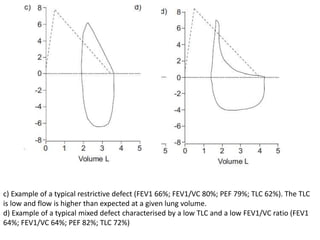
c) Example of a typical restrictive defect (FEV1 66%; FEV1/VC 80%; PEF 79%; TLC 62%). The TLC 
is low and flow is higher than expected at a given lung volume. 
d) Example of a typical mixed defect characterised by a low TLC and a low FEV1/VC ratio (FEV1 
64%; FEV1/VC 64%; PEF 82%; TLC 72%)
Restrictive abnormalities 
 A restrictive ventilatory defect is characterised by a reduction in TLC 
below the 5th percentile of the predicted value, and a normal 
FEV1/VC. 
 The presence of a restrictive ventilatory defect may be suspected 
when VC is reduced, the FEV1/VC is increased (.85–90%) and the 
flow–volume curve shows a convex pattern.
Mixed abnormalities 
 A mixed ventilatory defect is characterised by the coexistence of 
obstruction and restriction, and is defined physiologically when both 
FEV1/VC and TLC are below the 5th percentiles of their relevant 
predicted values.
Types of ventilatory defects and their diagnoses 
• Obstruction: < FEV1/VC ,5th percentile of predicted 
• Restriction TLC :<5th percentile of predicted 
• Mixed defect : FEV1/VC and TLC <5th percentile of predicted
INTERPRETATION AND PATTERNS OF 
DYSFUNCTION 
 In contrast with a fixed value of 0.7, the use of the 5th percentile 
does not lead to an overestimation of the ventilatory defect in older 
people with no history of exposure to noxious particles or gases.
Omitting the quality review and relying only on 
numerical results for clinical decision making is a 
common mistake,
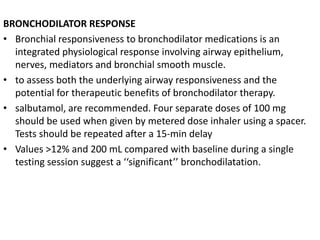
BRONCHODILATOR RESPONSE 
• Bronchial responsiveness to bronchodilator medications is an 
integrated physiological response involving airway epithelium, 
nerves, mediators and bronchial smooth muscle. 
• to assess both the underlying airway responsiveness and the 
potential for therapeutic benefits of bronchodilator therapy. 
• salbutamol, are recommended. Four separate doses of 100 mg 
should be used when given by metered dose inhaler using a spacer. 
Tests should be repeated after a 15-min delay 
• Values >12% and 200 mL compared with baseline during a single 
testing session suggest a ‘‘significant’’ bronchodilatation.
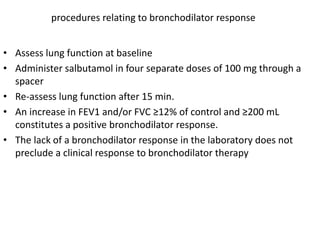
procedures relating to bronchodilator response 
• Assess lung function at baseline 
• Administer salbutamol in four separate doses of 100 mg through a 
spacer 
• Re-assess lung function after 15 min. 
• An increase in FEV1 and/or FVC ≥12% of control and ≥200 mL 
constitutes a positive bronchodilator response. 
• The lack of a bronchodilator response in the laboratory does not 
preclude a clinical response to bronchodilator therapy
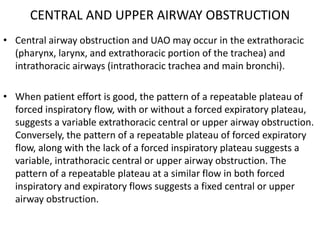
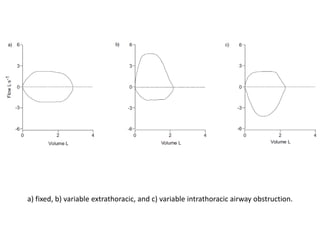
CENTRAL AND UPPER AIRWAY OBSTRUCTION 
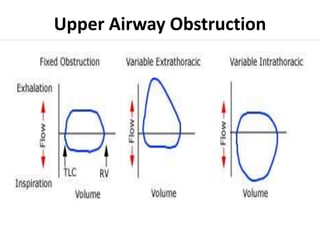
• Central airway obstruction and UAO may occur in the extrathoracic 
(pharynx, larynx, and extrathoracic portion of the trachea) and 
intrathoracic airways (intrathoracic trachea and main bronchi). 
• When patient effort is good, the pattern of a repeatable plateau of 
forced inspiratory flow, with or without a forced expiratory plateau, 
suggests a variable extrathoracic central or upper airway obstruction. 
Conversely, the pattern of a repeatable plateau of forced expiratory 
flow, along with the lack of a forced inspiratory plateau suggests a 
variable, intrathoracic central or upper airway obstruction. The 
pattern of a repeatable plateau at a similar flow in both forced 
inspiratory and expiratory flows suggests a fixed central or upper 
airway obstruction.
a) fixed, b) variable extrathoracic, and c) variable intrathoracic airway obstruction.
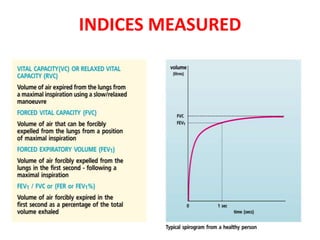
INDICES MEASURED
ANNUAL FEV1? 
• Used to detect sudden deterioration in lung 
function 
• Should precipitate action if deterioration 
marked. 
Normal deterioration in FEV1 thought to be 
50ml/annum in none smoking individual
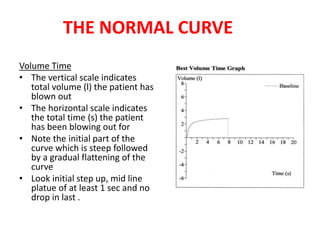
THE NORMAL CURVE 
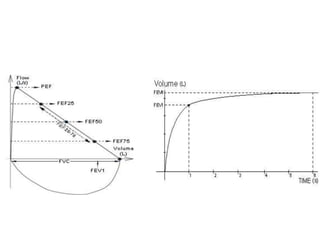
Volume Time 
• The vertical scale indicates 
total volume (l) the patient has 
blown out 
• The horizontal scale indicates 
the total time (s) the patient 
has been blowing out for 
• Note the initial part of the 
curve which is steep followed 
by a gradual flattening of the 
curve 
• Look initial step up, mid line 
platue of at least 1 sec and no 
drop in last .
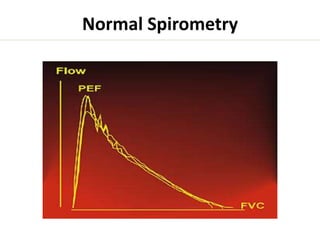
Normal Spirometry
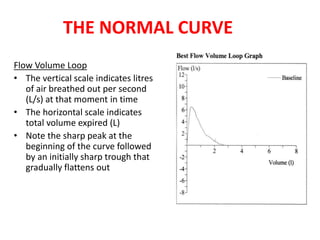
THE NORMAL CURVE 
Flow Volume Loop 
• The vertical scale indicates litres 
of air breathed out per second 
(L/s) at that moment in time 
• The horizontal scale indicates 
total volume expired (L) 
• Note the sharp peak at the 
beginning of the curve followed 
by an initially sharp trough that 
gradually flattens out
• The FVC may be reduced by suboptimal 
patient effort, airflow limitation, restriction 
(eg, from lung parenchymal, pleural, or 
thoracic cage disease), or a combination of 
these. 
• The lower limit of normal FEV1 is more 
accurately defined by the fifth percentile of 
healthy never-smokers, instead of the 
traditional 80 percent of predicted .
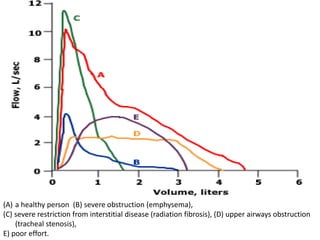
(A) a healthy person (B) severe obstruction (emphysema), 
(C) severe restriction from interstitial disease (radiation fibrosis), (D) upper airways obstruction 
(tracheal stenosis), 
E) poor effort.
• At least three acceptable spirograms must be 
obtained. 
• In each test, patients should exhale for at least six 
seconds and stop when there is no volume 
change for one second. 
• The test session is finished when the difference 
between the two largest FVC measurements and 
between the two largest FEV1 measurements is 
within 0.2 L. 
• If both criteria are not met after three 
maneuvers, the test should not be interpreted. 
• Repeat testing should continue until the criteria 
are met or until eight tests have been performed.
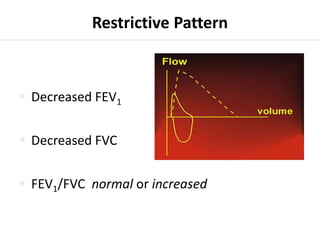
Restrictive Pattern 
 Decreased FEV1 
 Decreased FVC 
 FEV1/FVC normal or increased
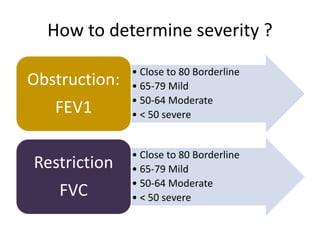
How to determine severity ? 
• Close to 80 Borderline 
• 65-79 Mild 
• 50-64 Moderate 
• < 50 severe 
Obstruction: 
FEV1 
• Close to 80 Borderline 
• 65-79 Mild 
• 50-64 Moderate 
• < 50 severe 
Restriction 
FVC
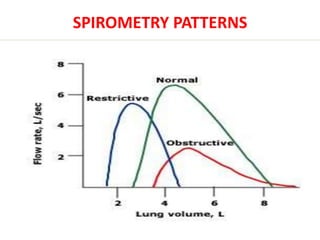
SPIROMETRY PATTERNS
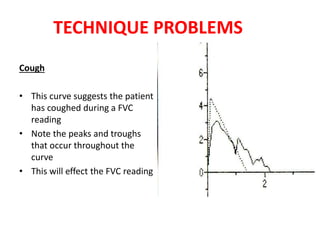
TECHNIQUE PROBLEMS 
Cough 
• This curve suggests the patient 
has coughed during a FVC 
reading 
• Note the peaks and troughs 
that occur throughout the 
curve 
• This will effect the FVC reading
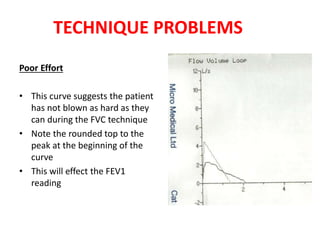
TECHNIQUE PROBLEMS 
Poor Effort 
• This curve suggests the patient 
has not blown as hard as they 
can during the FVC technique 
• Note the rounded top to the 
peak at the beginning of the 
curve 
• This will effect the FEV1 
reading
TECHNIQUE PROBLEMS 
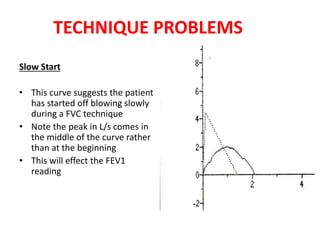
Slow Start 
• This curve suggests the patient 
has started off blowing slowly 
during a FVC technique 
• Note the peak in L/s comes in 
the middle of the curve rather 
than at the beginning 
• This will effect the FEV1 
reading
TECHNIQUE PROBLEMS 
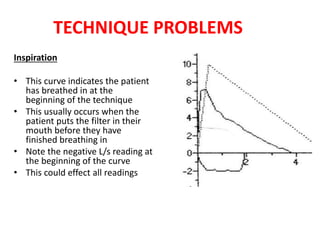
Inspiration 
• This curve indicates the patient 
has breathed in at the 
beginning of the technique 
• This usually occurs when the 
patient puts the filter in their 
mouth before they have 
finished breathing in 
• Note the negative L/s reading at 
the beginning of the curve 
• This could effect all readings
TECHNIQUE PROBLEMS 
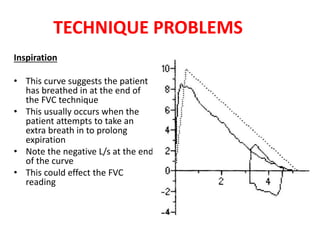
Inspiration 
• This curve suggests the patient 
has breathed in at the end of 
the FVC technique 
• This usually occurs when the 
patient attempts to take an 
extra breath in to prolong 
expiration 
• Note the negative L/s at the end 
of the curve 
• This could effect the FVC 
reading
Bronchodilator challenge test response 
• FVC increase 200mL or 
• FEV1 increase 12% or 
• FEF 25-75% increase15- 25% 
• “ Improved after bronchodilation” 
• “Reversible airway disease”
BRONCHODILATOR RESPONSE 
 Degree to which FEV1 improves with inhaled 
bronchodilator 
 Documents reversible airflow obstruction 
 Significant response if: 
- FEV1 increases by 12% and >200ml 
 Request if obstructive pattern on spirometry
REVERSIBILITY 
Repeat Spirometry following one of the 
following (Post); 
1. Salbutamol 100mcg MDI 4 puffs via spacer 
2. Salbutamol 2.5mg nebuliser 
Repeat Spirometry after 15-30 minutes
Reversibility 
• Useful if diagnosis is not clear 
Either; 
• Measure peak flows for 14 days morning and 
evening. Diurnal variation of greater than 20% 
indicates asthma 
• Record pre and post bronchodilator 
spirometry
REVERSIBILITY 
• An FEV1 that increases by < 400mls is likely to 
have COPD 
• An FEV1 that increases by > 400mls is likely to 
have asthma 
• However if; 
– FEV1 < 80% 
– Ratio < 70% 
– Post > 400mls 
– Obstruction is not fully reversible
Reversibility (Example) 
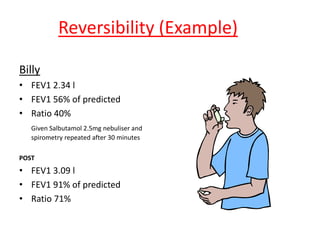
Billy 
• FEV1 2.34 l 
• FEV1 56% of predicted 
• Ratio 40% 
Given Salbutamol 2.5mg nebuliser and 
spirometry repeated after 30 minutes 
POST 
• FEV1 3.09 l 
• FEV1 91% of predicted 
• Ratio 71%
Flow Volume Loop 
 “Spirogram” 
 Measures forced inspiratory and expiratory 
flow rate 
 Augments spirometry results 
 Indications: evaluation of upper airway 
obstruction (stridor, unexplained dyspnea)
Flow Volume Loop
Upper Airway Obstruction 
 Variable intrathoracic obstruction 
 Variable extrathoracic obstruction 
 Fixed obstruction
Upper Airway Obstruction
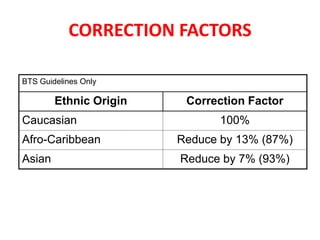
CORRECTION FACTORS 
BTS Guidelines Only 
Ethnic Origin Correction Factor 
Caucasian 100% 
Afro-Caribbean Reduce by 13% (87%) 
Asian Reduce by 7% (93%)
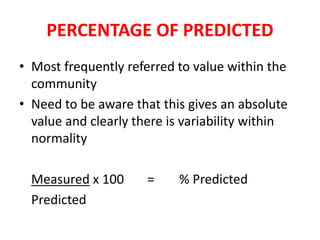
PERCENTAGE OF PREDICTED 
• Most frequently referred to value within the 
community 
• Need to be aware that this gives an absolute 
value and clearly there is variability within 
normality 
Measured x 100 = % Predicted 
Predicted
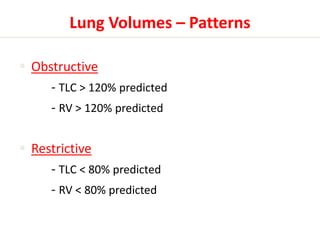
Lung Volumes – Patterns 
 Obstructive 
- TLC > 120% predicted 
- RV > 120% predicted 
 Restrictive 
- TLC < 80% predicted 
- RV < 80% predicted
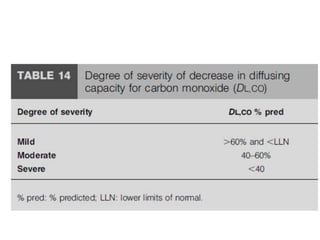
Diffusing Capacity 
 Diffusing capacity of lungs for CO 
 Measures ability of lungs to transport inhaled gas 
from alveoli to pulmonary capillaries 
 Depends on: 
- alveolar—capillary membrane 
- hemoglobin concentration 
- cardiac output
Documentation 
• 1.Progress note 
– Indication 
– Patient effort 
– Assessment 
• 2. Scanned original report in Special Studies
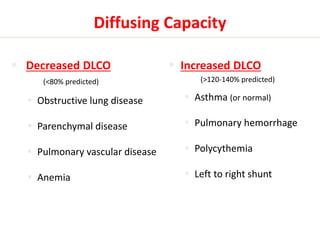
Diffusing Capacity 
 Decreased DLCO 
(<80% predicted) 
 Obstructive lung disease 
 Parenchymal disease 
 Pulmonary vascular disease 
 Anemia 
 Increased DLCO 
(>120-140% predicted) 
 Asthma (or normal) 
 Pulmonary hemorrhage 
 Polycythemia 
 Left to right shunt
DLCO — Indications 
 Differentiate asthma from emphysema 
 Evaluation and severity of restrictive lung disease 
 Early stages of pulmonary hypertension 
 Expensive!

Pft

  • 1.
    Pulmonary Function Test Khagendra Jang Shah MD, Resident NAMS
  • 2.
    Spirometry is aphysiological test that measures how an individual inhales or exhales volumes of air as a function of time. The primary signal measured in spirometry may be volume or flow.  The test effort can be presented as a ‘FLOW-VOLUME LOOP’ or as a ‘VOLUME-TIME CURVE’.
  • 3.
    PRESENTATION PLAN •Acceptability and repeatabiltiy criteria • Reversibility criteria • Test result selection. Best curve • Reference values • Advantages of LLN over % predicted • Normal pattern • Obstructive pattern • Restrictive pattern
  • 4.
    evaluating spirometric results • acceptability and repeatability criteria • reversibility criteria for bronchodilator test • information on reference values and comparing the results with normal values • normal, obstructive and restrictive patterns of spirometry • changes of spirometric indices over time
  • 5.
    Spirometric results evaluationmay be considered as a two-step process  acceptibility criteria: Expiratory effort show good start of test with flow volume loop and volume time curve showing rapid rise to PEF and good effort , end of test criteria met (plateau of volume for more than 1 sec is present in all attempts and all expiratory efforts are beyonds 6 secs. No coughing or closer of glottis seen no extra breath . Good spirometry implies that at least three acceptable manoeuvers should be recorded  reproducibility criteria: difference between the best and the second best value of FEV1 and FVC less than 150 ml.
  • 6.
    • When doinga bronchodilator test, one should be aware that both spirometries (pre- and post- ) should be technically acceptable and the bronchodilating agent should be properly delivered. • pre and post values of FEV1 and FVC are analysed. A positive response is achieved • when the increase in postbronchodilator values is greater than 200 ml and 12% of prebronchodilator value. • Recorded best values are compared with reference values, that are created using results obtained from the examination of a healthy subpopulation and have the form of equations relating respective parameters to sex, age, height and ethnic origin. • interpreting the results is to compare the measured value with the lower limit of normal (LLN) – which is set at the level of 5th percentile
  • 7.
    • With spirometryobstructive defect can be stated when the FEV1/ (F)VC factor is below the lower limit of normal. • The severity of obstruction is quantified using the value of FEV1 expressed as a percentage of predicted. • When FEV1/ (F)VC remains within normal limits and FVC is below LLN a restrictive ventilator defect may be suspected, but confirmation of this requires the measurement of total lung capacity (TLC) done either by plethysmography or gas dilution method
  • 9.
     Actual measurement:  There are three important steps (FFF) the subject has to follow in spirometry: a) Full inspiration, b) Forceful expiration, c) Full expiration.  Quality control of spirometry includes  the assessment of acceptability (within-manoeuvre evaluation  and repeatability (between-manoeuvre evaluation) of the tests.  acceptability criteria 1) There is a good start of the test, 2) Spirogram is free from artefacts: continuous blow as fast and as hard as possible, without cough, variable effort, and early termination, etc 3) There is a satisfactory exhalation.
  • 10.
    The rapid startis defined as a back extrapolated volume of <5% of the FVC or less than 0.15 l, whichever is greater. The end of test criteria are: • -The subject cannot or should not continue further exhalation or • -The volume-time curve shows an obvious plateau (no change in volume: 0.025 l for >1 second) or • -The subject has tried to exhale for at least 6 seconds (for at least 3 seconds in children < 10 yrs)
  • 11.
    • The repeatabilitycriteria are used as a guide to whether more than three acceptable FVC manoeuvres are needed. • The following reproducibility criteria are applied after three acceptable spirograms have been obtained: • 1) The two largest values of FVC must be within 0.150 l of each other, • 2) The two largest values of FEV1 must be within 0.150 l of each other, • 3) If criteria 1 and 2 are not met, testing should be continued.
  • 12.
    Interpretation of PFTsis usually based on comparisons of data measured in an individual patient or subject with reference (predicted) values based on healthy subjects. Predicted values should be obtained from studies of ‘‘normal’’ or ‘‘healthy’’ subjects with the same anthropometric (e.g. sex, age and height) and, where relevant, ethnic characteristics of the patient being tested
  • 13.
    Obstructive abnormalities Anobstructive ventilatory defect is a disproportionate reduction of maximal airflow from the lung in relation to the maximal volume (i.e. VC) that can be displaced from the lung [45–47]. It implies airway narrowing during exhalation and is defined by a reduced FEV1/VC ratio below the 5th percentile of the predicted value. The earliest change associated with airflow obstruction in small airways is thought to be a slowing in the terminal portion of the spirogram, even when the initial part of the spirogram is barely affected
  • 14.
    This slowing ofexpiratory flow is most obviously reflected in a concave shape on the flow–volume curve. As airway disease becomes more advanced and/or more central airways become involved, timed segments of the spirogram such as the FEV1 will, in general, be reduced out of proportion to the reduction in VC.
  • 15.
    a, b) Examplesof obstructive pulmonary defects with a low (a; forced expiratory volume in one second (FEV1) 38%; FEV1/vital capacity (VC) 46%; peak expiratory flow (PEF) 48%; total lung capacity (TLC) 101%) or normal . (b; FEV1 57%; FEV1/VC 73%; PEF 43%; TLC 96%) ratio of FEV1/VC. In both cases, TLC is normal, and flows are less than expected over the entire volume range.
  • 16.
    c) Example ofa typical restrictive defect (FEV1 66%; FEV1/VC 80%; PEF 79%; TLC 62%). The TLC is low and flow is higher than expected at a given lung volume. d) Example of a typical mixed defect characterised by a low TLC and a low FEV1/VC ratio (FEV1 64%; FEV1/VC 64%; PEF 82%; TLC 72%)
  • 17.
    Restrictive abnormalities A restrictive ventilatory defect is characterised by a reduction in TLC below the 5th percentile of the predicted value, and a normal FEV1/VC.  The presence of a restrictive ventilatory defect may be suspected when VC is reduced, the FEV1/VC is increased (.85–90%) and the flow–volume curve shows a convex pattern.
  • 18.
    Mixed abnormalities A mixed ventilatory defect is characterised by the coexistence of obstruction and restriction, and is defined physiologically when both FEV1/VC and TLC are below the 5th percentiles of their relevant predicted values.
  • 19.
    Types of ventilatorydefects and their diagnoses • Obstruction: < FEV1/VC ,5th percentile of predicted • Restriction TLC :<5th percentile of predicted • Mixed defect : FEV1/VC and TLC <5th percentile of predicted
  • 20.
    INTERPRETATION AND PATTERNSOF DYSFUNCTION  In contrast with a fixed value of 0.7, the use of the 5th percentile does not lead to an overestimation of the ventilatory defect in older people with no history of exposure to noxious particles or gases.
  • 21.
    Omitting the qualityreview and relying only on numerical results for clinical decision making is a common mistake,
  • 23.
    BRONCHODILATOR RESPONSE •Bronchial responsiveness to bronchodilator medications is an integrated physiological response involving airway epithelium, nerves, mediators and bronchial smooth muscle. • to assess both the underlying airway responsiveness and the potential for therapeutic benefits of bronchodilator therapy. • salbutamol, are recommended. Four separate doses of 100 mg should be used when given by metered dose inhaler using a spacer. Tests should be repeated after a 15-min delay • Values >12% and 200 mL compared with baseline during a single testing session suggest a ‘‘significant’’ bronchodilatation.
  • 24.
    procedures relating tobronchodilator response • Assess lung function at baseline • Administer salbutamol in four separate doses of 100 mg through a spacer • Re-assess lung function after 15 min. • An increase in FEV1 and/or FVC ≥12% of control and ≥200 mL constitutes a positive bronchodilator response. • The lack of a bronchodilator response in the laboratory does not preclude a clinical response to bronchodilator therapy
  • 25.
    CENTRAL AND UPPERAIRWAY OBSTRUCTION • Central airway obstruction and UAO may occur in the extrathoracic (pharynx, larynx, and extrathoracic portion of the trachea) and intrathoracic airways (intrathoracic trachea and main bronchi). • When patient effort is good, the pattern of a repeatable plateau of forced inspiratory flow, with or without a forced expiratory plateau, suggests a variable extrathoracic central or upper airway obstruction. Conversely, the pattern of a repeatable plateau of forced expiratory flow, along with the lack of a forced inspiratory plateau suggests a variable, intrathoracic central or upper airway obstruction. The pattern of a repeatable plateau at a similar flow in both forced inspiratory and expiratory flows suggests a fixed central or upper airway obstruction.
  • 26.
    a) fixed, b)variable extrathoracic, and c) variable intrathoracic airway obstruction.
  • 29.
  • 30.
    ANNUAL FEV1? •Used to detect sudden deterioration in lung function • Should precipitate action if deterioration marked. Normal deterioration in FEV1 thought to be 50ml/annum in none smoking individual
  • 31.
    THE NORMAL CURVE Volume Time • The vertical scale indicates total volume (l) the patient has blown out • The horizontal scale indicates the total time (s) the patient has been blowing out for • Note the initial part of the curve which is steep followed by a gradual flattening of the curve • Look initial step up, mid line platue of at least 1 sec and no drop in last .
  • 32.
  • 33.
    THE NORMAL CURVE Flow Volume Loop • The vertical scale indicates litres of air breathed out per second (L/s) at that moment in time • The horizontal scale indicates total volume expired (L) • Note the sharp peak at the beginning of the curve followed by an initially sharp trough that gradually flattens out
  • 34.
    • The FVCmay be reduced by suboptimal patient effort, airflow limitation, restriction (eg, from lung parenchymal, pleural, or thoracic cage disease), or a combination of these. • The lower limit of normal FEV1 is more accurately defined by the fifth percentile of healthy never-smokers, instead of the traditional 80 percent of predicted .
  • 35.
    (A) a healthyperson (B) severe obstruction (emphysema), (C) severe restriction from interstitial disease (radiation fibrosis), (D) upper airways obstruction (tracheal stenosis), E) poor effort.
  • 36.
    • At leastthree acceptable spirograms must be obtained. • In each test, patients should exhale for at least six seconds and stop when there is no volume change for one second. • The test session is finished when the difference between the two largest FVC measurements and between the two largest FEV1 measurements is within 0.2 L. • If both criteria are not met after three maneuvers, the test should not be interpreted. • Repeat testing should continue until the criteria are met or until eight tests have been performed.
  • 37.
    Restrictive Pattern Decreased FEV1  Decreased FVC  FEV1/FVC normal or increased
  • 38.
    How to determineseverity ? • Close to 80 Borderline • 65-79 Mild • 50-64 Moderate • < 50 severe Obstruction: FEV1 • Close to 80 Borderline • 65-79 Mild • 50-64 Moderate • < 50 severe Restriction FVC
  • 39.
  • 40.
    TECHNIQUE PROBLEMS Cough • This curve suggests the patient has coughed during a FVC reading • Note the peaks and troughs that occur throughout the curve • This will effect the FVC reading
  • 41.
    TECHNIQUE PROBLEMS PoorEffort • This curve suggests the patient has not blown as hard as they can during the FVC technique • Note the rounded top to the peak at the beginning of the curve • This will effect the FEV1 reading
  • 42.
    TECHNIQUE PROBLEMS SlowStart • This curve suggests the patient has started off blowing slowly during a FVC technique • Note the peak in L/s comes in the middle of the curve rather than at the beginning • This will effect the FEV1 reading
  • 43.
    TECHNIQUE PROBLEMS Inspiration • This curve indicates the patient has breathed in at the beginning of the technique • This usually occurs when the patient puts the filter in their mouth before they have finished breathing in • Note the negative L/s reading at the beginning of the curve • This could effect all readings
  • 44.
    TECHNIQUE PROBLEMS Inspiration • This curve suggests the patient has breathed in at the end of the FVC technique • This usually occurs when the patient attempts to take an extra breath in to prolong expiration • Note the negative L/s at the end of the curve • This could effect the FVC reading
  • 45.
    Bronchodilator challenge testresponse • FVC increase 200mL or • FEV1 increase 12% or • FEF 25-75% increase15- 25% • “ Improved after bronchodilation” • “Reversible airway disease”
  • 46.
    BRONCHODILATOR RESPONSE Degree to which FEV1 improves with inhaled bronchodilator  Documents reversible airflow obstruction  Significant response if: - FEV1 increases by 12% and >200ml  Request if obstructive pattern on spirometry
  • 47.
    REVERSIBILITY Repeat Spirometryfollowing one of the following (Post); 1. Salbutamol 100mcg MDI 4 puffs via spacer 2. Salbutamol 2.5mg nebuliser Repeat Spirometry after 15-30 minutes
  • 48.
    Reversibility • Usefulif diagnosis is not clear Either; • Measure peak flows for 14 days morning and evening. Diurnal variation of greater than 20% indicates asthma • Record pre and post bronchodilator spirometry
  • 49.
    REVERSIBILITY • AnFEV1 that increases by < 400mls is likely to have COPD • An FEV1 that increases by > 400mls is likely to have asthma • However if; – FEV1 < 80% – Ratio < 70% – Post > 400mls – Obstruction is not fully reversible
  • 50.
    Reversibility (Example) Billy • FEV1 2.34 l • FEV1 56% of predicted • Ratio 40% Given Salbutamol 2.5mg nebuliser and spirometry repeated after 30 minutes POST • FEV1 3.09 l • FEV1 91% of predicted • Ratio 71%
  • 51.
    Flow Volume Loop  “Spirogram”  Measures forced inspiratory and expiratory flow rate  Augments spirometry results  Indications: evaluation of upper airway obstruction (stridor, unexplained dyspnea)
  • 52.
  • 53.
    Upper Airway Obstruction  Variable intrathoracic obstruction  Variable extrathoracic obstruction  Fixed obstruction
  • 54.
  • 55.
    CORRECTION FACTORS BTSGuidelines Only Ethnic Origin Correction Factor Caucasian 100% Afro-Caribbean Reduce by 13% (87%) Asian Reduce by 7% (93%)
  • 56.
    PERCENTAGE OF PREDICTED • Most frequently referred to value within the community • Need to be aware that this gives an absolute value and clearly there is variability within normality Measured x 100 = % Predicted Predicted
  • 58.
    Lung Volumes –Patterns  Obstructive - TLC > 120% predicted - RV > 120% predicted  Restrictive - TLC < 80% predicted - RV < 80% predicted
  • 59.
    Diffusing Capacity Diffusing capacity of lungs for CO  Measures ability of lungs to transport inhaled gas from alveoli to pulmonary capillaries  Depends on: - alveolar—capillary membrane - hemoglobin concentration - cardiac output
  • 60.
    Documentation • 1.Progressnote – Indication – Patient effort – Assessment • 2. Scanned original report in Special Studies
  • 61.
    Diffusing Capacity Decreased DLCO (<80% predicted)  Obstructive lung disease  Parenchymal disease  Pulmonary vascular disease  Anemia  Increased DLCO (>120-140% predicted)  Asthma (or normal)  Pulmonary hemorrhage  Polycythemia  Left to right shunt
  • 62.
    DLCO — Indications  Differentiate asthma from emphysema  Evaluation and severity of restrictive lung disease  Early stages of pulmonary hypertension  Expensive!