Meassuring lung
functions
Prof.dr D. Bokonjic
Pulmonary Function Tests
 Pulmonary function tests (PFT’s) are breathing tests to
find out how well you move air in and out of your lungs
and how well oxygen enters your blood stream.
 The most common PFT’s are spirometry, diffusion
studies, and body plethysmography
 Sometimes only one test is done, other times all tests will
be scheduled on the same day
Lung function tests can be
used...
 Compare your lung function with known standards that
show how well your lungs should be working.
 Measure the effect of chronic diseases like asthma,
chronic obstructive lung disease (COPD), or cystic
fibrosis on lung function.
 Identify early changes in lung function that might show
a need for a change in treatment.
 Detect narrowing in the airways.
Lung function tests can be
used...
 Decide if a medicine (such as a bronchodilator) could be
helpful to use.
 Show whether exposure to substances in your home or
workplace may have harmed your lungs.
 Determine your ability to tolerate surgery and medical
procedures.
To get the most accurate results
from your breathing tests
 Do not smoke for at least 1 hour before the test.
 Do not drink alcohol for at least 4 hours before the test.
 Do not exercise heavily for at least 30 minutes before the test.
 Do not wear tight clothing that makes it difficult for you to
take a deep breath.
 Do not eat a large meal within 2 hours before the test.
 Ask your health care provider if there are any medicines you
should not take on the day of your test.
What is spirometry?
 Spirometry is used to measure lung volumes and air flow.
 Alongside clinical assessment, it is an essential tool used
in the diagnosis, assessment and monitoring of Chronic
Obstructive Pulmonary Disease (COPD),
 May contribute to the diagnosis of asthma and detect
restrictive respiratory conditions.
What measurements are
undertaken using spirometry?
 Relaxed or slow vital capacity (VC). The volume of air
that can be slowly expelled from the lung from maximal
inspiration to maximum expiration
 Forced vital capacity (FVC). The volume of air that can
be forcibly expelled from the lung from maximal
inspiration to maximum expiration.
 Forced Expiratory Volume in 1 second (FEV1). The
volume of air that can be forcibly expelled from
maximum inspiration in the first second
What measurements are
undertaken using spirometry?
 FEV1/FVC ratio. The FEV1/FVC ratio is the FEV1
expressed as a percentage of the FVC (or VC if that is
greater). i.e. the proportion of the vital capacity exhaled
in the first second. It distinguishes between a reduced
FEV1 due to restrictive lung volume and that due to
obstruction. Obstruction is defined as an FEV1/FV ratio
less than 70%
 Forced Expiratory Volume in 6 seconds (FEV6). The
volume of air that can be forcibly expelled from
maximum inspiration in six seconds.
Flow volume curve
Abnormal spirometry
 Abnormal spirometry is divided into restrictive and
obstructive ventilatory patterns.
 Restrictive patterns appearin conditions where the lung
volume is reduced e.g. interstitial lung diseases, scoliosis.
The FVC and FEV1 are reduced proportionately
 Obstructive patterns appear when the airways are
obstructed e.g. due to asthma or COPD. The FEV1 is
reduced more than the FVC
Predicted values
 Predicted normal values can be calculated and depend on
age, sex, height, mass and ethnicity.
 FEV1 is often expressed as a percentage of the predicted
value for any person of similar age sex, and height with
adjust ments for ethnic origin.
 FEV1 % predicted is used to classify the severity of COPD.
 National and international guidelines use the levels of
FEV1 <80%, <50% or <30% predicted to define moderate,
severe or very severe disease
Types of spirometry testing
 Baseline testing. Used to investigate lung function where
diagnosis has not been established.
 Post-bronchodilator testing. Investigative: To diagnose
obstructive conditions where baseline spirometry shows
an obstructive pattern. Monitoring: To monitor clinical
progress in diagnosed asthma and COPD
 Reversibility testing May help to differentiate asthma
from COPD.
What equipment is required
to conduct spirometry?
 Spirometer (must meet ISO standard 26783).
 Small hand-held meters which provide digital
readings(but no visual display) are a cheap option which
may be useful as a screening tool to identify people with
abnormal readings who should be assessed by full
diagnostic spirometry
 One-way disposable mouthpieces and nose clips
 Bacterial and viral filters (selected patients with any risk
of infection)
What equipment is required
to conduct spirometry?
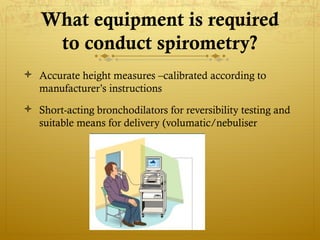
 Accurate height measures –calibrated according to
manufacturer’s instructions
 Short-acting bronchodilators for reversibility testing and
suitable means for delivery (volumatic/nebuliser
Contraindications to
spirometry testing
Absolute
Active infection e.g. AFB positive TB until treated for 2
weeks
Conditions that may cause serious consequences to health
if aggravated by forced expiration e.g. dissecting/unstable
aortic aneurysm, pneumothorax, recent surgery (abdominal,
thoracic, neurosurgery, eye surgery)
Contraindications to
spirometry testing
Relative
Suspected respiratory infection in the last 4-6 weeks requiring
antibiotics or steroids
Undiagnosed chest symptoms e.g. haemoptysis
Any condition which may be aggravated by forced expiration e.g. prior
pneumothorax, history of myocardial infarction, stroke or embolism in
the last 3 months, previous thoracic, abdominal or eye surgery
Perforated ear drum. Acute disorders such as nausea and vomiting
Confusion, communication problems
Common errors in spirometry
testing
 Poor seal around mouthpiece
 Hesitation or false start
 Early termination of exhalation: a ‘short blow’ which has not
achieved the full FVC
 Poor intake of breath
 Poor forced expiratory effort. Cough during procedure
 Incorrect data entered into the spirometer prior to testing
 Spirometer not calibrated and verified
Calibration
 Calibration of spirometry test equipment should be
performed using a certificated 3 litre syringe and
following
 The manufacturer’s recommended procedures. For a
device to be within calibration limits it must read +/- 3%
of true.
 Calibration should be verified prior to each
clinic/session or after every 10th patient (which ever
comes first). A calibration log should be maintained
Preparation of the patient
 Explain to the patient that they will need to breathe in until
they have completely filled their lungs, then blow out as hard
and fast as they can into the mouthpiece until the lungs are
completely empty.
 This could take a few seconds longer than feels comfortable.
 — demonstrate the correct posture and the amount of force
needed when exhaling.
 — explain that this process will be repeated at least three times,
and that several more attempts may be needed to get reliable
results.
Measuring expiratory and
inspiratory flow
 Sit upright with their legs uncrossed and their feet flat on
the floor, without leaning forward
 Place the mouthpiece in their mouth and close their lips
to form a tight seal
 Breathe normally for 2–3 breaths
 Breathe in rapidly and deeply until their lungs are
completely full
Measuring expiratory and
inspiratory flow
 Without pausing for more than 2 seconds, blast air out as
hard and fast as possible and for as long as possible, until
their lungs are completely empty or they cannot possibly
blow out any longer
 Keeping a tight seal on the mouthpiece, breathe in again
as forcefully and fully as possible
 Remove the mouthpiece and breathe normally
Measuring expiratory flow
 Sit upright with their legs uncrossed and their feet flat on the
floor, without leaning forward
 Breathe in rapidly and deeply until their lungs are completely full
 Immediately place the mouthpiece in their mouth and close their
lips to form a tight seal
 Without pausing for more than 2 seconds, blast air out as hard
and fast as possible and for as long as possible, until their lungs
are completely empty or they cannot possibly blowout any longer.
 Remove the mouthpiece and breathe normally
Accetability
 Spirometry results are acceptable if the testing session yields
manoeuvres (blows) that:
 — meet objective criteria for determining that maximal effort
was achieved and acceptable FEV1 and/or FVC
measurements were obtained (usually termed ‘acceptability’)
 — meet criteria for consistency across multiple manoeuvres
(usually termed ‘repeatability’).
 However, occasionally FEV1 or FVC measurements may be
clinically usable even if they are not technically acceptable.
Pulmonary diffusion test
 Lung diffusion testing determines how well oxygen
moves from your lungs to your blood. It’s a type of
pulmonary function test. It helps your healthcare
provider understand how well your lungs are working.
 During the test, you breathe in a gas that contains a
small amount of carbon monoxide. The test measures
how much carbon monoxide passes from your lungs to
your blood, or the “diffusing capacity for carbon
monoxide” (DLCO for short). It’s also called transfer
factor for carbon monoxide (TLCO).
 When you breathe air in, the oxygen travels through your airways into small
air sacs (alveoli).
 From there, your blood picks up the oxygen as it travels through nearby
blood vessels (capillaries). A number of factors determine how well oxygen
transfers from your lungs to your blood (diffusion), including:
 The amount of surface area in your alveoli.
 The amount of blood in your capillaries.
 The concentration of hemoglobin (a protein that carries oxygen) in your
blood.
 The thickness of the membrane between your alveoli and capillaries. Excess
fluid in your alveoli.
What is lung diffusion testing
(DLCO) used for?
 Understand what’s causing certain symptoms such as
shortness of breath, coughing or wheezing.
 Assess lung damage.
 Screen for certain lung diseases.
 Understand how an underlying disease is affecting your
lung function.
 Get information on how well a treatment is working.
 A DLCO test uses a special mixture of gas to measure how well oxygen and
carbon dioxide are moving between your lungs and your blood.
 During the test, you breathe in a gas that’s a mixture of nitrogen and oxygen
plus:
 A small amount of carbon monoxide (not enough to hurt you), which should
move easily from your lungs to your blood.
 A tracer gas, like helium. A tracer gas isn’t absorbed into your blood and helps
measure the amount of carbon monoxide absorbed.
 When you breathe in, your blood absorbs some or all of the carbon monoxide
from the gas in your lungs. When you breathe out into the machine, it measures
how much carbon monoxide your blood absorbed based on how much is left in
the gas you breathed out.
What should I know before
doing a diffusion test?
 Do not smoke and stay away from others who are
smoking on the day of the test.
 If you are on oxygen, you will usually be asked to be off
oxygen for a few minutes before taking this test.
What are diffusion studies?
 Like spirometry, this test is done by having you breathe into
a mouthpiece connected to a machine. You will be asked to
empty your lungs by gently breathing out as much air as you
can.
Then you will breathe in a quick (but deep breath), hold your
breath for 10 seconds, and then breathe out as instructed.
You will do the test several times. It usually takes about 30
minutes to complete this test
What are diffusion studies?
 During a DLCO test, a technician will put a clip over your nose or a mask on your
face. They’ll have you:
 Put your mouth over a mouthpiece attached to a machine. The machine will deliver
the gas mix. It will also measure and record your results throughout the test.
 Take a few normal, steady breaths.
 Inhale deeply and exhale completely.
 Breathe in quickly through your mouth.
 Hold your breath for 10 seconds or as long as you can.
 Breathe out.
 Your technician may wait a few minutes and repeat the test at least one more time.
Results
 The results of a lung diffusion test are given in a percentage of
what they expect your DLCO to be (predicted value). Not
everyone’s expected DLCO value is the same. It’s based on
factors like age and sex. Your results could be:
 Normal DLCO: Between 75% and 140% of the predicted
value.
 Mildly reduced DLCO: 60% to 75% or the lower limit of
normal (LLN) predicted value.
 Severely reduced DLCO: Less than 40% of the predicted value.
LOW DLCO
 Many things can cause a low DLCO. Some specific causes includes
 Smoking.
 Cystic fibrosis.
 COPD.
 Emphysema.
 Sarcoidosis and other interstitial lung diseases.
 Heart and blood conditions, like pulmonary embolism, pulmonary arterial
hypertension, congestive heart failure and anemia.
 Autoimmune disorders like mixed connective tissue disease, scleroderma and lupus
(SLE).
High DLCO
 Some conditions cause you to have a higher DLCO than expected. These include:
 Obesity.
 Asthma.
 Exercising before the test.
 High altitude.
 Bleeding in your lungs.
 Cardiac shunt.
 Heart failure.
 Polycythemia vera.
What is body plethysmography?
 Body plethysmography is a test to find out how much air is
in your lungs after you take in a deep breath, and how
much air is left in your lungs after breathing out as much as
you can.
 No matter how hard you try, you can never get all of the air
out of your lungs.
 Measuring the total amount of air your lungs can hold and
the amount of air left in your lungs after you breathe out
gives your healthcare provider information about how well
your lungs are working and helps guide your treatment.
What is body plethysmography?
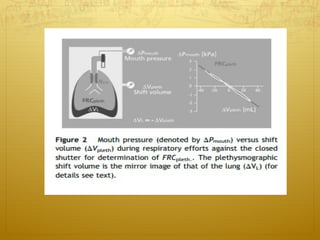
 The volume-constant whole-body plethysmograph isa
chamber resembling a glass-walled telephone box in shape
and volume (about 700e1000 L). During measurement the
box is closed with an airtight seal, except for a small
controlled leak that is used to stabilize the internal pressure
by allowing for equilibration of slow pressure changes,
 One pressure transducer serves to measure the pressure
inside the box relative to ambient pressure, another one is
placed close to the mouth for recording mouth pressure
during a shutter maneuver.
 The shutter mechanism can be used to deliberately block the airflow by
transient occlusion.
 Moreover, respiratory flow rate is recorded by conventional equipment,
such as pneumotachograph,
 You will be asked to wear a nose clip and you will be given instructions
on how to breathe through the mouthpiece.
 You will be asked to take short, shallow breaths through the mouthpiece
when it is blocked for a few seconds, which may be uncomfortable.
 If you have difficulty with being in closed spaces (claustrophobia),
mention this to your provider ordering the test.
What is body plethysmography?
 This will avoid any misunderstanding and discomfort to
you.
 It usually takes about 15 minutes to complete.
 Some PFT labs will use other tests instead of
plethysmography to measure the total volume of air in
your lungs
What should be done before
this test?
 If you are on oxygen, you will usually be asked to be off
oxygen during this test.
 Let the staff know if you have difficulty in closed spaces
Practical consideration
 Obviously, the “thoracic gas volume (TGV)” determined
in this way is that at occlusion; it is commonly
performed at the end of expiration, i.e. under the
condition of mechanical relaxation.
 This volume is the “functional residual capacity assessed
by body plethysmography” (FRC, more specifically
FRCpleth).
 Occasionally the expression “intrathoracic gas volume
(ITGV)” is used as synonym for FRCpleth.
Practical consideration
 In practical measurements there is a small deviation
from this, as a small initial inspiratory volume has to be
detected in order to reliably define the end of expiration,
 After the first occlusion maneuver, patients should
continue to breathe normally until they have
recoveredfrom potential changes in FRC subsequent to
the maneuver.
Practical consideration
 There are two ways to continue the measurement after
the last occlusion maneuver. If possible, the patient
should perform a maximal expiration to determine
expiratory reserve volume (ERV) without potential for
intermediate shifts in FRC.
 This should be followed by a maximal inspiration to
determine inspiratory vital capacity (IVC)
Practical consideration
 Residual volume (RV) can then be calculated as FRC minus ERV
 Probably the best choice is to take median FRC and maximum
ERV for this.
 Next, total lung capacity (TLC) is computed as the sum of RV
and the maximal IVC from all satisfactory respiratory
maneuvers.
 For patients with dyspnea it might be difficult to perform these
linked maneuvers immediately after opening of the shutter.
These patients should be allowed for a few cycles of quiet
breathing before initiation of the ERV maneuver.
Airway resistance

Spirometry is test of lung function.ppt

  • 1.
  • 2.
    Pulmonary Function Tests Pulmonary function tests (PFT’s) are breathing tests to find out how well you move air in and out of your lungs and how well oxygen enters your blood stream.  The most common PFT’s are spirometry, diffusion studies, and body plethysmography  Sometimes only one test is done, other times all tests will be scheduled on the same day
  • 3.
    Lung function testscan be used...  Compare your lung function with known standards that show how well your lungs should be working.  Measure the effect of chronic diseases like asthma, chronic obstructive lung disease (COPD), or cystic fibrosis on lung function.  Identify early changes in lung function that might show a need for a change in treatment.  Detect narrowing in the airways.
  • 4.
    Lung function testscan be used...  Decide if a medicine (such as a bronchodilator) could be helpful to use.  Show whether exposure to substances in your home or workplace may have harmed your lungs.  Determine your ability to tolerate surgery and medical procedures.
  • 5.
    To get themost accurate results from your breathing tests  Do not smoke for at least 1 hour before the test.  Do not drink alcohol for at least 4 hours before the test.  Do not exercise heavily for at least 30 minutes before the test.  Do not wear tight clothing that makes it difficult for you to take a deep breath.  Do not eat a large meal within 2 hours before the test.  Ask your health care provider if there are any medicines you should not take on the day of your test.
  • 6.
    What is spirometry? Spirometry is used to measure lung volumes and air flow.  Alongside clinical assessment, it is an essential tool used in the diagnosis, assessment and monitoring of Chronic Obstructive Pulmonary Disease (COPD),  May contribute to the diagnosis of asthma and detect restrictive respiratory conditions.
  • 7.
    What measurements are undertakenusing spirometry?  Relaxed or slow vital capacity (VC). The volume of air that can be slowly expelled from the lung from maximal inspiration to maximum expiration  Forced vital capacity (FVC). The volume of air that can be forcibly expelled from the lung from maximal inspiration to maximum expiration.  Forced Expiratory Volume in 1 second (FEV1). The volume of air that can be forcibly expelled from maximum inspiration in the first second
  • 8.
    What measurements are undertakenusing spirometry?  FEV1/FVC ratio. The FEV1/FVC ratio is the FEV1 expressed as a percentage of the FVC (or VC if that is greater). i.e. the proportion of the vital capacity exhaled in the first second. It distinguishes between a reduced FEV1 due to restrictive lung volume and that due to obstruction. Obstruction is defined as an FEV1/FV ratio less than 70%  Forced Expiratory Volume in 6 seconds (FEV6). The volume of air that can be forcibly expelled from maximum inspiration in six seconds.
  • 9.
  • 10.
    Abnormal spirometry  Abnormalspirometry is divided into restrictive and obstructive ventilatory patterns.  Restrictive patterns appearin conditions where the lung volume is reduced e.g. interstitial lung diseases, scoliosis. The FVC and FEV1 are reduced proportionately  Obstructive patterns appear when the airways are obstructed e.g. due to asthma or COPD. The FEV1 is reduced more than the FVC
  • 11.
    Predicted values  Predictednormal values can be calculated and depend on age, sex, height, mass and ethnicity.  FEV1 is often expressed as a percentage of the predicted value for any person of similar age sex, and height with adjust ments for ethnic origin.  FEV1 % predicted is used to classify the severity of COPD.  National and international guidelines use the levels of FEV1 <80%, <50% or <30% predicted to define moderate, severe or very severe disease
  • 12.
    Types of spirometrytesting  Baseline testing. Used to investigate lung function where diagnosis has not been established.  Post-bronchodilator testing. Investigative: To diagnose obstructive conditions where baseline spirometry shows an obstructive pattern. Monitoring: To monitor clinical progress in diagnosed asthma and COPD  Reversibility testing May help to differentiate asthma from COPD.
  • 13.
    What equipment isrequired to conduct spirometry?  Spirometer (must meet ISO standard 26783).  Small hand-held meters which provide digital readings(but no visual display) are a cheap option which may be useful as a screening tool to identify people with abnormal readings who should be assessed by full diagnostic spirometry  One-way disposable mouthpieces and nose clips  Bacterial and viral filters (selected patients with any risk of infection)
  • 14.
    What equipment isrequired to conduct spirometry?  Accurate height measures –calibrated according to manufacturer’s instructions  Short-acting bronchodilators for reversibility testing and suitable means for delivery (volumatic/nebuliser
  • 15.
    Contraindications to spirometry testing Absolute Activeinfection e.g. AFB positive TB until treated for 2 weeks Conditions that may cause serious consequences to health if aggravated by forced expiration e.g. dissecting/unstable aortic aneurysm, pneumothorax, recent surgery (abdominal, thoracic, neurosurgery, eye surgery)
  • 16.
    Contraindications to spirometry testing Relative Suspectedrespiratory infection in the last 4-6 weeks requiring antibiotics or steroids Undiagnosed chest symptoms e.g. haemoptysis Any condition which may be aggravated by forced expiration e.g. prior pneumothorax, history of myocardial infarction, stroke or embolism in the last 3 months, previous thoracic, abdominal or eye surgery Perforated ear drum. Acute disorders such as nausea and vomiting Confusion, communication problems
  • 17.
    Common errors inspirometry testing  Poor seal around mouthpiece  Hesitation or false start  Early termination of exhalation: a ‘short blow’ which has not achieved the full FVC  Poor intake of breath  Poor forced expiratory effort. Cough during procedure  Incorrect data entered into the spirometer prior to testing  Spirometer not calibrated and verified
  • 19.
    Calibration  Calibration ofspirometry test equipment should be performed using a certificated 3 litre syringe and following  The manufacturer’s recommended procedures. For a device to be within calibration limits it must read +/- 3% of true.  Calibration should be verified prior to each clinic/session or after every 10th patient (which ever comes first). A calibration log should be maintained
  • 20.
    Preparation of thepatient  Explain to the patient that they will need to breathe in until they have completely filled their lungs, then blow out as hard and fast as they can into the mouthpiece until the lungs are completely empty.  This could take a few seconds longer than feels comfortable.  — demonstrate the correct posture and the amount of force needed when exhaling.  — explain that this process will be repeated at least three times, and that several more attempts may be needed to get reliable results.
  • 21.
    Measuring expiratory and inspiratoryflow  Sit upright with their legs uncrossed and their feet flat on the floor, without leaning forward  Place the mouthpiece in their mouth and close their lips to form a tight seal  Breathe normally for 2–3 breaths  Breathe in rapidly and deeply until their lungs are completely full
  • 22.
    Measuring expiratory and inspiratoryflow  Without pausing for more than 2 seconds, blast air out as hard and fast as possible and for as long as possible, until their lungs are completely empty or they cannot possibly blow out any longer  Keeping a tight seal on the mouthpiece, breathe in again as forcefully and fully as possible  Remove the mouthpiece and breathe normally
  • 23.
    Measuring expiratory flow Sit upright with their legs uncrossed and their feet flat on the floor, without leaning forward  Breathe in rapidly and deeply until their lungs are completely full  Immediately place the mouthpiece in their mouth and close their lips to form a tight seal  Without pausing for more than 2 seconds, blast air out as hard and fast as possible and for as long as possible, until their lungs are completely empty or they cannot possibly blowout any longer.  Remove the mouthpiece and breathe normally
  • 24.
    Accetability  Spirometry resultsare acceptable if the testing session yields manoeuvres (blows) that:  — meet objective criteria for determining that maximal effort was achieved and acceptable FEV1 and/or FVC measurements were obtained (usually termed ‘acceptability’)  — meet criteria for consistency across multiple manoeuvres (usually termed ‘repeatability’).  However, occasionally FEV1 or FVC measurements may be clinically usable even if they are not technically acceptable.
  • 29.
    Pulmonary diffusion test Lung diffusion testing determines how well oxygen moves from your lungs to your blood. It’s a type of pulmonary function test. It helps your healthcare provider understand how well your lungs are working.  During the test, you breathe in a gas that contains a small amount of carbon monoxide. The test measures how much carbon monoxide passes from your lungs to your blood, or the “diffusing capacity for carbon monoxide” (DLCO for short). It’s also called transfer factor for carbon monoxide (TLCO).
  • 30.
     When youbreathe air in, the oxygen travels through your airways into small air sacs (alveoli).  From there, your blood picks up the oxygen as it travels through nearby blood vessels (capillaries). A number of factors determine how well oxygen transfers from your lungs to your blood (diffusion), including:  The amount of surface area in your alveoli.  The amount of blood in your capillaries.  The concentration of hemoglobin (a protein that carries oxygen) in your blood.  The thickness of the membrane between your alveoli and capillaries. Excess fluid in your alveoli.
  • 31.
    What is lungdiffusion testing (DLCO) used for?  Understand what’s causing certain symptoms such as shortness of breath, coughing or wheezing.  Assess lung damage.  Screen for certain lung diseases.  Understand how an underlying disease is affecting your lung function.  Get information on how well a treatment is working.
  • 32.
     A DLCOtest uses a special mixture of gas to measure how well oxygen and carbon dioxide are moving between your lungs and your blood.  During the test, you breathe in a gas that’s a mixture of nitrogen and oxygen plus:  A small amount of carbon monoxide (not enough to hurt you), which should move easily from your lungs to your blood.  A tracer gas, like helium. A tracer gas isn’t absorbed into your blood and helps measure the amount of carbon monoxide absorbed.  When you breathe in, your blood absorbs some or all of the carbon monoxide from the gas in your lungs. When you breathe out into the machine, it measures how much carbon monoxide your blood absorbed based on how much is left in the gas you breathed out.
  • 33.
    What should Iknow before doing a diffusion test?  Do not smoke and stay away from others who are smoking on the day of the test.  If you are on oxygen, you will usually be asked to be off oxygen for a few minutes before taking this test.
  • 34.
    What are diffusionstudies?  Like spirometry, this test is done by having you breathe into a mouthpiece connected to a machine. You will be asked to empty your lungs by gently breathing out as much air as you can. Then you will breathe in a quick (but deep breath), hold your breath for 10 seconds, and then breathe out as instructed. You will do the test several times. It usually takes about 30 minutes to complete this test
  • 35.
    What are diffusionstudies?  During a DLCO test, a technician will put a clip over your nose or a mask on your face. They’ll have you:  Put your mouth over a mouthpiece attached to a machine. The machine will deliver the gas mix. It will also measure and record your results throughout the test.  Take a few normal, steady breaths.  Inhale deeply and exhale completely.  Breathe in quickly through your mouth.  Hold your breath for 10 seconds or as long as you can.  Breathe out.  Your technician may wait a few minutes and repeat the test at least one more time.
  • 36.
    Results  The resultsof a lung diffusion test are given in a percentage of what they expect your DLCO to be (predicted value). Not everyone’s expected DLCO value is the same. It’s based on factors like age and sex. Your results could be:  Normal DLCO: Between 75% and 140% of the predicted value.  Mildly reduced DLCO: 60% to 75% or the lower limit of normal (LLN) predicted value.  Severely reduced DLCO: Less than 40% of the predicted value.
  • 37.
    LOW DLCO  Manythings can cause a low DLCO. Some specific causes includes  Smoking.  Cystic fibrosis.  COPD.  Emphysema.  Sarcoidosis and other interstitial lung diseases.  Heart and blood conditions, like pulmonary embolism, pulmonary arterial hypertension, congestive heart failure and anemia.  Autoimmune disorders like mixed connective tissue disease, scleroderma and lupus (SLE).
  • 38.
    High DLCO  Someconditions cause you to have a higher DLCO than expected. These include:  Obesity.  Asthma.  Exercising before the test.  High altitude.  Bleeding in your lungs.  Cardiac shunt.  Heart failure.  Polycythemia vera.
  • 39.
    What is bodyplethysmography?  Body plethysmography is a test to find out how much air is in your lungs after you take in a deep breath, and how much air is left in your lungs after breathing out as much as you can.  No matter how hard you try, you can never get all of the air out of your lungs.  Measuring the total amount of air your lungs can hold and the amount of air left in your lungs after you breathe out gives your healthcare provider information about how well your lungs are working and helps guide your treatment.
  • 40.
    What is bodyplethysmography?  The volume-constant whole-body plethysmograph isa chamber resembling a glass-walled telephone box in shape and volume (about 700e1000 L). During measurement the box is closed with an airtight seal, except for a small controlled leak that is used to stabilize the internal pressure by allowing for equilibration of slow pressure changes,  One pressure transducer serves to measure the pressure inside the box relative to ambient pressure, another one is placed close to the mouth for recording mouth pressure during a shutter maneuver.
  • 41.
     The shuttermechanism can be used to deliberately block the airflow by transient occlusion.  Moreover, respiratory flow rate is recorded by conventional equipment, such as pneumotachograph,  You will be asked to wear a nose clip and you will be given instructions on how to breathe through the mouthpiece.  You will be asked to take short, shallow breaths through the mouthpiece when it is blocked for a few seconds, which may be uncomfortable.  If you have difficulty with being in closed spaces (claustrophobia), mention this to your provider ordering the test.
  • 42.
    What is bodyplethysmography?  This will avoid any misunderstanding and discomfort to you.  It usually takes about 15 minutes to complete.  Some PFT labs will use other tests instead of plethysmography to measure the total volume of air in your lungs
  • 44.
    What should bedone before this test?  If you are on oxygen, you will usually be asked to be off oxygen during this test.  Let the staff know if you have difficulty in closed spaces
  • 46.
    Practical consideration  Obviously,the “thoracic gas volume (TGV)” determined in this way is that at occlusion; it is commonly performed at the end of expiration, i.e. under the condition of mechanical relaxation.  This volume is the “functional residual capacity assessed by body plethysmography” (FRC, more specifically FRCpleth).  Occasionally the expression “intrathoracic gas volume (ITGV)” is used as synonym for FRCpleth.
  • 47.
    Practical consideration  Inpractical measurements there is a small deviation from this, as a small initial inspiratory volume has to be detected in order to reliably define the end of expiration,  After the first occlusion maneuver, patients should continue to breathe normally until they have recoveredfrom potential changes in FRC subsequent to the maneuver.
  • 48.
    Practical consideration  Thereare two ways to continue the measurement after the last occlusion maneuver. If possible, the patient should perform a maximal expiration to determine expiratory reserve volume (ERV) without potential for intermediate shifts in FRC.  This should be followed by a maximal inspiration to determine inspiratory vital capacity (IVC)
  • 49.
    Practical consideration  Residualvolume (RV) can then be calculated as FRC minus ERV  Probably the best choice is to take median FRC and maximum ERV for this.  Next, total lung capacity (TLC) is computed as the sum of RV and the maximal IVC from all satisfactory respiratory maneuvers.  For patients with dyspnea it might be difficult to perform these linked maneuvers immediately after opening of the shutter. These patients should be allowed for a few cycles of quiet breathing before initiation of the ERV maneuver.
  • 50.