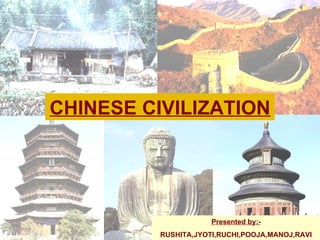
CHINESE CIVILIZATION Presented by:- RUSHITA,JYOTI,RUCHI,POOJA,MANOJ,RAVI
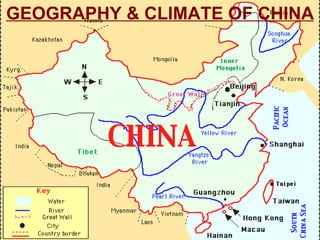
GEOGRAPHY & CLIMATE OF CHINA
GEOGRAPHICAL  AREAS China Ranges from plateaus and Mountains in the west to lower land in the east. Principle river In the central-east are the Deltas of China's two  major rivers, the  Hang He (yellow river)  and  Yangize  in central North-East  Aamur . Sometimes towards south  pearl river ,  Mekong river , and  Brahmaputra . Chinese rivers are emptying into  Pacific Ocean . In the East, along the Shores of the  Yellow Sea . On the edges of the Inner  Mongolian plateau  in the north,  grasslands  can be seen. Southern China is dominated by  hills  and  low Mountain ranges .
CLIMATE OF CHINA The central zone has a generally  temperate climate .  The southern zone has a generally  subtropical climate .  The northern zone has a climate with  winters of Arctic severity.
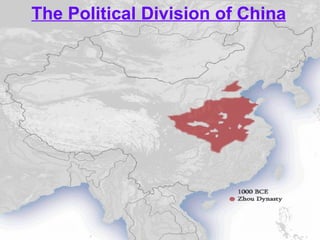
The Political Division of China
Ancient Era   -  Xia Dynasty  (2100-1600 B.C.)   -  Shang Dynasty  (1600-1046 B.C.)   -  Zhou Dynasty  (1122-256 B.C.)   Spring & Antumn Period   Waring States Period
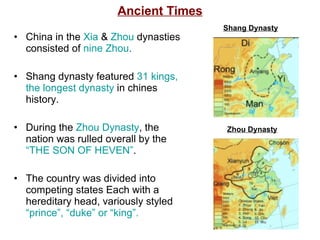
Ancient Times China in the  Xia  &   Zhou  dynasties consisted of  nine Zhou . Shang dynasty featured  31 kings, the longest dynasty   in chines history. During the  Zhou Dynasty , the nation was rulled overall by the  “THE SON OF HEVEN” . The country was divided into competing states Each with a hereditary head, variously styled  “prince”, “duke” or “king”. Shang Dynasty Zhou Dynasty
Imperial Era (221 B.C. – 1911 B.C.) Qin Dynasty Han Dynasty Southern & Northern Dynasties Sui Dynasty Tang Dynasty Five Dynasties & Ten Kingdoms Song Dynasty Yuan Dynasty Ming Dynasty Qing Dynasty
Qin Dynasty The major contributions of the Qin include the concept of a  centralized government, the unification of the legal code, written language, measurement, and currency of China . Han Dynasty Emperor Wu  consolidated and extended the Chinese empire .   This enabled the first opening of trading connections between China and the West, the  Silk Road .   Three states tried to gain predominance in the Period of the  Three Kingdoms . This time period has been greatly romanticized in works such as  Romance of the Three Kingdoms .
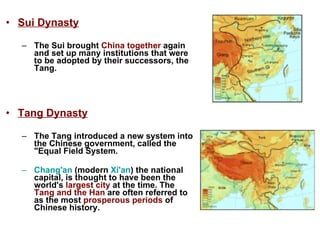
Sui Dynasty The Sui brought  China together  again and set up many institutions that were to be adopted by their successors, the Tang.  Tang Dynasty The Tang introduced a new system into the Chinese government, called the "Equal Field System. Chang'an  (modern  Xi'an ) the national capital, is thought to have been the world's  largest city  at the time. The  Tang and the Han  are often referred to as the most  prosperous periods  of Chinese history.
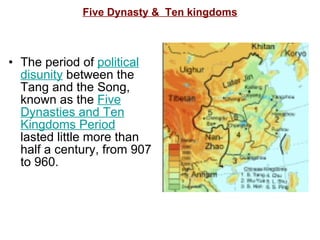
Five Dynasty &  Ten kingdoms The period of  political disunity  between the Tang and the Song, known as the  Five Dynasties and Ten Kingdoms Period  lasted little more than half a century, from 907 to 960.
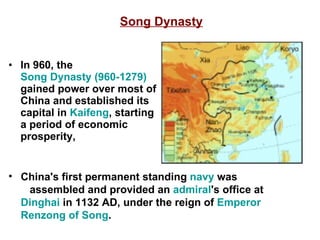
Song Dynasty In 960, the  Song Dynasty (960-1279)  gained power over most of China and established its capital in  Kaifeng , starting a period of economic prosperity,  China's first permanent standing  navy  was  assembled and provided an  admiral 's office at  Dinghai  in 1132 AD, under the reign of  Emperor  Renzong  of Song .
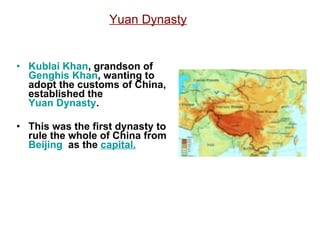
Yuan Dynasty Kublai Khan , grandson of  Genghis Khan , wanting to adopt the customs of China, established the  Yuan Dynasty . This was the first dynasty to rule the whole of China from  Beijing   as the  capital.
Ming Dynasty Emperor  Yong-le  strenuously tried to extend China's influence beyond its borders by demanding other rulers send ambassadors to China to present tribute. A large navy was built, including four-massed ships displacing 1,500 tons. A standing army of 1 million troops was created. The Chinese armies conquered Vietnam for around 20 years. The  Grand Canal  was expanded, and proved to be a stimulus to domestic trade. During the Ming dynasty the last construction on the  Great Wall  was undertaken to protect China from foreign invasions.
Qing Dynasty Emperor  Kangxi  ordered the creation of  the most complete dictionary  of  Chinese characters  ever put together at the time. The Manchus set up the "Eight Banners" system in an attempt to avoid being assimilated into Chinese society. Banner membership was to be based on traditional Manchu skills such as archery, horsemanship, and frugality.
 
Modern Era With the proclamation of the  People's Republic of China  on October 1, 1949, Taiwan was again politically separated from mainland China and was continued to be governed by the  Republic of China .
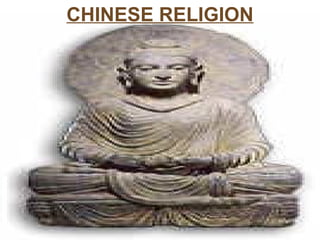
CHINESE RELIGION
Taoism Confucianism Buddhism - Gods  - Buddhas
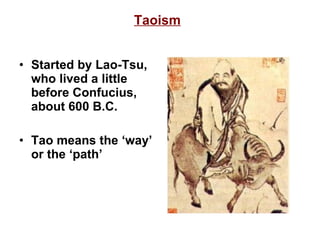
Taoism Started by Lao-Tsu, who lived a little before Confucius, about 600 B.C. Tao means the ‘way’ or the ‘path’
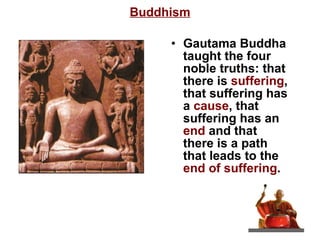
Buddhism Gautama Buddha taught the four noble truths: that there is  suffering , that suffering has a  cause , that suffering has an  end  and that there is a path that leads to the  end of suffering .
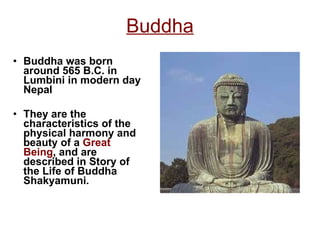
Buddha Buddha was born around 565 B.C. in Lumbini in modern day Nepal They are the  characteristics of the physical harmony and beauty of a  Great Being , and are described in Story of the Life of Buddha Shakyamuni.
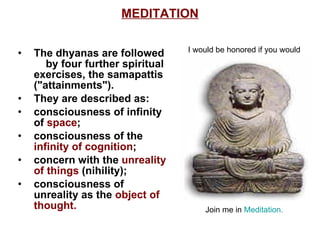
MEDITATION The dhyanas are followed  by four further spiritual exercises, the samapattis ("attainments").  They are described as: consciousness of infinity of  space ;  consciousness of the  infinity of cognition ;  concern with the  unreality of things  (nihility); consciousness of unreality as the  object of thought.  I would be honored if you would                                                  Join me in  Meditation.
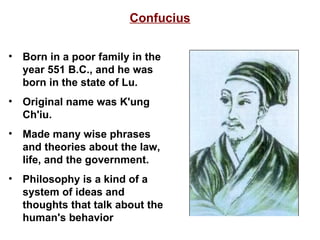
Confucius Born in a poor family in the year 551 B.C., and he was born in the state of Lu. Original name was K'ung Ch'iu.  Made many wise phrases and theories about the law, life, and the government. Philosophy is a kind of a system of ideas and thoughts that talk about the human's behavior
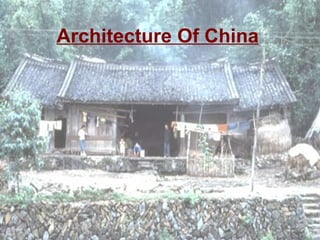
Architecture Of China
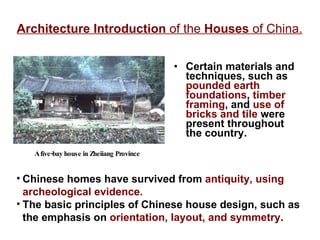
A five-bay house in Zheiiang Province   Certain materials and techniques, such as   pounded earth foundations ,  timber framing ,   and   use of bricks and tile   were present throughout the country.  Architecture   Introduction  of the  Houses  of China. Chinese homes have survived from  antiquity, using archeological evidence. The basic principles of Chinese house design, such as the emphasis on  orientation, layout, and symmetry .
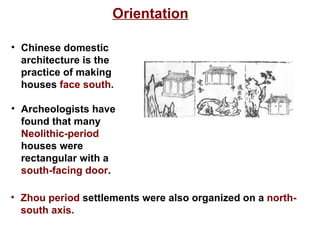
Orientation Zhou period  settlements were also organized on a  north-south axis.  Chinese domestic architecture is the practice of making houses  face south . Archeologists have found that many  Neolithic-period  houses were rectangular with a  south-facing door .
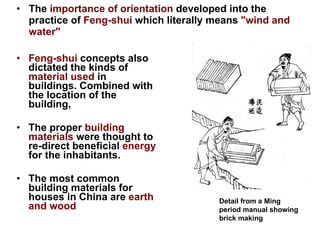
The  importance of orientation  developed into the practice of  Feng-shui  which literally means  "wind and water" Feng-shui   concepts also dictated the kinds of  material used  in buildings. Combined with the location of the building, The proper  building materials  were thought to re-direct beneficial  energy  for the inhabitants. The most common building materials for houses in China are  earth and wood Detail from a Ming period manual showing brick making  
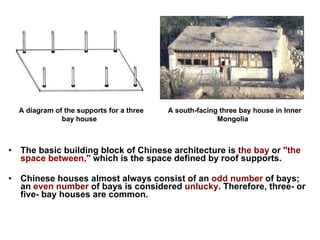
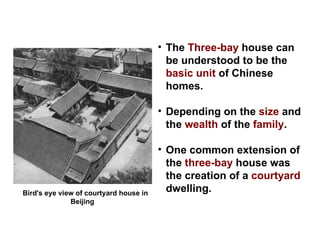
The basic building block of Chinese architecture is  the bay  or  "the space between,"  which is the space defined by roof supports.  Chinese houses almost always consist of an  odd number  of bays; an  even number  of bays is considered  unlucky . Therefore, three- or five- bay houses are common. A diagram of the supports for a three bay house   A south-facing three bay house in Inner Mongolia 
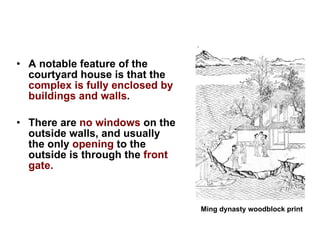
The  Three-bay  house can be understood to be the  basic unit  of Chinese homes. Depending on the  size  and the  wealth  of the  family . One common extension of the  three-bay  house was the creation of a  courtyard  dwelling.  Bird's eye view of courtyard house in Beijing  
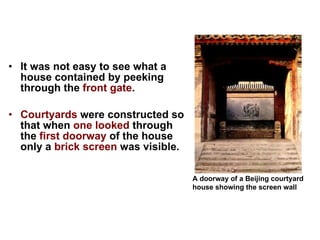
A notable feature of the courtyard house is that the  complex is fully enclosed by buildings and walls .  There are  no windows  on the outside walls, and usually the only  opening  to the outside is through the  front gate. Ming dynasty woodblock print 
It was not easy to see what a house contained by peeking through the  front gate .  Courtyards  were constructed so that when  one looked  through the  first doorway  of the house only a  brick screen  was visible.  A doorway of a Beijing courtyard house showing the screen wall             
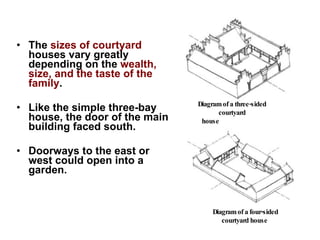
The  sizes of courtyard  houses vary greatly depending on the  wealth, size, and the taste of the family . Like the simple three-bay house, the door of the main building faced south. Doorways to the east or west could open into a garden. Diagram of a three-sided courtyard house                            Diagram of a four-sided courtyard house
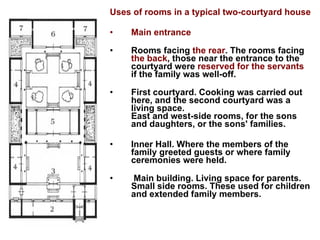
Uses of rooms in a typical two-courtyard house Main entrance Rooms facing  the rear . The rooms facing  the back , those near the entrance to the courtyard were  reserved for the servants  if the family was well-off. First courtyard. Cooking was carried out here, and the second courtyard was a living space. East and west-side rooms, for the sons and daughters, or the sons' families. Inner Hall. Where the members of the family greeted guests or where family ceremonies were held. Main building. Living space for parents. Small side rooms. These used for children and extended family members.
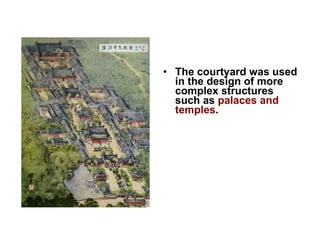
The courtyard was used in the design of more complex structures such as  palaces and temples .   
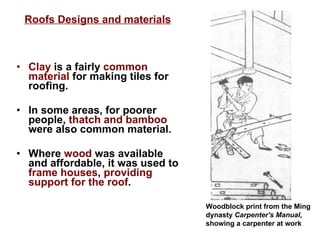
Clay  is a fairly  common material  for making tiles for roofing.  In some areas, for poorer people,  thatch and bamboo  were also common material. Where  wood  was available and affordable, it was used to  frame houses ,  providing support for the roof . Woodblock print from the Ming dynasty  Carpenter's Manual,  showing a carpenter at work    Roofs Designs and materials
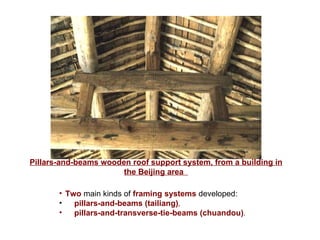
Pillars-and-beams wooden roof support system, from a building in the Beijing area   Two  main kinds of  framing systems  developed:  pillars-and-beams   (tailiang) ,   pillars-and-transverse-tie-beams (chuandou) .
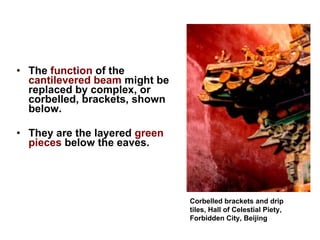
The  function  of the  cantilevered beam  might be replaced by complex, or corbelled, brackets, shown below.  They are the layered  green pieces  below the eaves.  Corbelled brackets and drip tiles, Hall of Celestial Piety, Forbidden City, Beijing  
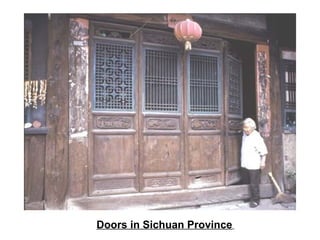
How Did They Decorate their Houses ? Walls and eaves  are often  decorated , but particular attention is paid to doorways and windows because these are places where good or evil spirits were thought to enter. Elegant decorative schemes would also provide  ventilation or shading . Many openings would be covered with  latticework  in an endless variety of patterns that  "shape the wind"  or alter the way air flows into a home.
Doors in Sichuan Province
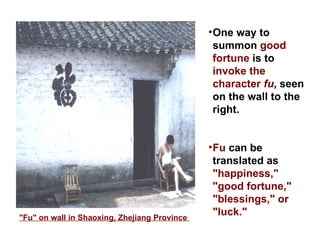
One way to summon  good fortune  is to  invoke the character  fu , seen on the wall to the right.  Fu  can be translated as  "happiness," "good fortune," "blessings," or "luck." "Fu" on wall in Shaoxing, Zhejiang Province
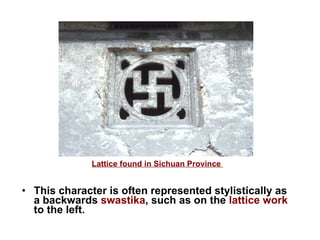
This character is often represented stylistically as a backwards  swastika , such as on the  lattice work  to the left.  Lattice found in Sichuan Province
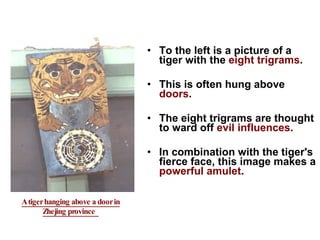
To the left is a picture of a tiger with the  eight trigrams . This is often hung above  doors . The eight trigrams are thought to ward off  evil influences . In combination with the tiger's fierce face, this image makes a  powerful amulet . A tiger hanging above a door in Zhejing province 
THE  GREAT  WALL  OF  CHINA
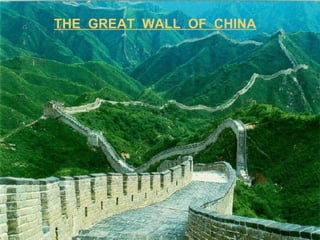
The Great Wall of China is a  series of stone  and earthen fortifications in China, built, rebuilt, and maintained between the  5th century BC and the 16th century  to protect the  northern borders  of the Chinese Empire during the rule of successive dynasties. Several walls, referred to as the Great Wall of China, were built since the  5th century BC . The most famous is the wall built between  220 BC and 200 BC by the first Emperor  of China,  Qin Shi Huang ; little of it remains; it was much farther north than the current wall, which was built during the  Ming Dynasty .
TEMPLE
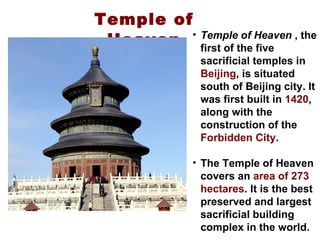
Temple of Heaven Temple of Heaven  , the first of the five sacrificial temples in  Beijing , is situated south of Beijing city. It was first built in  1420 , along with the construction of the  Forbidden City . The Temple of Heaven covers an  area of 273 hectares . It is the best preserved and largest sacrificial building complex in the world.
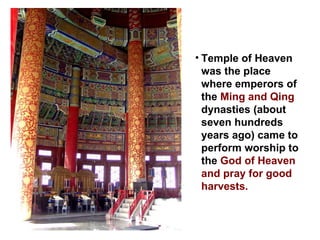
Temple of Heaven was the place where emperors of the  Ming and Qing  dynasties (about seven hundreds years ago) came to perform worship to the  God of Heaven and pray for good harvests.
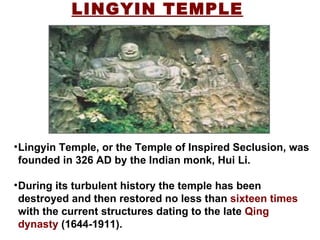
LINGYIN TEMPLE Lingyin Temple, or the Temple of Inspired Seclusion, was founded in 326 AD by the Indian monk, Hui Li. During its turbulent history the temple has been destroyed and then restored no less than  sixteen times  with the current structures dating to the late  Qing dynasty  (1644-1911).
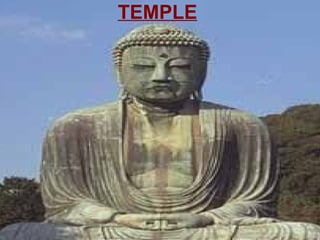
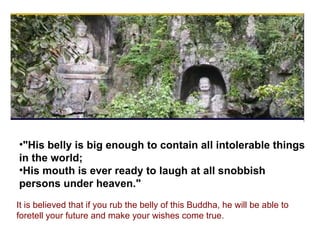
"His belly is big enough to contain all intolerable things in the world; His mouth is ever ready to laugh at all snobbish persons under heaven."  It is believed that if you rub the belly of this Buddha, he will be able to foretell your future and make your wishes come true.
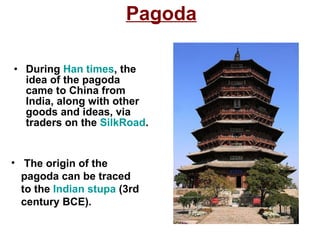
Pagoda During  Han times , the idea of the pagoda came to China from India, along with other goods and ideas, via traders on the  SilkRoad .  The origin of the pagoda can be traced to the  Indian   stupa  (3rd century BCE).
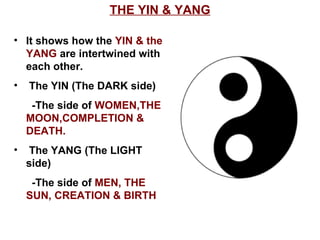
THE YIN & YANG It shows how the  YIN & the  YANG  are intertwined with each other. The YIN (The DARK side) -The side of  WOMEN,THE MOON,COMPLETION & DEATH. The YANG (The LIGHT side) -The side of  MEN, THE SUN, CREATION & BIRTH
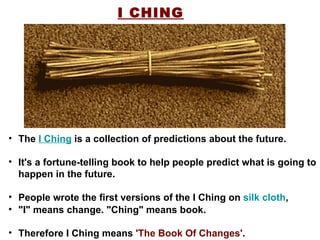
I CHING "I" means change. "Ching" means book. Therefore I Ching means  'The Book Of Changes' .  The  I Ching  is a collection of predictions about the future. It's a fortune-telling book to help people predict what is going to happen in the future. People wrote the first versions of the I Ching on  silk cloth ,
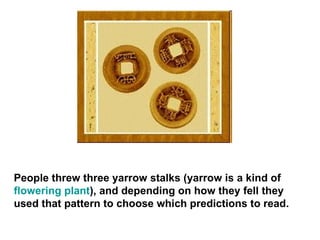
People threw three yarrow stalks (yarrow is a kind of  flowering plant ), and depending on how they fell they used that pattern to choose which predictions to read.
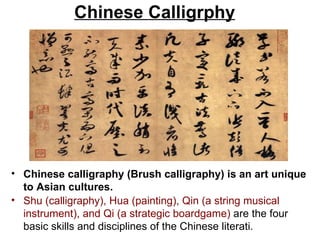
Chinese Calligrphy Chinese calligraphy (Brush calligraphy) is an art unique to Asian cultures.  Shu (calligraphy), Hua (painting), Qin (a string musical instrument), and Qi (a strategic boardgame)  are the four basic skills and disciplines of the Chinese literati.
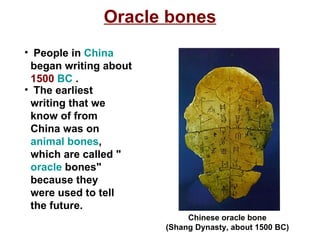
Oracle bones People in  China  began writing about  1500  BC  . The earliest writing that we know of from China was on  animal bones , which are called " oracle  bones" because they were used to tell the future.  Chinese oracle bone (Shang Dynasty, about 1500 BC)
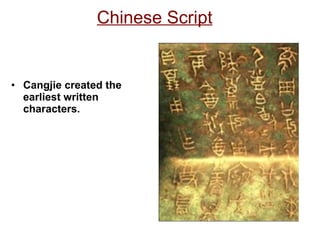
Chinese Script Cangjie created the earliest written characters.
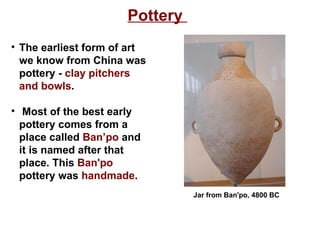
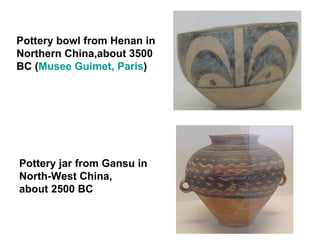
Pottery  The earliest form of art we know from China was pottery -  clay pitchers and bowls . Most of the best early pottery comes from a place called  Ban’po  and it is named after that place. This  Ban'po  pottery was  handmade .   Jar from Ban'po, 4800 BC
Pottery bowl from Henan in Northern China,about 3500 BC ( Musee   Guimet , Paris )  Pottery jar from Gansu in North-West China,  about 2500 BC

Chinese civilization

  • 1.
    CHINESE CIVILIZATION Presentedby:- RUSHITA,JYOTI,RUCHI,POOJA,MANOJ,RAVI
  • 2.
  • 3.
    GEOGRAPHICAL AREASChina Ranges from plateaus and Mountains in the west to lower land in the east. Principle river In the central-east are the Deltas of China's two major rivers, the Hang He (yellow river) and Yangize in central North-East Aamur . Sometimes towards south pearl river , Mekong river , and Brahmaputra . Chinese rivers are emptying into Pacific Ocean . In the East, along the Shores of the Yellow Sea . On the edges of the Inner Mongolian plateau in the north, grasslands can be seen. Southern China is dominated by hills and low Mountain ranges .
  • 4.
    CLIMATE OF CHINAThe central zone has a generally temperate climate . The southern zone has a generally subtropical climate . The northern zone has a climate with winters of Arctic severity.
  • 5.
  • 6.
    Ancient Era - Xia Dynasty (2100-1600 B.C.) - Shang Dynasty (1600-1046 B.C.) - Zhou Dynasty (1122-256 B.C.) Spring & Antumn Period Waring States Period
  • 7.
    Ancient Times Chinain the Xia & Zhou dynasties consisted of nine Zhou . Shang dynasty featured 31 kings, the longest dynasty in chines history. During the Zhou Dynasty , the nation was rulled overall by the “THE SON OF HEVEN” . The country was divided into competing states Each with a hereditary head, variously styled “prince”, “duke” or “king”. Shang Dynasty Zhou Dynasty
  • 8.
    Imperial Era (221B.C. – 1911 B.C.) Qin Dynasty Han Dynasty Southern & Northern Dynasties Sui Dynasty Tang Dynasty Five Dynasties & Ten Kingdoms Song Dynasty Yuan Dynasty Ming Dynasty Qing Dynasty
  • 9.
    Qin Dynasty Themajor contributions of the Qin include the concept of a centralized government, the unification of the legal code, written language, measurement, and currency of China . Han Dynasty Emperor Wu consolidated and extended the Chinese empire . This enabled the first opening of trading connections between China and the West, the Silk Road . Three states tried to gain predominance in the Period of the Three Kingdoms . This time period has been greatly romanticized in works such as Romance of the Three Kingdoms .
  • 10.
    Sui Dynasty TheSui brought China together again and set up many institutions that were to be adopted by their successors, the Tang. Tang Dynasty The Tang introduced a new system into the Chinese government, called the "Equal Field System. Chang'an (modern Xi'an ) the national capital, is thought to have been the world's largest city at the time. The Tang and the Han are often referred to as the most prosperous periods of Chinese history.
  • 11.
    Five Dynasty & Ten kingdoms The period of political disunity between the Tang and the Song, known as the Five Dynasties and Ten Kingdoms Period lasted little more than half a century, from 907 to 960.
  • 12.
    Song Dynasty In960, the Song Dynasty (960-1279) gained power over most of China and established its capital in Kaifeng , starting a period of economic prosperity, China's first permanent standing navy was assembled and provided an admiral 's office at Dinghai in 1132 AD, under the reign of Emperor Renzong of Song .
  • 13.
    Yuan Dynasty KublaiKhan , grandson of Genghis Khan , wanting to adopt the customs of China, established the Yuan Dynasty . This was the first dynasty to rule the whole of China from Beijing as the capital.
  • 14.
    Ming Dynasty Emperor Yong-le strenuously tried to extend China's influence beyond its borders by demanding other rulers send ambassadors to China to present tribute. A large navy was built, including four-massed ships displacing 1,500 tons. A standing army of 1 million troops was created. The Chinese armies conquered Vietnam for around 20 years. The Grand Canal was expanded, and proved to be a stimulus to domestic trade. During the Ming dynasty the last construction on the Great Wall was undertaken to protect China from foreign invasions.
  • 15.
    Qing Dynasty Emperor Kangxi ordered the creation of the most complete dictionary of Chinese characters ever put together at the time. The Manchus set up the "Eight Banners" system in an attempt to avoid being assimilated into Chinese society. Banner membership was to be based on traditional Manchu skills such as archery, horsemanship, and frugality.
  • 16.
  • 17.
    Modern Era Withthe proclamation of the People's Republic of China on October 1, 1949, Taiwan was again politically separated from mainland China and was continued to be governed by the Republic of China .
  • 18.
  • 19.
  • 20.
    Taoism Started byLao-Tsu, who lived a little before Confucius, about 600 B.C. Tao means the ‘way’ or the ‘path’
  • 21.
    Buddhism Gautama Buddhataught the four noble truths: that there is suffering , that suffering has a cause , that suffering has an end and that there is a path that leads to the end of suffering .
  • 22.
    Buddha Buddha wasborn around 565 B.C. in Lumbini in modern day Nepal They are the characteristics of the physical harmony and beauty of a Great Being , and are described in Story of the Life of Buddha Shakyamuni.
  • 23.
    MEDITATION The dhyanasare followed by four further spiritual exercises, the samapattis ("attainments"). They are described as: consciousness of infinity of space ; consciousness of the infinity of cognition ; concern with the unreality of things (nihility); consciousness of unreality as the object of thought. I would be honored if you would                                             Join me in Meditation.
  • 24.
    Confucius Born ina poor family in the year 551 B.C., and he was born in the state of Lu. Original name was K'ung Ch'iu. Made many wise phrases and theories about the law, life, and the government. Philosophy is a kind of a system of ideas and thoughts that talk about the human's behavior
  • 25.
  • 26.
    A five-bay housein Zheiiang Province Certain materials and techniques, such as pounded earth foundations , timber framing , and use of bricks and tile were present throughout the country. Architecture Introduction of the Houses of China. Chinese homes have survived from antiquity, using archeological evidence. The basic principles of Chinese house design, such as the emphasis on orientation, layout, and symmetry .
  • 27.
    Orientation Zhou period settlements were also organized on a north-south axis. Chinese domestic architecture is the practice of making houses face south . Archeologists have found that many Neolithic-period houses were rectangular with a south-facing door .
  • 28.
    The importanceof orientation developed into the practice of Feng-shui which literally means "wind and water" Feng-shui concepts also dictated the kinds of material used in buildings. Combined with the location of the building, The proper building materials were thought to re-direct beneficial energy for the inhabitants. The most common building materials for houses in China are earth and wood Detail from a Ming period manual showing brick making  
  • 29.
    The basic buildingblock of Chinese architecture is the bay or "the space between," which is the space defined by roof supports. Chinese houses almost always consist of an odd number of bays; an even number of bays is considered unlucky . Therefore, three- or five- bay houses are common. A diagram of the supports for a three bay house  A south-facing three bay house in Inner Mongolia 
  • 30.
    The Three-bay house can be understood to be the basic unit of Chinese homes. Depending on the size and the wealth of the family . One common extension of the three-bay house was the creation of a courtyard dwelling. Bird's eye view of courtyard house in Beijing  
  • 31.
    A notable featureof the courtyard house is that the complex is fully enclosed by buildings and walls . There are no windows on the outside walls, and usually the only opening to the outside is through the front gate. Ming dynasty woodblock print 
  • 32.
    It was noteasy to see what a house contained by peeking through the front gate . Courtyards were constructed so that when one looked through the first doorway of the house only a brick screen was visible.  A doorway of a Beijing courtyard house showing the screen wall             
  • 33.
    The sizesof courtyard houses vary greatly depending on the wealth, size, and the taste of the family . Like the simple three-bay house, the door of the main building faced south. Doorways to the east or west could open into a garden. Diagram of a three-sided courtyard house                           Diagram of a four-sided courtyard house
  • 34.
    Uses of roomsin a typical two-courtyard house Main entrance Rooms facing the rear . The rooms facing the back , those near the entrance to the courtyard were reserved for the servants if the family was well-off. First courtyard. Cooking was carried out here, and the second courtyard was a living space. East and west-side rooms, for the sons and daughters, or the sons' families. Inner Hall. Where the members of the family greeted guests or where family ceremonies were held. Main building. Living space for parents. Small side rooms. These used for children and extended family members.
  • 35.
    The courtyard wasused in the design of more complex structures such as palaces and temples .   
  • 36.
    Clay isa fairly common material for making tiles for roofing. In some areas, for poorer people, thatch and bamboo were also common material. Where wood was available and affordable, it was used to frame houses , providing support for the roof . Woodblock print from the Ming dynasty Carpenter's Manual, showing a carpenter at work   Roofs Designs and materials
  • 37.
    Pillars-and-beams wooden roofsupport system, from a building in the Beijing area  Two main kinds of framing systems developed: pillars-and-beams (tailiang) , pillars-and-transverse-tie-beams (chuandou) .
  • 38.
    The function of the cantilevered beam might be replaced by complex, or corbelled, brackets, shown below. They are the layered green pieces below the eaves. Corbelled brackets and drip tiles, Hall of Celestial Piety, Forbidden City, Beijing  
  • 39.
    How Did TheyDecorate their Houses ? Walls and eaves are often decorated , but particular attention is paid to doorways and windows because these are places where good or evil spirits were thought to enter. Elegant decorative schemes would also provide ventilation or shading . Many openings would be covered with latticework in an endless variety of patterns that "shape the wind" or alter the way air flows into a home.
  • 40.
  • 41.
    One way tosummon good fortune is to invoke the character fu , seen on the wall to the right. Fu can be translated as "happiness," "good fortune," "blessings," or "luck." "Fu" on wall in Shaoxing, Zhejiang Province
  • 42.
    This character isoften represented stylistically as a backwards swastika , such as on the lattice work to the left. Lattice found in Sichuan Province
  • 43.
    To the leftis a picture of a tiger with the eight trigrams . This is often hung above doors . The eight trigrams are thought to ward off evil influences . In combination with the tiger's fierce face, this image makes a powerful amulet . A tiger hanging above a door in Zhejing province 
  • 44.
    THE GREAT WALL OF CHINA
  • 45.
    The Great Wallof China is a series of stone and earthen fortifications in China, built, rebuilt, and maintained between the 5th century BC and the 16th century to protect the northern borders of the Chinese Empire during the rule of successive dynasties. Several walls, referred to as the Great Wall of China, were built since the 5th century BC . The most famous is the wall built between 220 BC and 200 BC by the first Emperor of China, Qin Shi Huang ; little of it remains; it was much farther north than the current wall, which was built during the Ming Dynasty .
  • 46.
  • 47.
    Temple of HeavenTemple of Heaven , the first of the five sacrificial temples in Beijing , is situated south of Beijing city. It was first built in 1420 , along with the construction of the Forbidden City . The Temple of Heaven covers an area of 273 hectares . It is the best preserved and largest sacrificial building complex in the world.
  • 48.
    Temple of Heavenwas the place where emperors of the Ming and Qing dynasties (about seven hundreds years ago) came to perform worship to the God of Heaven and pray for good harvests.
  • 49.
    LINGYIN TEMPLE LingyinTemple, or the Temple of Inspired Seclusion, was founded in 326 AD by the Indian monk, Hui Li. During its turbulent history the temple has been destroyed and then restored no less than sixteen times with the current structures dating to the late Qing dynasty (1644-1911).
  • 50.
    "His belly isbig enough to contain all intolerable things in the world; His mouth is ever ready to laugh at all snobbish persons under heaven." It is believed that if you rub the belly of this Buddha, he will be able to foretell your future and make your wishes come true.
  • 51.
    Pagoda During Han times , the idea of the pagoda came to China from India, along with other goods and ideas, via traders on the SilkRoad . The origin of the pagoda can be traced to the Indian stupa (3rd century BCE).
  • 52.
    THE YIN &YANG It shows how the YIN & the YANG are intertwined with each other. The YIN (The DARK side) -The side of WOMEN,THE MOON,COMPLETION & DEATH. The YANG (The LIGHT side) -The side of MEN, THE SUN, CREATION & BIRTH
  • 53.
    I CHING "I"means change. "Ching" means book. Therefore I Ching means 'The Book Of Changes' . The I Ching is a collection of predictions about the future. It's a fortune-telling book to help people predict what is going to happen in the future. People wrote the first versions of the I Ching on silk cloth ,
  • 54.
    People threw threeyarrow stalks (yarrow is a kind of flowering plant ), and depending on how they fell they used that pattern to choose which predictions to read.
  • 55.
    Chinese Calligrphy Chinesecalligraphy (Brush calligraphy) is an art unique to Asian cultures. Shu (calligraphy), Hua (painting), Qin (a string musical instrument), and Qi (a strategic boardgame) are the four basic skills and disciplines of the Chinese literati.
  • 56.
    Oracle bones Peoplein China began writing about 1500 BC . The earliest writing that we know of from China was on animal bones , which are called " oracle bones" because they were used to tell the future. Chinese oracle bone (Shang Dynasty, about 1500 BC)
  • 57.
    Chinese Script Cangjiecreated the earliest written characters.
  • 58.
    Pottery Theearliest form of art we know from China was pottery - clay pitchers and bowls . Most of the best early pottery comes from a place called Ban’po and it is named after that place. This Ban'po pottery was handmade . Jar from Ban'po, 4800 BC
  • 59.
    Pottery bowl fromHenan in Northern China,about 3500 BC ( Musee Guimet , Paris ) Pottery jar from Gansu in North-West China, about 2500 BC