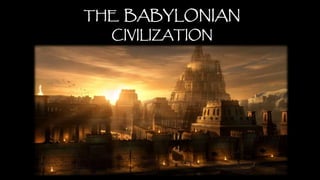
THE BABYLONIAN
CIVILIZATION
Ancient Babylon
 The city of Babylon was the capital of the ancient land of
Babylonia in southern Mesopotamia.
 It was situated on the Euphrates River about 50 miles south of
modern Baghdad, just north of what is now the modern Iraqi town
of al-Hillah.
 The tremendous wealth and power of this city, along with
its monumental size and appearance, were certainly considered a
Biblical myth, that is, until its foundations were unearthed and
its riches substantiated during the 19th century.
 Archaeologists stood in awe as their discoveries revealed that
certain stories in the Bible were an actual situation that had
happened in time.
Ancient Babylon - Where
was it?
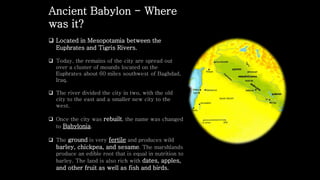
 Located in Mesopotamia between the
Euphrates and Tigris Rivers.
 Today, the remains of the city are spread out
over a cluster of mounds located on the
Euphrates about 60 miles southwest of Baghdad,
Iraq.
 The river divided the city in two, with the old
city to the east and a smaller new city to the
west.
 Once the city was rebuilt, the name was changed
to Babylonia.
 The ground is very fertile and produces wild
barley, chickpea, and sesame. The marshlands
produce an edible root that is equal in nutrition to
barley. The land is also rich with dates, apples,
and other fruit as well as fish and birds.
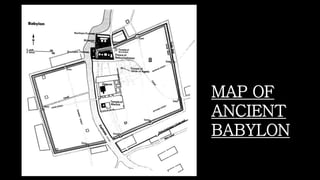
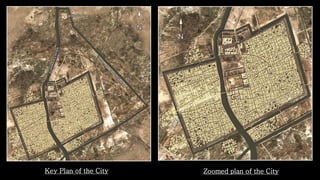
MAP OF
ANCIENT
BABYLON
Key Plan of the City Zoomed plan of the City
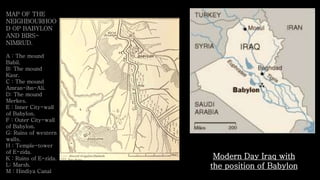
MAP OF THE
NEIGHBOURHOO
D OP BABYLON
AND BIRS-
NIMRUD.
A : The mound
Babil.
B: The mound
Kasr.
C : The mound
Amran-ibn-Ali.
D: The mound
Merkes.
E : Inner City-wall
of Babylon.
F : Outer City-wall
of Babylon.
G: Ruins of western
walls.
H : Temple-tower
of E-zida.
K : Ruins of E-zida.
L: Marsh.
M : Hindiya Canal
Modern Day Iraq with
the position of Babylon
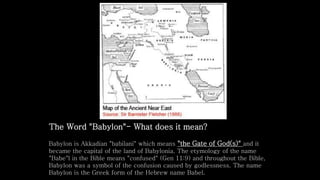
The Word "Babylon"- What does it mean?
Babylon is Akkadian "babilani" which means "the Gate of God(s)" and it
became the capital of the land of Babylonia. The etymology of the name
"Babe"l in the Bible means "confused" (Gen 11:9) and throughout the Bible,
Babylon was a symbol of the confusion caused by godlessness. The name
Babylon is the Greek form of the Hebrew name Babel.
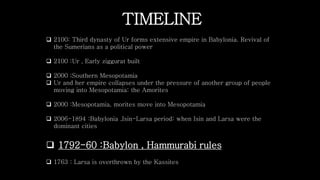
 2100: Third dynasty of Ur forms extensive empire in Babylonia. Revival of
the Sumerians as a political power
 2100 :Ur , Early ziggurat built
 2000 ;Southern Mesopotamia
 Ur and her empire collapses under the pressure of another group of people
moving into Mesopotamia: the Amorites
 2000 :Mesopotamia, morites move into Mesopotamia
 2006-1894 :Babylonia ,Isin-Larsa period: when Isin and Larsa were the
dominant cities
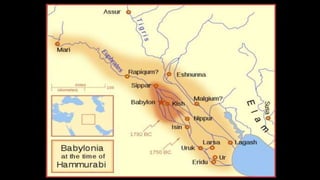
 1792-60 :Babylon , Hammurabi rules
 1763 : Larsa is overthrown by the Kassites
TIMELINE
 1757: Mari, Royal palace destroyed by the Babylonians
 1415-1155 :Southern Mesopotamia, Kassite invaders rule Babylon
and most of southern Mesopotamia.
 612 : Assyria is defeated by the Medes and Babylonians
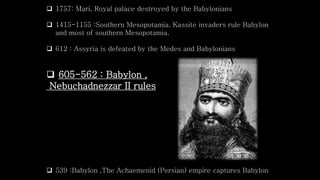
 605-562 : Babylon ,
Nebuchadnezzar II rules
 539 :Babylon ,The Achaemenid (Persian) empire captures Babylon
Rise to Power
 Babylonia was a long, narrow country about 40 miles wide at its
widest point and having an area of about 8,000 square miles.
 It was bordered on the north by Assyria, on the east by Elam, on the
south and west by the Arabian desert, and on the southeast by the
Persian Gulf.
 Babylonia was founded as a kingdom around 1900 BC by Semitic
Amorite barbarians who overran much of Canaan, Akkad, and Sumer
one hundred years earlier.
 In 1792 BC the small kingdom was inherited by
Hammurabi who ruled until 1750. During those 42 years,
Hammurabi extended the kingdom to encompass all of
Sumer to the east and Akkad to the north.
 He also defeated the barbarian Gutians in the Zagros Mountains to
the northeast who had previously sacked Akkad.
 Irrigation and dikes controlled the waters of the Euphrates River,
providing bountiful harvests of grain, vegetables, and fruit in normal
years.
 These foods were supplemented by herds of sheep and some cattle.
 Traded food surpluses for raw materials like copper, gold, and wood,
which they used to manufacture weapons, household objects, jewelry,
and other items that could be traded.
 Hammurabi’s army of the Old Empire made important use of chariots
when these were first coming into use.
 Made extensive use of cavalry, especially mounted bowmen.
 Foot troops probably used iron weapons and wore iron helmets and
some chain mail armor.
Ancient Babylon- About their Base of Economy and
Military force
The Old Babylonian
Period
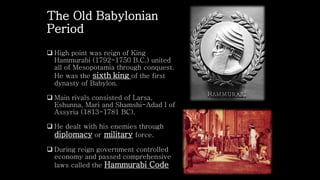
 High point was reign of King
Hammurabi (1792-1750 B.C.) united
all of Mesopotamia through conquest.
He was the sixth king of the first
dynasty of Babylon.
 Main rivals consisted of Larsa,
Eshunna, Mari and Shamshi-Adad I of
Assyria (1813-1781 BC).
 He dealt with his enemies through
diplomacy or military force.
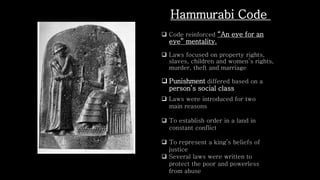
 During reign government controlled
economy and passed comprehensive
laws called the Hammurabi Code
 Code reinforced “An eye for an
eye” mentality.
 Laws focused on property rights,
slaves, children and women’s rights,
murder, theft and marriage
 Punishment differed based on a
person’s social class
Hammurabi Code
 Laws were introduced for two
main reasons
 To establish order in a land in
constant conflict
 To represent a king’s beliefs of
justice
 Several laws were written to
protect the poor and powerless
from abuse
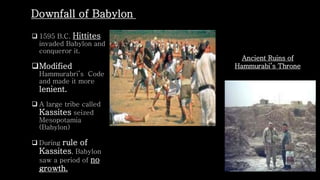
 1595 B.C. Hittites
invaded Babylon and
conqueror it.
Modified
Hammurabri’s Code
and made it more
lenient.
 A large tribe called
Kassites seized
Mesopotamia
(Babylon)
 During rule of
Kassites, Babylon
saw a period of no
growth.
Downfall of Babylon
Ancient Ruins of
Hammurabi’s Throne
Neo- Babylonian Period
 Nebuchadnezzar II was the real genius and builder of Babylon.
 Of its 70 years in existence he ruled for 45 years.
 As the commander of Nabopalassar’s armies he was unstoppable.
 He broke the power of Egypt at the battle of Carchemish and proved
to be one of the mightiest monarchs of all time.
 Among the cities he invaded and plundered were Tyre, Moab, Ammon,
Edom, and Jerusalem.
Contributions in Planning :
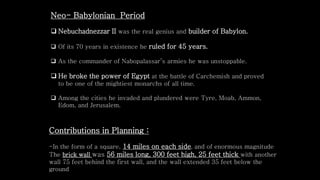
-In the form of a square, 14 miles on each side, and of enormous magnitude
The brick wall was 56 miles long, 300 feet high, 25 feet thick with another
wall 75 feet behind the first wall, and the wall extended 35 feet below the
ground
-250 towers that were 450 feet high
-A wide and deep moat that encircled the city.
-The Euphrates River also flowed through the middle of the city. Ferry boats
and a 1/2 mi. long bridge with drawbridges closed at night.
-”Hanging Gardens” with the water was raised from the river by
hydraulic pumps.
-Eight massive gates that led to the inner city and 100 brass gates
-Streets were paved with stone slabs 3 feet square
-The great Tower (Ziggurat) and 53 temples including the "GreatTemple of
Marduk." 180 altars to Ishtar
-Nebuchadnezzar’s palace was considered to be the most
magnificent building ever erected on earth.
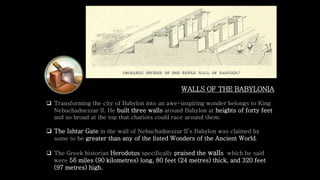
WALLS OF THE BABYLONIA
 Transforming the city of Babylon into an awe-inspiring wonder belongs to King
Nebuchadnezzar II. He built three walls around Babylon at heights of forty feet
and so broad at the top that chariots could race around them.
 The Ishtar Gate in the wall of Nebuchadnezzar II’s Babylon was claimed by
some to be greater than any of the listed Wonders of the Ancient World.
 The Greek historian Herodotus specifically praised the walls which he said
were 56 miles (90 kilometres) long, 80 feet (24 metres) thick, and 320 feet
(97 metres) high.
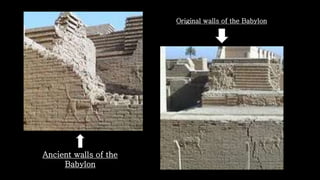
Original walls of the Babylon
Ancient walls of the
Babylon
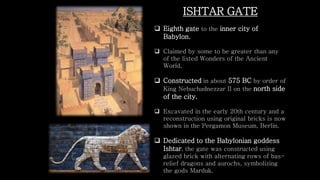
ISHTAR GATE
 Eighth gate to the inner city of
Babylon.
 Claimed by some to be greater than any
of the listed Wonders of the Ancient
World.
 Constructed in about 575 BC by order of
King Nebuchadnezzar II on the north side
of the city.
 Excavated in the early 20th century and a
reconstruction using original bricks is now
shown in the Pergamon Museum, Berlin.
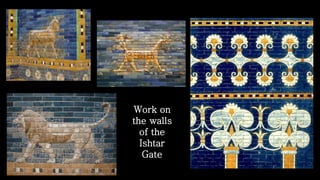
 Dedicated to the Babylonian goddess
Ishtar, the gate was constructed using
glazed brick with alternating rows of bas-
relief dragons and aurochs, symbolizing
the gods Marduk.
Work on
the walls
of the
Ishtar
Gate
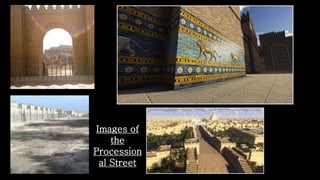
Images of
the
Procession
al Street
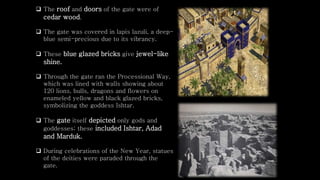
 The roof and doors of the gate were of
cedar wood.
 The gate was covered in lapis lazuli, a deep-
blue semi-precious due to its vibrancy.
 These blue glazed bricks give jewel-like
shine.
 Through the gate ran the Processional Way,
which was lined with walls showing about
120 lions, bulls, dragons and flowers on
enameled yellow and black glazed bricks,
symbolizing the goddess Ishtar.
 The gate itself depicted only gods and
goddesses; these included Ishtar, Adad
and Marduk.
 During celebrations of the New Year, statues
of the deities were paraded through the
gate.
THE HANGING GARDENS OF BABYLON
 The Hanging Gardens of Babylon were one of the Seven Wonders of
the Ancient World, and the only one whose location has not been
definitely established.
 Distinctive feature of ancient Babylon.
 Built by King Nebuchadnezzar II in 600 BC, the gardens are believed to
have been a remarkable feat of engineering: an ascending series of
tiered gardens containing all manner of trees, shrubs, and vines.
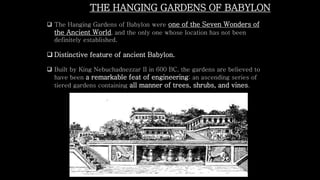
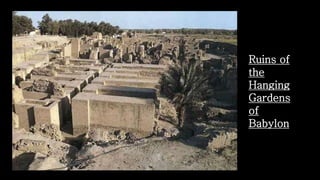
Ruins of
the
Hanging
Gardens
of
Babylon
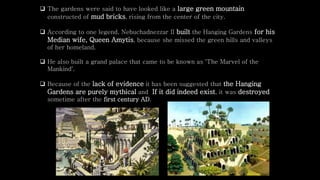
 The gardens were said to have looked like a large green mountain
constructed of mud bricks, rising from the center of the city.
 According to one legend, Nebuchadnezzar II built the Hanging Gardens for his
Median wife, Queen Amytis, because she missed the green hills and valleys
of her homeland.
 He also built a grand palace that came to be known as 'The Marvel of the
Mankind'.
 Because of the lack of evidence it has been suggested that the Hanging
Gardens are purely mythical and If it did indeed exist, it was destroyed
sometime after the first century AD.
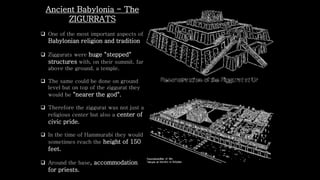
Ancient Babylonia - The
ZIGURRATS
 One of the most important aspects of
Babylonian religion and tradition
 Ziggurats were huge "stepped"
structures with, on their summit, far
above the ground, a temple.
 The same could be done on ground
level but on top of the ziggurat they
would be "nearer the god".
 Therefore the ziggurat was not just a
religious center but also a center of
civic pride.
 In the time of Hammurabi they would
sometimes reach the height of 150
feet.
 Around the base, accommodation
for priests.
HOUSES AND FARMS
 Houses made of sun-dried bricks .Inhabited by farmers and artisans.
 The city streets -narrow, winding, and quite irregular, with high, windowless walls of houses on
both sides. The streets were unpaved and undrained.
 The average house- a small, one-story, mud-brick structure, consisting of several rooms grouped around
a court. The house of a well-to-do -two-story brick dwelling of about a dozen rooms and was plastered
and whitewashed both inside and out.
 The ground floor consisted of a reception room, kitchen, lavatory, servants' quarters, and, sometimes, even
a private chapel. Furniture consisted of low tables, high-backed chairs, and beds with wooden frames.
Household vessels were made of clay, stone, copper, and bronze, and baskets and chests of reed and
wood.
 Floors and walls were adorned with reed mats, skin rugs, and woolen hangings.
 Below the house was often located a mausoleum in which the family dead were buried.
 Agriculture formed the economic base of Babylonian civilization with production of barley, wheat, fruits,
vegetables, with cattle and sheep predominating.
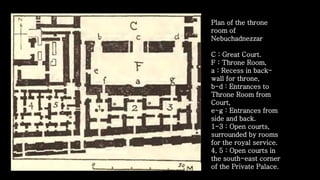
Plan of the throne
room of
Nebuchadnezzar
C : Great Court.
F : Throne Room,
a : Recess in back-
wall for throne,
b-d : Entrances to
Throne Room from
Court,
e-g : Entrances from
side and back.
1-3 : Open courts,
surrounded by rooms
for the royal service.
4, 5 : Open courts in
the south-east corner
of the Private Palace.
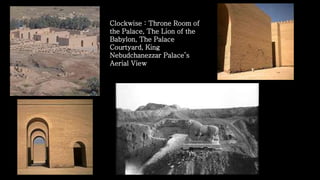
Clockwise : Throne Room of
the Palace, The Lion of the
Babylon, The Palace
Courtyard, King
Nebudchanezzar Palace’s
Aerial View
Legacy
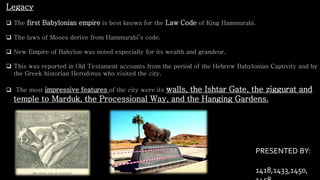
 The first Babylonian empire is best known for the Law Code of King Hammurabi.
 The laws of Moses derive from Hammurabi’s code.
 New Empire of Babylon was noted especially for its wealth and grandeur.
 This was reported in Old Testament accounts from the period of the Hebrew Babylonian Captivity and by
the Greek historian Herodotus who visited the city.
 The most impressive features of the city were its walls, the Ishtar Gate, the ziggurat and
temple to Marduk, the Processional Way, and the Hanging Gardens.
PRESENTED BY:
1418,1433,1450,

Babylonian Civilization

  • 1.
  • 2.
    Ancient Babylon  Thecity of Babylon was the capital of the ancient land of Babylonia in southern Mesopotamia.  It was situated on the Euphrates River about 50 miles south of modern Baghdad, just north of what is now the modern Iraqi town of al-Hillah.  The tremendous wealth and power of this city, along with its monumental size and appearance, were certainly considered a Biblical myth, that is, until its foundations were unearthed and its riches substantiated during the 19th century.  Archaeologists stood in awe as their discoveries revealed that certain stories in the Bible were an actual situation that had happened in time.
  • 3.
    Ancient Babylon -Where was it?  Located in Mesopotamia between the Euphrates and Tigris Rivers.  Today, the remains of the city are spread out over a cluster of mounds located on the Euphrates about 60 miles southwest of Baghdad, Iraq.  The river divided the city in two, with the old city to the east and a smaller new city to the west.  Once the city was rebuilt, the name was changed to Babylonia.  The ground is very fertile and produces wild barley, chickpea, and sesame. The marshlands produce an edible root that is equal in nutrition to barley. The land is also rich with dates, apples, and other fruit as well as fish and birds.
  • 4.
  • 5.
    Key Plan ofthe City Zoomed plan of the City
  • 6.
    MAP OF THE NEIGHBOURHOO DOP BABYLON AND BIRS- NIMRUD. A : The mound Babil. B: The mound Kasr. C : The mound Amran-ibn-Ali. D: The mound Merkes. E : Inner City-wall of Babylon. F : Outer City-wall of Babylon. G: Ruins of western walls. H : Temple-tower of E-zida. K : Ruins of E-zida. L: Marsh. M : Hindiya Canal Modern Day Iraq with the position of Babylon
  • 7.
    The Word "Babylon"-What does it mean? Babylon is Akkadian "babilani" which means "the Gate of God(s)" and it became the capital of the land of Babylonia. The etymology of the name "Babe"l in the Bible means "confused" (Gen 11:9) and throughout the Bible, Babylon was a symbol of the confusion caused by godlessness. The name Babylon is the Greek form of the Hebrew name Babel.
  • 8.
     2100: Thirddynasty of Ur forms extensive empire in Babylonia. Revival of the Sumerians as a political power  2100 :Ur , Early ziggurat built  2000 ;Southern Mesopotamia  Ur and her empire collapses under the pressure of another group of people moving into Mesopotamia: the Amorites  2000 :Mesopotamia, morites move into Mesopotamia  2006-1894 :Babylonia ,Isin-Larsa period: when Isin and Larsa were the dominant cities  1792-60 :Babylon , Hammurabi rules  1763 : Larsa is overthrown by the Kassites TIMELINE
  • 9.
     1757: Mari,Royal palace destroyed by the Babylonians  1415-1155 :Southern Mesopotamia, Kassite invaders rule Babylon and most of southern Mesopotamia.  612 : Assyria is defeated by the Medes and Babylonians  605-562 : Babylon , Nebuchadnezzar II rules  539 :Babylon ,The Achaemenid (Persian) empire captures Babylon
  • 10.
    Rise to Power Babylonia was a long, narrow country about 40 miles wide at its widest point and having an area of about 8,000 square miles.  It was bordered on the north by Assyria, on the east by Elam, on the south and west by the Arabian desert, and on the southeast by the Persian Gulf.  Babylonia was founded as a kingdom around 1900 BC by Semitic Amorite barbarians who overran much of Canaan, Akkad, and Sumer one hundred years earlier.  In 1792 BC the small kingdom was inherited by Hammurabi who ruled until 1750. During those 42 years, Hammurabi extended the kingdom to encompass all of Sumer to the east and Akkad to the north.  He also defeated the barbarian Gutians in the Zagros Mountains to the northeast who had previously sacked Akkad.
  • 11.
     Irrigation anddikes controlled the waters of the Euphrates River, providing bountiful harvests of grain, vegetables, and fruit in normal years.  These foods were supplemented by herds of sheep and some cattle.  Traded food surpluses for raw materials like copper, gold, and wood, which they used to manufacture weapons, household objects, jewelry, and other items that could be traded.  Hammurabi’s army of the Old Empire made important use of chariots when these were first coming into use.  Made extensive use of cavalry, especially mounted bowmen.  Foot troops probably used iron weapons and wore iron helmets and some chain mail armor. Ancient Babylon- About their Base of Economy and Military force
  • 12.
    The Old Babylonian Period High point was reign of King Hammurabi (1792-1750 B.C.) united all of Mesopotamia through conquest. He was the sixth king of the first dynasty of Babylon.  Main rivals consisted of Larsa, Eshunna, Mari and Shamshi-Adad I of Assyria (1813-1781 BC).  He dealt with his enemies through diplomacy or military force.  During reign government controlled economy and passed comprehensive laws called the Hammurabi Code
  • 14.
     Code reinforced“An eye for an eye” mentality.  Laws focused on property rights, slaves, children and women’s rights, murder, theft and marriage  Punishment differed based on a person’s social class Hammurabi Code  Laws were introduced for two main reasons  To establish order in a land in constant conflict  To represent a king’s beliefs of justice  Several laws were written to protect the poor and powerless from abuse
  • 15.
     1595 B.C.Hittites invaded Babylon and conqueror it. Modified Hammurabri’s Code and made it more lenient.  A large tribe called Kassites seized Mesopotamia (Babylon)  During rule of Kassites, Babylon saw a period of no growth. Downfall of Babylon Ancient Ruins of Hammurabi’s Throne
  • 16.
    Neo- Babylonian Period Nebuchadnezzar II was the real genius and builder of Babylon.  Of its 70 years in existence he ruled for 45 years.  As the commander of Nabopalassar’s armies he was unstoppable.  He broke the power of Egypt at the battle of Carchemish and proved to be one of the mightiest monarchs of all time.  Among the cities he invaded and plundered were Tyre, Moab, Ammon, Edom, and Jerusalem. Contributions in Planning : -In the form of a square, 14 miles on each side, and of enormous magnitude The brick wall was 56 miles long, 300 feet high, 25 feet thick with another wall 75 feet behind the first wall, and the wall extended 35 feet below the ground
  • 18.
    -250 towers thatwere 450 feet high -A wide and deep moat that encircled the city. -The Euphrates River also flowed through the middle of the city. Ferry boats and a 1/2 mi. long bridge with drawbridges closed at night. -”Hanging Gardens” with the water was raised from the river by hydraulic pumps. -Eight massive gates that led to the inner city and 100 brass gates -Streets were paved with stone slabs 3 feet square -The great Tower (Ziggurat) and 53 temples including the "GreatTemple of Marduk." 180 altars to Ishtar -Nebuchadnezzar’s palace was considered to be the most magnificent building ever erected on earth.
  • 19.
    WALLS OF THEBABYLONIA  Transforming the city of Babylon into an awe-inspiring wonder belongs to King Nebuchadnezzar II. He built three walls around Babylon at heights of forty feet and so broad at the top that chariots could race around them.  The Ishtar Gate in the wall of Nebuchadnezzar II’s Babylon was claimed by some to be greater than any of the listed Wonders of the Ancient World.  The Greek historian Herodotus specifically praised the walls which he said were 56 miles (90 kilometres) long, 80 feet (24 metres) thick, and 320 feet (97 metres) high.
  • 20.
    Original walls ofthe Babylon Ancient walls of the Babylon
  • 22.
    ISHTAR GATE  Eighthgate to the inner city of Babylon.  Claimed by some to be greater than any of the listed Wonders of the Ancient World.  Constructed in about 575 BC by order of King Nebuchadnezzar II on the north side of the city.  Excavated in the early 20th century and a reconstruction using original bricks is now shown in the Pergamon Museum, Berlin.  Dedicated to the Babylonian goddess Ishtar, the gate was constructed using glazed brick with alternating rows of bas- relief dragons and aurochs, symbolizing the gods Marduk.
  • 23.
    Work on the walls ofthe Ishtar Gate
  • 24.
  • 25.
     The roofand doors of the gate were of cedar wood.  The gate was covered in lapis lazuli, a deep- blue semi-precious due to its vibrancy.  These blue glazed bricks give jewel-like shine.  Through the gate ran the Processional Way, which was lined with walls showing about 120 lions, bulls, dragons and flowers on enameled yellow and black glazed bricks, symbolizing the goddess Ishtar.  The gate itself depicted only gods and goddesses; these included Ishtar, Adad and Marduk.  During celebrations of the New Year, statues of the deities were paraded through the gate.
  • 26.
    THE HANGING GARDENSOF BABYLON  The Hanging Gardens of Babylon were one of the Seven Wonders of the Ancient World, and the only one whose location has not been definitely established.  Distinctive feature of ancient Babylon.  Built by King Nebuchadnezzar II in 600 BC, the gardens are believed to have been a remarkable feat of engineering: an ascending series of tiered gardens containing all manner of trees, shrubs, and vines.
  • 27.
  • 28.
     The gardenswere said to have looked like a large green mountain constructed of mud bricks, rising from the center of the city.  According to one legend, Nebuchadnezzar II built the Hanging Gardens for his Median wife, Queen Amytis, because she missed the green hills and valleys of her homeland.  He also built a grand palace that came to be known as 'The Marvel of the Mankind'.  Because of the lack of evidence it has been suggested that the Hanging Gardens are purely mythical and If it did indeed exist, it was destroyed sometime after the first century AD.
  • 29.
    Ancient Babylonia -The ZIGURRATS  One of the most important aspects of Babylonian religion and tradition  Ziggurats were huge "stepped" structures with, on their summit, far above the ground, a temple.  The same could be done on ground level but on top of the ziggurat they would be "nearer the god".  Therefore the ziggurat was not just a religious center but also a center of civic pride.  In the time of Hammurabi they would sometimes reach the height of 150 feet.  Around the base, accommodation for priests.
  • 30.
    HOUSES AND FARMS Houses made of sun-dried bricks .Inhabited by farmers and artisans.  The city streets -narrow, winding, and quite irregular, with high, windowless walls of houses on both sides. The streets were unpaved and undrained.  The average house- a small, one-story, mud-brick structure, consisting of several rooms grouped around a court. The house of a well-to-do -two-story brick dwelling of about a dozen rooms and was plastered and whitewashed both inside and out.  The ground floor consisted of a reception room, kitchen, lavatory, servants' quarters, and, sometimes, even a private chapel. Furniture consisted of low tables, high-backed chairs, and beds with wooden frames. Household vessels were made of clay, stone, copper, and bronze, and baskets and chests of reed and wood.  Floors and walls were adorned with reed mats, skin rugs, and woolen hangings.  Below the house was often located a mausoleum in which the family dead were buried.  Agriculture formed the economic base of Babylonian civilization with production of barley, wheat, fruits, vegetables, with cattle and sheep predominating.
  • 31.
    Plan of thethrone room of Nebuchadnezzar C : Great Court. F : Throne Room, a : Recess in back- wall for throne, b-d : Entrances to Throne Room from Court, e-g : Entrances from side and back. 1-3 : Open courts, surrounded by rooms for the royal service. 4, 5 : Open courts in the south-east corner of the Private Palace.
  • 32.
    Clockwise : ThroneRoom of the Palace, The Lion of the Babylon, The Palace Courtyard, King Nebudchanezzar Palace’s Aerial View
  • 33.
    Legacy  The firstBabylonian empire is best known for the Law Code of King Hammurabi.  The laws of Moses derive from Hammurabi’s code.  New Empire of Babylon was noted especially for its wealth and grandeur.  This was reported in Old Testament accounts from the period of the Hebrew Babylonian Captivity and by the Greek historian Herodotus who visited the city.  The most impressive features of the city were its walls, the Ishtar Gate, the ziggurat and temple to Marduk, the Processional Way, and the Hanging Gardens. PRESENTED BY: 1418,1433,1450,