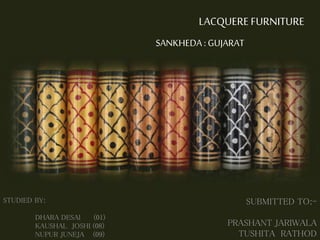
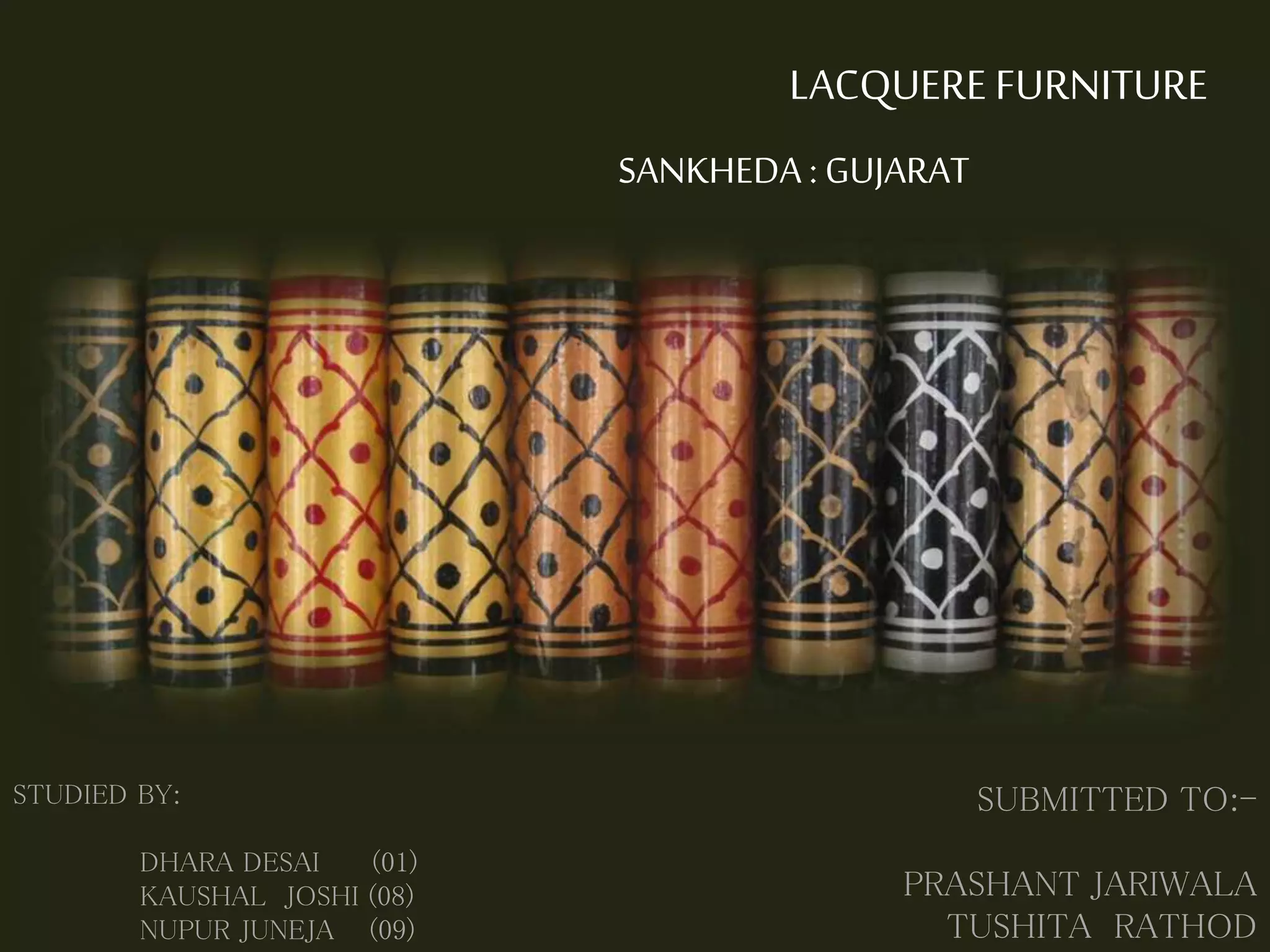
LACQUERE FURNITURE
SANKHEDA : GUJARAT
STUDIED BY:
DHARA DESAI (01)
KAUSHAL JOSHI (08)
NUPUR JUNEJA (09)
SUBMITTED TO:-
PRASHANT JARIWALA
TUSHITA RATHOD
Contents
About Gujarat
Culture of Gujarat
Art & Crafts in Gujarat
Introduction : Sankheda
Sankheda location
Lacquered furniture
Making of the Sankheda
Process
Teakwood
Finishes
tools
Joinery
Design and decoration
USES
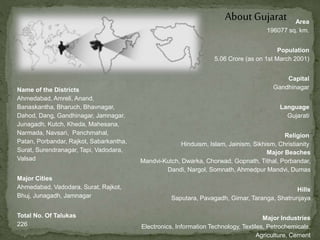
About Gujarat Area
196077 sq. km.
Population
5.06 Crore (as on 1st March 2001)
Capital
Gandhinagar
Language
Gujarati
Religion
Hinduism, Islam, Jainism, Sikhism, Christianity
Name of the Districts
Ahmedabad, Amreli, Anand,
Banaskantha, Bharuch, Bhavnagar,
Dahod, Dang, Gandhinagar, Jamnagar,
Junagadh, Kutch, Kheda, Mahesana,
Narmada, Navsari, Panchmahal,
Patan, Porbandar, Rajkot, Sabarkantha,
Surat, Surendranagar, Tapi, Vadodara,
Valsad
Major Cities
Ahmedabad, Vadodara, Surat, Rajkot,
Bhuj, Junagadh, Jamnagar
Total No. Of Talukas
226
Major Beaches
Mandvi-Kutch, Dwarka, Chorwad, Gopnath, Tithal, Porbandar,
Dandi, Nargol, Somnath, Ahmedpur Mandvi, Dumas
Hills
Saputara, Pavagadh, Girnar, Taranga, Shatrunjaya
Major Industries
Electronics, Information Technology, Textiles, Petrochemicals,
Agriculture, Cement
Cultureof Gujarat
The Gujarat, boasts of a rich culture and heritage. The people of Gujarat
are very particular regarding their value system. They have preserved the ancient
art and craft techniques and still practice them with great determination. Gujaratis
are proud of their customs and traditions and follow them with utmost pride. The
people of Gujarat are very simple and live life to the fullest. The spirit of Gujarat is
quite visible from the varied fairs and festivals celebrated in the state. It is further
enriched by the tribal people residing here. They have their own set of customs
and rituals. Thus, Gujarat has a cultural diversity which is a unique feature of the
state and is randomly seen.
Gujarat known for….
Guajarati wedding ceremony
Gujarati dances(Dandiya Raas, Garba, Garbi, Padhar)
Languages
Literature
Religions
Fairs and festivals(Dangs Darbar, Chitra — Vichitra Mela , Dhrang Fair ,
Trinetreshwar Mahadev Fair , Vautha Mela , Shamlaji Melo )
Gujarat Cuisine
Art & Crafts in Gujarat
Gujarat is one of the most vibrant states of India. This is due to the fact that
it has a rich culture. The people of the state still follow the ancient practices of art
and craft with great zeal. Gujarat arts and crafts are famous world wide. They were
originally made for daily use purpose in homes. But with time, the stature of the
crafts grew, converting it into a full fledged industry. Skilled artisans, inherent good
taste, creativity and economical use of the resources contributed to the growth of the
art and craft. Consequently, there are varied items available in the craft galore of the
state.
The wide array of items to choose from include furniture, jewelry, metalwork
items, embroidered garments, colorful linen, leatherwork, beadwork, mirror work,
baked clay articles, etc. Gujarat is famous for its furnishings also. You can decorate
your home with ethnic craft pieces, ranging from elegant cushion covers to quilts and
from tablemats to bedcovers. These items are available in simple colorful geometric
designs as well as complex patterns. Gujarat's arts and crafts are essentially the
legacy of its glorious past. They truly reflect the lifestyle, culture and, above all, the
spirit of the state.
Introduction : Sankheda
The Sankheda artisans are very proud of their centuries old
legendary. Legend has it that about hundred and fifty years ago, the
carpenters in Sankheda lived in penury. One day, a baba (holy man)
came from nearby Pawagarh in the Araavali hills, seeking alms from the
villagers. The already distraught carpenters pleaded with the holy man
to show them the way out of their plight. The baba realized that besides
carpentry they did not known anything else. He decided to teach them
how to improve upon their existing skills by adding a new dimension to
their craft. Thus, was born the unique art of Sankheda, which uses paint
and lacquer on wood to fashion exquisite pieces of furniture as well as
other ornate objects.
Sankheda furniture has a very typical beauty of its own. It is
made in very distinctive colors of golden, orange and brown with ornate
designs in silver. Of late, the new generation of artisans has
successfully experimented with ivory, green and purple.
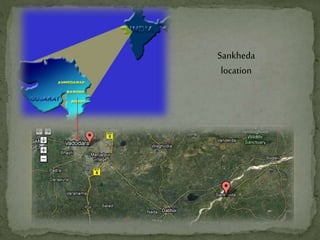
Sankheda
location
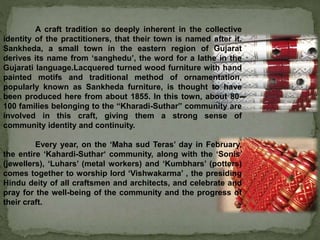
A craft tradition so deeply inherent in the collective
identity of the practitioners, that their town is named after it.
Sankheda, a small town in the eastern region of Gujarat
derives its name from ‘sanghedu’, the word for a lathe in the
Gujarati language.Lacquered turned wood furniture with hand
painted motifs and traditional method of ornamentation,
popularly known as Sankheda furniture, is thought to have
been produced here from about 1855. In this town, about 80-
100 families belonging to the “Kharadi-Suthar” community are
involved in this craft, giving them a strong sense of
community identity and continuity.
Every year, on the ‘Maha sud Teras’ day in February,
the entire ‘Kahardi-Suthar‘ community, along with the ‘Sonis’
(jewellers), ‘Luhars’ (metal workers) and ‘Kumbhars’ (potters)
comes together to worship lord ‘Vishwakarma’ , the presiding
Hindu deity of all craftsmen and architects, and celebrate and
pray for the well-being of the community and the progress of
their craft.
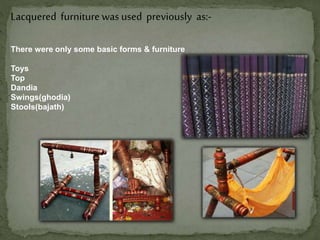
Lacquered furniturewas used previously as:-
There were only some basic forms & furniture
Toys
Top
Dandia
Swings(ghodia)
Stools(bajath)
Making of the Sankheda: Furniture
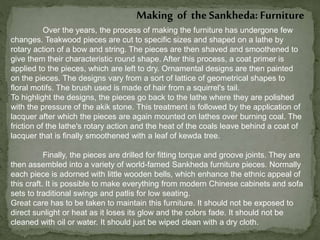
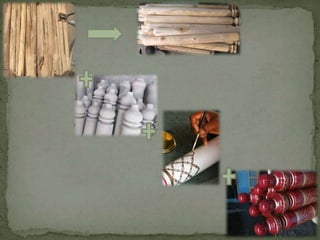
Over the years, the process of making the furniture has undergone few
changes. Teakwood pieces are cut to specific sizes and shaped on a lathe by
rotary action of a bow and string. The pieces are then shaved and smoothened to
give them their characteristic round shape. After this process, a coat primer is
applied to the pieces, which are left to dry. Ornamental designs are then painted
on the pieces. The designs vary from a sort of lattice of geometrical shapes to
floral motifs. The brush used is made of hair from a squirrel's tail.
To highlight the designs, the pieces go back to the lathe where they are polished
with the pressure of the akik stone. This treatment is followed by the application of
lacquer after which the pieces are again mounted on lathes over burning coal. The
friction of the lathe's rotary action and the heat of the coals leave behind a coat of
lacquer that is finally smoothened with a leaf of kewda tree.
Finally, the pieces are drilled for fitting torque and groove joints. They are
then assembled into a variety of world-famed Sankheda furniture pieces. Normally
each piece is adorned with little wooden bells, which enhance the ethnic appeal of
this craft. It is possible to make everything from modern Chinese cabinets and sofa
sets to traditional swings and patlis for low seating.
Great care has to be taken to maintain this furniture. It should not be exposed to
direct sunlight or heat as it loses its glow and the colors fade. It should not be
cleaned with oil or water. It should just be wiped clean with a dry cloth.
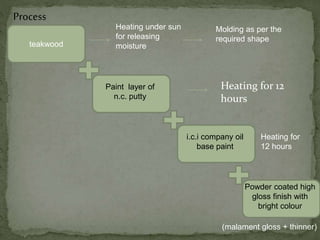
Process
teakwood
Heating under sun
for releasing
moisture
Molding as per the
required shape
Paint layer of
n.c. putty
Heating for 12
hours
i.c.i company oil
base paint
Heating for
12 hours
Powder coated high
gloss finish with
bright colour
(malament gloss + thinner)
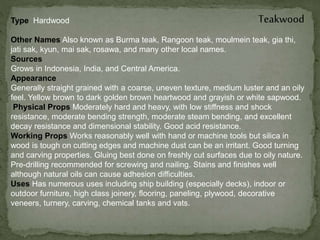
TeakwoodType Hardwood
Other Names Also known as Burma teak, Rangoon teak, moulmein teak, gia thi,
jati sak, kyun, mai sak, rosawa, and many other local names.
Sources
Grows in Indonesia, India, and Central America.
Appearance
Generally straight grained with a coarse, uneven texture, medium luster and an oily
feel. Yellow brown to dark golden brown heartwood and grayish or white sapwood.
Physical Props Moderately hard and heavy, with low stiffness and shock
resistance, moderate bending strength, moderate steam bending, and excellent
decay resistance and dimensional stability. Good acid resistance.
Working Props Works reasonably well with hand or machine tools but silica in
wood is tough on cutting edges and machine dust can be an irritant. Good turning
and carving properties. Gluing best done on freshly cut surfaces due to oily nature.
Pre-drilling recommended for screwing and nailing. Stains and finishes well
although natural oils can cause adhesion difficulties.
Uses Has numerous uses including ship building (especially decks), indoor or
outdoor furniture, high class joinery, flooring, paneling, plywood, decorative
veneers, turnery, carving, chemical tanks and vats.
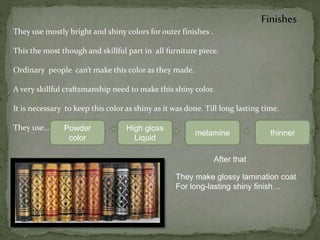
Finishes
They use mostly bright and shiny colors for outer finishes .
This the most though and skillful part in all furniture piece.
Ordinary people can’t make this color as they made.
A very skillful craftsmanship need to make this shiny color.
It is necessary to keep this color as shiny as it was done. Till long lasting time.
They use… Powder
color
High gloss
Liquid
melamine thinner
After that
They make glossy lamination coat
For long-lasting shiny finish…
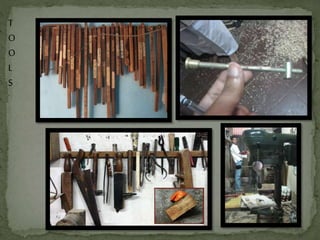
T
O
O
L
S
Joinery
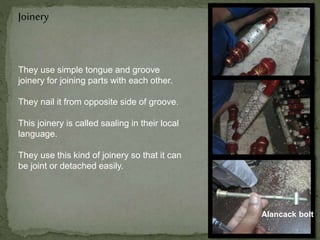
They use simple tongue and groove
joinery for joining parts with each other.
They nail it from opposite side of groove.
This joinery is called saaling in their local
language.
They use this kind of joinery so that it can
be joint or detached easily.
Alancack bolt
Design and decoration
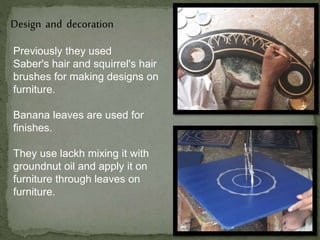
Previously they used
Saber's hair and squirrel's hair
brushes for making designs on
furniture.
Banana leaves are used for
finishes.
They use lackh mixing it with
groundnut oil and apply it on
furniture through leaves on
furniture.
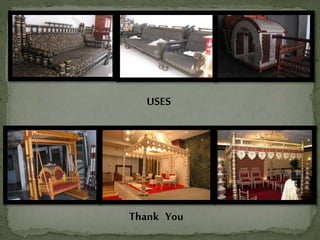
USES
Thank You

Sankheda furniture

  • 1.
    LACQUERE FURNITURE SANKHEDA :GUJARAT STUDIED BY: DHARA DESAI (01) KAUSHAL JOSHI (08) NUPUR JUNEJA (09) SUBMITTED TO:- PRASHANT JARIWALA TUSHITA RATHOD
  • 2.
    Contents About Gujarat Culture ofGujarat Art & Crafts in Gujarat Introduction : Sankheda Sankheda location Lacquered furniture Making of the Sankheda Process Teakwood Finishes tools Joinery Design and decoration USES
  • 3.
    About Gujarat Area 196077sq. km. Population 5.06 Crore (as on 1st March 2001) Capital Gandhinagar Language Gujarati Religion Hinduism, Islam, Jainism, Sikhism, Christianity Name of the Districts Ahmedabad, Amreli, Anand, Banaskantha, Bharuch, Bhavnagar, Dahod, Dang, Gandhinagar, Jamnagar, Junagadh, Kutch, Kheda, Mahesana, Narmada, Navsari, Panchmahal, Patan, Porbandar, Rajkot, Sabarkantha, Surat, Surendranagar, Tapi, Vadodara, Valsad Major Cities Ahmedabad, Vadodara, Surat, Rajkot, Bhuj, Junagadh, Jamnagar Total No. Of Talukas 226 Major Beaches Mandvi-Kutch, Dwarka, Chorwad, Gopnath, Tithal, Porbandar, Dandi, Nargol, Somnath, Ahmedpur Mandvi, Dumas Hills Saputara, Pavagadh, Girnar, Taranga, Shatrunjaya Major Industries Electronics, Information Technology, Textiles, Petrochemicals, Agriculture, Cement
  • 4.
    Cultureof Gujarat The Gujarat,boasts of a rich culture and heritage. The people of Gujarat are very particular regarding their value system. They have preserved the ancient art and craft techniques and still practice them with great determination. Gujaratis are proud of their customs and traditions and follow them with utmost pride. The people of Gujarat are very simple and live life to the fullest. The spirit of Gujarat is quite visible from the varied fairs and festivals celebrated in the state. It is further enriched by the tribal people residing here. They have their own set of customs and rituals. Thus, Gujarat has a cultural diversity which is a unique feature of the state and is randomly seen. Gujarat known for…. Guajarati wedding ceremony Gujarati dances(Dandiya Raas, Garba, Garbi, Padhar) Languages Literature Religions Fairs and festivals(Dangs Darbar, Chitra — Vichitra Mela , Dhrang Fair , Trinetreshwar Mahadev Fair , Vautha Mela , Shamlaji Melo ) Gujarat Cuisine
  • 5.
    Art & Craftsin Gujarat Gujarat is one of the most vibrant states of India. This is due to the fact that it has a rich culture. The people of the state still follow the ancient practices of art and craft with great zeal. Gujarat arts and crafts are famous world wide. They were originally made for daily use purpose in homes. But with time, the stature of the crafts grew, converting it into a full fledged industry. Skilled artisans, inherent good taste, creativity and economical use of the resources contributed to the growth of the art and craft. Consequently, there are varied items available in the craft galore of the state. The wide array of items to choose from include furniture, jewelry, metalwork items, embroidered garments, colorful linen, leatherwork, beadwork, mirror work, baked clay articles, etc. Gujarat is famous for its furnishings also. You can decorate your home with ethnic craft pieces, ranging from elegant cushion covers to quilts and from tablemats to bedcovers. These items are available in simple colorful geometric designs as well as complex patterns. Gujarat's arts and crafts are essentially the legacy of its glorious past. They truly reflect the lifestyle, culture and, above all, the spirit of the state.
  • 6.
    Introduction : Sankheda TheSankheda artisans are very proud of their centuries old legendary. Legend has it that about hundred and fifty years ago, the carpenters in Sankheda lived in penury. One day, a baba (holy man) came from nearby Pawagarh in the Araavali hills, seeking alms from the villagers. The already distraught carpenters pleaded with the holy man to show them the way out of their plight. The baba realized that besides carpentry they did not known anything else. He decided to teach them how to improve upon their existing skills by adding a new dimension to their craft. Thus, was born the unique art of Sankheda, which uses paint and lacquer on wood to fashion exquisite pieces of furniture as well as other ornate objects. Sankheda furniture has a very typical beauty of its own. It is made in very distinctive colors of golden, orange and brown with ornate designs in silver. Of late, the new generation of artisans has successfully experimented with ivory, green and purple.
  • 7.
  • 8.
    A craft traditionso deeply inherent in the collective identity of the practitioners, that their town is named after it. Sankheda, a small town in the eastern region of Gujarat derives its name from ‘sanghedu’, the word for a lathe in the Gujarati language.Lacquered turned wood furniture with hand painted motifs and traditional method of ornamentation, popularly known as Sankheda furniture, is thought to have been produced here from about 1855. In this town, about 80- 100 families belonging to the “Kharadi-Suthar” community are involved in this craft, giving them a strong sense of community identity and continuity. Every year, on the ‘Maha sud Teras’ day in February, the entire ‘Kahardi-Suthar‘ community, along with the ‘Sonis’ (jewellers), ‘Luhars’ (metal workers) and ‘Kumbhars’ (potters) comes together to worship lord ‘Vishwakarma’ , the presiding Hindu deity of all craftsmen and architects, and celebrate and pray for the well-being of the community and the progress of their craft.
  • 9.
    Lacquered furniturewas usedpreviously as:- There were only some basic forms & furniture Toys Top Dandia Swings(ghodia) Stools(bajath)
  • 10.
    Making of theSankheda: Furniture Over the years, the process of making the furniture has undergone few changes. Teakwood pieces are cut to specific sizes and shaped on a lathe by rotary action of a bow and string. The pieces are then shaved and smoothened to give them their characteristic round shape. After this process, a coat primer is applied to the pieces, which are left to dry. Ornamental designs are then painted on the pieces. The designs vary from a sort of lattice of geometrical shapes to floral motifs. The brush used is made of hair from a squirrel's tail. To highlight the designs, the pieces go back to the lathe where they are polished with the pressure of the akik stone. This treatment is followed by the application of lacquer after which the pieces are again mounted on lathes over burning coal. The friction of the lathe's rotary action and the heat of the coals leave behind a coat of lacquer that is finally smoothened with a leaf of kewda tree. Finally, the pieces are drilled for fitting torque and groove joints. They are then assembled into a variety of world-famed Sankheda furniture pieces. Normally each piece is adorned with little wooden bells, which enhance the ethnic appeal of this craft. It is possible to make everything from modern Chinese cabinets and sofa sets to traditional swings and patlis for low seating. Great care has to be taken to maintain this furniture. It should not be exposed to direct sunlight or heat as it loses its glow and the colors fade. It should not be cleaned with oil or water. It should just be wiped clean with a dry cloth.
  • 11.
    Process teakwood Heating under sun forreleasing moisture Molding as per the required shape Paint layer of n.c. putty Heating for 12 hours i.c.i company oil base paint Heating for 12 hours Powder coated high gloss finish with bright colour (malament gloss + thinner)
  • 13.
    TeakwoodType Hardwood Other NamesAlso known as Burma teak, Rangoon teak, moulmein teak, gia thi, jati sak, kyun, mai sak, rosawa, and many other local names. Sources Grows in Indonesia, India, and Central America. Appearance Generally straight grained with a coarse, uneven texture, medium luster and an oily feel. Yellow brown to dark golden brown heartwood and grayish or white sapwood. Physical Props Moderately hard and heavy, with low stiffness and shock resistance, moderate bending strength, moderate steam bending, and excellent decay resistance and dimensional stability. Good acid resistance. Working Props Works reasonably well with hand or machine tools but silica in wood is tough on cutting edges and machine dust can be an irritant. Good turning and carving properties. Gluing best done on freshly cut surfaces due to oily nature. Pre-drilling recommended for screwing and nailing. Stains and finishes well although natural oils can cause adhesion difficulties. Uses Has numerous uses including ship building (especially decks), indoor or outdoor furniture, high class joinery, flooring, paneling, plywood, decorative veneers, turnery, carving, chemical tanks and vats.
  • 14.
    Finishes They use mostlybright and shiny colors for outer finishes . This the most though and skillful part in all furniture piece. Ordinary people can’t make this color as they made. A very skillful craftsmanship need to make this shiny color. It is necessary to keep this color as shiny as it was done. Till long lasting time. They use… Powder color High gloss Liquid melamine thinner After that They make glossy lamination coat For long-lasting shiny finish…
  • 15.
  • 16.
    Joinery They use simpletongue and groove joinery for joining parts with each other. They nail it from opposite side of groove. This joinery is called saaling in their local language. They use this kind of joinery so that it can be joint or detached easily. Alancack bolt
  • 17.
    Design and decoration Previouslythey used Saber's hair and squirrel's hair brushes for making designs on furniture. Banana leaves are used for finishes. They use lackh mixing it with groundnut oil and apply it on furniture through leaves on furniture.
  • 18.