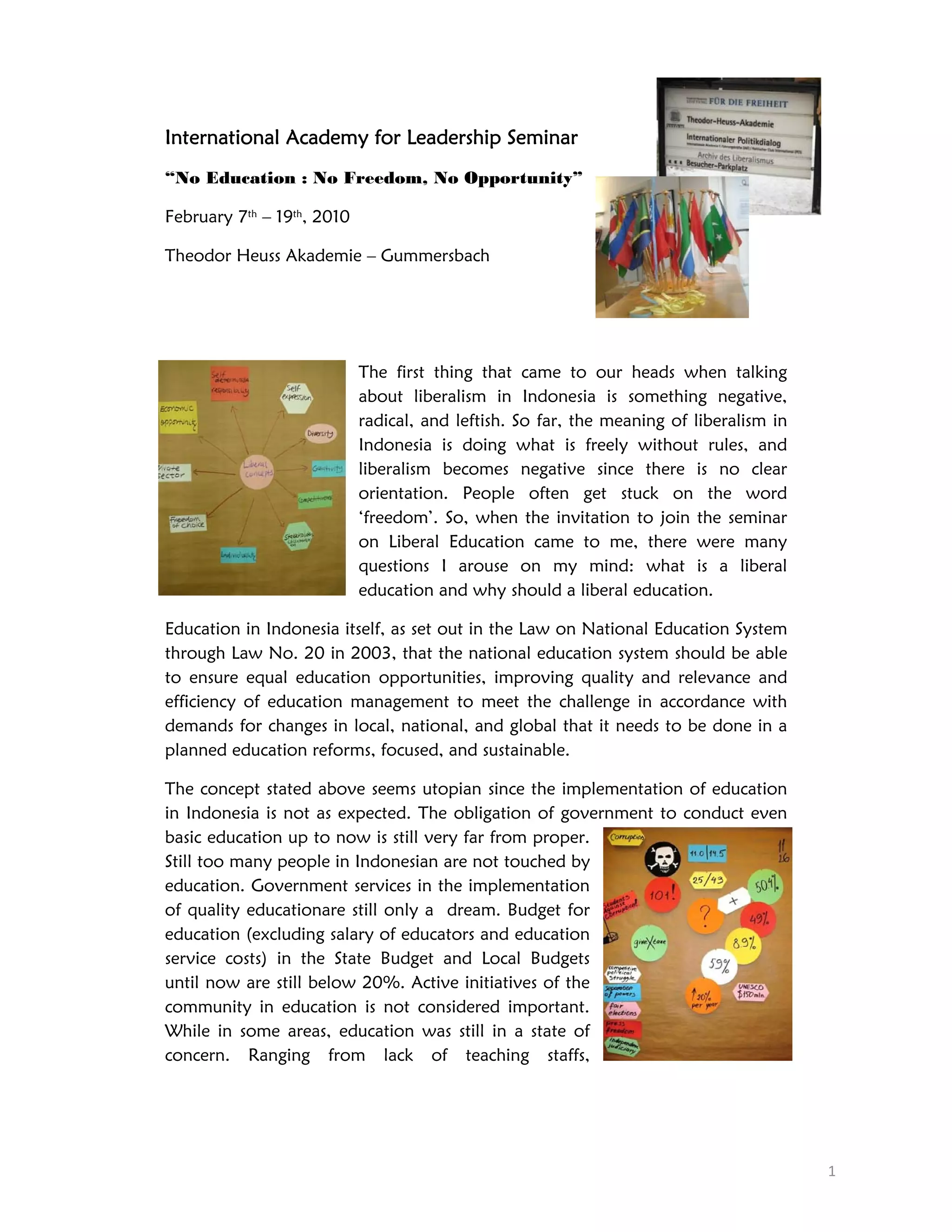
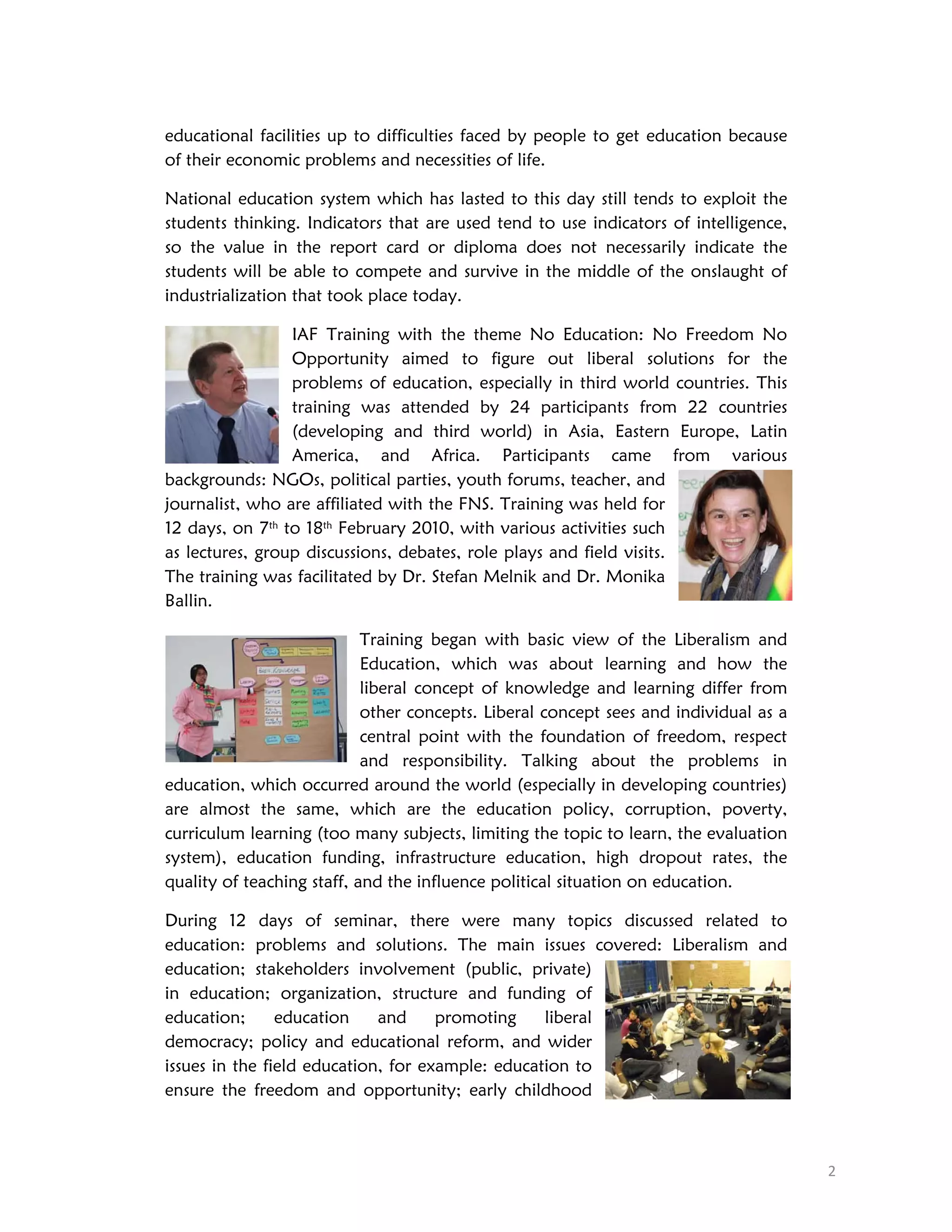
International Academy for Leadership Seminar
“No Education : No Freedom, No Opportunity”
February 7th – 19th, 2010
Theodor Heuss Akademie – Gummersbach

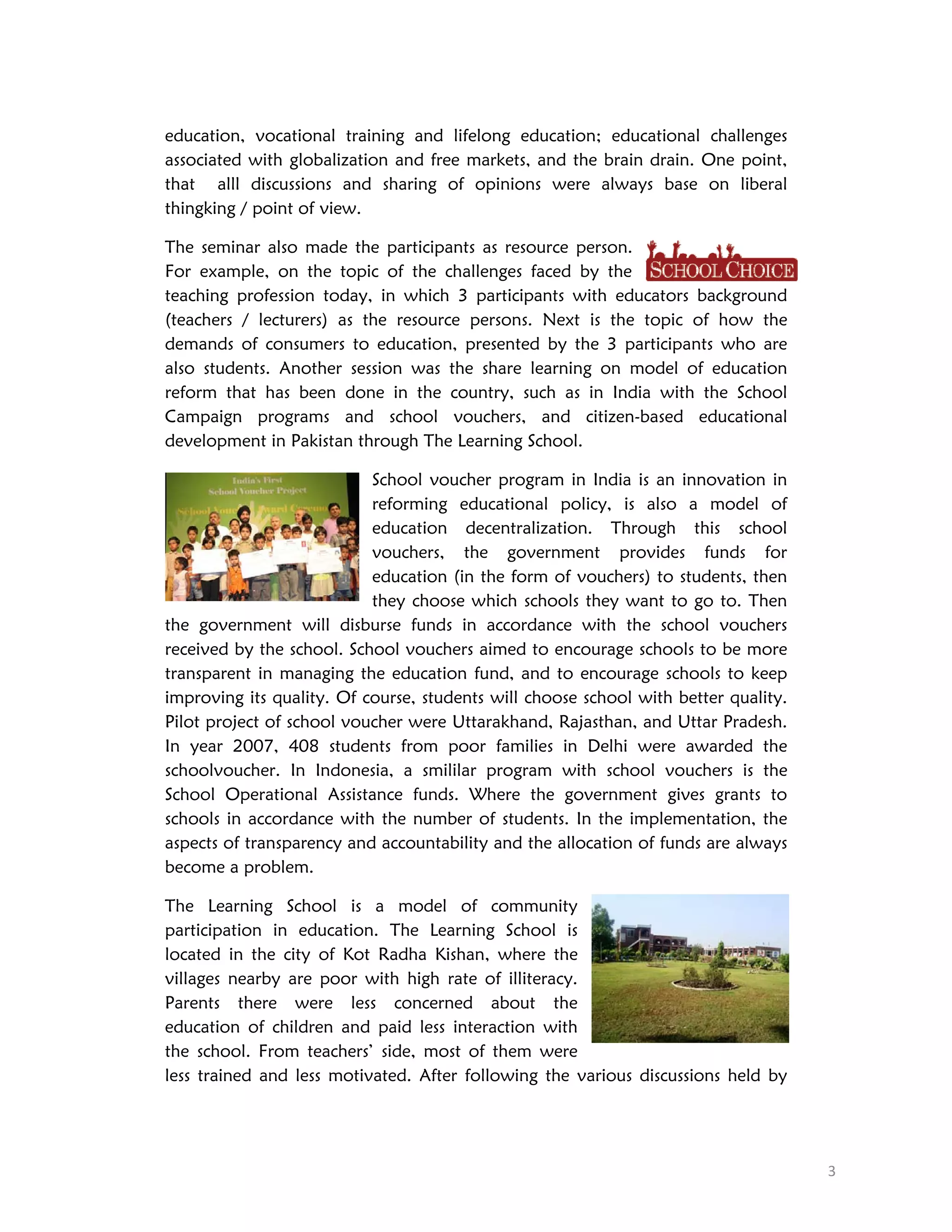
The first thing that came to our heads when talking
about liberalism in Indonesia is something negative,
radical, and leftish. So far, the meaning of liberalism in
Indonesia is doing what is freely without rules, and
liberalism becomes negative since there is no clear
orientation. People often get stuck on the word
‘freedom’. So, when the invitation to join the seminar
on Liberal Education came to me, there were many
questions I arouse on my mind: what is a liberal
education and why should a liberal education.
Education in Indonesia itself, as set out in the Law on National Education System
through Law No. 20 in 2003, that the national education system should be able
to ensure equal education opportunities, improving quality and relevance and
efficiency of education management to meet the challenge in accordance with
demands for changes in local, national, and global that it needs to be done in a
planned education reforms, focused, and sustainable.
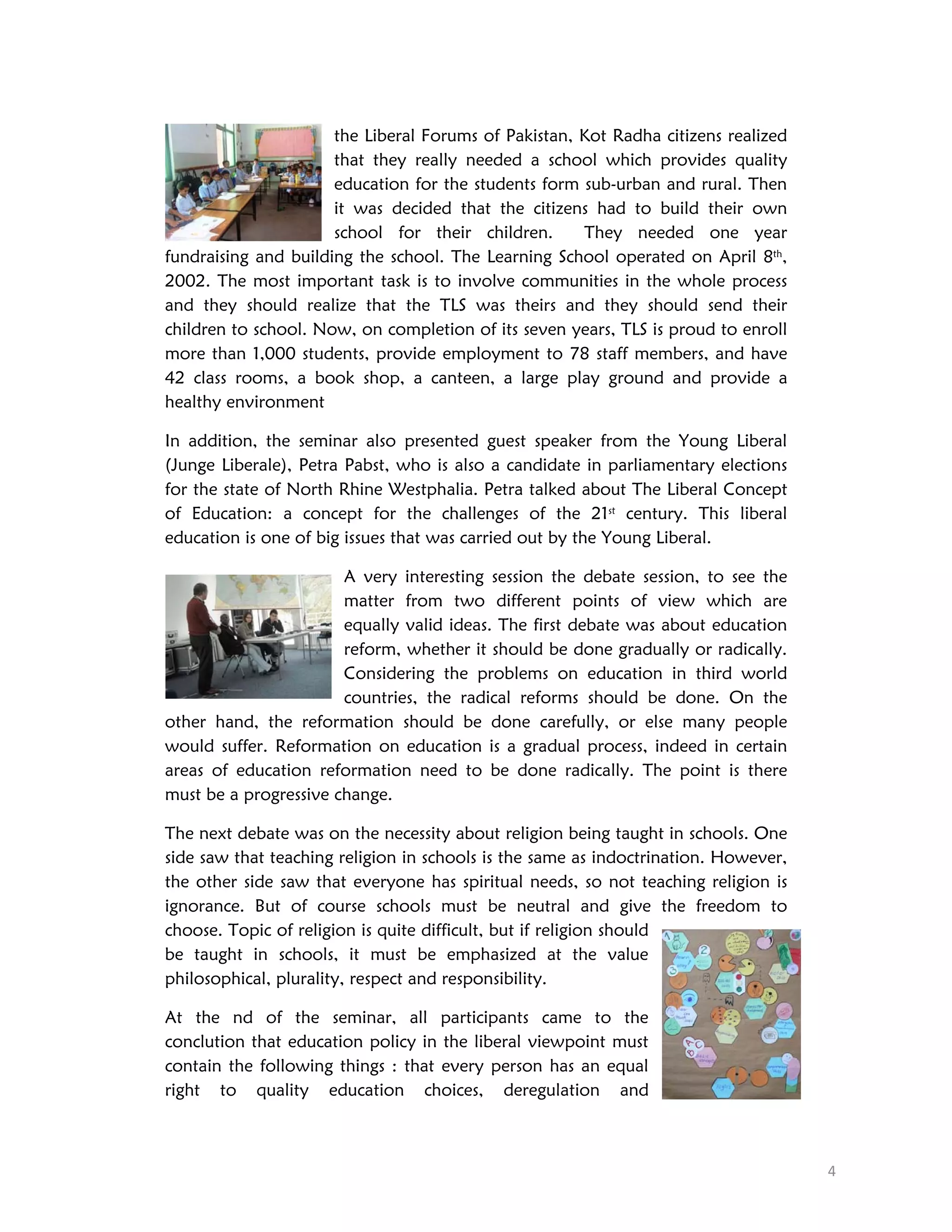
The concept stated above seems utopian since the implementation of education
in Indonesia is not as expected. The obligation of government to conduct even
basic education up to now is still very far from proper.
Still too many people in Indonesian are not touched by
education. Government services in the implementation
of quality educationare still only a dream. Budget for
education (excluding salary of educators and education
service costs) in the State Budget and Local Budgets
until now are still below 20%. Active initiatives of the
community in education is not considered important.
While in some areas, education was still in a state of
concern. Ranging from lack of teaching staffs,

 
1 
educational facilities up to difficulties faced by people to get education because
of their economic problems and necessities of life.
National education system which has lasted to this day still tends to exploit the
students thinking. Indicators that are used tend to use indicators of intelligence,
so the value in the report card or diploma does not necessarily indicate the
students will be able to compete and survive in the middle of the onslaught of
industrialization that took place today.
IAF Training with the theme No Education: No Freedom No
Opportunity aimed to figure out liberal solutions for the
problems of education, especially in third world countries. This
training was attended by 24 participants from 22 countries
(developing and third world) in Asia, Eastern Europe, Latin
America, and Africa. Participants came from various
backgrounds: NGOs, political parties, youth forums, teacher, and
journalist, who are affiliated with the FNS. Training was held for
12 days, on 7th to 18th February 2010, with various activities such
as lectures, group discussions, debates, role plays and field visits.
The training was facilitated by Dr. Stefan Melnik and Dr. Monika
Ballin.
Training began with basic view of the Liberalism and
Education, which was about learning and how the
liberal concept of knowledge and learning differ from
other concepts. Liberal concept sees and individual as a
central point with the foundation of freedom, respect
and responsibility. Talking about the problems in
education, which occurred around the world (especially in developing countries)
are almost the same, which are the education policy, corruption, poverty,
curriculum learning (too many subjects, limiting the topic to learn, the evaluation
system), education funding, infrastructure education, high dropout rates, the
quality of teaching staff, and the influence political situation on education.
During 12 days of seminar, there were many topics discussed related to
education: problems and solutions. The main issues covered: Liberalism and
education; stakeholders involvement (public, private)
in education; organization, structure and funding of
education;
education
and
promoting
liberal
democracy; policy and educational reform, and wider
issues in the field education, for example: education to
ensure the freedom and opportunity; early childhood

 
2 
education, vocational training and lifelong education; educational challenges
associated with globalization and free markets, and the brain drain. One point,
that alll discussions and sharing of opinions were always base on liberal
thingking / point of view.
The seminar also made the participants as resource person.
For example, on the topic of the challenges faced by the
teaching profession today, in which 3 participants with educators background
(teachers / lecturers) as the resource persons. Next is the topic of how the
demands of consumers to education, presented by the 3 participants who are
also students. Another session was the share learning on model of education
reform that has been done in the country, such as in India with the School
Campaign programs and school vouchers, and citizen-based educational
development in Pakistan through The Learning School.
School voucher program in India is an innovation in
reforming educational policy, is also a model of
education decentralization. Through this school
vouchers, the government provides funds for
education (in the form of vouchers) to students, then
they choose which schools they want to go to. Then
the government will disburse funds in accordance with the school vouchers
received by the school. School vouchers aimed to encourage schools to be more
transparent in managing the education fund, and to encourage schools to keep
improving its quality. Of course, students will choose school with better quality.
Pilot project of school voucher were Uttarakhand, Rajasthan, and Uttar Pradesh.
In year 2007, 408 students from poor families in Delhi were awarded the
schoolvoucher. In Indonesia, a smililar program with school vouchers is the
School Operational Assistance funds. Where the government gives grants to
schools in accordance with the number of students. In the implementation, the
aspects of transparency and accountability and the allocation of funds are always
become a problem.
The Learning School is a model of community
participation in education. The Learning School is
located in the city of Kot Radha Kishan, where the
villages nearby are poor with high rate of illiteracy.
Parents there were less concerned about the
education of children and paid less interaction with
the school. From teachers’ side, most of them were
less trained and less motivated. After following the various discussions held by

 
3 
the Liberal Forums of Pakistan, Kot Radha citizens realized
that they really needed a school which provides quality
education for the students form sub-urban and rural. Then
it was decided that the citizens had to build their own
school for their children.
They needed one year
fundraising and building the school. The Learning School operated on April 8th,
2002. The most important task is to involve communities in the whole process
and they should realize that the TLS was theirs and they should send their
children to school. Now, on completion of its seven years, TLS is proud to enroll
more than 1,000 students, provide employment to 78 staff members, and have
42 class rooms, a book shop, a canteen, a large play ground and provide a
healthy environment
In addition, the seminar also presented guest speaker from the Young Liberal
(Junge Liberale), Petra Pabst, who is also a candidate in parliamentary elections
for the state of North Rhine Westphalia. Petra talked about The Liberal Concept
of Education: a concept for the challenges of the 21st century. This liberal
education is one of big issues that was carried out by the Young Liberal.
A very interesting session the debate session, to see the
matter from two different points of view which are
equally valid ideas. The first debate was about education
reform, whether it should be done gradually or radically.
Considering the problems on education in third world
countries, the radical reforms should be done. On the
other hand, the reformation should be done carefully, or else many people
would suffer. Reformation on education is a gradual process, indeed in certain
areas of education reformation need to be done radically. The point is there
must be a progressive change.
The next debate was on the necessity about religion being taught in schools. One
side saw that teaching religion in schools is the same as indoctrination. However,
the other side saw that everyone has spiritual needs, so not teaching religion is
ignorance. But of course schools must be neutral and give the freedom to
choose. Topic of religion is quite difficult, but if religion should
be taught in schools, it must be emphasized at the value
philosophical, plurality, respect and responsibility.
At the nd of the seminar, all participants came to the
conclution that education policy in the liberal viewpoint must
contain the following things : that every person has an equal
right to quality education choices, deregulation and

 
4 
decentralization, accessible and affordable education, expanding opportunities
and choices , a focused curriculum, the stakeholder involvement in the
implementation of education, and market-oriented education.
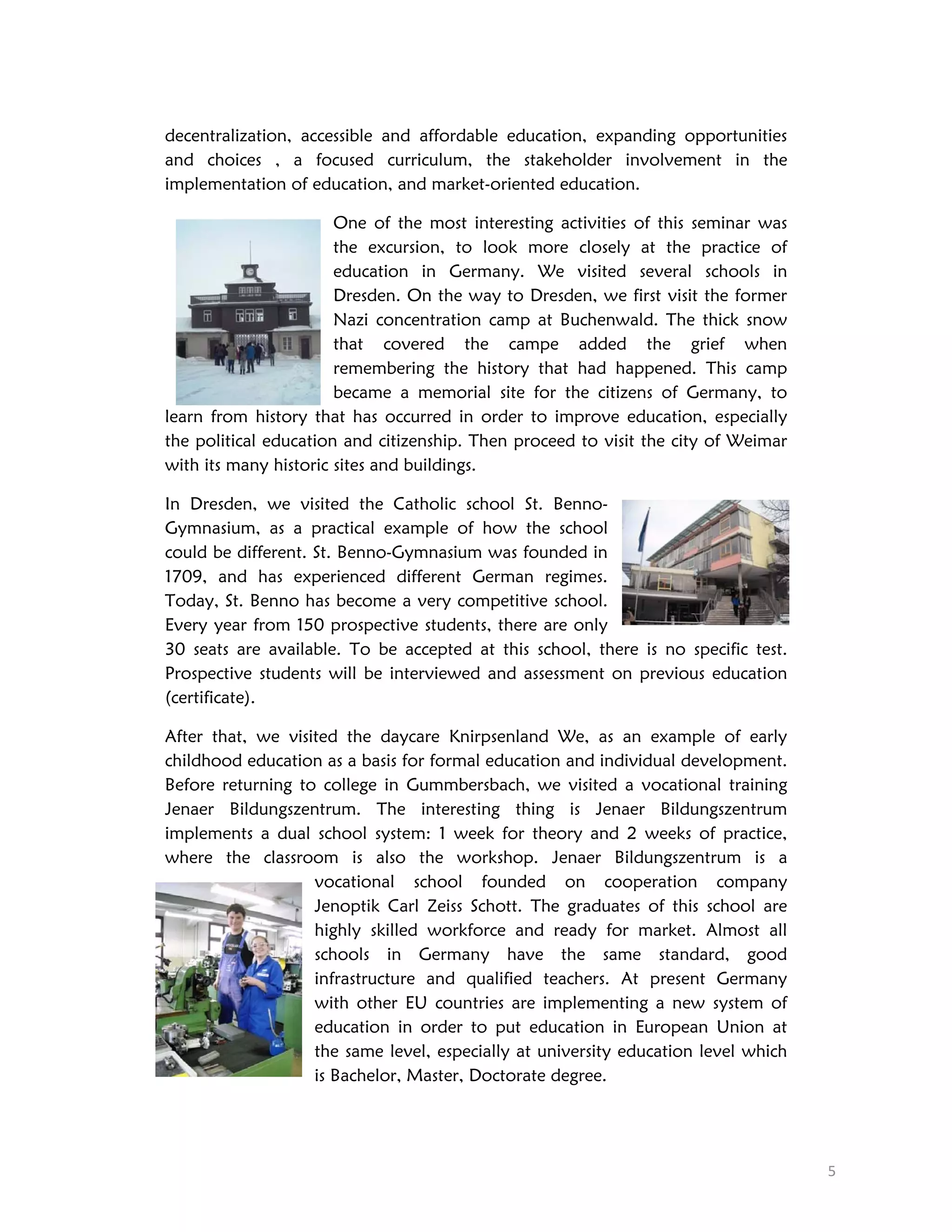
One of the most interesting activities of this seminar was
the excursion, to look more closely at the practice of
education in Germany. We visited several schools in
Dresden. On the way to Dresden, we first visit the former
Nazi concentration camp at Buchenwald. The thick snow
that covered the campe added the grief when
remembering the history that had happened. This camp
became a memorial site for the citizens of Germany, to
learn from history that has occurred in order to improve education, especially
the political education and citizenship. Then proceed to visit the city of Weimar
with its many historic sites and buildings.
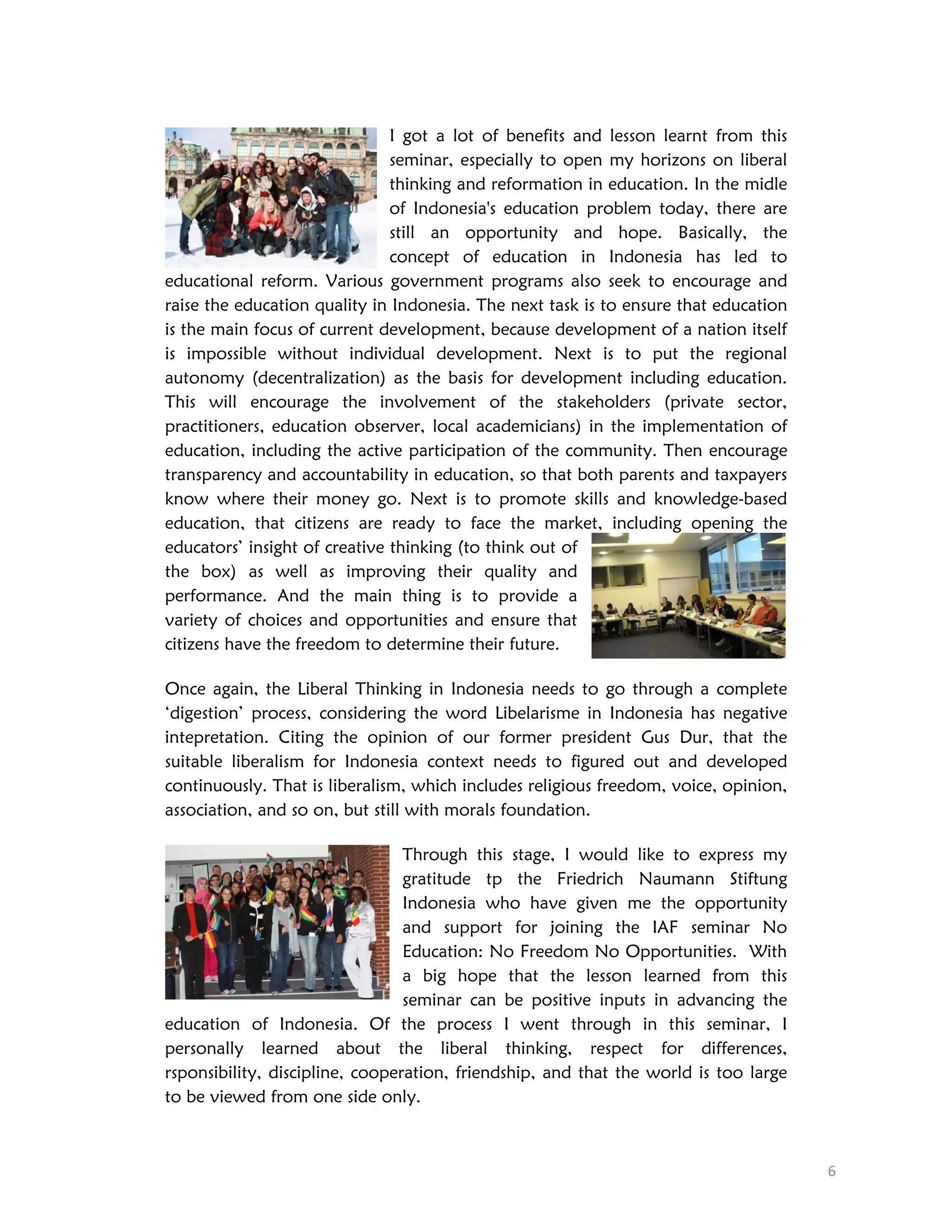
In Dresden, we visited the Catholic school St. BennoGymnasium, as a practical example of how the school
could be different. St. Benno-Gymnasium was founded in
1709, and has experienced different German regimes.
Today, St. Benno has become a very competitive school.
Every year from 150 prospective students, there are only
30 seats are available. To be accepted at this school, there is no specific test.
Prospective students will be interviewed and assessment on previous education
(certificate).
After that, we visited the daycare Knirpsenland We, as an example of early
childhood education as a basis for formal education and individual development.
Before returning to college in Gummbersbach, we visited a vocational training
Jenaer Bildungszentrum. The interesting thing is Jenaer Bildungszentrum
implements a dual school system: 1 week for theory and 2 weeks of practice,
where the classroom is also the workshop. Jenaer Bildungszentrum is a
vocational school founded on cooperation company
Jenoptik Carl Zeiss Schott. The graduates of this school are
highly skilled workforce and ready for market. Almost all
schools in Germany have the same standard, good
infrastructure and qualified teachers. At present Germany
with other EU countries are implementing a new system of
education in order to put education in European Union at
the same level, especially at university education level which
is Bachelor, Master, Doctorate degree.

 
5 
I got a lot of benefits and lesson learnt from this
seminar, especially to open my horizons on liberal
thinking and reformation in education. In the midle
of Indonesia's education problem today, there are
still an opportunity and hope. Basically, the
concept of education in Indonesia has led to
educational reform. Various government programs also seek to encourage and
raise the education quality in Indonesia. The next task is to ensure that education
is the main focus of current development, because development of a nation itself
is impossible without individual development. Next is to put the regional
autonomy (decentralization) as the basis for development including education.
This will encourage the involvement of the stakeholders (private sector,
practitioners, education observer, local academicians) in the implementation of
education, including the active participation of the community. Then encourage
transparency and accountability in education, so that both parents and taxpayers
know where their money go. Next is to promote skills and knowledge-based
education, that citizens are ready to face the market, including opening the
educators’ insight of creative thinking (to think out of
the box) as well as improving their quality and
performance. And the main thing is to provide a
variety of choices and opportunities and ensure that
citizens have the freedom to determine their future.
Once again, the Liberal Thinking in Indonesia needs to go through a complete
‘digestion’ process, considering the word Libelarisme in Indonesia has negative
intepretation. Citing the opinion of our former president Gus Dur, that the
suitable liberalism for Indonesia context needs to figured out and developed
continuously. That is liberalism, which includes religious freedom, voice, opinion,
association, and so on, but still with morals foundation.
Through this stage, I would like to express my
gratitude tp the Friedrich Naumann Stiftung
Indonesia who have given me the opportunity
and support for joining the IAF seminar No
Education: No Freedom No Opportunities. With
a big hope that the lesson learned from this
seminar can be positive inputs in advancing the
education of Indonesia. Of the process I went through in this seminar, I
personally learned about the liberal thinking, respect for differences,
rsponsibility, discipline, cooperation, friendship, and that the world is too large
to be viewed from one side only.
 
6 

IAF Training Report: No Education; No Freedom No Opportunity - February 2010

  • 1.
    International Academy forLeadership Seminar “No Education : No Freedom, No Opportunity” February 7th – 19th, 2010 Theodor Heuss Akademie – Gummersbach The first thing that came to our heads when talking about liberalism in Indonesia is something negative, radical, and leftish. So far, the meaning of liberalism in Indonesia is doing what is freely without rules, and liberalism becomes negative since there is no clear orientation. People often get stuck on the word ‘freedom’. So, when the invitation to join the seminar on Liberal Education came to me, there were many questions I arouse on my mind: what is a liberal education and why should a liberal education. Education in Indonesia itself, as set out in the Law on National Education System through Law No. 20 in 2003, that the national education system should be able to ensure equal education opportunities, improving quality and relevance and efficiency of education management to meet the challenge in accordance with demands for changes in local, national, and global that it needs to be done in a planned education reforms, focused, and sustainable. The concept stated above seems utopian since the implementation of education in Indonesia is not as expected. The obligation of government to conduct even basic education up to now is still very far from proper. Still too many people in Indonesian are not touched by education. Government services in the implementation of quality educationare still only a dream. Budget for education (excluding salary of educators and education service costs) in the State Budget and Local Budgets until now are still below 20%. Active initiatives of the community in education is not considered important. While in some areas, education was still in a state of concern. Ranging from lack of teaching staffs,   1 
  • 2.
    educational facilities upto difficulties faced by people to get education because of their economic problems and necessities of life. National education system which has lasted to this day still tends to exploit the students thinking. Indicators that are used tend to use indicators of intelligence, so the value in the report card or diploma does not necessarily indicate the students will be able to compete and survive in the middle of the onslaught of industrialization that took place today. IAF Training with the theme No Education: No Freedom No Opportunity aimed to figure out liberal solutions for the problems of education, especially in third world countries. This training was attended by 24 participants from 22 countries (developing and third world) in Asia, Eastern Europe, Latin America, and Africa. Participants came from various backgrounds: NGOs, political parties, youth forums, teacher, and journalist, who are affiliated with the FNS. Training was held for 12 days, on 7th to 18th February 2010, with various activities such as lectures, group discussions, debates, role plays and field visits. The training was facilitated by Dr. Stefan Melnik and Dr. Monika Ballin. Training began with basic view of the Liberalism and Education, which was about learning and how the liberal concept of knowledge and learning differ from other concepts. Liberal concept sees and individual as a central point with the foundation of freedom, respect and responsibility. Talking about the problems in education, which occurred around the world (especially in developing countries) are almost the same, which are the education policy, corruption, poverty, curriculum learning (too many subjects, limiting the topic to learn, the evaluation system), education funding, infrastructure education, high dropout rates, the quality of teaching staff, and the influence political situation on education. During 12 days of seminar, there were many topics discussed related to education: problems and solutions. The main issues covered: Liberalism and education; stakeholders involvement (public, private) in education; organization, structure and funding of education; education and promoting liberal democracy; policy and educational reform, and wider issues in the field education, for example: education to ensure the freedom and opportunity; early childhood   2 
  • 3.
    education, vocational trainingand lifelong education; educational challenges associated with globalization and free markets, and the brain drain. One point, that alll discussions and sharing of opinions were always base on liberal thingking / point of view. The seminar also made the participants as resource person. For example, on the topic of the challenges faced by the teaching profession today, in which 3 participants with educators background (teachers / lecturers) as the resource persons. Next is the topic of how the demands of consumers to education, presented by the 3 participants who are also students. Another session was the share learning on model of education reform that has been done in the country, such as in India with the School Campaign programs and school vouchers, and citizen-based educational development in Pakistan through The Learning School. School voucher program in India is an innovation in reforming educational policy, is also a model of education decentralization. Through this school vouchers, the government provides funds for education (in the form of vouchers) to students, then they choose which schools they want to go to. Then the government will disburse funds in accordance with the school vouchers received by the school. School vouchers aimed to encourage schools to be more transparent in managing the education fund, and to encourage schools to keep improving its quality. Of course, students will choose school with better quality. Pilot project of school voucher were Uttarakhand, Rajasthan, and Uttar Pradesh. In year 2007, 408 students from poor families in Delhi were awarded the schoolvoucher. In Indonesia, a smililar program with school vouchers is the School Operational Assistance funds. Where the government gives grants to schools in accordance with the number of students. In the implementation, the aspects of transparency and accountability and the allocation of funds are always become a problem. The Learning School is a model of community participation in education. The Learning School is located in the city of Kot Radha Kishan, where the villages nearby are poor with high rate of illiteracy. Parents there were less concerned about the education of children and paid less interaction with the school. From teachers’ side, most of them were less trained and less motivated. After following the various discussions held by   3 
  • 4.
    the Liberal Forumsof Pakistan, Kot Radha citizens realized that they really needed a school which provides quality education for the students form sub-urban and rural. Then it was decided that the citizens had to build their own school for their children. They needed one year fundraising and building the school. The Learning School operated on April 8th, 2002. The most important task is to involve communities in the whole process and they should realize that the TLS was theirs and they should send their children to school. Now, on completion of its seven years, TLS is proud to enroll more than 1,000 students, provide employment to 78 staff members, and have 42 class rooms, a book shop, a canteen, a large play ground and provide a healthy environment In addition, the seminar also presented guest speaker from the Young Liberal (Junge Liberale), Petra Pabst, who is also a candidate in parliamentary elections for the state of North Rhine Westphalia. Petra talked about The Liberal Concept of Education: a concept for the challenges of the 21st century. This liberal education is one of big issues that was carried out by the Young Liberal. A very interesting session the debate session, to see the matter from two different points of view which are equally valid ideas. The first debate was about education reform, whether it should be done gradually or radically. Considering the problems on education in third world countries, the radical reforms should be done. On the other hand, the reformation should be done carefully, or else many people would suffer. Reformation on education is a gradual process, indeed in certain areas of education reformation need to be done radically. The point is there must be a progressive change. The next debate was on the necessity about religion being taught in schools. One side saw that teaching religion in schools is the same as indoctrination. However, the other side saw that everyone has spiritual needs, so not teaching religion is ignorance. But of course schools must be neutral and give the freedom to choose. Topic of religion is quite difficult, but if religion should be taught in schools, it must be emphasized at the value philosophical, plurality, respect and responsibility. At the nd of the seminar, all participants came to the conclution that education policy in the liberal viewpoint must contain the following things : that every person has an equal right to quality education choices, deregulation and   4 
  • 5.
    decentralization, accessible andaffordable education, expanding opportunities and choices , a focused curriculum, the stakeholder involvement in the implementation of education, and market-oriented education. One of the most interesting activities of this seminar was the excursion, to look more closely at the practice of education in Germany. We visited several schools in Dresden. On the way to Dresden, we first visit the former Nazi concentration camp at Buchenwald. The thick snow that covered the campe added the grief when remembering the history that had happened. This camp became a memorial site for the citizens of Germany, to learn from history that has occurred in order to improve education, especially the political education and citizenship. Then proceed to visit the city of Weimar with its many historic sites and buildings. In Dresden, we visited the Catholic school St. BennoGymnasium, as a practical example of how the school could be different. St. Benno-Gymnasium was founded in 1709, and has experienced different German regimes. Today, St. Benno has become a very competitive school. Every year from 150 prospective students, there are only 30 seats are available. To be accepted at this school, there is no specific test. Prospective students will be interviewed and assessment on previous education (certificate). After that, we visited the daycare Knirpsenland We, as an example of early childhood education as a basis for formal education and individual development. Before returning to college in Gummbersbach, we visited a vocational training Jenaer Bildungszentrum. The interesting thing is Jenaer Bildungszentrum implements a dual school system: 1 week for theory and 2 weeks of practice, where the classroom is also the workshop. Jenaer Bildungszentrum is a vocational school founded on cooperation company Jenoptik Carl Zeiss Schott. The graduates of this school are highly skilled workforce and ready for market. Almost all schools in Germany have the same standard, good infrastructure and qualified teachers. At present Germany with other EU countries are implementing a new system of education in order to put education in European Union at the same level, especially at university education level which is Bachelor, Master, Doctorate degree.   5 
  • 6.
    I got alot of benefits and lesson learnt from this seminar, especially to open my horizons on liberal thinking and reformation in education. In the midle of Indonesia's education problem today, there are still an opportunity and hope. Basically, the concept of education in Indonesia has led to educational reform. Various government programs also seek to encourage and raise the education quality in Indonesia. The next task is to ensure that education is the main focus of current development, because development of a nation itself is impossible without individual development. Next is to put the regional autonomy (decentralization) as the basis for development including education. This will encourage the involvement of the stakeholders (private sector, practitioners, education observer, local academicians) in the implementation of education, including the active participation of the community. Then encourage transparency and accountability in education, so that both parents and taxpayers know where their money go. Next is to promote skills and knowledge-based education, that citizens are ready to face the market, including opening the educators’ insight of creative thinking (to think out of the box) as well as improving their quality and performance. And the main thing is to provide a variety of choices and opportunities and ensure that citizens have the freedom to determine their future. Once again, the Liberal Thinking in Indonesia needs to go through a complete ‘digestion’ process, considering the word Libelarisme in Indonesia has negative intepretation. Citing the opinion of our former president Gus Dur, that the suitable liberalism for Indonesia context needs to figured out and developed continuously. That is liberalism, which includes religious freedom, voice, opinion, association, and so on, but still with morals foundation. Through this stage, I would like to express my gratitude tp the Friedrich Naumann Stiftung Indonesia who have given me the opportunity and support for joining the IAF seminar No Education: No Freedom No Opportunities. With a big hope that the lesson learned from this seminar can be positive inputs in advancing the education of Indonesia. Of the process I went through in this seminar, I personally learned about the liberal thinking, respect for differences, rsponsibility, discipline, cooperation, friendship, and that the world is too large to be viewed from one side only.   6