Dwarf Planets Solar System Debris
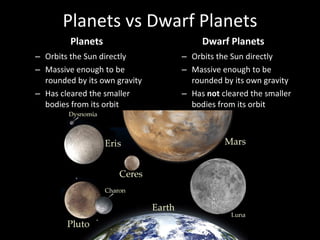
Planets vs Dwarf Planets Planets Orbits the Sun directly Massive enough to be rounded by its own gravity Has cleared the smaller bodies from its orbit Dwarf Planets Orbits the Sun directly Massive enough to be rounded by its own gravity Has  not  cleared the smaller bodies from its orbit
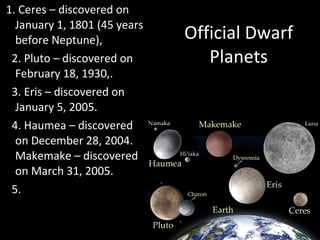
Official Dwarf Planets 1. Ceres – discovered on January 1, 1801 (45 years before Neptune),  2. Pluto – discovered on February 18, 1930,. 3. Eris – discovered on January 5, 2005.  4. Haumea – discovered on December 28, 2004. Makemake – discovered on March 31, 2005.  5.
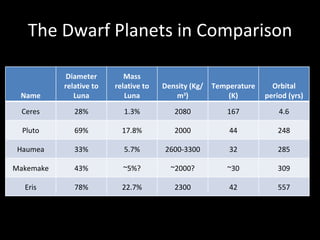
The Dwarf Planets in Comparison Name Diameter relative to Luna Mass relative to Luna Density (Kg/m 3 ) Temperature (K) Orbital period (yrs) Ceres 28% 1.3% 2080 167 4.6 Pluto 69% 17.8% 2000 44 248 Haumea 33% 5.7% 2600-3300 32 285 Makemake 43% ~5%? ~2000? ~30 309 Eris 78% 22.7% 2300 42 557
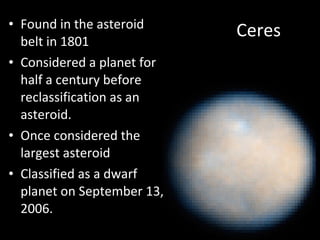
Ceres Found in the asteroid belt in 1801 Considered a planet for half a century before reclassification as an asteroid.  Once considered the largest asteroid Classified as a dwarf planet on September 13, 2006.
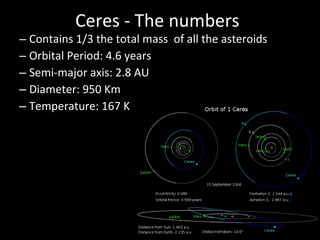
Ceres - The numbers Contains 1/3 the total mass  of all the asteroids Orbital Period: 4.6 years Semi-major axis: 2.8 AU Diameter: 950 Km Temperature: 167 K
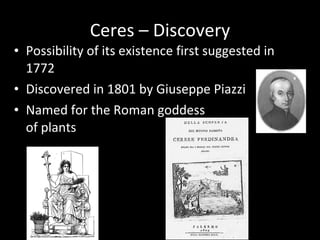
Ceres – Discovery Possibility of its existence first suggested in 1772 Discovered in 1801 by Giuseppe Piazzi Named for the Roman goddess  of plants
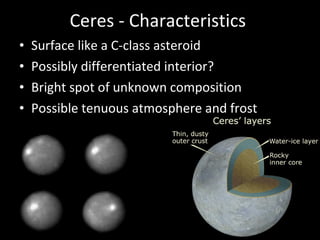
Ceres - Characteristics  Surface like a C-class asteroid Possibly differentiated interior? Bright spot of unknown composition Possible tenuous atmosphere and frost
The Dawn Mission Will study asteroids Vesta and Ceres Will arrive at Vesta in July 2011 Will arrive at Ceres in February 2015
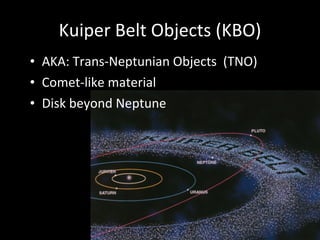
Kuiper Belt Objects (KBO) AKA: Trans-Neptunian Objects  (TNO) Comet-like material Disk beyond Neptune
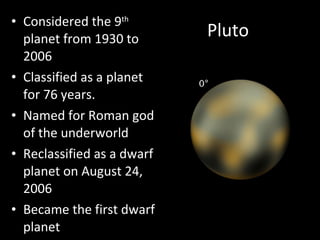
Pluto Considered the 9 th  planet from 1930 to 2006 Classified as a planet for 76 years.  Named for Roman god of the underworld Reclassified as a dwarf planet on August 24, 2006 Became the first dwarf planet
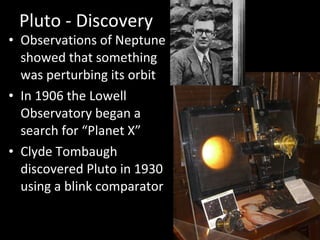
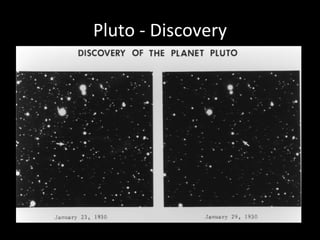
Pluto - Discovery Observations of Neptune showed that something was perturbing its orbit In 1906 the Lowell Observatory began a search for “Planet X” Clyde Tombaugh discovered Pluto in 1930 using a blink comparator
Pluto - Discovery
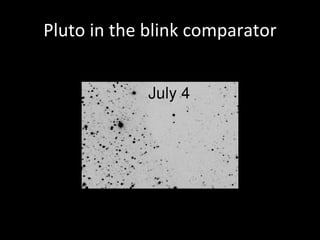
Pluto in the blink comparator
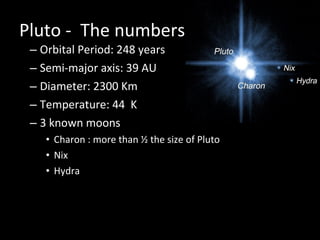
Pluto -  The numbers Orbital Period: 248 years Semi-major axis: 39 AU Diameter: 2300 Km Temperature: 44  K 3 known moons Charon : more than ½ the size of Pluto Nix Hydra
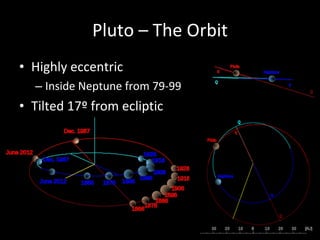
Pluto – The Orbit Highly eccentric Inside Neptune from 79-99 Tilted 17º from ecliptic
Pluto – What is it really? Highly eccentric orbit +Atmosphere thaws and freezes depending on distance from Sun +Highly inclined from ecliptic = comet
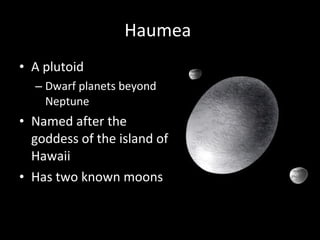
Haumea  A plutoid Dwarf planets beyond Neptune Named after the goddess of the island of Hawaii Has two known moons
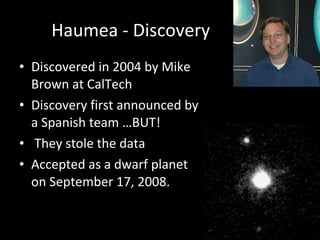
Haumea - Discovery Discovered in 2004 by Mike Brown at CalTech Discovery first announced by a Spanish team …BUT! They stole the data Accepted as a dwarf planet on September 17, 2008.
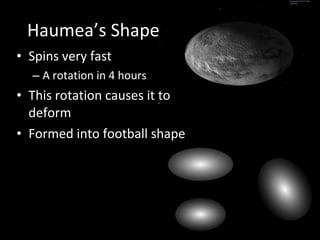
Haumea’s Shape Spins very fast A rotation in 4 hours This rotation causes it to deform Formed into football shape
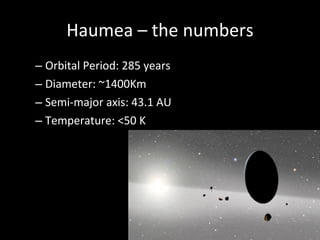
Haumea – the numbers Orbital Period: 285 years Diameter: ~1400Km Semi-major axis: 43.1 AU Temperature: <50 K
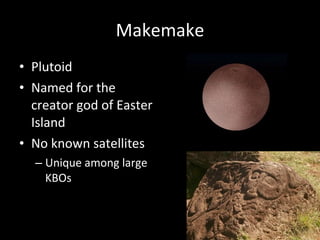
Makemake Plutoid Named for the creator god of Easter Island No known satellites Unique among large KBOs
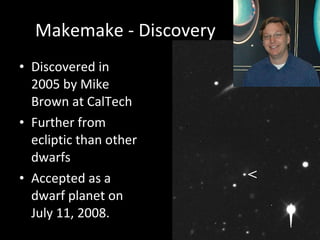
Makemake - Discovery Discovered in 2005 by Mike Brown at CalTech Further from ecliptic than other dwarfs Accepted as a dwarf planet on July 11, 2008.
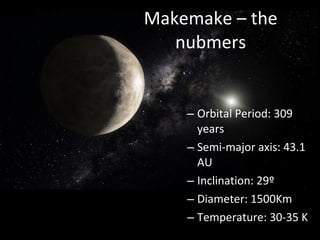
Makemake – the nubmers Orbital Period: 309 years Semi-major axis: 43.1 AU Inclination: 29º Diameter: 1500Km Temperature: 30-35 K
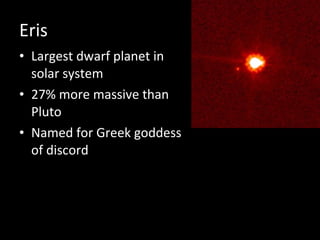
Eris Largest dwarf planet in solar system 27% more massive than Pluto Named for Greek goddess of discord
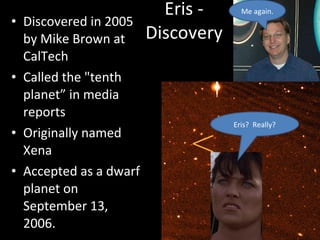
Eris - Discovery Discovered in 2005 by Mike Brown at CalTech Called the &quot;tenth planet” in media reports Originally named Xena Accepted as a dwarf planet on September 13, 2006. Eris?  Really? Me again.
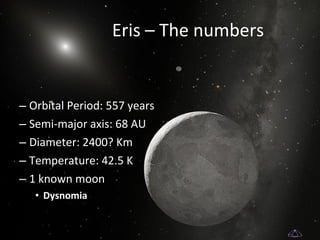
Eris – The numbers Orbital Period: 557 years Semi-major axis: 68 AU Diameter: 2400? Km Temperature: 42.5 K 1 known moon Dysnomia
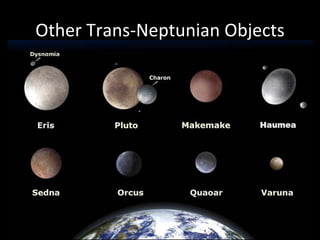
Other Trans-Neptunian Objects
Pluto’s Demise

Dwarf planets

  • 1.
    Dwarf Planets SolarSystem Debris
  • 2.
    Planets vs DwarfPlanets Planets Orbits the Sun directly Massive enough to be rounded by its own gravity Has cleared the smaller bodies from its orbit Dwarf Planets Orbits the Sun directly Massive enough to be rounded by its own gravity Has not cleared the smaller bodies from its orbit
  • 3.
    Official Dwarf Planets1. Ceres – discovered on January 1, 1801 (45 years before Neptune), 2. Pluto – discovered on February 18, 1930,. 3. Eris – discovered on January 5, 2005. 4. Haumea – discovered on December 28, 2004. Makemake – discovered on March 31, 2005. 5.
  • 4.
    The Dwarf Planetsin Comparison Name Diameter relative to Luna Mass relative to Luna Density (Kg/m 3 ) Temperature (K) Orbital period (yrs) Ceres 28% 1.3% 2080 167 4.6 Pluto 69% 17.8% 2000 44 248 Haumea 33% 5.7% 2600-3300 32 285 Makemake 43% ~5%? ~2000? ~30 309 Eris 78% 22.7% 2300 42 557
  • 5.
    Ceres Found inthe asteroid belt in 1801 Considered a planet for half a century before reclassification as an asteroid. Once considered the largest asteroid Classified as a dwarf planet on September 13, 2006.
  • 6.
    Ceres - Thenumbers Contains 1/3 the total mass of all the asteroids Orbital Period: 4.6 years Semi-major axis: 2.8 AU Diameter: 950 Km Temperature: 167 K
  • 7.
    Ceres – DiscoveryPossibility of its existence first suggested in 1772 Discovered in 1801 by Giuseppe Piazzi Named for the Roman goddess of plants
  • 8.
    Ceres - Characteristics Surface like a C-class asteroid Possibly differentiated interior? Bright spot of unknown composition Possible tenuous atmosphere and frost
  • 9.
    The Dawn MissionWill study asteroids Vesta and Ceres Will arrive at Vesta in July 2011 Will arrive at Ceres in February 2015
  • 10.
    Kuiper Belt Objects(KBO) AKA: Trans-Neptunian Objects (TNO) Comet-like material Disk beyond Neptune
  • 11.
    Pluto Considered the9 th planet from 1930 to 2006 Classified as a planet for 76 years. Named for Roman god of the underworld Reclassified as a dwarf planet on August 24, 2006 Became the first dwarf planet
  • 12.
    Pluto - DiscoveryObservations of Neptune showed that something was perturbing its orbit In 1906 the Lowell Observatory began a search for “Planet X” Clyde Tombaugh discovered Pluto in 1930 using a blink comparator
  • 13.
  • 14.
    Pluto in theblink comparator
  • 15.
    Pluto - The numbers Orbital Period: 248 years Semi-major axis: 39 AU Diameter: 2300 Km Temperature: 44  K 3 known moons Charon : more than ½ the size of Pluto Nix Hydra
  • 16.
    Pluto – TheOrbit Highly eccentric Inside Neptune from 79-99 Tilted 17º from ecliptic
  • 17.
    Pluto – Whatis it really? Highly eccentric orbit +Atmosphere thaws and freezes depending on distance from Sun +Highly inclined from ecliptic = comet
  • 18.
    Haumea Aplutoid Dwarf planets beyond Neptune Named after the goddess of the island of Hawaii Has two known moons
  • 19.
    Haumea - DiscoveryDiscovered in 2004 by Mike Brown at CalTech Discovery first announced by a Spanish team …BUT! They stole the data Accepted as a dwarf planet on September 17, 2008.
  • 20.
    Haumea’s Shape Spinsvery fast A rotation in 4 hours This rotation causes it to deform Formed into football shape
  • 21.
    Haumea – thenumbers Orbital Period: 285 years Diameter: ~1400Km Semi-major axis: 43.1 AU Temperature: <50 K
  • 22.
    Makemake Plutoid Namedfor the creator god of Easter Island No known satellites Unique among large KBOs
  • 23.
    Makemake - DiscoveryDiscovered in 2005 by Mike Brown at CalTech Further from ecliptic than other dwarfs Accepted as a dwarf planet on July 11, 2008.
  • 24.
    Makemake – thenubmers Orbital Period: 309 years Semi-major axis: 43.1 AU Inclination: 29º Diameter: 1500Km Temperature: 30-35 K
  • 25.
    Eris Largest dwarfplanet in solar system 27% more massive than Pluto Named for Greek goddess of discord
  • 26.
    Eris - DiscoveryDiscovered in 2005 by Mike Brown at CalTech Called the &quot;tenth planet” in media reports Originally named Xena Accepted as a dwarf planet on September 13, 2006. Eris? Really? Me again.
  • 27.
    Eris – Thenumbers Orbital Period: 557 years Semi-major axis: 68 AU Diameter: 2400? Km Temperature: 42.5 K 1 known moon Dysnomia
  • 28.
  • 29.