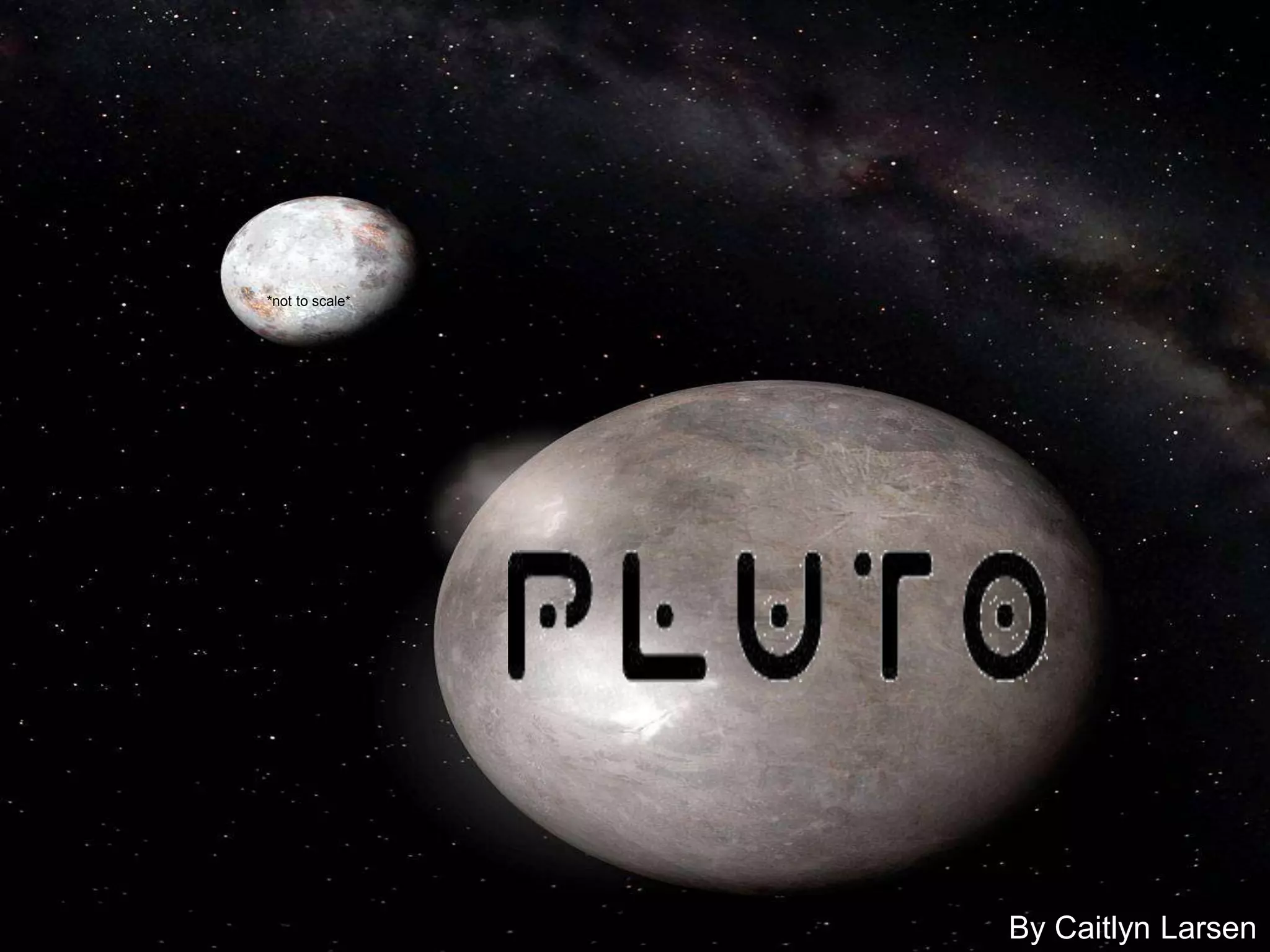
*not to scale*
By Caitlyn Larsen
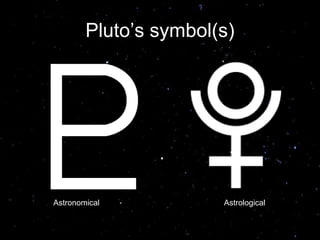
Pluto’s symbol(s)
Astronomical Astrological
Discovery
• Pluto was discovered by Clyde Tambaugh
on February 18th, 1930. He was assigned
the task of finding a trans-Neptunian
object predicted by another astronomer.
He spent months looking for “Planet X”
before finding it as it was crossing
Neptune’s orbital.
How it was named
• In Greek mythology, Pluto was the god of the
underworld. He was an outcast compared to his
heavenly brothers and sisters, like how this
planet is an outcast in our solar system.
• Since most of the other planets were named
after Greek gods, they decided to do the same
for Pluto. Which Greek god to name it after was
decided by Venita Burney, an 11 year old
schoolgirl. She intended to name it after
Disney’s famous orange hound and the
scientists went along with it.
Planet Measurements
• Mass: 1.3 x 10^22 Kg
• Volume: 7.1 x 10^9 Km^3
• Equatorial Circumference:
• Mean Density: Approx. 2
• Gravity: Approx. 16X weaker than Earth’s
• If you weighed 100 lbs on Earth, you
would weigh 6.6lbs on Pluto.
Distances
• Pluto is the 9th planet from the sun (even
though it’s a dwarf planet)
• Its average distance from the sun is
39.5AU (5.9 billion kilometers)
• Its distance from Earth is 35AU (4.6 billion
kilometers)
• Its closest moon, Charon, is only
19,600km away.
Orbit and Rotation
• It takes 90,520 Earth days for Pluto to orbit
the sun once.
• At perihelion, Pluto is only 29.7AU away
from the sun, closer than Neptune gets at
its perihelion! And at aphelion, it gets as
far away as 49.3AU away.
• The length of one day on Pluto is equal to
153.4 hours (about 6.4 Earth days)
Appearance
• Pluto's appearance is very icy and
rocky. The color of Pluto is a brownish
yellow color.
• The surface is covered with ice and has
traces of methane and carbon monoxide
ice on it. It is hard and rocky, unlike the
other outer planets.
• It’s mainly mainly icy and rocky
Moons and Satellites
In order from closest to furthest (excluding Charon, Pluto’s biggest and closest moon)
Styx
Average diameter is 10-25km and takes 20.2 Earth days to orbit
Nix
Average diameter is 46-137km and takes 24.9 Earth days to orbit
Kerberos
Average diameter is 13-34km and takes 32.1 Earth days to orbit
Hydra
Average diameter is 61-167km and takes 38.2 Earth days to orbit
Charon
• Average distance from Pluto: 19,600km
• Orbit period: 6.3872 Earth days
• Rotation period: 6.3872 Earth days
Like our own moon to Earth, only one side of
Charon can be seen from Pluto.
• Equatorial diameter: 593km
• Mass: 1.62 x 10^21 kg
• Surface gravity: .31 m/s^2
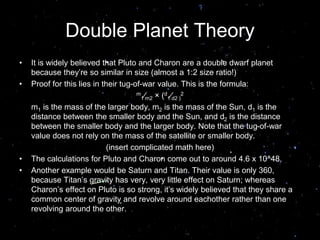
Double Planet Theory
• It is widely believed that Pluto and Charon are a double dwarf planet
because they’re so similar in size (almost a 1:2 size ratio!)
• Proof for this lies in their tug-of-war value. This is the formula:
m
1⁄m2 × (d
1⁄d2 )
2
m1 is the mass of the larger body, m2 is the mass of the Sun, d1 is the
distance between the smaller body and the Sun, and d2 is the distance
between the smaller body and the larger body. Note that the tug-of-war
value does not rely on the mass of the satellite or smaller body.
(insert complicated math here)
• The calculations for Pluto and Charon come out to around 4.6 x 10^48.
• Another example would be Saturn and Titan. Their value is only 360,
because Titan’s gravity has very, very little effect on Saturn; whereas
Charon’s effect on Pluto is so strong, it’s widely believed that they share a
common center of gravity and revolve around eachother rather than one
revolving around the other.
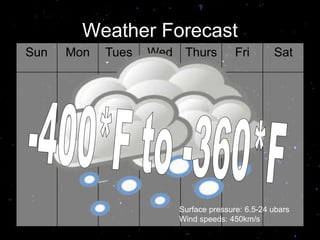
Weather Forecast
Sun Mon Tues Wed Thurs Fri Sat
Surface pressure: 6.5-24 ubars
Wind speeds: 450km/s
Atmosphere and Rings
• Pluto seems almost incapable of having an
atmosphere. Between its small size and its
distant location, the dwarf planet seems unlikely
to have what it takes. Yet the tiny body boasts
an atmosphere in a constant state of flux.
• What atmosphere it does have consists of
mostly nitrogen and extends halfway to Charon
(further proving the double-planet theory
because Charon shares part of Pluto’s
atmosphere
• Pluto has no known rings, as it is a terrestrial
planet.
Composition
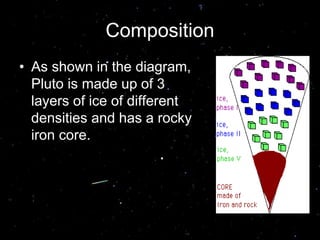
• As shown in the diagram,
Pluto is made up of 3
layers of ice of different
densities and has a rocky
iron core.
Is there water on Pluto?
• Little is known about what’s under Pluto’s
thick layers of ice and just what the ice is
made of. What we do know is that if
there’s anything other than ice, it’s liquid
nitrogen.
• Even if there is water, it would be 100%
solid ice on account of the frigid -400
degree climate.
Exploration, Human Travel and
Terraforming
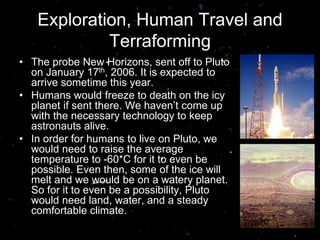
• The probe New Horizons, sent off to Pluto
on January 17th, 2006. It is expected to
arrive sometime this year.
• Humans would freeze to death on the icy
planet if sent there. We haven’t come up
with the necessary technology to keep
astronauts alive.
• In order for humans to live on Pluto, we
would need to raise the average
temperature to -60*C for it to even be
possible. Even then, some of the ice will
melt and we would be on a watery planet.
So for it to even be a possibility, Pluto
would need land, water, and a steady
comfortable climate.
2/28/07
END!
Question 1
How many moons does Pluto have?
a) 1
b) 3
c) 5
d) 7
Answer C
Question 2
How far is Pluto from the sun? (in km)
a) 5.9 billion
b) 4.6 billion
c) 39.5
d) 19,600
Answer A
Question 3
What is the name of the theory that
suggests Pluto and Charon share a
common center of gravity?
a) Tug of war theory
b) Double planet theory
c) Charon’s theory
d) Moon-planet theory
Answer B

Pluto Lesson

  • 1.
    *not to scale* ByCaitlyn Larsen
  • 2.
  • 3.
    Discovery • Pluto wasdiscovered by Clyde Tambaugh on February 18th, 1930. He was assigned the task of finding a trans-Neptunian object predicted by another astronomer. He spent months looking for “Planet X” before finding it as it was crossing Neptune’s orbital.
  • 4.
    How it wasnamed • In Greek mythology, Pluto was the god of the underworld. He was an outcast compared to his heavenly brothers and sisters, like how this planet is an outcast in our solar system. • Since most of the other planets were named after Greek gods, they decided to do the same for Pluto. Which Greek god to name it after was decided by Venita Burney, an 11 year old schoolgirl. She intended to name it after Disney’s famous orange hound and the scientists went along with it.
  • 5.
    Planet Measurements • Mass:1.3 x 10^22 Kg • Volume: 7.1 x 10^9 Km^3 • Equatorial Circumference: • Mean Density: Approx. 2 • Gravity: Approx. 16X weaker than Earth’s • If you weighed 100 lbs on Earth, you would weigh 6.6lbs on Pluto.
  • 6.
    Distances • Pluto isthe 9th planet from the sun (even though it’s a dwarf planet) • Its average distance from the sun is 39.5AU (5.9 billion kilometers) • Its distance from Earth is 35AU (4.6 billion kilometers) • Its closest moon, Charon, is only 19,600km away.
  • 7.
    Orbit and Rotation •It takes 90,520 Earth days for Pluto to orbit the sun once. • At perihelion, Pluto is only 29.7AU away from the sun, closer than Neptune gets at its perihelion! And at aphelion, it gets as far away as 49.3AU away. • The length of one day on Pluto is equal to 153.4 hours (about 6.4 Earth days)
  • 8.
    Appearance • Pluto's appearanceis very icy and rocky. The color of Pluto is a brownish yellow color. • The surface is covered with ice and has traces of methane and carbon monoxide ice on it. It is hard and rocky, unlike the other outer planets. • It’s mainly mainly icy and rocky
  • 9.
    Moons and Satellites Inorder from closest to furthest (excluding Charon, Pluto’s biggest and closest moon) Styx Average diameter is 10-25km and takes 20.2 Earth days to orbit Nix Average diameter is 46-137km and takes 24.9 Earth days to orbit Kerberos Average diameter is 13-34km and takes 32.1 Earth days to orbit Hydra Average diameter is 61-167km and takes 38.2 Earth days to orbit
  • 10.
    Charon • Average distancefrom Pluto: 19,600km • Orbit period: 6.3872 Earth days • Rotation period: 6.3872 Earth days Like our own moon to Earth, only one side of Charon can be seen from Pluto. • Equatorial diameter: 593km • Mass: 1.62 x 10^21 kg • Surface gravity: .31 m/s^2
  • 11.
    Double Planet Theory •It is widely believed that Pluto and Charon are a double dwarf planet because they’re so similar in size (almost a 1:2 size ratio!) • Proof for this lies in their tug-of-war value. This is the formula: m 1⁄m2 × (d 1⁄d2 ) 2 m1 is the mass of the larger body, m2 is the mass of the Sun, d1 is the distance between the smaller body and the Sun, and d2 is the distance between the smaller body and the larger body. Note that the tug-of-war value does not rely on the mass of the satellite or smaller body. (insert complicated math here) • The calculations for Pluto and Charon come out to around 4.6 x 10^48. • Another example would be Saturn and Titan. Their value is only 360, because Titan’s gravity has very, very little effect on Saturn; whereas Charon’s effect on Pluto is so strong, it’s widely believed that they share a common center of gravity and revolve around eachother rather than one revolving around the other.
  • 12.
    Weather Forecast Sun MonTues Wed Thurs Fri Sat Surface pressure: 6.5-24 ubars Wind speeds: 450km/s
  • 13.
    Atmosphere and Rings •Pluto seems almost incapable of having an atmosphere. Between its small size and its distant location, the dwarf planet seems unlikely to have what it takes. Yet the tiny body boasts an atmosphere in a constant state of flux. • What atmosphere it does have consists of mostly nitrogen and extends halfway to Charon (further proving the double-planet theory because Charon shares part of Pluto’s atmosphere • Pluto has no known rings, as it is a terrestrial planet.
  • 14.
    Composition • As shownin the diagram, Pluto is made up of 3 layers of ice of different densities and has a rocky iron core.
  • 15.
    Is there wateron Pluto? • Little is known about what’s under Pluto’s thick layers of ice and just what the ice is made of. What we do know is that if there’s anything other than ice, it’s liquid nitrogen. • Even if there is water, it would be 100% solid ice on account of the frigid -400 degree climate.
  • 16.
    Exploration, Human Traveland Terraforming • The probe New Horizons, sent off to Pluto on January 17th, 2006. It is expected to arrive sometime this year. • Humans would freeze to death on the icy planet if sent there. We haven’t come up with the necessary technology to keep astronauts alive. • In order for humans to live on Pluto, we would need to raise the average temperature to -60*C for it to even be possible. Even then, some of the ice will melt and we would be on a watery planet. So for it to even be a possibility, Pluto would need land, water, and a steady comfortable climate. 2/28/07
  • 17.
  • 18.
    Question 1 How manymoons does Pluto have? a) 1 b) 3 c) 5 d) 7 Answer C
  • 19.
    Question 2 How faris Pluto from the sun? (in km) a) 5.9 billion b) 4.6 billion c) 39.5 d) 19,600 Answer A
  • 20.
    Question 3 What isthe name of the theory that suggests Pluto and Charon share a common center of gravity? a) Tug of war theory b) Double planet theory c) Charon’s theory d) Moon-planet theory Answer B