























Word
Ignatius Joseph N. Estroga, MA-Eng
Liceo de Cagayan University, Philippines
http://grammar.about.com/
ormation
Word
Formation
In linguistics, the ways in which new
words are made on the basis of other
words or morphemes. Also called
derivational morphology.
Word-formation can denote either a
state or a process, and it can be
viewed either diachronically or
synchronically.
Diachronic
linguistics
The study of a language
through different periods in
history.
Synchronic
linguistics
The study of a language at
one period in time (usually
the present).
Diachronic linguistics and Synchronic
linguistics are the two main temporal
dimensions of language study introduced
by Swiss linguist Ferdinand de Saussure
in Course in General Linguistics (1916).
Word
ormation
Compounding
compound
adjective
Two or more words that act as a single
idea to modify a noun
Ex. a part-time employee
a high-speed chase
 As a general rule, the words in a compound adjective are
hyphenated when they come before a noun but not when they
come after
Ex. a well-known actor (√)
The actor is well known (x)
 Also, compound adjectives formed with an adverb ending in -
ly are usually not hyphenated.
Ex. rapidly changing
violently swirled
compound
adjective
exercise
 "If nothing else works, a total pig-headed unwillingness
to look facts in the face will see us through.“
 "The general was meeting someone for dinner at
an out-of-the-way restaurant, not in the suburb of
Nanterre, but close by."
(Robert Ludlum,The Bourne Identity. Richard Marek Publishers, 1980)
 "A well-developed sense of humor is the pole that adds
balance to your steps as you walk the tightrope of life."
(WilliamArthurWard)
 "In the 19th century, before the science of archaeology
became well developed, the Ottomans laid out the
brick and concrete city that stands today."
exercise
Write 10 compound adjectives
and present them in class
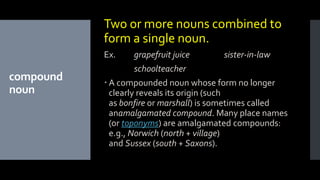
compound
noun
Two or more nouns combined to
form a single noun.
Ex. grapefruit juice sister-in-law
schoolteacher
 A compounded noun whose form no longer
clearly reveals its origin (such
as bonfire or marshall) is sometimes called
anamalgamated compound. Many place names
(or toponyms) are amalgamated compounds:
e.g., Norwich (north + village)
and Sussex (south + Saxons).
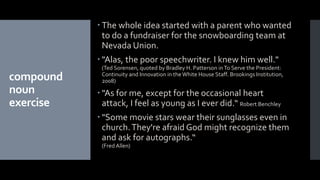
compound
noun
exercise
 The whole idea started with a parent who wanted
to do a fundraiser for the snowboarding team at
Nevada Union.
 "Alas, the poor speechwriter. I knew him well."
(Ted Sorensen, quoted by Bradley H. Patterson inTo Serve the President:
Continuity and Innovation in the White House Staff. Brookings Institution,
2008)
 "As for me, except for the occasional heart
attack, I feel as young as I ever did.“ Robert Benchley
 "Some movie stars wear their sunglasses even in
church.They're afraid God might recognize them
and ask for autographs.“
(Fred Allen)
exercise
Write 10 compound nouns and
present them in class
compound
verb
Two or more words combined to form a single
verb. Compounds are written as either one word
or two hyphenated words
Ex. stir fry
sleep walk
brainwash
was playing
would have been playing
rhyming
compound
A compound word that
contains rhymingelements, such
as blackjack, fuddy duddy, pooper-
scooper, and voodoo.
rhyming
compound
 "What would the English language be without Georgie-Porgie,
tootsy-wootsy, razzle-dazzle, heebie-jeebies, walkie-talkie,
nitty-gritty, and polly-wolly-doodle? . . .We barely notice the
presence of rhyme in picnic, humdrum, humbug,
hobnob, and tidbit: the humor of their inner form has worn
off."
(Anatoly Liberman, Word Origins: Etymology for Everyone. Oxford Univ. Press, 2009)
 "For all the hullabaloo surrounding the 'mobile gaming
revolution' there are few games that really tailor themselves
well to the medium."
(Toby Moses, "Extraction: Project Outbreak." The Observber, Nov. 26, 2011)
 "Look out helter skelter
She's coming down fast
Yes she is
Yes she is coming down fast."
(John Lennon and Paul McCartney, "Helter Skelter")
Affixation
Affixation
In the process of adding an affix
to a word to create either;
(a) a different form of that word
(e.g., bird → birds), or
(b) (b) a new word with a different meaning
(bind →binder).
The two primary kinds of affixation
are prefixation (the addition of a prefix)
and suffixation (the addition of a suffix).
Blending
Blending
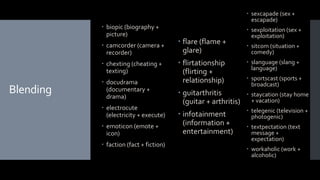
A word formed by merging the
sounds and meanings of two or
more other words or word parts.
Also known as a portmanteau word.
One common type of blend is a full
word followed by a word part (called
a splinter), as
in motorcade (motor + cavalcade).
Blending
 biopic (biography +
picture)
 camcorder (camera +
recorder)
 chexting (cheating +
texting)
 docudrama
(documentary +
drama)
 electrocute
(electricity + execute)
 emoticon (emote +
icon)
 faction (fact + fiction)
 flare (flame +
glare)
 flirtationship
(flirting +
relationship)
 guitarthritis
(guitar + arthritis)
 infotainment
(information +
entertainment)
 sexcapade (sex +
escapade)
 sexploitation (sex +
exploitation)
 sitcom (situation +
comedy)
 slanguage (slang +
language)
 sportscast (sports +
broadcast)
 staycation (stay home
+ vacation)
 telegenic (television +
photogenic)
 textpectation (text
message +
expectation)
 workaholic (work +
alcoholic)
Derivation
Derivation
The process of creating a new
word out of an old word, usually
by adding a prefix or a suffix.
Adjective:derivational.
 LinguistGeert Booij notes that one criterion for distinguishing derivation
and inflection "is that derivation may feed inflection, but not vice versa.
Derivation applies to the stem-forms of words, without their inflectional
endings, and creates new, more complex stems to which inflectional rules
can be applied" (The Grammar ofWords, 2005).
Derivation
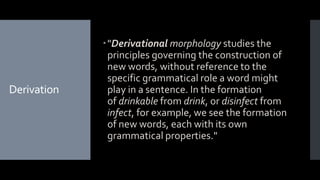
"Derivational morphology studies the
principles governing the construction of
new words, without reference to the
specific grammatical role a word might
play in a sentence. In the formation
of drinkable from drink, or disinfect from
infect, for example, we see the formation
of new words, each with its own
grammatical properties."
Derivation
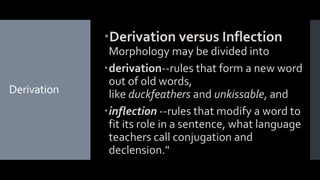
Derivation versus Inflection
Morphology may be divided into
derivation--rules that form a new word
out of old words,
like duckfeathers and unkissable, and
inflection --rules that modify a word to
fit its role in a sentence, what language
teachers call conjugation and
declension."
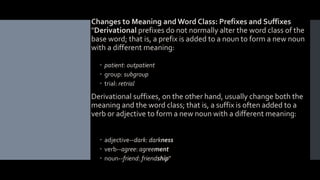
 Changes to Meaning and Word Class: Prefixes and Suffixes
"Derivational prefixes do not normally alter the word class of the
base word; that is, a prefix is added to a noun to form a new noun
with a different meaning:
 patient: outpatient
 group: subgroup
 trial: retrial
 Derivational suffixes, on the other hand, usually change both the
meaning and the word class; that is, a suffix is often added to a
verb or adjective to form a new noun with a different meaning:
 adjective--dark: darkness
 verb--agree: agreement
 noun--friend: friendship"
Etymology
Etymology
Etymology is the scientific study
of the origin of words.This
etymological study improves your
vocabulary.
 The strong vocabulary gives you
 a more challenging and rewarding job.
 greater self-confidence in speaking and in writing.
 improved comprehension in all your reading.
 success in your studies.
Etymology
The etymology of a word refers
to its origin and historical
development: that is, its earliest
known use, its transmission from
one language to another, and its
changes in form and meaning.
Etymology is also the term for the
branch of linguistics that studies
word histories.
Borrowing
Borrowing
The majority of the words used in
modern English have been
borrowed from other languages.
Although most of our vocabulary comes
from Latin and Greek (often by way of
other European languages), English has
borrowed words from more than 300
different languages around the world.
Borrowing
futon (from the Japanese word for
"bedclothes, bedding")
gorilla (Greek Gorillai, a tribe of hairy
women, perhaps of African origin)
hamster (Middle High German hamastra)
kangaroo (Aboriginal language of Guugu
Yimidhirr, gangurru , referring to a species
of kangaroo)
kink (Dutch, "twist in a rope")

Borrowing
 moccasin (Native American Indian,Virginia
Algonquian, akin to Powhatanmäkäsn and
Ojibwa makisin)
 molasses (Portuguese melaços, from Late
Latin mellceum, from Latin mel, "honey")
 muscle (Latin musculus, "mouse")
 slogan (alteration of Scots slogorne, "battle
cry")
 smorgasbord (Swedish, literally "bread and
butter table")
 whiskey (Old Irish uisce, "water,"
and bethad, "of life")
Clipping orShortening
Clipping or
Shortening
Some new words are simply
shortened forms of existing
words
Ex. indie from independent
exam from examination
flu from influenza
fax from facsimile.
Imitation ofSounds
Imitation of
Sounds
Words are also created
by onomatopoeia, naming
things by imitating the
sounds that are
associated with them:
Ex. boo, bow-wow, tinkle, click.
first-sister principle
first-sister
principle
 In compounding, the principle that the "first sister" to
the right of a verb is moved by transformation to the
left of the verb. (The "first sister" is the position
immediately adjacent to the verb.)
 The first-sister principle (FSP) was proposed byThomas
Roeper and Muffy Siegel in "A LexicalTransformation
forVerbal Compounds" (Linguistic Inquiry 9, 1978): "All
verbal compounds are formed by incorporation of a
word in first sister position of the verb.“
 Examples
 hand-built
 factory-built
 hand-built in a factory
 factory-built by hand
Similative
similative
In morphology, a construction
expressing sameness or
similarity of manner or being,
such as the compounds dead
loss and ice cold.
Similitive meanings may also be
conveyed by -like and other suffixes.
These suffixes are sometimes called
extenders.
similative
 "During the show, to the jesting and prompting
of clowns, an elephant of snow-
white complexion performed humiliating and
belittling tasks, and as he did, not
unexpectedly, his 'whiteness' left a white mark
on everything he touched.“
 "There is a marked distinction between what
we believe to be true and what is truth, as there
is an ocean-wide difference between reason
and reasoning.“
 "His skin was the color of uncooked fish, and
his small, rat-like eyes had to them the irritated
squint of a newborn."
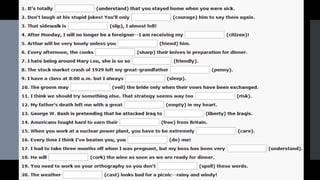
Exercises
Exercises
In Exercise 1, you must change the
words given into new adjectives,
adverbs, or verbs by adding the
prefix or suffix that best suits
the context.
http://www.tolearnenglish.com
Exercises
Exercise 2- OscarWilde Paragraph
Words can have a number of forms in
English depending on what part of
speech is used.These related words are
content words and will vary in noun, verb,
adjective and adverb forms.
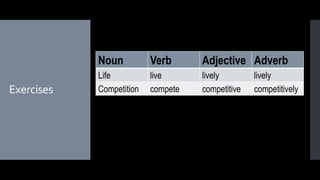
Exercises
Noun Verb Adjective Adverb
Life live lively lively
Competition compete competitive competitively
Group
Exercises
Noun Verb Adjective Adverb
Word formation
Word formation
Word formation
Word formation
Word formation

Word formation

  • 1.
    Word Ignatius Joseph N.Estroga, MA-Eng Liceo de Cagayan University, Philippines http://grammar.about.com/ ormation
  • 2.
    Word Formation In linguistics, theways in which new words are made on the basis of other words or morphemes. Also called derivational morphology. Word-formation can denote either a state or a process, and it can be viewed either diachronically or synchronically.
  • 3.
    Diachronic linguistics The study ofa language through different periods in history.
  • 4.
    Synchronic linguistics The study ofa language at one period in time (usually the present). Diachronic linguistics and Synchronic linguistics are the two main temporal dimensions of language study introduced by Swiss linguist Ferdinand de Saussure in Course in General Linguistics (1916).
  • 5.
  • 6.
  • 7.
    compound adjective Two or morewords that act as a single idea to modify a noun Ex. a part-time employee a high-speed chase  As a general rule, the words in a compound adjective are hyphenated when they come before a noun but not when they come after Ex. a well-known actor (√) The actor is well known (x)  Also, compound adjectives formed with an adverb ending in - ly are usually not hyphenated. Ex. rapidly changing violently swirled
  • 8.
    compound adjective exercise  "If nothingelse works, a total pig-headed unwillingness to look facts in the face will see us through.“  "The general was meeting someone for dinner at an out-of-the-way restaurant, not in the suburb of Nanterre, but close by." (Robert Ludlum,The Bourne Identity. Richard Marek Publishers, 1980)  "A well-developed sense of humor is the pole that adds balance to your steps as you walk the tightrope of life." (WilliamArthurWard)  "In the 19th century, before the science of archaeology became well developed, the Ottomans laid out the brick and concrete city that stands today."
  • 9.
    exercise Write 10 compoundadjectives and present them in class
  • 10.
    compound noun Two or morenouns combined to form a single noun. Ex. grapefruit juice sister-in-law schoolteacher  A compounded noun whose form no longer clearly reveals its origin (such as bonfire or marshall) is sometimes called anamalgamated compound. Many place names (or toponyms) are amalgamated compounds: e.g., Norwich (north + village) and Sussex (south + Saxons).
  • 11.
    compound noun exercise  The wholeidea started with a parent who wanted to do a fundraiser for the snowboarding team at Nevada Union.  "Alas, the poor speechwriter. I knew him well." (Ted Sorensen, quoted by Bradley H. Patterson inTo Serve the President: Continuity and Innovation in the White House Staff. Brookings Institution, 2008)  "As for me, except for the occasional heart attack, I feel as young as I ever did.“ Robert Benchley  "Some movie stars wear their sunglasses even in church.They're afraid God might recognize them and ask for autographs.“ (Fred Allen)
  • 12.
    exercise Write 10 compoundnouns and present them in class
  • 13.
    compound verb Two or morewords combined to form a single verb. Compounds are written as either one word or two hyphenated words Ex. stir fry sleep walk brainwash was playing would have been playing
  • 14.
    rhyming compound A compound wordthat contains rhymingelements, such as blackjack, fuddy duddy, pooper- scooper, and voodoo.
  • 15.
    rhyming compound  "What wouldthe English language be without Georgie-Porgie, tootsy-wootsy, razzle-dazzle, heebie-jeebies, walkie-talkie, nitty-gritty, and polly-wolly-doodle? . . .We barely notice the presence of rhyme in picnic, humdrum, humbug, hobnob, and tidbit: the humor of their inner form has worn off." (Anatoly Liberman, Word Origins: Etymology for Everyone. Oxford Univ. Press, 2009)  "For all the hullabaloo surrounding the 'mobile gaming revolution' there are few games that really tailor themselves well to the medium." (Toby Moses, "Extraction: Project Outbreak." The Observber, Nov. 26, 2011)  "Look out helter skelter She's coming down fast Yes she is Yes she is coming down fast." (John Lennon and Paul McCartney, "Helter Skelter")
  • 16.
  • 17.
    Affixation In the processof adding an affix to a word to create either; (a) a different form of that word (e.g., bird → birds), or (b) (b) a new word with a different meaning (bind →binder). The two primary kinds of affixation are prefixation (the addition of a prefix) and suffixation (the addition of a suffix).
  • 18.
  • 19.
    Blending A word formedby merging the sounds and meanings of two or more other words or word parts. Also known as a portmanteau word. One common type of blend is a full word followed by a word part (called a splinter), as in motorcade (motor + cavalcade).
  • 20.
    Blending  biopic (biography+ picture)  camcorder (camera + recorder)  chexting (cheating + texting)  docudrama (documentary + drama)  electrocute (electricity + execute)  emoticon (emote + icon)  faction (fact + fiction)  flare (flame + glare)  flirtationship (flirting + relationship)  guitarthritis (guitar + arthritis)  infotainment (information + entertainment)  sexcapade (sex + escapade)  sexploitation (sex + exploitation)  sitcom (situation + comedy)  slanguage (slang + language)  sportscast (sports + broadcast)  staycation (stay home + vacation)  telegenic (television + photogenic)  textpectation (text message + expectation)  workaholic (work + alcoholic)
  • 21.
  • 22.
    Derivation The process ofcreating a new word out of an old word, usually by adding a prefix or a suffix. Adjective:derivational.  LinguistGeert Booij notes that one criterion for distinguishing derivation and inflection "is that derivation may feed inflection, but not vice versa. Derivation applies to the stem-forms of words, without their inflectional endings, and creates new, more complex stems to which inflectional rules can be applied" (The Grammar ofWords, 2005).
  • 23.
    Derivation "Derivational morphology studiesthe principles governing the construction of new words, without reference to the specific grammatical role a word might play in a sentence. In the formation of drinkable from drink, or disinfect from infect, for example, we see the formation of new words, each with its own grammatical properties."
  • 24.
    Derivation Derivation versus Inflection Morphologymay be divided into derivation--rules that form a new word out of old words, like duckfeathers and unkissable, and inflection --rules that modify a word to fit its role in a sentence, what language teachers call conjugation and declension."
  • 25.
     Changes toMeaning and Word Class: Prefixes and Suffixes "Derivational prefixes do not normally alter the word class of the base word; that is, a prefix is added to a noun to form a new noun with a different meaning:  patient: outpatient  group: subgroup  trial: retrial  Derivational suffixes, on the other hand, usually change both the meaning and the word class; that is, a suffix is often added to a verb or adjective to form a new noun with a different meaning:  adjective--dark: darkness  verb--agree: agreement  noun--friend: friendship"
  • 26.
  • 27.
    Etymology Etymology is thescientific study of the origin of words.This etymological study improves your vocabulary.  The strong vocabulary gives you  a more challenging and rewarding job.  greater self-confidence in speaking and in writing.  improved comprehension in all your reading.  success in your studies.
  • 28.
    Etymology The etymology ofa word refers to its origin and historical development: that is, its earliest known use, its transmission from one language to another, and its changes in form and meaning. Etymology is also the term for the branch of linguistics that studies word histories.
  • 29.
  • 30.
    Borrowing The majority ofthe words used in modern English have been borrowed from other languages. Although most of our vocabulary comes from Latin and Greek (often by way of other European languages), English has borrowed words from more than 300 different languages around the world.
  • 31.
    Borrowing futon (from theJapanese word for "bedclothes, bedding") gorilla (Greek Gorillai, a tribe of hairy women, perhaps of African origin) hamster (Middle High German hamastra) kangaroo (Aboriginal language of Guugu Yimidhirr, gangurru , referring to a species of kangaroo) kink (Dutch, "twist in a rope") 
  • 32.
    Borrowing  moccasin (NativeAmerican Indian,Virginia Algonquian, akin to Powhatanmäkäsn and Ojibwa makisin)  molasses (Portuguese melaços, from Late Latin mellceum, from Latin mel, "honey")  muscle (Latin musculus, "mouse")  slogan (alteration of Scots slogorne, "battle cry")  smorgasbord (Swedish, literally "bread and butter table")  whiskey (Old Irish uisce, "water," and bethad, "of life")
  • 33.
  • 34.
    Clipping or Shortening Some newwords are simply shortened forms of existing words Ex. indie from independent exam from examination flu from influenza fax from facsimile.
  • 35.
  • 36.
    Imitation of Sounds Words arealso created by onomatopoeia, naming things by imitating the sounds that are associated with them: Ex. boo, bow-wow, tinkle, click.
  • 37.
  • 38.
    first-sister principle  In compounding,the principle that the "first sister" to the right of a verb is moved by transformation to the left of the verb. (The "first sister" is the position immediately adjacent to the verb.)  The first-sister principle (FSP) was proposed byThomas Roeper and Muffy Siegel in "A LexicalTransformation forVerbal Compounds" (Linguistic Inquiry 9, 1978): "All verbal compounds are formed by incorporation of a word in first sister position of the verb.“  Examples  hand-built  factory-built  hand-built in a factory  factory-built by hand
  • 39.
  • 40.
    similative In morphology, aconstruction expressing sameness or similarity of manner or being, such as the compounds dead loss and ice cold. Similitive meanings may also be conveyed by -like and other suffixes. These suffixes are sometimes called extenders.
  • 41.
    similative  "During theshow, to the jesting and prompting of clowns, an elephant of snow- white complexion performed humiliating and belittling tasks, and as he did, not unexpectedly, his 'whiteness' left a white mark on everything he touched.“  "There is a marked distinction between what we believe to be true and what is truth, as there is an ocean-wide difference between reason and reasoning.“  "His skin was the color of uncooked fish, and his small, rat-like eyes had to them the irritated squint of a newborn."
  • 42.
  • 43.
    Exercises In Exercise 1,you must change the words given into new adjectives, adverbs, or verbs by adding the prefix or suffix that best suits the context. http://www.tolearnenglish.com
  • 45.
    Exercises Exercise 2- OscarWildeParagraph Words can have a number of forms in English depending on what part of speech is used.These related words are content words and will vary in noun, verb, adjective and adverb forms.
  • 46.
    Exercises Noun Verb AdjectiveAdverb Life live lively lively Competition compete competitive competitively
  • 47.