












CHATER 7
LANGUAGE AND SOCIETY
Juan Alejandro Cruz Flores20131003914
Diana Maria Ocampo Ponce 20131008665
Erick Eduardo Carcamo.20122302317
Gissela Patricia Ramirez Carcamo.20131003946
Jeniffer Paola Rodriguez Vindel 20131003029
Jonatan Jaziel Mejia R. 20131000786
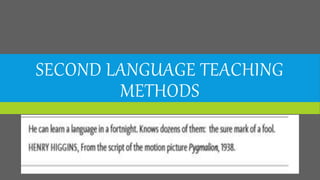
SECOND LANGUAGE TEACHING
METHODS
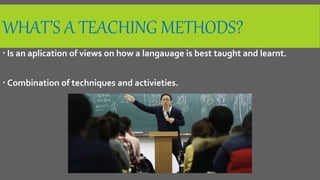
WHAT’S A TEACHING METHODS?
 Is an aplication of views on how a langauage is best taught and learnt.
 Combination of techniques and activieties.
PEOPLE CAN LEARN A LANGUAGE IN TWO WEEKS
BUT NOT WITH A USEFUL DEGREE OF FLUENCY
THERE ARE TOO MANY APPROACHES FOR LEARNING A
LANGUAGE
GrammarTranslation
Total Physical Response Approach
Suggestopedia
Silent Way
Communicative LanguageTeaching
Audiolingual
Task-Based LanguageTeaching (TBLT)
ENGLISH TEACHING METHODS FALL INTO TWO
BROAD CATEGORIES
SYNTHETIC APPROACH
It stresses the teaching of the grammatical, lexical,
phonological and function units of the language step
by step.
Bottom up method
ANALYTIC APPROACH
The goal is not to explicitly teach the component parts or rules
of the target language.
The instructor selects topics, texts, or tasks that are relevant to
the needs and interests of the learner, whose job then is to
discover the constituent parts of the language.
Top- Down Method
TEACHING METHODS
GRAMMAR TRANSLATION
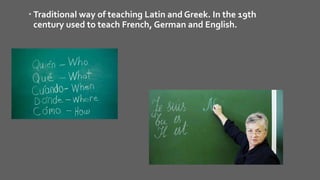
 Traditional way of teaching Latin and Greek. In the 19th
century used to teach French, German and English.
CHARACTERISTICS
 It was originally used for “Dead” languages
 Students learn a list of vocabulary, verb paradigms and
grammatical rules.
 The have to translate from a target language to their native
language.
 The target language is not taught.
 Emphasis on learning to read and write.
WHAT’S A TARGET LANGUAGE?
 Students that use this method are often given a text in order to translate it
in to their language.
 The definition of a target language is a language that someone is learning,
or a language into which a text has to be translated.
TOTAL PHYSICAL RESPONSE APPROACH
(TPR)
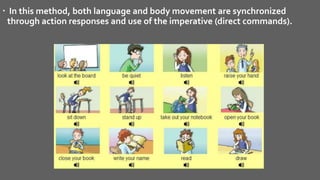
 In this method, both language and body movement are synchronized
through action responses and use of the imperative (direct commands).
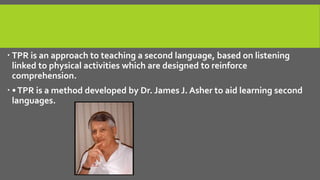
 TPR is an approach to teaching a second language, based on listening
linked to physical activities which are designed to reinforce
comprehension.
 •TPR is a method developed by Dr. James J. Asher to aid learning second
languages.
CHARACTERISTICS
 Students respond to commands that require physical movement.
 Appropriate activities can produce stress-free learning.
 Learners are encourage to speak when they feel ready to speak.
 Grammar is taught inductively
 Grammar and vocabulary according to the situation
 Students should be more active and talkative.
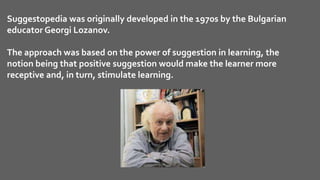
SUGGESTOPEDIA
Suggestopedia was originally developed in the 1970s by the Bulgarian
educator Georgi Lozanov.
The approach was based on the power of suggestion in learning, the
notion being that positive suggestion would make the learner more
receptive and, in turn, stimulate learning.
CHARACTERISTICS
 It uses the power of suggestion to help students eliminate the feeling that
they cannot succeed.
 Students’ imagination is used.They can assume new names, and new
identities and respond to the teacher accordingly using the target
language.
 Teaching is done by integrating music, song, and drama.
 The emphasis of teaching is more on content. Errors made by students are
tolerated at the beginning of the lesson but in the later part, the correct
forms are used by the teachers.
 No formal tests are given, but the evaluation is done during the normal
in-class performance.
SILENT WAY
Created by Caleb Gattegno
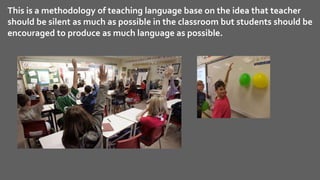
This is a methodology of teaching language base on the idea that teacher
should be silent as much as possible in the classroom but students should be
encouraged to produce as much language as possible.
CHARACTERISTICS
 Characterized by a problem-solving approach
 Develops independence, autonomy and encourages students to
cooperate with each other.
 Learning is facilitated if the learner discovers or creates rather that
remembers and repeats what is to be learned.
 Learning is facilitated by problem solving the material to be learned.
 Learning is facilitated by accompanying ( mediating and physical
objects)
COMMUNICATIVE LANGUAGE
TEACHING
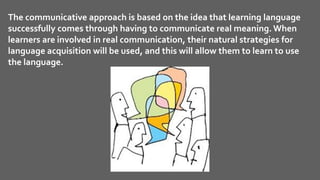
The communicative approach is based on the idea that learning language
successfully comes through having to communicate real meaning. When
learners are involved in real communication, their natural strategies for
language acquisition will be used, and this will allow them to learn to use
the language.
COMMUNICATION
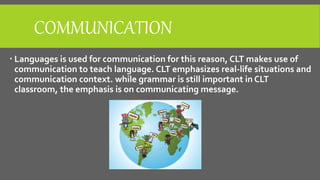
 Languages is used for communication for this reason, CLT makes use of
communication to teach language. CLT emphasizes real-life situations and
communication context. while grammar is still important in CLT
classroom, the emphasis is on communicating message.
THE AUDIO LINGUAL METHOD
CHARACTERISTICS
 1. Attends to structure and form more than meaning.
 2. Demands memorization of structure based dialogs.
 3. Language ítems are not contextualized.
 4. Language is learning structures, sounds or words.
 5. Mastery is sought.
 6. Driliing is a central technique
 7. Native-speaker-like pronunciation is sought.
 8. Grammatical explanation is avoided.
 9. Communicative activities only come after a long driliing.
 10. "Language is habit" so errors must be prevented.
TASK-BASED LANGUAGUAGE TEACHING
(TBLT)
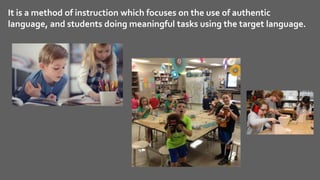
It is a method of instruction which focuses on the use of authentic
language, and students doing meaningful tasks using the target language.
Little error correction is provided.
“TBLT” IS POPULAR FOR DEVELOPINGTARGET
LANGUAGE FLUENCY AND STUDENT CONFIDENCE
Second language teaching methods

Second language teaching methods

  • 1.
    CHATER 7 LANGUAGE ANDSOCIETY Juan Alejandro Cruz Flores20131003914 Diana Maria Ocampo Ponce 20131008665 Erick Eduardo Carcamo.20122302317 Gissela Patricia Ramirez Carcamo.20131003946 Jeniffer Paola Rodriguez Vindel 20131003029 Jonatan Jaziel Mejia R. 20131000786
  • 2.
  • 3.
    WHAT’S A TEACHINGMETHODS?  Is an aplication of views on how a langauage is best taught and learnt.  Combination of techniques and activieties.
  • 4.
    PEOPLE CAN LEARNA LANGUAGE IN TWO WEEKS BUT NOT WITH A USEFUL DEGREE OF FLUENCY
  • 5.
    THERE ARE TOOMANY APPROACHES FOR LEARNING A LANGUAGE GrammarTranslation Total Physical Response Approach Suggestopedia Silent Way Communicative LanguageTeaching Audiolingual Task-Based LanguageTeaching (TBLT)
  • 6.
    ENGLISH TEACHING METHODSFALL INTO TWO BROAD CATEGORIES
  • 7.
    SYNTHETIC APPROACH It stressesthe teaching of the grammatical, lexical, phonological and function units of the language step by step. Bottom up method
  • 8.
    ANALYTIC APPROACH The goalis not to explicitly teach the component parts or rules of the target language. The instructor selects topics, texts, or tasks that are relevant to the needs and interests of the learner, whose job then is to discover the constituent parts of the language. Top- Down Method
  • 9.
  • 10.
  • 11.
     Traditional wayof teaching Latin and Greek. In the 19th century used to teach French, German and English.
  • 12.
    CHARACTERISTICS  It wasoriginally used for “Dead” languages  Students learn a list of vocabulary, verb paradigms and grammatical rules.  The have to translate from a target language to their native language.  The target language is not taught.  Emphasis on learning to read and write.
  • 13.
    WHAT’S A TARGETLANGUAGE?  Students that use this method are often given a text in order to translate it in to their language.  The definition of a target language is a language that someone is learning, or a language into which a text has to be translated.
  • 14.
  • 15.
     In thismethod, both language and body movement are synchronized through action responses and use of the imperative (direct commands).
  • 16.
     TPR isan approach to teaching a second language, based on listening linked to physical activities which are designed to reinforce comprehension.  •TPR is a method developed by Dr. James J. Asher to aid learning second languages.
  • 18.
    CHARACTERISTICS  Students respondto commands that require physical movement.  Appropriate activities can produce stress-free learning.  Learners are encourage to speak when they feel ready to speak.  Grammar is taught inductively  Grammar and vocabulary according to the situation  Students should be more active and talkative.
  • 19.
  • 20.
    Suggestopedia was originallydeveloped in the 1970s by the Bulgarian educator Georgi Lozanov. The approach was based on the power of suggestion in learning, the notion being that positive suggestion would make the learner more receptive and, in turn, stimulate learning.
  • 22.
    CHARACTERISTICS  It usesthe power of suggestion to help students eliminate the feeling that they cannot succeed.  Students’ imagination is used.They can assume new names, and new identities and respond to the teacher accordingly using the target language.  Teaching is done by integrating music, song, and drama.  The emphasis of teaching is more on content. Errors made by students are tolerated at the beginning of the lesson but in the later part, the correct forms are used by the teachers.  No formal tests are given, but the evaluation is done during the normal in-class performance.
  • 23.
    SILENT WAY Created byCaleb Gattegno
  • 24.
    This is amethodology of teaching language base on the idea that teacher should be silent as much as possible in the classroom but students should be encouraged to produce as much language as possible.
  • 25.
    CHARACTERISTICS  Characterized bya problem-solving approach  Develops independence, autonomy and encourages students to cooperate with each other.  Learning is facilitated if the learner discovers or creates rather that remembers and repeats what is to be learned.  Learning is facilitated by problem solving the material to be learned.  Learning is facilitated by accompanying ( mediating and physical objects)
  • 26.
  • 27.
    The communicative approachis based on the idea that learning language successfully comes through having to communicate real meaning. When learners are involved in real communication, their natural strategies for language acquisition will be used, and this will allow them to learn to use the language.
  • 28.
    COMMUNICATION  Languages isused for communication for this reason, CLT makes use of communication to teach language. CLT emphasizes real-life situations and communication context. while grammar is still important in CLT classroom, the emphasis is on communicating message.
  • 29.
  • 31.
    CHARACTERISTICS  1. Attendsto structure and form more than meaning.  2. Demands memorization of structure based dialogs.  3. Language ítems are not contextualized.  4. Language is learning structures, sounds or words.  5. Mastery is sought.  6. Driliing is a central technique  7. Native-speaker-like pronunciation is sought.  8. Grammatical explanation is avoided.  9. Communicative activities only come after a long driliing.  10. "Language is habit" so errors must be prevented.
  • 32.
  • 33.
    It is amethod of instruction which focuses on the use of authentic language, and students doing meaningful tasks using the target language.
  • 34.
  • 35.
    “TBLT” IS POPULARFOR DEVELOPINGTARGET LANGUAGE FLUENCY AND STUDENT CONFIDENCE