Chapter 10: Europe in the Middle
    Ages: A.D. 1000-1500

   The Great Schism
The Great Schism
•   As we discussed earlier, a power struggle between Philip IV of France
    & Pope Boniface VIII led to the creation of the Estates General
•   This disagreement stemmed in part to two official papal orders issued
    by Boniface


• Bull of 1296: Stated that the
  Church could not be taxed
  by the King of France
Great Schism..cont
• Unam Sanctam: Declared that
  there were two powers on earth,
  the temporal (earthly) & the
  spiritual (heavenly).
• The spiritual power, according to the pope, was always
  supreme over temporal power
• In short, kings must always obey popes
•   Philip IV is threatened w/excommunication
•   But before he is excommunicated he takes the offensive
Great Schism..cont
• Philip sends a small army to Italy with the
  goal of kidnapping the pope to bring him
  back to France for trial
• French soldiers burst into the pope’s palace
  in Anagni, outside of Rome, in Sept 1303
  and take him captive
• He escapes thanks to the people of Anagni
• Boniface dies one month later
Great Schism..cont
• Two years later, Philip IV persuades the College of
  Cardinals to choose a French archbishop as the new pope

• Clement V: : French
  archbishop who was elected
  pope in 1305
• In 1309, Clement claimed that political violence in Rome
  was threatening his life
Great Schism..cont
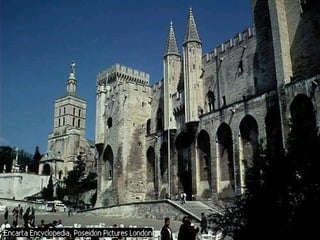
• With the help of Philip IV, Clement V moved his papacy
  out of Rome

• Avignon: French city that
  Clement V moved the papacy to in
  1309
• This outraged the English, German, & Italian Christians

• “Babylonian  Captivity”: Used to
  describe the Avignon papacy
Great Schism..cont
• In 1378, Pope Gregory XI died while visiting Rome, The
  College of Cardinals then met in Rome to choose a
  successor
• Pope Urban VI: Italian
  archbishop of Bari who was
  elected pope in 1378
• Urban VI moved the papacy back
  to Rome after his election
Great Schism..cont
•   A little over a year later, 13 French cardinals decided to elect another
    pope

• Robert of Geneva: French
  cardinal who became Pope
  Clement VII & moved the papacy
  back to Avignon
• Now there were two popes, each excommunicated the
  other
Great Schism..cont

• Great Schism: Period in which
  the church was divided in
  western Europe. Lasted from
  1378 to 1417
• The French supported the Avignon papacy
• The English, Germans, & Italians supported the Roman
  papacy
• There were church officials appointed by both popes
Great Schism..cont
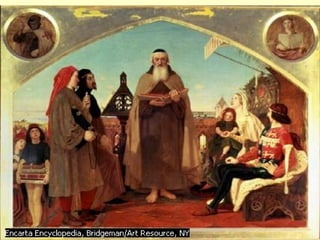
John Wycliffe: English professor who
  challenged the actions of the Church
• 1) Jesus true head of Church, not
  pope
• 2) Clergy should not own land or
  wealth
• 3) Bible final authority for Christian
  life
Great Schism..cont
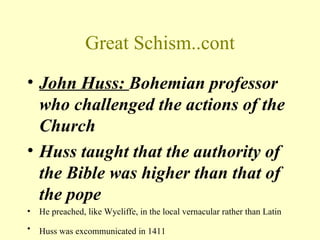
• John Huss: Bohemian professor
  who challenged the actions of the
  Church
• Huss taught that the authority of
  the Bible was higher than that of
  the pope
•   He preached, like Wycliffe, in the local vernacular rather than Latin
•   Huss was excommunicated in 1411
Great Schism..cont
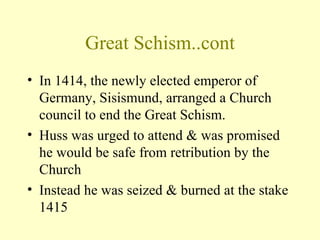
• In 1414, the newly elected emperor of
  Germany, Sisismund, arranged a Church
  council to end the Great Schism.
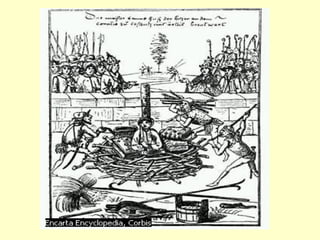
• Huss was urged to attend & was promised
  he would be safe from retribution by the
  Church
• Instead he was seized & burned at the stake
  1415
Great Schism..cont
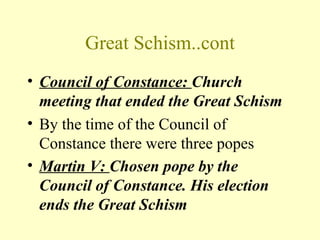
• Council of Constance: Church
  meeting that ended the Great Schism
• By the time of the Council of
  Constance there were three popes
• Martin V: Chosen pope by the
  Council of Constance. His election
  ends the Great Schism

Great schism

  • 1.
    Chapter 10: Europein the Middle Ages: A.D. 1000-1500 The Great Schism
  • 2.
    The Great Schism • As we discussed earlier, a power struggle between Philip IV of France & Pope Boniface VIII led to the creation of the Estates General • This disagreement stemmed in part to two official papal orders issued by Boniface • Bull of 1296: Stated that the Church could not be taxed by the King of France
  • 3.
    Great Schism..cont • UnamSanctam: Declared that there were two powers on earth, the temporal (earthly) & the spiritual (heavenly). • The spiritual power, according to the pope, was always supreme over temporal power • In short, kings must always obey popes • Philip IV is threatened w/excommunication • But before he is excommunicated he takes the offensive
  • 4.
    Great Schism..cont • Philipsends a small army to Italy with the goal of kidnapping the pope to bring him back to France for trial • French soldiers burst into the pope’s palace in Anagni, outside of Rome, in Sept 1303 and take him captive • He escapes thanks to the people of Anagni • Boniface dies one month later
  • 5.
    Great Schism..cont • Twoyears later, Philip IV persuades the College of Cardinals to choose a French archbishop as the new pope • Clement V: : French archbishop who was elected pope in 1305 • In 1309, Clement claimed that political violence in Rome was threatening his life
  • 6.
    Great Schism..cont • Withthe help of Philip IV, Clement V moved his papacy out of Rome • Avignon: French city that Clement V moved the papacy to in 1309 • This outraged the English, German, & Italian Christians • “Babylonian Captivity”: Used to describe the Avignon papacy
  • 8.
    Great Schism..cont • In1378, Pope Gregory XI died while visiting Rome, The College of Cardinals then met in Rome to choose a successor • Pope Urban VI: Italian archbishop of Bari who was elected pope in 1378 • Urban VI moved the papacy back to Rome after his election
  • 9.
    Great Schism..cont • A little over a year later, 13 French cardinals decided to elect another pope • Robert of Geneva: French cardinal who became Pope Clement VII & moved the papacy back to Avignon • Now there were two popes, each excommunicated the other
  • 10.
    Great Schism..cont • GreatSchism: Period in which the church was divided in western Europe. Lasted from 1378 to 1417 • The French supported the Avignon papacy • The English, Germans, & Italians supported the Roman papacy • There were church officials appointed by both popes
  • 11.
    Great Schism..cont John Wycliffe:English professor who challenged the actions of the Church • 1) Jesus true head of Church, not pope • 2) Clergy should not own land or wealth • 3) Bible final authority for Christian life
  • 13.
    Great Schism..cont • JohnHuss: Bohemian professor who challenged the actions of the Church • Huss taught that the authority of the Bible was higher than that of the pope • He preached, like Wycliffe, in the local vernacular rather than Latin • Huss was excommunicated in 1411
  • 14.
    Great Schism..cont • In1414, the newly elected emperor of Germany, Sisismund, arranged a Church council to end the Great Schism. • Huss was urged to attend & was promised he would be safe from retribution by the Church • Instead he was seized & burned at the stake 1415
  • 16.
    Great Schism..cont • Councilof Constance: Church meeting that ended the Great Schism • By the time of the Council of Constance there were three popes • Martin V: Chosen pope by the Council of Constance. His election ends the Great Schism