SUB-SAHARA
  AFRICA
   Climate and
   Vegetation
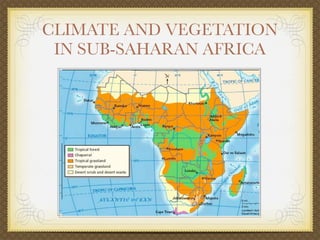
CLIMATE AND VEGETATION
 IN SUB-SAHARAN AFRICA
CLIMATE AND VEGETATION
 IN SUB-SAHARAN AFRICA
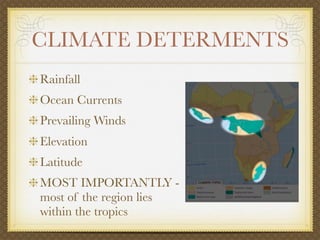
CLIMATE DETERMENTS
Rainfall
Ocean Currents
Prevailing Winds
Elevation
Latitude
MOST IMPORTANTLY -
most of the region lies
within the tropics
CLIMATE DETERMENTS
Rainfall
Ocean Currents
Prevailing Winds
Elevation
Latitude
MOST IMPORTANTLY -
most of the region lies
within the tropics
CLIMATE DETERMENTS
Rainfall
Ocean Currents
Prevailing Winds
Elevation
Latitude
MOST IMPORTANTLY -
most of the region lies
within the tropics
CLIMATE DETERMENTS
Rainfall
Ocean Currents
Prevailing Winds
Elevation
Latitude
MOST IMPORTANTLY -
most of the region lies
within the tropics
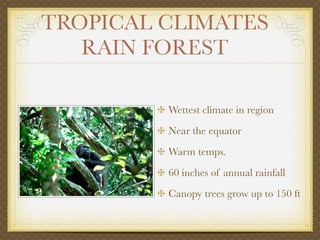
TROPICAL CLIMATES
   RAIN FOREST

         Wettest climate in region
         Near the equator
         Warm temps.
         60 inches of annual rainfall
         Canopy trees grow up to 150 ft
HUMAN - ENVIRONMENT
          INTERACTION
Rain leaches soil
Can still grow cash
crops 
 banana, pineapples,
 cocoa, tea, coffee, palms
 for oil, rubber and cotton

Deforestation
 Rain forest threatened by
 farmers and loggers
HUMAN - ENVIRONMENT
          INTERACTION
Rain leaches soil
Can still grow cash
crops 
 banana, pineapples,
 cocoa, tea, coffee, palms
 for oil, rubber and cotton

Deforestation
 Rain forest threatened by
 farmers and loggers
HUMAN - ENVIRONMENT
          INTERACTION
Rain leaches soil
Can still grow cash
crops 
 banana, pineapples,
 cocoa, tea, coffee, palms
 for oil, rubber and cotton

Deforestation
 Rain forest threatened by
 farmers and loggers
TROPICAL SAVANNAS
                   Grasslands w/scattered
                   trees
                   Cover almost 1/2 of Africa
                   Seasonal rainfall - wetter
                   near equator
                   Dry air from Sahara
                   carried by harmattan drys
                   moisture
Serengeti Plains
                   Grass as tall as 15 ft
TROPICAL SAVANNAS
                   Grasslands w/scattered
                   trees
                   Cover almost 1/2 of Africa
                   Seasonal rainfall - wetter
                   near equator
                   Dry air from Sahara
                   carried by harmattan drys
                   moisture
Serengeti Plains
                   Grass as tall as 15 ft
SAHEL
  Means “shore” -
  represents “coast” of the
  Sahara
  Dry land between Senegal
  and Sudan
  Expanding due to decline
  in rain, climate change,
  overgrazing and
  population growth
  Transhumance
DESERT

    South - Namib and
    Kalahari
    North - Sahara
    Kenya and Somalia
    are mostly deserts in
    the east

Africa climates

  • 1.
    SUB-SAHARA AFRICA Climate and Vegetation
  • 2.
    CLIMATE AND VEGETATION IN SUB-SAHARAN AFRICA
  • 3.
    CLIMATE AND VEGETATION IN SUB-SAHARAN AFRICA
  • 4.
    CLIMATE DETERMENTS Rainfall Ocean Currents PrevailingWinds Elevation Latitude MOST IMPORTANTLY - most of the region lies within the tropics
  • 5.
    CLIMATE DETERMENTS Rainfall Ocean Currents PrevailingWinds Elevation Latitude MOST IMPORTANTLY - most of the region lies within the tropics
  • 6.
    CLIMATE DETERMENTS Rainfall Ocean Currents PrevailingWinds Elevation Latitude MOST IMPORTANTLY - most of the region lies within the tropics
  • 7.
    CLIMATE DETERMENTS Rainfall Ocean Currents PrevailingWinds Elevation Latitude MOST IMPORTANTLY - most of the region lies within the tropics
  • 8.
    TROPICAL CLIMATES RAIN FOREST Wettest climate in region Near the equator Warm temps. 60 inches of annual rainfall Canopy trees grow up to 150 ft
  • 9.
    HUMAN - ENVIRONMENT INTERACTION Rain leaches soil Can still grow cash crops banana, pineapples, cocoa, tea, coffee, palms for oil, rubber and cotton Deforestation Rain forest threatened by farmers and loggers
  • 10.
    HUMAN - ENVIRONMENT INTERACTION Rain leaches soil Can still grow cash crops banana, pineapples, cocoa, tea, coffee, palms for oil, rubber and cotton Deforestation Rain forest threatened by farmers and loggers
  • 11.
    HUMAN - ENVIRONMENT INTERACTION Rain leaches soil Can still grow cash crops banana, pineapples, cocoa, tea, coffee, palms for oil, rubber and cotton Deforestation Rain forest threatened by farmers and loggers
  • 12.
    TROPICAL SAVANNAS Grasslands w/scattered trees Cover almost 1/2 of Africa Seasonal rainfall - wetter near equator Dry air from Sahara carried by harmattan drys moisture Serengeti Plains Grass as tall as 15 ft
  • 13.
    TROPICAL SAVANNAS Grasslands w/scattered trees Cover almost 1/2 of Africa Seasonal rainfall - wetter near equator Dry air from Sahara carried by harmattan drys moisture Serengeti Plains Grass as tall as 15 ft
  • 14.
    SAHEL Means“shore” - represents “coast” of the Sahara Dry land between Senegal and Sudan Expanding due to decline in rain, climate change, overgrazing and population growth Transhumance
  • 15.
    DESERT South - Namib and Kalahari North - Sahara Kenya and Somalia are mostly deserts in the east

Editor's Notes

  • #2 \n
  • #3 \n
  • #4 \n
  • #5 \n
  • #6 \n
  • #7 Congo Basin contains the second largest expanse of tropical rainforest in the world. \n
  • #8 Deforestation: extensive woodlands remain in africa but many have been replaced by grasslands, and farms. The result is shortages in biofuels (wood and charcoal used for household energy needs, especially cooking)\nKenya’s green belt movement, plant millions of trees.\n\nAgricultural Substance: Stable crops of millet, sorgum, corn. Swidden Agriculture practices in Areas with poorer tropical soil.\n\nShifting cultivation: burning natural vegetation to release fertility, then plant indigenous crops; allow fallow periods. Often fine tuned to local conditions, but unable to support high population densities.\n\nPlantation agriculture: export crops are ciritical to the economies of many african states: Coffee, Peanuts, Cotton, Cocoa, Rubber.\n
  • #9 Deforestation: extensive woodlands remain in africa but many have been replaced by grasslands, and farms. The result is shortages in biofuels (wood and charcoal used for household energy needs, especially cooking)\nKenya’s green belt movement, plant millions of trees.\n\nAgricultural Substance: Stable crops of millet, sorgum, corn. Swidden Agriculture practices in Areas with poorer tropical soil.\n\nShifting cultivation: burning natural vegetation to release fertility, then plant indigenous crops; allow fallow periods. Often fine tuned to local conditions, but unable to support high population densities.\n\nPlantation agriculture: export crops are ciritical to the economies of many african states: Coffee, Peanuts, Cotton, Cocoa, Rubber.\n
  • #10 Savannas: wet and dry savannas surround central African rainforest belt. \n\nThe Serengeti hosts the largest mammal migration in the world, which is one of the ten natural travel wonders of the world.[1]\nThe region contains one national park: Serengeti National Park and several game reserves. Serengeti is derived from the Maasai language, Maa; specifically, "Serengit" meaning "Endless Plains".[2][3]\nApproximately 70 larger mammal and some 500 avifauna species are found there. This high diversity in terms of species is a function of diverse habitats ranging from riverine forests, swamps, kopjes, grasslands and woodlands.[4] Blue Wildebeests, gazelles, zebras and buffalos are some of the commonly found large mammals in the region.\nCurrently there is controversy surrounding a proposed road that is to be built through the Serengeti in Tanzania.\n\n
  • #11 Sahel- zone of ecological transition between the Sahara to the north and wetter savannas and forest to the south\nDesertification: the expansion of desert-like conditions as a result of human-induced degradation.\n\nTranshumance is the movement of animals between we-season and dry season pasture \n
  • #12 Sahara, Namib, Kalahari\nHorn of Africa - Northeastern corner that includes Somalia, Ethiopia, Djibouti, and Eritrea. \n