The Birthplace of Three Major Religions
                 Video Project
History and
                       Governance
•       Early Peoples
    •        Started farming 6000 BC
         •      Domesticated plants and
                animals
    •        1st civilizations formed
•       Early Civilizations
    •        1. Mesopotamia
         •      Tigris and Euphrates
         •      Sumerians
         •      Irrigated, canals, and flood
                controlling dikes
         •      Excelled in math,
                engineering, and soil science
         •      Invented writing: cuneiform
Egypt

•       Nile River
    •     Annual floods
          deposited alluvial soils
•       Built the pyramids
    •     Mummified people
•       365-day calendar
•       Hieroglyphics:
        picture writing
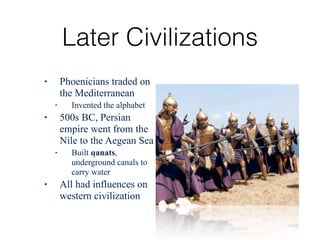
Later Civilizations
•       Phoenicians traded on
        the Mediterranean
    •     Invented the alphabet
•       500s BC, Persian
        empire went from the
        Nile to the Aegean Sea
    •     Built qanats,
          underground canals to
          carry water
•       All had influences on
        western civilization
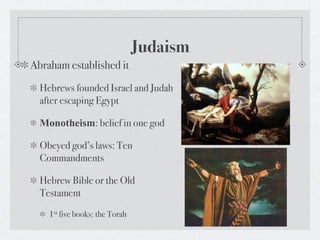
Judaism
Abraham established it
  Hebrews founded Israel and Judah
  after escaping Egypt

  Monotheism: belief in one god

  Obeyed god’s laws: Ten
  Commandments

  Hebrew Bible or the Old
  Testament
    1st five books: the Torah
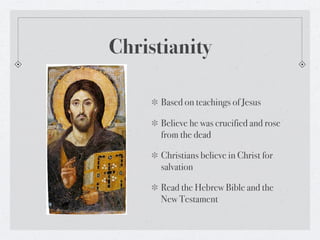
Christianity

      Based on teachings of Jesus

      Believe he was crucified and rose
      from the dead

      Christians believe in Christ for
      salvation

      Read the Hebrew Bible and the
      New Testament
Islam
  Founded by Muhammad in Mecca in the
  600s AD

Five Pillars of Faith
  1. “Allah is the one true god and
  Muhammad is the prophet.”

  2. Pray five times a day, facing Mecca

  3. Give Alms

  4. Fast during the month of Ramadan

  5. Make a Pilgrimage to Mecca once in
  one’s lifetime
Islam
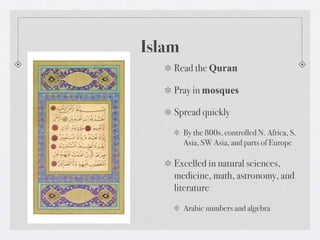
    Read the Quran

    Pray in mosques

    Spread quickly
        By the 800s, controlled N. Africa, S.
        Asia, SW Asia, and parts of Europe

    Excelled in natural sciences,
    medicine, math, astronomy, and
    literature
        Arabic numbers and algebra

Three major religions

  • 1.
    The Birthplace ofThree Major Religions Video Project
  • 2.
    History and Governance • Early Peoples • Started farming 6000 BC • Domesticated plants and animals • 1st civilizations formed • Early Civilizations • 1. Mesopotamia • Tigris and Euphrates • Sumerians • Irrigated, canals, and flood controlling dikes • Excelled in math, engineering, and soil science • Invented writing: cuneiform
  • 3.
    Egypt • Nile River • Annual floods deposited alluvial soils • Built the pyramids • Mummified people • 365-day calendar • Hieroglyphics: picture writing
  • 4.
    Later Civilizations • Phoenicians traded on the Mediterranean • Invented the alphabet • 500s BC, Persian empire went from the Nile to the Aegean Sea • Built qanats, underground canals to carry water • All had influences on western civilization
  • 5.
    Judaism Abraham established it Hebrews founded Israel and Judah after escaping Egypt Monotheism: belief in one god Obeyed god’s laws: Ten Commandments Hebrew Bible or the Old Testament 1st five books: the Torah
  • 6.
    Christianity Based on teachings of Jesus Believe he was crucified and rose from the dead Christians believe in Christ for salvation Read the Hebrew Bible and the New Testament
  • 7.
    Islam Foundedby Muhammad in Mecca in the 600s AD Five Pillars of Faith 1. “Allah is the one true god and Muhammad is the prophet.” 2. Pray five times a day, facing Mecca 3. Give Alms 4. Fast during the month of Ramadan 5. Make a Pilgrimage to Mecca once in one’s lifetime
  • 8.
    Islam Read the Quran Pray in mosques Spread quickly By the 800s, controlled N. Africa, S. Asia, SW Asia, and parts of Europe Excelled in natural sciences, medicine, math, astronomy, and literature Arabic numbers and algebra

Editor's Notes

  • #2 \n
  • #3 Domesticate to tame a plant or animal for human use\n\nSumerians had the oldest known written language, whose relationship to any other language is unclear. Theirs is the first historically attested civilization, and they invented cuneiform writing, a system of mathematics and the sociopolitical institution of the city state. \n \nThe wedge-shaped characters used in the ancient writing systems of Mesopotamia, Persia, and Urgarit, surviving mainly impressed on clay tablets. \n
  • #4 The ancient civil Egyptian calendar had a year that was 365 days long and was divided into 12 months of 30 days each, plus five extra days (epagomenae, from Greek ἐπαγόμεναι) at the end of the year. The months were divided into three weeks of ten days each. Because the ancient Egyptian year was almost a quarter of a day shorter than the solar year and stellar events therefore "wandered" through the calendar, it has been referred to as the annus vagus, or "wandering year".\n\nPyramid \nPyramids were built as royal tombs for Egyptian Pharos from the 3rd dynasty 2600 BC until 1600BC. \n
  • #5 Phoenicians were members of a Semitic people inhabiting ancient phoenicia and its colonies. The Phoenicians prospered from trade and manufacturing until the capital, Tyre, was sacked by Alexander the great in 332BC\n\nThe Semitic language of this people, written in an alphabet that was the ancestor of the Greek and Roman alphabets.\n\nA qanāt (from Arabic: قناة, in Persian: کاریز kariz) is a water management system used to provide a reliable supply of water for human settlements and irrigation in hot, arid and semi-arid climates.\n\nThe qanat technology is known to have developed on the Iranian plateau and possibly also in the Arabian peninsula sometime in the early 1st millennium BC spread from there slowly west- and eastward. \n
  • #6 For its origins Judaism looks to the biblical covenant made by god with Abraham, and to the laws revealed to Moses and recorded in the Torah (supplemented by the Talmud), which establish the Jewish people's special relationship with god. Since the destruction of the temple in Jerusalem in AD 70, the rituals of judaism have centered on the home and in the synagogue, the chief day of worship being the sabbath (sunset on Friday to sunset on Saturday), and the annual observances including Yom Kippur and the Passover. \n
  • #7 The religion based on the person and teachings of jeasus of Nazareth, or it's beliefs and practices. \n\nChristianity today is the the worlds most wide spread religion. With more than a billion members, mainly divided between roman catholic Protestant, and Easter orthodox churches.\n\n It originated among the Jewish followers of Jesus of Nazareth who believed that he was the promised messiah or christ. The Christian \n
  • #8 Five pillars of faith\n\n Shahadah is a saying professing monotheism and accepting Muhammad as God's messenger. The shahadah is a set statement normally recited in Arabic states, " there is no god except ALLAH and Muhammad is the Messenger of ALLAH." Also, it is said that when dying one should recite this declaration of faith. In Azaan (call to prayer) it is recited. Reciting this statement is a key part in a person's conversion to Islam.\n\n\n\n2. Salat is the Islamic prayer.\n\n Salat consists of five daily prayers: Fajr, zuhr, Asr, Maghrib, and Isha'a. Fajr is performed before the light of dawn, zuhr is performed when the sun starts to decline from its zenith, Asr is performed in the afternoon, Maghrib is the sunset prayer, and Isha'a is the evening prayer. Each prayer consists of a certain amount of rakaʿāt. A prayer either consists of two, three, or four rakaʿāt. All of these prayers are recited while facing the Ka'bah in Mecca. Muslims must wash themselves before prayer, this washing is called Wudu. The prayer is accompanied by a series of set positions including; bowing with hands on knees, standing, prostrating and sitting in a special position (not on the heels, nor on the buttocks, with the toes pointing away from Mecca), usually with one foot tucked under the body.\n\n\n\n3. Alms\n\nZakat or alms-giving is the practice of charitable giving by Muslims based on accumulated wealth, and is obligatory for all who are able to do so. It is considered to be a personal responsibility for Muslims to ease economic hardship for others and eliminate inequality. Zakat consists of spending 2.5% of one's wealth for the benefit of the poor or needy, including slaves, debtors and travelers. A Muslim may also donate more as an act of voluntary charity (sadaqah), rather than to achieve additional divine reward. \n\n4. fasting (Sawm) Ritual fasting\n fasting as compensation for repentance \n\nRitual fasting is an obligatory act during the month of Ramadan. Muslims must abstain from food and drink from dawn to dusk during this month, and are to be especially mindful of other sins. Fasting is necessary for every Muslim that has reached puberty.\n\nThe fast is meant to allow Muslims to seek nearness to God, to express their gratitude to and dependence on him, atone for their past sins, and to remind them of the needy. During Ramadan, Muslims are also expected to put more effort into following the teachings of Islam by refraining from violence, anger, envy, greed, lust, profane language, gossip and to try to get along with fellow Muslims better. In addition, all obscene and irreligious sights and sounds are to be avoided.\n\n\n5. The Hajj is a pilgrimage that occurs during the Islamic month of Dhu al-Hijjah to the holy city of Mecca. \n\nEvery able-bodied Muslim is obliged to make the pilgrimage to Mecca at least once in their lifetime . When the pilgrim is around 10 km (6.2 mi) from Mecca, he must dress in Ihram clothing, which consists of two white sheets. Both men and women are required to make the pilgrimage to Mecca. After a Muslim makes the trip to Mecca, he/she is known as a hajj/hajja (one who made the pilgrimage to Mecca). The main rituals of the Hajj include walking seven times around the Kaaba, touching the Black Stone, traveling seven times between Mount Safa and Mount Marwah, and symbolically stoning the Devil in Mina.\n\n\n\n
  • #9 Quran - Islamic sacred book, believed to be the word of God as dictated to Muhammad by the archangel Gabriel and written down in Arabic. The Koran consists of 114 units of varying lengths, known as suras, the first sura is said to be part of the ritual prayer. These touch upon all aspects of human existence, including matters of doctrine, social organization, and legislation.\n\nMosques consist of an are reserved for communal prayers, frequently in a domed building with a minaret, and with a niche (mihrab) or other structure indicating the direction of Mecca. There may also be a platform for preaching (minbar), and an adjacent courtyard in which water is provided for the obligatory ablutions before prayer. \n