Rwanda Genocide
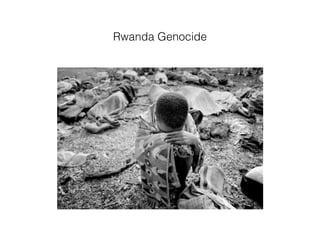
Rwanda Genocide
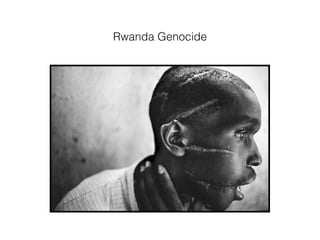
Rwanda Genocide
Once, Hutus and
     Tutsis lived in
 harmony in Central
  Africa. About 600
 years ago, Tutsis, a
 tall, warrior people,
  moved south from
Ethiopia and invaded
the homeland of the
Hutus. Though much
 smaller in number,
 they conquered the
Hutus, who agreed to
raise crops for them
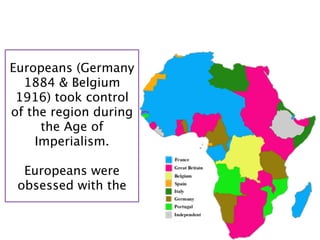
Europeans (Germany
  1884 & Belgium
 1916) took control
of the region during
     the Age of
    Imperialism.

  Europeans were
 obsessed with the
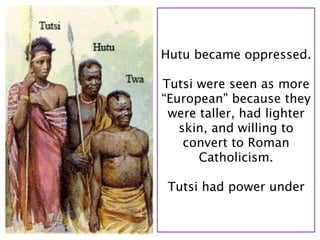
Hutu became oppressed.

Tutsi were seen as more
“European” because they
 were taller, had lighter
   skin, and willing to
    convert to Roman
      Catholicism.

 Tutsi had power under
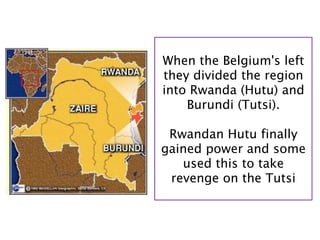
When the Belgium's left
they divided the region
into Rwanda (Hutu) and
    Burundi (Tutsi).

 Rwandan Hutu finally
gained power and some
   used this to take
 revenge on the Tutsi
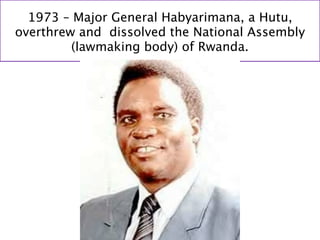
1973 – Major General Habyarimana, a Hutu,
overthrew and dissolved the National Assembly
         (lawmaking body) of Rwanda.
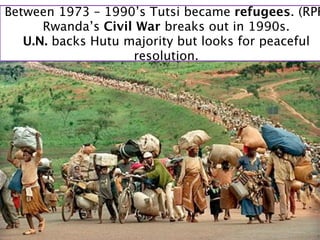
Between 1973 – 1990’s Tutsi became refugees. (RPF
      Rwanda’s Civil War breaks out in 1990s.
   U.N. backs Hutu majority but looks for peaceful
                    resolution.
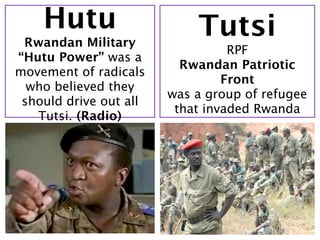
Hutu                    Tutsi
 Rwandan Military
                                  RPF
“Hutu Power” was a
                          Rwandan Patriotic
movement of radicals
                                 Front
  who believed they
                        was a group of refugee
 should drive out all
                         that invaded Rwanda
   Tutsi. (Radio)
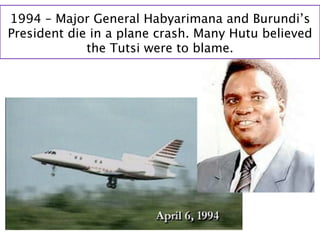
1994 – Major General Habyarimana and Burundi’s
President die in a plane crash. Many Hutu believed
             the Tutsi were to blame.
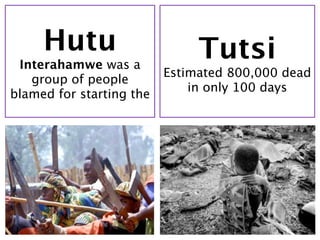
Hutu                      Tutsi
 Interahamwe was a
                          Estimated 800,000 dead
   group of people
                              in only 100 days
blamed for starting the
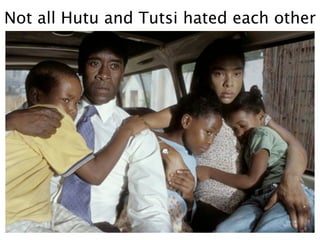
Not all Hutu and Tutsi hated each other

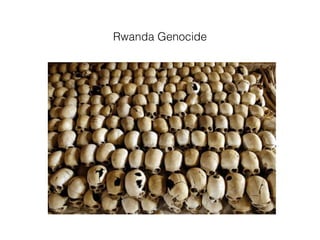
Rwanda Genocide

  • 1.
  • 2.
  • 3.
  • 4.
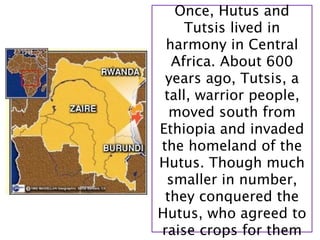
    Once, Hutus and Tutsis lived in harmony in Central Africa. About 600 years ago, Tutsis, a tall, warrior people, moved south from Ethiopia and invaded the homeland of the Hutus. Though much smaller in number, they conquered the Hutus, who agreed to raise crops for them
  • 5.
    Europeans (Germany 1884 & Belgium 1916) took control of the region during the Age of Imperialism. Europeans were obsessed with the
  • 6.
    Hutu became oppressed. Tutsiwere seen as more “European” because they were taller, had lighter skin, and willing to convert to Roman Catholicism. Tutsi had power under
  • 7.
    When the Belgium'sleft they divided the region into Rwanda (Hutu) and Burundi (Tutsi). Rwandan Hutu finally gained power and some used this to take revenge on the Tutsi
  • 8.
    1973 – MajorGeneral Habyarimana, a Hutu, overthrew and dissolved the National Assembly (lawmaking body) of Rwanda.
  • 9.
    Between 1973 –1990’s Tutsi became refugees. (RPF Rwanda’s Civil War breaks out in 1990s. U.N. backs Hutu majority but looks for peaceful resolution.
  • 10.
    Hutu Tutsi Rwandan Military RPF “Hutu Power” was a Rwandan Patriotic movement of radicals Front who believed they was a group of refugee should drive out all that invaded Rwanda Tutsi. (Radio)
  • 11.
    1994 – MajorGeneral Habyarimana and Burundi’s President die in a plane crash. Many Hutu believed the Tutsi were to blame.
  • 12.
    Hutu Tutsi Interahamwe was a Estimated 800,000 dead group of people in only 100 days blamed for starting the
  • 13.
    Not all Hutuand Tutsi hated each other

Editor's Notes

  • #2 3 descriptive words, 2 predictions, 1 questions\n\n\n\nThe bloody history of Hutu and Tutsi conflict stained the 20th century, from the slaughter of 80,000 to 200,000 Hutus by the Tutsi army in Burundi in 1972 to the 1994 Rwanda genocide in which Hutu militias targeted Tutsis, resulting in a 100-day death toll between 800,000 and 1 million.\n
  • #3 3 descriptive words, 2 predictions, 1 questions\n\n\n\nThe bloody history of Hutu and Tutsi conflict stained the 20th century, from the slaughter of 80,000 to 200,000 Hutus by the Tutsi army in Burundi in 1972 to the 1994 Rwanda genocide in which Hutu militias targeted Tutsis, resulting in a 100-day death toll between 800,000 and 1 million.\n
  • #4 But many observers would be surprised to learn that the longstanding conflict between the Hutu and Tutsi has nothing to do with language or religion -- they speak the same Bantu tongues as well as French, and generally practice Christianity -- and many geneticists have been hard-pressed to find marked ethnic differences between the two, though the Tutsi have generally been noted to be taller. Many believe that German and Belgian colonizers tried to find differences between the Hutu and Tutsi in order to better categorize native peoples in their censuses.\n
  • #5 \n\n
  • #6 Generally, the Hutu-Tutsi strife stems from class warfare, with the Tutsis perceived to have greater wealth and social status (as well as favoring cattle ranching over what is seen as the lower-class farming of the Hutus). The Tutsis are thought to have originally come from Ethiopia, and arrived after the Hutu came from Chad. The Tutsis had a monarchy dating back to the 15th century; this was overthrown at the urging of Belgian colonizers in the early 1960s and the Hutu took power by force in Rwanda. In Burundi, however, a Hutu uprising failed and the Tutsis controlled the country.\n
  • #7 \n\n
  • #8 Burundi, 1972: The seeds of resentment for the minority Tutsis were sown when the first elections after winning independence in May 1965 saw strong Hutu wins, but the king appointed a Tutsi friend prime minister, sparking a failed coup attempt by Hutus. Even though this was quickly quelled in the capital, it set off additional violence between the two ethnicities in the countryside. In addition, Tutsis, which made up about 15 percent of the population to the 80 percent Hutus, occupied other key government and military positions.\n\nOn April 27, some Hutu policemen rebelled, killing all Tutsis and Hutus (estimates range from 800 to 1,200 dead) who refused to join the rebellion in the lakeside towns of Rumonge and Nyanza-Lac. The leaders of the rebellion have been described as radicalized Hutu intellectuals who operated out of Tanzania. The Tutsi president, Michel Micombero, responded by declaring martial law and putting the wheels of a Hutu genocide in motion. The first phase virtually wiped out the educated Hutu (by June, nearly 45 percent of teachers were reported missing; students at technical schools were targeted, as well), and by the time the carnage was done in May about 5 percent of the population had been killed: estimates range from 100,000 to up to 300,000 Hutu.\n
  • #9 \n\n
  • #10 \n\n
  • #11 Rwanda, 1994: In April 1994 Burundian president Cyprien Ntaryamira, a Hutu, and Rwandan president Juvenal Habyarimana, also a Hutu, were killed when their plane was shot down. By this time, tens of thousands of Hutus had fled the Burundi violence into Rwanda. Blame for the assassination has been pointed at both Tutsi and Hutu extremists; current Rwandan President Paul Kagame, who at the time led a Tutsi rebel group, has said that the Hutu extremists conducted the rocket attack to set in motion their long-laid-out plans to wipe out the Tutsis. These genocidal plans were hatched not just at cabinet meetings, but spread in media incitement, and capped a long period of ethnic unrest in Rwanda.\n\nBetween April and July, some 800,000 Tutsis and moderate Hutus were killed, with a militia group called the Interahamwe taking lead in the slaughter. Sometimes Hutus were forced to kill their Tutsi neighbors; other participants in the genocide were given monetary incentives. The United Nations let the killings go on unabated after 10 Belgian peacekeepers were killed in the early days of the genocide.\n
  • #12 Rwanda, 1994: In April 1994 Burundian president Cyprien Ntaryamira, a Hutu, and Rwandan president Juvenal Habyarimana, also a Hutu, were killed when their plane was shot down. By this time, tens of thousands of Hutus had fled the Burundi violence into Rwanda. Blame for the assassination has been pointed at both Tutsi and Hutu extremists; current Rwandan President Paul Kagame, who at the time led a Tutsi rebel group, has said that the Hutu extremists conducted the rocket attack to set in motion their long-laid-out plans to wipe out the Tutsis. These genocidal plans were hatched not just at cabinet meetings, but spread in media incitement, and capped a long period of ethnic unrest in Rwanda.\n\nBetween April and July, some 800,000 Tutsis and moderate Hutus were killed, with a militia group called the Interahamwe taking lead in the slaughter. Sometimes Hutus were forced to kill their Tutsi neighbors; other participants in the genocide were given monetary incentives. The United Nations let the killings go on unabated after 10 Belgian peacekeepers were killed in the early days of the genocide.\n
  • #13 Democratic Republic of Congo, post-Rwandan Genocide to the present: Many Hutu militants who participated in the Rwandan genocide fled to the Congo in 1994, setting up encampments in the mountainous areas akin to fiefdoms. In addition, several groups of Hutu fighting the Tutsi-dominated government of Burundi settled in the eastern part of the country. Rwanda's Tutsi government has twice invaded with the intention of wiping out the Hutu militants. The Hutu also battle a Tutsi rebel leader, General Laurent Nkunda, and his forces. Up to five million deaths have been caused by the years of fighting in the Congo. The Interahamwe now call themselves the Democratic Forces for the Liberation of Rwanda and use the country as a staging base to overthrow Kagame in Rwanda. One of the group's commanders told the Daily Telegraph in 2008, We are fighting every day because we are Hutu and they are Tutsis. We cannot mix, we are always in conflict. We will stay enemies forever."\n