Chapter 8
 Part 1
Early Middle Ages
                
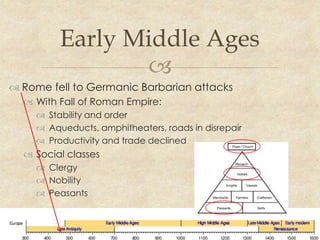
 Rome fell to Germanic Barbarian attacks
   With Fall of Roman Empire:
     Stability and order
     Aqueducts, amphitheaters, roads in disrepair
     Productivity and trade declined
   Social classes
     Clergy
     Nobility
     Peasants
Growth of Medieval Church
           
 In the midst of chaos, the church represented stability
  and safety
     Order and political leadership
     Authority, power and prestige
     Preserve classical culture (writings & arts)
     Provided inns and hospitals in time of war
     Help poor, sick and needy
     Leading role in education (only place of literacy)
     Good farmers 
Roman Catholic Church
            
 Earthly institution
    It has Biblical truths mixed with human traditions
 Began to give more importance to traditions rather
  than Biblical truth
 Concerned with keeping unity NOT inner peace
  through a relationship with Jesus Christ
    Wanted more and more people under their control
 People began to look at “the church” for salvation
  NOT God
Church in Rome
                     
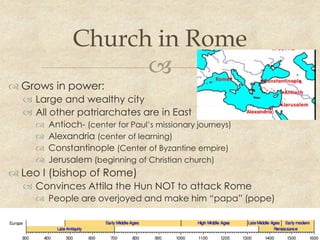
 Grows in power:
   Large and wealthy city
   All other patriarchates are in East
        Antioch- (center for Paul’s missionary journeys)
        Alexandria (center of learning)
        Constantinople (Center of Byzantine empire)
        Jerusalem (beginning of Christian church)
 Leo I (bishop of Rome)
   Convinces Attila the Hun NOT to attack Rome
      People are overjoyed and make him “papa” (pope)
“Petrine” Theory
              
 Rome used this theory to further advance their power
 Based on 2 FALSE assumptions:
    1. Christ appointed Peter as pope over church
       No Biblical evidence
    2. Peter served as bishop of Rome and gave his authority to
     followers
       No biblical evidence of Peters importance over other apostles
 Peter = substitute for Jesus
    If this is true, then by Petrine theory ALL POPES of Rome are
     substitute for Jesus ( How much power does that give them?)
Warriors of the Church
               
 Church organized like an army
   Clergy = servants of the church
      Joined for many reasons:
           Ambition
           Wealth
           Luxury
           Power
           Get away from personal/family problems
 Organized into different branches of service: secular
  and regular
Secular (“world”)                         Regular (renounced world)
• Conducted religious services            • Sacrificed personal ambitions
• Administered sacraments                 • Life of social service
• Took care of business and property of   • Retired to life of solitude and study
  church                                  • Lived in monastic communities
• Many times mixed personal business      • Followed strict regulations
  with church business
 Benedictine Rule
   Strict regulations on lives of monks
   Manual labor, prayers, study
   Poverty, chastity, obedience
 Missionaries (later made into saints)
   Patrick- Ireland
   Boniface- Germans
 Gregory I
   First great pope
   Expanded power of church
   blinded by superstition and ignorance
      Officially embraced:
         Mass
         Penance
         Purgatory (temporary place of punishment of souls on their way
          to heaven)
New Western Empire
       
Clovis of the
      Franks
              
 Powerful Germanic People = Franks
 481 AD- Clovis becomes boss
   Takes over most of present day France
   Converts to Christianity (encouraged by
    his wife)
     Requires his soldiers to convert too
     Believe God granted him military victory
     Began alliance with Roman Catholic
      church
        Benefits for both sides
Merovingian House
                              Their descendants =
 Clovis dies, leaves land to his sons.
  Merovingian House
   Frankish kings became “do nothing kings”
    drunkenness, immorality and family strife
 Real power behind the throne was held by MAYOR Of the
  PALACE
   Administer palace, military, finances, and government
    affairs (Kings just a puppet figure)
   Pepin II mayor of one of great kings in France
     Son- Charles Martel stopped Muslim invasion at Battle of Tours
      732 AD
Birth of the Carolingian House
                                  
 Pepin the Short (son of Charles Martel)
   Mayor of palace & asked pope, “Shouldn't’t I be king since
    I am in charge anyways?”
      Pope says yes, and comes to France and crowns Pepin king
         This is the start of the Carolingian House, end of Merovingian
          house
   Pope wants Pepin’s help
      Protection against the Lombards in Italy
         Germanic people who invaded Italy and threatened Rome
      Pepin defeats Lombards and gives lands to Pope (become
       Papal states

 Pepin was the first king to be anointed with “holy
  oil” by the pope
   This introduced the idea in western thought that
    kings have the “divine right” to rule

Ch8 medievaleurope

  • 1.
  • 2.
    Early Middle Ages   Rome fell to Germanic Barbarian attacks  With Fall of Roman Empire:  Stability and order  Aqueducts, amphitheaters, roads in disrepair  Productivity and trade declined  Social classes  Clergy  Nobility  Peasants
  • 3.
    Growth of MedievalChurch   In the midst of chaos, the church represented stability and safety  Order and political leadership  Authority, power and prestige  Preserve classical culture (writings & arts)  Provided inns and hospitals in time of war  Help poor, sick and needy  Leading role in education (only place of literacy)  Good farmers 
  • 4.
    Roman Catholic Church   Earthly institution  It has Biblical truths mixed with human traditions  Began to give more importance to traditions rather than Biblical truth  Concerned with keeping unity NOT inner peace through a relationship with Jesus Christ  Wanted more and more people under their control  People began to look at “the church” for salvation NOT God
  • 5.
    Church in Rome   Grows in power:  Large and wealthy city  All other patriarchates are in East  Antioch- (center for Paul’s missionary journeys)  Alexandria (center of learning)  Constantinople (Center of Byzantine empire)  Jerusalem (beginning of Christian church)  Leo I (bishop of Rome)  Convinces Attila the Hun NOT to attack Rome  People are overjoyed and make him “papa” (pope)
  • 7.
    “Petrine” Theory   Rome used this theory to further advance their power  Based on 2 FALSE assumptions:  1. Christ appointed Peter as pope over church  No Biblical evidence  2. Peter served as bishop of Rome and gave his authority to followers  No biblical evidence of Peters importance over other apostles  Peter = substitute for Jesus  If this is true, then by Petrine theory ALL POPES of Rome are substitute for Jesus ( How much power does that give them?)
  • 8.
    Warriors of theChurch   Church organized like an army  Clergy = servants of the church  Joined for many reasons:  Ambition  Wealth  Luxury  Power  Get away from personal/family problems  Organized into different branches of service: secular and regular
  • 9.
    Secular (“world”) Regular (renounced world) • Conducted religious services • Sacrificed personal ambitions • Administered sacraments • Life of social service • Took care of business and property of • Retired to life of solitude and study church • Lived in monastic communities • Many times mixed personal business • Followed strict regulations with church business
  • 10.
     Benedictine Rule  Strict regulations on lives of monks  Manual labor, prayers, study  Poverty, chastity, obedience  Missionaries (later made into saints)  Patrick- Ireland  Boniface- Germans  Gregory I  First great pope  Expanded power of church  blinded by superstition and ignorance  Officially embraced:  Mass  Penance  Purgatory (temporary place of punishment of souls on their way to heaven)
  • 11.
  • 12.
    Clovis of the Franks   Powerful Germanic People = Franks  481 AD- Clovis becomes boss  Takes over most of present day France  Converts to Christianity (encouraged by his wife)  Requires his soldiers to convert too  Believe God granted him military victory  Began alliance with Roman Catholic church  Benefits for both sides
  • 13.
    Merovingian House  Their descendants =  Clovis dies, leaves land to his sons. Merovingian House  Frankish kings became “do nothing kings” drunkenness, immorality and family strife  Real power behind the throne was held by MAYOR Of the PALACE  Administer palace, military, finances, and government affairs (Kings just a puppet figure)  Pepin II mayor of one of great kings in France  Son- Charles Martel stopped Muslim invasion at Battle of Tours 732 AD
  • 14.
    Birth of theCarolingian House   Pepin the Short (son of Charles Martel)  Mayor of palace & asked pope, “Shouldn't’t I be king since I am in charge anyways?”  Pope says yes, and comes to France and crowns Pepin king  This is the start of the Carolingian House, end of Merovingian house  Pope wants Pepin’s help  Protection against the Lombards in Italy  Germanic people who invaded Italy and threatened Rome  Pepin defeats Lombards and gives lands to Pope (become Papal states
  • 15.
      Pepin wasthe first king to be anointed with “holy oil” by the pope  This introduced the idea in western thought that kings have the “divine right” to rule