SUB-SAHARA
  AFRICA
  Physical Geography
HIGHLAND FEATURES
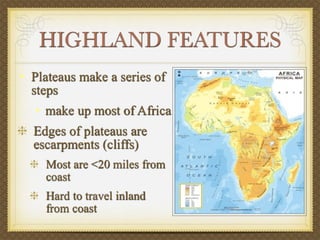
• Plateaus make a series of
  steps
  • make up most of Africa
  Edges of plateaus are
  escarpments (cliffs)
    Most are <20 miles from
    coast
    Hard to travel inland
    from coast
HIGHLAND FEATURES

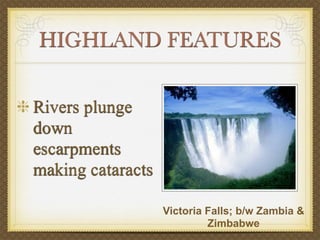
Rivers plunge
down
escarpments
making cataracts

                   Victoria Falls; b/w Zambia &
                            Zimbabwe
HIGHLAND FEATURES
Africa has highest overall
elevation than any other
continent…
But still few mountains
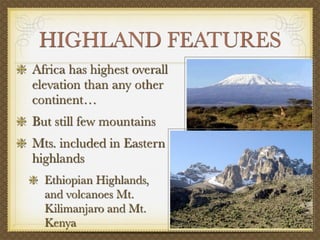
Mts. included in Eastern
highlands
  Ethiopian Highlands,
  and volcanoes Mt.
  Kilimanjaro and Mt.
  Kenya
HIGHLAND FEATURES
HIGHLAND FEATURES
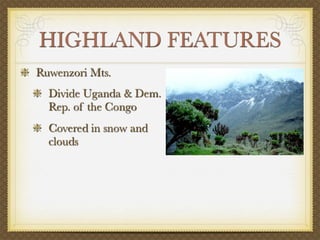
Ruwenzori Mts.
  Divide Uganda & Dem.
  Rep. of the Congo
  Covered in snow and
  clouds
HIGHLAND FEATURES
Ruwenzori Mts.
  Divide Uganda & Dem.
  Rep. of the Congo
  Covered in snow and
  clouds
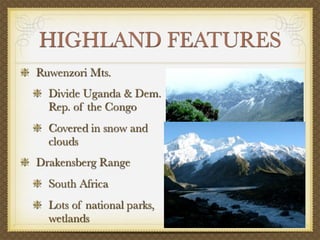
Drakensberg Range
  South Africa
  Lots of national parks,
  wetlands
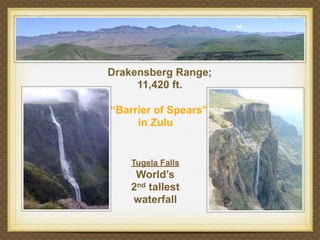
Drakensberg Range;
     11,420 ft.

- “Barrier of Spears”
       in Zulu


     Tugela Falls
      World’s
     2nd tallest
     waterfall
GREAT RIFT VALLEY
GREAT RIFT VALLEY
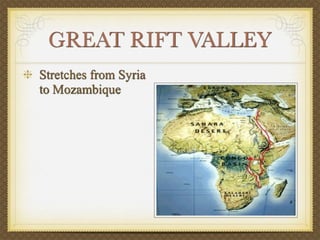
Stretches from Syria
to Mozambique
GREAT RIFT VALLEY
Stretches from Syria
to Mozambique
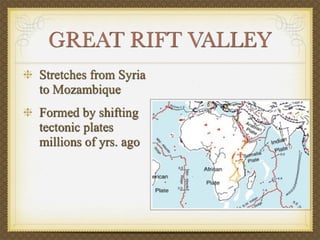
Formed by shifting
tectonic plates
millions of yrs. ago
GREAT RIFT VALLEY
Stretches from Syria
to Mozambique
Formed by shifting
tectonic plates
millions of yrs. ago
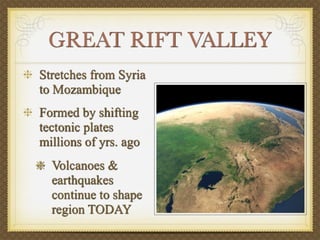
  Volcanoes &
  earthquakes
  continue to shape
  region TODAY
GREAT RIFT VALLEY
GREAT RIFT VALLEY
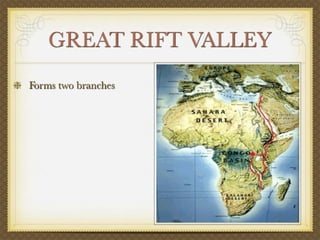
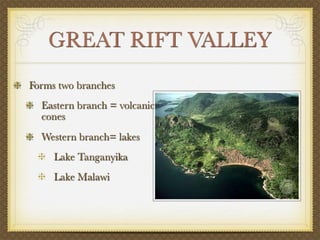
Forms two branches
GREAT RIFT VALLEY
Forms two branches
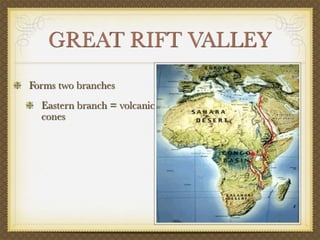
  Eastern branch = volcanic
  cones
GREAT RIFT VALLEY
Forms two branches
  Eastern branch = volcanic
  cones
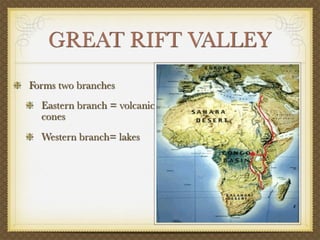
  Western branch= lakes
GREAT RIFT VALLEY
Forms two branches
  Eastern branch = volcanic
  cones
  Western branch= lakes
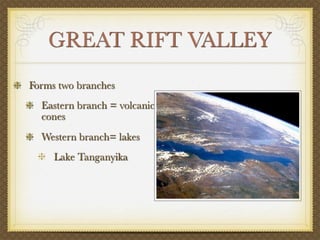
     Lake Tanganyika
GREAT RIFT VALLEY
Forms two branches
  Eastern branch = volcanic
  cones
  Western branch= lakes
     Lake Tanganyika
     Lake Malawi
GREAT RIFT VALLEY
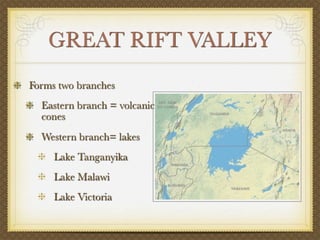
Forms two branches
  Eastern branch = volcanic
  cones
  Western branch= lakes
     Lake Tanganyika
     Lake Malawi
     Lake Victoria
WATER SYSTEMS
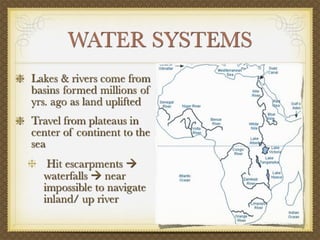
Lakes & rivers come from
basins formed millions of
yrs. ago as land uplifted
Travel from plateaus in
center of continent to the
sea
   Hit escarpments 
  waterfalls  near
  impossible to navigate
  inland/ up river
WATER SYSTEMS
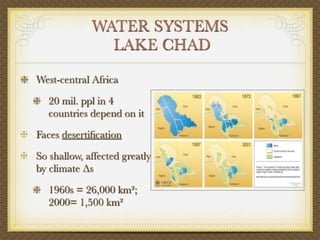
               LAKE CHAD

West-central Africa

   20 mil. ppl in 4
   countries depend on it

Faces desertification

So shallow, affected greatly
by climate Δs

   1960s = 26,000 km²;
   2000= 1,500 km²
WATER SYSTEMS
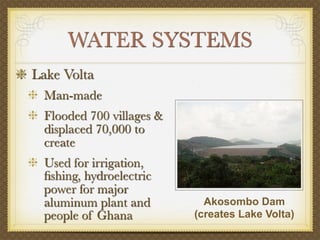
Lake Volta
 Man-made
 Flooded 700 villages &
 displaced 70,000 to
 create
 Used for irrigation,
 fishing, hydroelectric
 power for major
 aluminum plant and         Akosombo Dam
 people of Ghana          (creates Lake Volta)
WATER SYSTEMS
 NIGER RIVER
WATER SYSTEMS
            NIGER RIVER
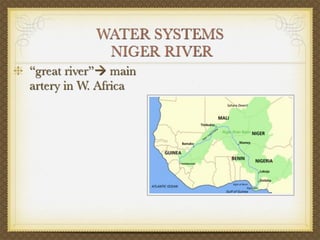
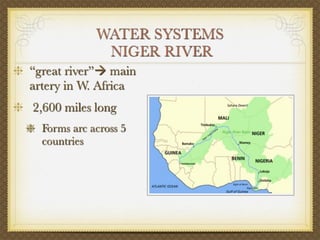
“great river” main
artery in W. Africa
WATER SYSTEMS
             NIGER RIVER
“great river” main
artery in W. Africa
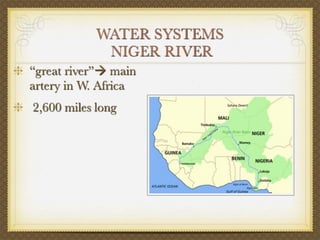
2,600 miles long
WATER SYSTEMS
              NIGER RIVER
“great river” main
artery in W. Africa
2,600 miles long
  Forms arc across 5
  countries
WATER SYSTEMS
              NIGER RIVER
“great river” main
artery in W. Africa
2,600 miles long
  Forms arc across 5
  countries
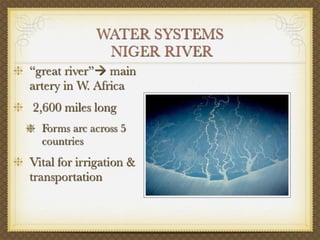
Vital for irrigation &
transportation
WATER SYSTEMS
              NIGER RIVER
“great river” main
artery in W. Africa
2,600 miles long
  Forms arc across 5
  countries
Vital for irrigation &
transportation
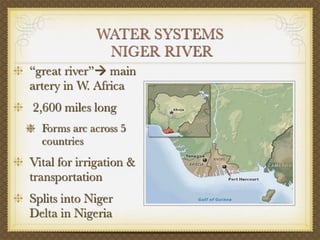
Splits into Niger
Delta in Nigeria
WATER SYSTEMS
WATER SYSTEMS
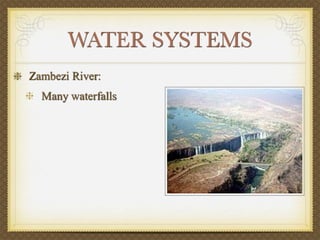
Zambezi River:
  Many waterfalls
WATER SYSTEMS
Zambezi River:
  Many waterfalls
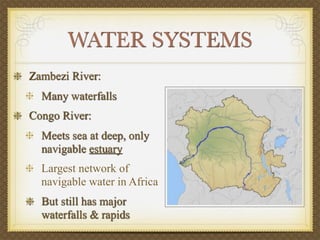
Congo River:
  Meets sea at deep, only
  navigable estuary
  Largest network of
  navigable water in Africa
  But still has major
  waterfalls & rapids
PHYSICAL BARRIERS
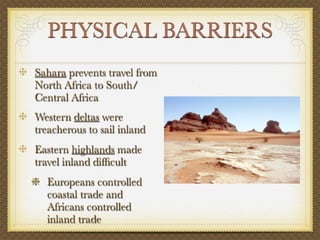
Sahara prevents travel from
North Africa to South/
Central Africa
Western deltas were
treacherous to sail inland
Eastern highlands made
travel inland difficult
  Europeans controlled
  coastal trade and
  Africans controlled
  inland trade
NATURAL RESOURCES
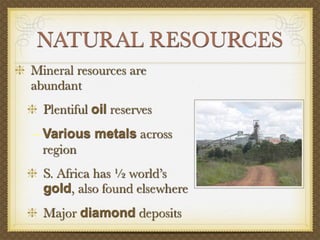
Mineral resources are
abundant
  Plentiful oil reserves
– Various metals across
  region
  S. Africa has ½ world’s
  gold, also found elsewhere
  Major diamond deposits
ENERGY RESOURCES
Water is ABUNDANT
The problem lies with
harnessing power
  Congo River- More potential
  hydroelectric power than
  U.S.
More development is occurring
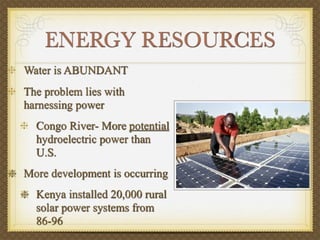
  Kenya installed 20,000 rural
  solar power systems from
  86-96

Sub sahara africa

  • 1.
    SUB-SAHARA AFRICA Physical Geography
  • 2.
    HIGHLAND FEATURES • Plateausmake a series of steps • make up most of Africa Edges of plateaus are escarpments (cliffs) Most are <20 miles from coast Hard to travel inland from coast
  • 3.
    HIGHLAND FEATURES Rivers plunge down escarpments makingcataracts Victoria Falls; b/w Zambia & Zimbabwe
  • 4.
    HIGHLAND FEATURES Africa hashighest overall elevation than any other continent… But still few mountains Mts. included in Eastern highlands Ethiopian Highlands, and volcanoes Mt. Kilimanjaro and Mt. Kenya
  • 5.
  • 6.
    HIGHLAND FEATURES Ruwenzori Mts. Divide Uganda & Dem. Rep. of the Congo Covered in snow and clouds
  • 7.
    HIGHLAND FEATURES Ruwenzori Mts. Divide Uganda & Dem. Rep. of the Congo Covered in snow and clouds Drakensberg Range South Africa Lots of national parks, wetlands
  • 8.
    Drakensberg Range; 11,420 ft. - “Barrier of Spears” in Zulu Tugela Falls World’s 2nd tallest waterfall
  • 9.
  • 10.
    GREAT RIFT VALLEY Stretchesfrom Syria to Mozambique
  • 11.
    GREAT RIFT VALLEY Stretchesfrom Syria to Mozambique Formed by shifting tectonic plates millions of yrs. ago
  • 12.
    GREAT RIFT VALLEY Stretchesfrom Syria to Mozambique Formed by shifting tectonic plates millions of yrs. ago Volcanoes & earthquakes continue to shape region TODAY
  • 13.
  • 14.
  • 15.
    GREAT RIFT VALLEY Formstwo branches Eastern branch = volcanic cones
  • 16.
    GREAT RIFT VALLEY Formstwo branches Eastern branch = volcanic cones Western branch= lakes
  • 17.
    GREAT RIFT VALLEY Formstwo branches Eastern branch = volcanic cones Western branch= lakes Lake Tanganyika
  • 18.
    GREAT RIFT VALLEY Formstwo branches Eastern branch = volcanic cones Western branch= lakes Lake Tanganyika Lake Malawi
  • 19.
    GREAT RIFT VALLEY Formstwo branches Eastern branch = volcanic cones Western branch= lakes Lake Tanganyika Lake Malawi Lake Victoria
  • 20.
    WATER SYSTEMS Lakes &rivers come from basins formed millions of yrs. ago as land uplifted Travel from plateaus in center of continent to the sea Hit escarpments  waterfalls  near impossible to navigate inland/ up river
  • 21.
    WATER SYSTEMS LAKE CHAD West-central Africa 20 mil. ppl in 4 countries depend on it Faces desertification So shallow, affected greatly by climate Δs 1960s = 26,000 km²; 2000= 1,500 km²
  • 22.
    WATER SYSTEMS Lake Volta Man-made Flooded 700 villages & displaced 70,000 to create Used for irrigation, fishing, hydroelectric power for major aluminum plant and Akosombo Dam people of Ghana (creates Lake Volta)
  • 23.
  • 24.
    WATER SYSTEMS NIGER RIVER “great river” main artery in W. Africa
  • 25.
    WATER SYSTEMS NIGER RIVER “great river” main artery in W. Africa 2,600 miles long
  • 26.
    WATER SYSTEMS NIGER RIVER “great river” main artery in W. Africa 2,600 miles long Forms arc across 5 countries
  • 27.
    WATER SYSTEMS NIGER RIVER “great river” main artery in W. Africa 2,600 miles long Forms arc across 5 countries Vital for irrigation & transportation
  • 28.
    WATER SYSTEMS NIGER RIVER “great river” main artery in W. Africa 2,600 miles long Forms arc across 5 countries Vital for irrigation & transportation Splits into Niger Delta in Nigeria
  • 29.
  • 30.
  • 31.
    WATER SYSTEMS Zambezi River: Many waterfalls Congo River: Meets sea at deep, only navigable estuary Largest network of navigable water in Africa But still has major waterfalls & rapids
  • 32.
    PHYSICAL BARRIERS Sahara preventstravel from North Africa to South/ Central Africa Western deltas were treacherous to sail inland Eastern highlands made travel inland difficult Europeans controlled coastal trade and Africans controlled inland trade
  • 33.
    NATURAL RESOURCES Mineral resourcesare abundant Plentiful oil reserves – Various metals across region S. Africa has ½ world’s gold, also found elsewhere Major diamond deposits
  • 34.
    ENERGY RESOURCES Water isABUNDANT The problem lies with harnessing power Congo River- More potential hydroelectric power than U.S. More development is occurring Kenya installed 20,000 rural solar power systems from 86-96

Editor's Notes

  • #2 \n
  • #3 Africa south of the Sahara is a series of plateaus that rise in elevation from the coast inland and from west to east. Ranging in elevation from 500 feet to 8,000 feet or more in the east, the plateaus are outcropping s of the solid rock that makes up most of the continent. \n\nThe edges of the plateaus are marked by escarpments - steep often jagged cliffs. Most are located less than 20 miles from the coast. Rivers that cross the plateaus plunge down the escarpment in &amp;#x201C;cataracts&amp;#x201D; or water falls. (on the Next slide)\n
  • #4 cataracts (waterfalls)\n\nThe zambezi river of south-central africa also meets the ocean ina delta. the Zambezi flows 2,200 miles from its source near the Zambia-Angola border in the west to the Indian Ocean in the east, where it fans out in a delta that is 37 miles wide. the Zambezi&amp;#x2019;s course to the sea is interrupted in many places by waterfalls. At victoria Falls, on the border of Zambia and Zimbabwe, the Zambezi plummets a sheer 355 feet!\n
  • #5 The eastern highlands stretch from Ethiopia almost to the cape of good hope. Include volcanic summits like mount Kilimanjaro and Mount Kenya. The Ruwenzon mountains are located in Uganda and the Democratic republic of Congo. Drakensberg Range in South Africa. \n\nMt. Kilimanjaro 19,330 ft; in Tanzania Highest Free-Standing Mountain in the world.\n\nMt. Kenya 17,057 ft; in Kenya\n\nCotopaxi the highest active volcano in the world, in the Andes in central Ecuador, that rises to 19,142 feet (5,896 m). Its name is Quechuan and means &amp;#x201C;shining peak.&amp;#x201D;\n
  • #6 East of the Easter High Lands, the Ruwenzori Mountains divide Uganda and the Democratic Republic of Congo. Covered with snow and cloaked with clouds, they are also called the &amp;#x201C;mountains of the moon&amp;#x201D; Moist air from the Indian Ocean creates the clouds that wrap around the Runwenzoris\n\nFarther south is the Drakensberg Range in South Africa and Lesotho. These mountains rise to more then 11,000 feet and from part of the escarpment along the southern edge of the continent. \n
  • #7 East of the Easter High Lands, the Ruwenzori Mountains divide Uganda and the Democratic Republic of Congo. Covered with snow and cloaked with clouds, they are also called the &amp;#x201C;mountains of the moon&amp;#x201D; Moist air from the Indian Ocean creates the clouds that wrap around the Runwenzoris\n\nFarther south is the Drakensberg Range in South Africa and Lesotho. These mountains rise to more then 11,000 feet and from part of the escarpment along the southern edge of the continent. \n
  • #8 East of the Easter High Lands, the Ruwenzori Mountains divide Uganda and the Democratic Republic of Congo. Covered with snow and cloaked with clouds, they are also called the &amp;#x201C;mountains of the moon&amp;#x201D; Moist air from the Indian Ocean creates the clouds that wrap around the Runwenzoris\n\nFarther south is the Drakensberg Range in South Africa and Lesotho. These mountains rise to more then 11,000 feet and from part of the escarpment along the southern edge of the continent. \n
  • #9 East of the Easter High Lands, the Ruwenzori Mountains divide Uganda and the Democratic Republic of Congo. Covered with snow and cloaked with clouds, they are also called the &amp;#x201C;mountains of the moon&amp;#x201D; Moist air from the Indian Ocean creates the clouds that wrap around the Runwenzoris\n\nFarther south is the Drakensberg Range in South Africa and Lesotho. These mountains rise to more then 11,000 feet and from part of the escarpment along the southern edge of the continent. \n
  • #10 \nAngel (Salto Angel)\nCanaima Nat&apos;l Park, Venezuela\nupper trib. of Rio Caroni\n3,212 feet\n\nTugela Falls is the world&apos;s second highest waterfall.[1] The total drop in five free-leaping falls is 948&amp;#xA0;m (3,110&amp;#xA0;ft). They are located in the Drakensberg (Dragon&apos;s Mountains) in the Royal Natal National Park in KwaZulu-Natal Province, Republic of South Africa. They are easily viewed after a heavy rain from the main travel road into the park, glistening from the reflection of the late afternoon sun. The source of the Tugela River (Zulu for &apos;sudden&apos;) is the Mont-Aux-Sources plateau which extends several kilometers beyond The Amphitheater escarpment from which the falls drop. There is an undeveloped camp site and mountain hut immediately above the falls.\n\n\nThere are two trails to the Tugela Falls. The most spectacular trail is to the top of Mount-Aux-Sources, which starts at the Sentinel car park (through Phuthaditjhaba on the R57, approximately 2hrs drive from Royal Natal National Park via the R74, 90 minutes from Harrismith via the R712, or 80 minutes from Golden Gate Highlands National Park). From here it is a relatively easy climb to the top of the Amphitheatre, however it does take about 4.5 to 8 hours round trip depending on fitness level. You can gain easy access to the summit via two chain ladders. This is the only day hiking trail which will take you to the top of the Drakensberg escarpment. Another trail to the foot of the Tugela Falls starts at Royal Natal National Park. The easy 7&amp;#xA0;km (4.3&amp;#xA0;mi) gradient up the Tugela Gorge winds though indigenous forests. The last part of the hike to the Tugela Falls is a boulder hop. A little chain ladder takes you over the final stretch from where you have a stunning view of the falls rushing down the Amphitheater in a series of five spectacular cascades.\n
  • #11 (what kind??) of tectonic plate movement?\nDivergent boundaries \nThe Somalian plate is pulling away from the African continent plate\nThe Arabian peninsula and the red sea resulted from the spreading of the Great Rift valley\n\n
  • #12 (what kind??) of tectonic plate movement?\nDivergent boundaries \nThe Somalian plate is pulling away from the African continent plate\nThe Arabian peninsula and the red sea resulted from the spreading of the Great Rift valley\n\n
  • #13 (what kind??) of tectonic plate movement?\nDivergent boundaries \nThe Somalian plate is pulling away from the African continent plate\nThe Arabian peninsula and the red sea resulted from the spreading of the Great Rift valley\n\n
  • #14 (what kind??) of tectonic plate movement?\nDivergent boundaries \nThe Somalian plate is pulling away from the African continent plate\nThe Arabian peninsula and the red sea resulted from the spreading of the Great Rift valley\n\n
  • #15 (what kind??) of tectonic plate movement?\nDivergent boundaries \nThe Somalian plate is pulling away from the African continent plate\nThe Arabian peninsula and the red sea resulted from the spreading of the Great Rift valley\n\n
  • #16 (what kind??) of tectonic plate movement?\nDivergent boundaries \nThe Somalian plate is pulling away from the African continent plate\nThe Arabian peninsula and the red sea resulted from the spreading of the Great Rift valley\n\n
  • #17 (what kind??) of tectonic plate movement?\nDivergent boundaries \nThe Somalian plate is pulling away from the African continent plate\nThe Arabian peninsula and the red sea resulted from the spreading of the Great Rift valley\n\n
  • #18 (what kind??) of tectonic plate movement?\nDivergent boundaries \nThe Somalian plate is pulling away from the African continent plate\nThe Arabian peninsula and the red sea resulted from the spreading of the Great Rift valley\n\n
  • #19 Lake Tanganyika (2nd lgst. freshwater &amp; 2nd deepest in world)\nLake Malawi (mt. rimmed, &gt;2,300 feet deep)\nLake Victoria (2nd widest in world, but shallow; source of White Nile)\n\n\n
  • #20 Lake Tanganyika (2nd lgst. freshwater &amp; 2nd deepest in world)\nLake Malawi (mt. rimmed, &gt;2,300 feet deep)\nLake Victoria (2nd widest in world, but shallow; source of White Nile)\n\n\n
  • #21 Lake Tanganyika (2nd lgst. freshwater &amp; 2nd deepest in world)\nLake Malawi (mt. rimmed, &gt;2,300 feet deep)\nLake Victoria (2nd widest in world, but shallow; source of White Nile)\n\n\n
  • #22 Lake Tanganyika (2nd lgst. freshwater &amp; 2nd deepest in world)\nLake Malawi (mt. rimmed, &gt;2,300 feet deep)\nLake Victoria (2nd widest in world, but shallow; source of White Nile)\n\n\n
  • #23 Lake Tanganyika (2nd lgst. freshwater &amp; 2nd deepest in world)\nLake Malawi (mt. rimmed, &gt;2,300 feet deep)\nLake Victoria (2nd widest in world, but shallow; source of White Nile)\n\n\n
  • #24 Lake Tanganyika (2nd lgst. freshwater &amp; 2nd deepest in world)\nLake Malawi (mt. rimmed, &gt;2,300 feet deep)\nLake Victoria (2nd widest in world, but shallow; source of White Nile)\n\n\n
  • #25 Lake Tanganyika (2nd lgst. freshwater &amp; 2nd deepest in world)\nLake Malawi (mt. rimmed, &gt;2,300 feet deep)\nLake Victoria (2nd widest in world, but shallow; source of White Nile)\n\n\n
  • #26 Lake Tanganyika (2nd lgst. freshwater &amp; 2nd deepest in world)\nLake Malawi (mt. rimmed, &gt;2,300 feet deep)\nLake Victoria (2nd widest in world, but shallow; source of White Nile)\n\n\n
  • #27 Lake Tanganyika (2nd lgst. freshwater &amp; 2nd deepest in world)\nLake Malawi (mt. rimmed, &gt;2,300 feet deep)\nLake Victoria (2nd widest in world, but shallow; source of White Nile)\n\n\n
  • #28 Lake Tanganyika (2nd lgst. freshwater &amp; 2nd deepest in world)\nLake Malawi (mt. rimmed, &gt;2,300 feet deep)\nLake Victoria (2nd widest in world, but shallow; source of White Nile)\n\n\n
  • #29 Lake Tanganyika (2nd lgst. freshwater &amp; 2nd deepest in world)\nLake Malawi (mt. rimmed, &gt;2,300 feet deep)\nLake Victoria (2nd widest in world, but shallow; source of White Nile)\n\n\n
  • #30 Lake Tanganyika (2nd lgst. freshwater &amp; 2nd deepest in world)\nLake Malawi (mt. rimmed, &gt;2,300 feet deep)\nLake Victoria (2nd widest in world, but shallow; source of White Nile)\n\n\n
  • #31 Lake Tanganyika (2nd lgst. freshwater &amp; 2nd deepest in world)\nLake Malawi (mt. rimmed, &gt;2,300 feet deep)\nLake Victoria (2nd widest in world, but shallow; source of White Nile)\n\n\n
  • #32 \n
  • #33 Faces desertification (droughts + natural climate)\n\nLake chad, outside the great rift valley in west- central africa, is threatened with extinction. Although fed by three large streams, landlocked Lake Chad is shrinking. Droughts in the 1970s completely dried up the Northern portion of the lake, and the water level continues to be shallow even during years when rainfall is normal. BEcause of the climate,(What Type of Climate) much of the lake&amp;#x2019;s water evaporates. It also seeps into the ground. Other factors contributing to the shrinkage of lake Chad include global warming, irrigation, and decertification. \n\nDesertification occurs when long period of drought and land use destroy the vegetation. The land is left dry and barren, unable to support life. As Lake Chad shrinks, the desert expands on the dry lake bottom. \n
  • #34 Lake Volta: Man-made lake by surface area. \nThe world&amp;#x2019;s largest man made lakes\nLargest Man Made lake by surface area is Lake Volta in Ghana at 8,482 Km2 (3,274.9 mi2). \nLargest Man Made lake by volume is Lake Kariba on the border of Zambia and Zimbabwe at 180 km3. \nThe lake was created in the 1960s by damming the Volta River south of Ajena, Ghana. The new lake flooded more than 700 villages, forcing more than 70,000 people to find new homes. Although the dam was originally built to provide hydroelectric power to an aluminum plant, the people of Ghana today benefit from the lake in many ways. It supplies irrigation for farming in the plains below the dam and is well stocked with fish. The hydroelectric plant now alos generates electricity used throughout Ghana. \n
  • #35  2,600 miles long (3rd longest river in Africa)\n\n\nSplits into Niger Delta in Nigeria (150 X 200 miles)\n\nThe niger river is known by many names along its course, but all of them roughly have the same meaning &amp;#x201C;great river&amp;#x201D;. The Niger is the main artery in western Africa, extending about 2,600 miles in length Originating in the highlands of Guinea, the river forms a great arc. it flows northeast and then curves southeast to the nigerian coast. In addition to being important to agriculture, the niger river is a major means of transportation. This great river does not flow as one well defined stream into the atlantic ocean. At Aboh in souther Nigeria, the Niger splits into a vast inland delta, a triangular section of land formed by sand and silt carried downriver. The Niger delta stretches 150 miles north to south and extends to a with of about 200 miles along the Gulf of Guinea. \n\n\n
  • #36  2,600 miles long (3rd longest river in Africa)\n\n\nSplits into Niger Delta in Nigeria (150 X 200 miles)\n\nThe niger river is known by many names along its course, but all of them roughly have the same meaning &amp;#x201C;great river&amp;#x201D;. The Niger is the main artery in western Africa, extending about 2,600 miles in length Originating in the highlands of Guinea, the river forms a great arc. it flows northeast and then curves southeast to the nigerian coast. In addition to being important to agriculture, the niger river is a major means of transportation. This great river does not flow as one well defined stream into the atlantic ocean. At Aboh in souther Nigeria, the Niger splits into a vast inland delta, a triangular section of land formed by sand and silt carried downriver. The Niger delta stretches 150 miles north to south and extends to a with of about 200 miles along the Gulf of Guinea. \n\n\n
  • #37  2,600 miles long (3rd longest river in Africa)\n\n\nSplits into Niger Delta in Nigeria (150 X 200 miles)\n\nThe niger river is known by many names along its course, but all of them roughly have the same meaning &amp;#x201C;great river&amp;#x201D;. The Niger is the main artery in western Africa, extending about 2,600 miles in length Originating in the highlands of Guinea, the river forms a great arc. it flows northeast and then curves southeast to the nigerian coast. In addition to being important to agriculture, the niger river is a major means of transportation. This great river does not flow as one well defined stream into the atlantic ocean. At Aboh in souther Nigeria, the Niger splits into a vast inland delta, a triangular section of land formed by sand and silt carried downriver. The Niger delta stretches 150 miles north to south and extends to a with of about 200 miles along the Gulf of Guinea. \n\n\n
  • #38  2,600 miles long (3rd longest river in Africa)\n\n\nSplits into Niger Delta in Nigeria (150 X 200 miles)\n\nThe niger river is known by many names along its course, but all of them roughly have the same meaning &amp;#x201C;great river&amp;#x201D;. The Niger is the main artery in western Africa, extending about 2,600 miles in length Originating in the highlands of Guinea, the river forms a great arc. it flows northeast and then curves southeast to the nigerian coast. In addition to being important to agriculture, the niger river is a major means of transportation. This great river does not flow as one well defined stream into the atlantic ocean. At Aboh in souther Nigeria, the Niger splits into a vast inland delta, a triangular section of land formed by sand and silt carried downriver. The Niger delta stretches 150 miles north to south and extends to a with of about 200 miles along the Gulf of Guinea. \n\n\n
  • #39  2,600 miles long (3rd longest river in Africa)\n\n\nSplits into Niger Delta in Nigeria (150 X 200 miles)\n\nThe niger river is known by many names along its course, but all of them roughly have the same meaning &amp;#x201C;great river&amp;#x201D;. The Niger is the main artery in western Africa, extending about 2,600 miles in length Originating in the highlands of Guinea, the river forms a great arc. it flows northeast and then curves southeast to the nigerian coast. In addition to being important to agriculture, the niger river is a major means of transportation. This great river does not flow as one well defined stream into the atlantic ocean. At Aboh in souther Nigeria, the Niger splits into a vast inland delta, a triangular section of land formed by sand and silt carried downriver. The Niger delta stretches 150 miles north to south and extends to a with of about 200 miles along the Gulf of Guinea. \n\n\n
  • #40  2,600 miles long (3rd longest river in Africa)\n\n\nSplits into Niger Delta in Nigeria (150 X 200 miles)\n\nThe niger river is known by many names along its course, but all of them roughly have the same meaning &amp;#x201C;great river&amp;#x201D;. The Niger is the main artery in western Africa, extending about 2,600 miles in length Originating in the highlands of Guinea, the river forms a great arc. it flows northeast and then curves southeast to the nigerian coast. In addition to being important to agriculture, the niger river is a major means of transportation. This great river does not flow as one well defined stream into the atlantic ocean. At Aboh in souther Nigeria, the Niger splits into a vast inland delta, a triangular section of land formed by sand and silt carried downriver. The Niger delta stretches 150 miles north to south and extends to a with of about 200 miles along the Gulf of Guinea. \n\n\n
  • #41  2,600 miles long (3rd longest river in Africa)\n\n\nSplits into Niger Delta in Nigeria (150 X 200 miles)\n\nThe niger river is known by many names along its course, but all of them roughly have the same meaning &amp;#x201C;great river&amp;#x201D;. The Niger is the main artery in western Africa, extending about 2,600 miles in length Originating in the highlands of Guinea, the river forms a great arc. it flows northeast and then curves southeast to the nigerian coast. In addition to being important to agriculture, the niger river is a major means of transportation. This great river does not flow as one well defined stream into the atlantic ocean. At Aboh in souther Nigeria, the Niger splits into a vast inland delta, a triangular section of land formed by sand and silt carried downriver. The Niger delta stretches 150 miles north to south and extends to a with of about 200 miles along the Gulf of Guinea. \n\n\n
  • #42  2,600 miles long (3rd longest river in Africa)\n\n\nSplits into Niger Delta in Nigeria (150 X 200 miles)\n\nThe niger river is known by many names along its course, but all of them roughly have the same meaning &amp;#x201C;great river&amp;#x201D;. The Niger is the main artery in western Africa, extending about 2,600 miles in length Originating in the highlands of Guinea, the river forms a great arc. it flows northeast and then curves southeast to the nigerian coast. In addition to being important to agriculture, the niger river is a major means of transportation. This great river does not flow as one well defined stream into the atlantic ocean. At Aboh in souther Nigeria, the Niger splits into a vast inland delta, a triangular section of land formed by sand and silt carried downriver. The Niger delta stretches 150 miles north to south and extends to a with of about 200 miles along the Gulf of Guinea. \n\n\n
  • #43  2,600 miles long (3rd longest river in Africa)\n\n\nSplits into Niger Delta in Nigeria (150 X 200 miles)\n\nThe niger river is known by many names along its course, but all of them roughly have the same meaning &amp;#x201C;great river&amp;#x201D;. The Niger is the main artery in western Africa, extending about 2,600 miles in length Originating in the highlands of Guinea, the river forms a great arc. it flows northeast and then curves southeast to the nigerian coast. In addition to being important to agriculture, the niger river is a major means of transportation. This great river does not flow as one well defined stream into the atlantic ocean. At Aboh in souther Nigeria, the Niger splits into a vast inland delta, a triangular section of land formed by sand and silt carried downriver. The Niger delta stretches 150 miles north to south and extends to a with of about 200 miles along the Gulf of Guinea. \n\n\n
  • #44  2,600 miles long (3rd longest river in Africa)\n\n\nSplits into Niger Delta in Nigeria (150 X 200 miles)\n\nThe niger river is known by many names along its course, but all of them roughly have the same meaning &amp;#x201C;great river&amp;#x201D;. The Niger is the main artery in western Africa, extending about 2,600 miles in length Originating in the highlands of Guinea, the river forms a great arc. it flows northeast and then curves southeast to the nigerian coast. In addition to being important to agriculture, the niger river is a major means of transportation. This great river does not flow as one well defined stream into the atlantic ocean. At Aboh in souther Nigeria, the Niger splits into a vast inland delta, a triangular section of land formed by sand and silt carried downriver. The Niger delta stretches 150 miles north to south and extends to a with of about 200 miles along the Gulf of Guinea. \n\n\n
  • #45 (Victoria Falls- 355 foot drop&amp;#x2013; 2X size of Niagara)\n\nthe Zambezi River of south-central Africa also meets the ocean in a delta. The Zambezi flows 2,200 miles from its source near the Zambia-Angola border in the west to the india Ocean in the east, where it fans out in a delta that is 37 miles wide. The Zambezi&apos;s course to the seas is interrupted in many places by waterfalls. At Victoria Falls on the Border of Zambia and Zimbabwe, the Zambezi plummets a sheer 355 feet. \n\nUnlike most African Rivers, the Congo River reaches the sea though a deep estuary, or passage where fresh water meets seawater. The Congo&amp;#x2019;s estuary is 7 miles wised and ships can navigate the deep water. The remaining 2,700 miles of the Congo form a large network of navigable waterways for smaller boats. Some parts of the river, however, have rapid and waterfalls that present serious obstacles for traffic. The river plunges almost 900 feet in numerous cataracts not far from where it meets the Atlantic Ocean. \n\n&amp;#x201C;An Estuary is a passage where freshwater meets seawater. or according to apple, the tidal mouth of a large river, where the tide meets the stream.&amp;#x201D;\n\n-----An estuary is a partly enclosed coastal body of water with one or more rivers or streams flowing into it, and with a free connection to the open sea.[1]\nEstuaries form a transition zone between river environments and ocean environments and are subject to both marine influences, such as tides, waves, and the influx of saline water; and riverine influences, such as flows of fresh water and sediment. The inflow of both seawater and freshwater provide high levels of nutrients in both the water column and sediment, making estuaries among the most productive natural habitats in the world.----\n
  • #46 (Victoria Falls- 355 foot drop&amp;#x2013; 2X size of Niagara)\n\nthe Zambezi River of south-central Africa also meets the ocean in a delta. The Zambezi flows 2,200 miles from its source near the Zambia-Angola border in the west to the india Ocean in the east, where it fans out in a delta that is 37 miles wide. The Zambezi&apos;s course to the seas is interrupted in many places by waterfalls. At Victoria Falls on the Border of Zambia and Zimbabwe, the Zambezi plummets a sheer 355 feet. \n\nUnlike most African Rivers, the Congo River reaches the sea though a deep estuary, or passage where fresh water meets seawater. The Congo&amp;#x2019;s estuary is 7 miles wised and ships can navigate the deep water. The remaining 2,700 miles of the Congo form a large network of navigable waterways for smaller boats. Some parts of the river, however, have rapid and waterfalls that present serious obstacles for traffic. The river plunges almost 900 feet in numerous cataracts not far from where it meets the Atlantic Ocean. \n\n&amp;#x201C;An Estuary is a passage where freshwater meets seawater. or according to apple, the tidal mouth of a large river, where the tide meets the stream.&amp;#x201D;\n\n-----An estuary is a partly enclosed coastal body of water with one or more rivers or streams flowing into it, and with a free connection to the open sea.[1]\nEstuaries form a transition zone between river environments and ocean environments and are subject to both marine influences, such as tides, waves, and the influx of saline water; and riverine influences, such as flows of fresh water and sediment. The inflow of both seawater and freshwater provide high levels of nutrients in both the water column and sediment, making estuaries among the most productive natural habitats in the world.----\n
  • #47 (Victoria Falls- 355 foot drop&amp;#x2013; 2X size of Niagara)\n\nthe Zambezi River of south-central Africa also meets the ocean in a delta. The Zambezi flows 2,200 miles from its source near the Zambia-Angola border in the west to the india Ocean in the east, where it fans out in a delta that is 37 miles wide. The Zambezi&apos;s course to the seas is interrupted in many places by waterfalls. At Victoria Falls on the Border of Zambia and Zimbabwe, the Zambezi plummets a sheer 355 feet. \n\nUnlike most African Rivers, the Congo River reaches the sea though a deep estuary, or passage where fresh water meets seawater. The Congo&amp;#x2019;s estuary is 7 miles wised and ships can navigate the deep water. The remaining 2,700 miles of the Congo form a large network of navigable waterways for smaller boats. Some parts of the river, however, have rapid and waterfalls that present serious obstacles for traffic. The river plunges almost 900 feet in numerous cataracts not far from where it meets the Atlantic Ocean. \n\n&amp;#x201C;An Estuary is a passage where freshwater meets seawater. or according to apple, the tidal mouth of a large river, where the tide meets the stream.&amp;#x201D;\n\n-----An estuary is a partly enclosed coastal body of water with one or more rivers or streams flowing into it, and with a free connection to the open sea.[1]\nEstuaries form a transition zone between river environments and ocean environments and are subject to both marine influences, such as tides, waves, and the influx of saline water; and riverine influences, such as flows of fresh water and sediment. The inflow of both seawater and freshwater provide high levels of nutrients in both the water column and sediment, making estuaries among the most productive natural habitats in the world.----\n
  • #48 (Victoria Falls- 355 foot drop&amp;#x2013; 2X size of Niagara)\n\nthe Zambezi River of south-central Africa also meets the ocean in a delta. The Zambezi flows 2,200 miles from its source near the Zambia-Angola border in the west to the india Ocean in the east, where it fans out in a delta that is 37 miles wide. The Zambezi&apos;s course to the seas is interrupted in many places by waterfalls. At Victoria Falls on the Border of Zambia and Zimbabwe, the Zambezi plummets a sheer 355 feet. \n\nUnlike most African Rivers, the Congo River reaches the sea though a deep estuary, or passage where fresh water meets seawater. The Congo&amp;#x2019;s estuary is 7 miles wised and ships can navigate the deep water. The remaining 2,700 miles of the Congo form a large network of navigable waterways for smaller boats. Some parts of the river, however, have rapid and waterfalls that present serious obstacles for traffic. The river plunges almost 900 feet in numerous cataracts not far from where it meets the Atlantic Ocean. \n\n&amp;#x201C;An Estuary is a passage where freshwater meets seawater. or according to apple, the tidal mouth of a large river, where the tide meets the stream.&amp;#x201D;\n\n-----An estuary is a partly enclosed coastal body of water with one or more rivers or streams flowing into it, and with a free connection to the open sea.[1]\nEstuaries form a transition zone between river environments and ocean environments and are subject to both marine influences, such as tides, waves, and the influx of saline water; and riverine influences, such as flows of fresh water and sediment. The inflow of both seawater and freshwater provide high levels of nutrients in both the water column and sediment, making estuaries among the most productive natural habitats in the world.----\n
  • #49 (Victoria Falls- 355 foot drop&amp;#x2013; 2X size of Niagara)\n\nthe Zambezi River of south-central Africa also meets the ocean in a delta. The Zambezi flows 2,200 miles from its source near the Zambia-Angola border in the west to the india Ocean in the east, where it fans out in a delta that is 37 miles wide. The Zambezi&apos;s course to the seas is interrupted in many places by waterfalls. At Victoria Falls on the Border of Zambia and Zimbabwe, the Zambezi plummets a sheer 355 feet. \n\nUnlike most African Rivers, the Congo River reaches the sea though a deep estuary, or passage where fresh water meets seawater. The Congo&amp;#x2019;s estuary is 7 miles wised and ships can navigate the deep water. The remaining 2,700 miles of the Congo form a large network of navigable waterways for smaller boats. Some parts of the river, however, have rapid and waterfalls that present serious obstacles for traffic. The river plunges almost 900 feet in numerous cataracts not far from where it meets the Atlantic Ocean. \n\n&amp;#x201C;An Estuary is a passage where freshwater meets seawater. or according to apple, the tidal mouth of a large river, where the tide meets the stream.&amp;#x201D;\n\n-----An estuary is a partly enclosed coastal body of water with one or more rivers or streams flowing into it, and with a free connection to the open sea.[1]\nEstuaries form a transition zone between river environments and ocean environments and are subject to both marine influences, such as tides, waves, and the influx of saline water; and riverine influences, such as flows of fresh water and sediment. The inflow of both seawater and freshwater provide high levels of nutrients in both the water column and sediment, making estuaries among the most productive natural habitats in the world.----\n
  • #50 a vast desert in North Africa that extends from the Atlantic Ocean on the west to the Red Sea on the east and from the Mediterranean Sea and the Atlas Mountains in the north to the Sahel in the south. The largest desert in the world, it covers an area of about 3,500,000 square miles (9,065,000 sq km).\n\nA Delta is a triangular tract of sediment deposited at the mouth of a river, typically where it diverges into several outlets.\n\n\nThe Eastern Highlands \nThe range forms Zimbabwe&apos;s eastern border with Mozambique and comprises three main mountain groups - Nyanga (to the north) which contains Zimbabwe&apos;s highest mountain Mount Nyangani, Africa&apos;s second-longest waterfall Mutarazi Falls and the Honde Valley which leads into Mozambique; Bvumba Mountains (centrally situated near the city of Mutare); and Chimanimani (to the south). These regions are all sparsely populated, highland country and are covered in rich grassland and forests.\nThe Highlands have a cooler and wetter climate than other parts of Africa with higher rainfall, low cloud and heavy mists and dew as moisture moves inland from the Indian Ocean. Many streams and rivers originate in these mountains, which form the watershed between the Zambezi and the Save River systems. hey\nThe East African Highlands physiographic division consists of the East African Rift and Abyssinian physiographic provinces, so are part of the long chain of mountains that runs down East Africa and share much common plant and animal habitats with other mountain areas in the east of the continent.\n
  • #51 The Wealth of natural resources is not distributed evenly among the region;s countries. MIneral resources are abundant throughout the region. Nigeria (35 billion barrels), Angola (5), Gabon(4), Congo(2), and Cameroon(1) have some oil reserves. of worldwide oil reserves in 2006, nearly 4 percent were located in Africa south of the Sahara. South Africa has about half the world&amp;#x2019;s gold. Uranium, usually found with gold, is also abundant there. South Africa, Botswana, and the Congo River basin hold major diamond deposits. \n
  • #52 Water is an abundant resources in parts of the region. for example, areas in WEst Africa near the Equator receive abundant rainfall. However controlling the water for practical uses such as irrigation and hydroelectric power, is difficult because rainfall is irregular and unpredictable. These challenges, combined with a lack of financial support, result in uses hydroelectric power potential in parts of the region. \n\nSolar power is another renewable energy source that has been harnessed in the region. IN Kenya, rural electrification programs resulted in the installation of more than 20,000 small-scale solar power systems from 1986 to 1996. The sues of solar power systems continues to expand. \n\n\n\nThe problem lies with harnessing power (physical &amp; financial problems)\n\nAfrica hold&amp;#x2019;s 25% of the world&amp;#x2019;s potential for hydroelectricity, but uses less than 10% of it.\n