SEVERE ASTHMA
M A N A G E M E N T A N D V E N T I L AT I O N S T R AT E G I E S
ASTHMA
Characteristics
– Episodic reversible bronchoconstriction
– Airway inflammation
– Increased mucus production
Consequences
– Increased WOB
• Increased airway resistance/Reduced Compliance
– Type 2 Resp failure – Hypercapnia & Hypoxia
• Impaired gas exchange
• V/Q mismatches
CASE MB
• 28/M
• Hx Asthma – Dx 2011 1 Prior hospital admission 1 yr ago – overnight
• Flixotide preventer, takes PRN Ventolin prior to exercise
• Office job, smoker
• BIBA:
• Unwell 1 week – cough/sputum /SOB/wheezy Has been self treating with Ventolin
• Spoke in words, accessory muscle use, diaphoretic, not confused
• RR 30, Sats 88RA, widespread wheeze
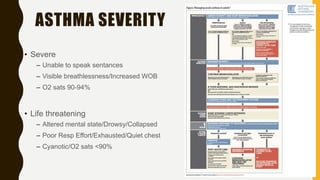
ASTHMA SEVERITY
• Severe
– Unable to speak sentances
– Visible breathlessness/Increased WOB
– O2 sats 90-94%
• Life threatening
– Altered mental state/Drowsy/Collapsed
– Poor Resp Effort/Exhausted/Quiet chest
– Cyanotic/O2 sats <90%
RISK FACTORS
• Previous poor control of asthma
– Frequent ED/hospital presentations
– Previous severe exacerbations / ICU & Intubation etc.
• Treatment received prior to presentation
– Frequency of Ventolin use
– Poor compliance with asthma medications /action plans
• Other factors:
– Smoking/Illicit drug use, psychosocial problems
– Comorbidities - cardiovascular or chronic lung disease
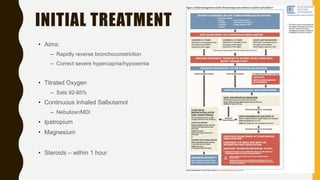
INITIAL TREATMENT
• Aims:
– Rapidly reverse bronchoconstriction
– Correct severe hypercapnia/hypoxemia
• Titrated Oxygen
– Sats 92-95%
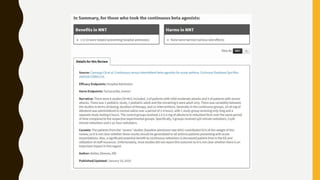
• Continuous Inhaled Salbutamol
– Nebulizer/MDI
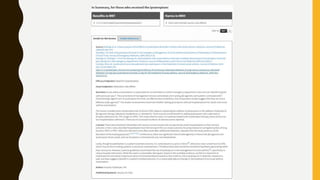
• Ipatropium
• Magnesium
• Steroids – within 1 hour
CASE MB
• Treated with 3 Ventolin nebs/ipratropium/hydrocort/magnesium
• Initial gases pH 7.15, Normal CO2, bicarb 20, Lac 2.4
• CXR clear
• Initial concerns may require ICU admission
• However clinically improved with treatment
• Reviewed by ICU – planned for HDU
CASE MB
Through the night:
– Drowsy/Tiring
– Increased WOB
– Gases relatively unchanged.
• Contacted HDU&ICU – Busy with another code
• Given cont Ventolin nebs with limited effect
• Started on NIV
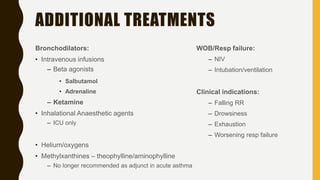
ADDITIONAL TREATMENTS
Bronchodilators:
• Intravenous infusions
– Beta agonists
• Salbutamol
• Adrenaline
– Ketamine
• Inhalational Anaesthetic agents
– ICU only
• Helium/oxygens
• Methylxanthines – theophylline/aminophylline
– No longer recommended as adjunct in acute asthma
WOB/Resp failure:
– NIV
– Intubation/ventilation
Clinical indications:
– Falling RR
– Drowsiness
– Exhaustion
– Worsening resp failure
MECH VENTILATION
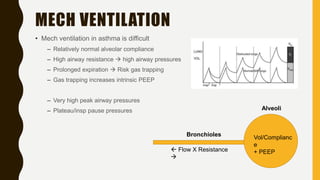
• Mech ventilation in asthma is difficult
– Relatively normal alveolar compliance
– High airway resistance  high airway pressures
– Prolonged expiration  Risk gas trapping
– Gas trapping increases intrinsic PEEP
– Very high peak airway pressures
– Plateau/insp pause pressures
 Flow X Resistance

Vol/Complianc
e
+ PEEP
Alveoli
Bronchioles
MECH VENTILATION
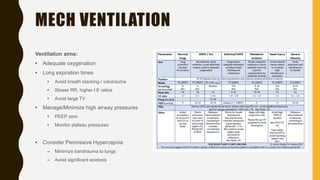
Ventilation aims:
• Adequate oxygenation
• Long expiration times
• Avoid breath stacking / volutrauma
• Slower RR, higher I:E ratios
• Avoid large TV
• Manage/Minimize high airway pressures
• PEEP zero
• Monitor plateau pressures
• Consider Permissive Hypercapnia
– Minimize barotrauma to lungs
– Avoid significant acidosis
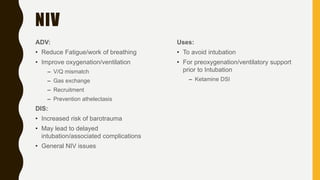
NIV
ADV:
• Reduce Fatigue/work of breathing
• Improve oxygenation/ventilation
– V/Q mismatch
– Gas exchange
– Recruitment
– Prevention athelectasis
DIS:
• Increased risk of barotrauma
• May lead to delayed
intubation/associated complications
• General NIV issues
Uses:
• To avoid intubation
• For preoxygenation/ventilatory support
prior to Intubation
– Ketamine DSI
INDUCTION
• Ketamine
– Drug of choice – bronchodilator
• Consider DSI
– Optimizing patient with Ketamine/NIV prior to intubation
• Prone to hypotension post intubation – caution with propofol etc.
– Breath stacking
– Hypovolemia
– Induction drugs
– Tension PTX
CASE MB
• Reviewed by ICU – Trial of Ketamine and Adrenaline infusions in ED as temporising
measure
• Taken up to ICU – Intubated - Ketamine/NIV prior
• Spent 2 nights intubated and further 5 days on the ward
• Discharged home with Preventer (increased dose)
• Seen further 5 weeks later on a night shift for another exacerbation of asthma…
RESOURCES/REFERENCES
• LITFL
– Acute Severe Asthma http://lifeinthefastlane.com/ccc/acute-severe-asthma/
– NIV & Asthma http://lifeinthefastlane.com/ccc/non-invasive-ventilation-niv-and-asthma/
• Australian Asthma Handbook https://www.asthmahandbook.org.au/
• EMRAP – C3 Asthma Summary Aug 2016 – S Swadron, M Herbert
• TheNNT: Quick Summaries of Evidence Based Medicine http://www.thennt.com/
• Ventilator settings in asthma – James Rippey http://scghed.com/2015/11/updated-
suggested-initial-ventilator-settings-112015/

Severe asthma management

  • 1.
    SEVERE ASTHMA M AN A G E M E N T A N D V E N T I L AT I O N S T R AT E G I E S
  • 2.
    ASTHMA Characteristics – Episodic reversiblebronchoconstriction – Airway inflammation – Increased mucus production Consequences – Increased WOB • Increased airway resistance/Reduced Compliance – Type 2 Resp failure – Hypercapnia & Hypoxia • Impaired gas exchange • V/Q mismatches
  • 3.
    CASE MB • 28/M •Hx Asthma – Dx 2011 1 Prior hospital admission 1 yr ago – overnight • Flixotide preventer, takes PRN Ventolin prior to exercise • Office job, smoker • BIBA: • Unwell 1 week – cough/sputum /SOB/wheezy Has been self treating with Ventolin • Spoke in words, accessory muscle use, diaphoretic, not confused • RR 30, Sats 88RA, widespread wheeze
  • 4.
    ASTHMA SEVERITY • Severe –Unable to speak sentances – Visible breathlessness/Increased WOB – O2 sats 90-94% • Life threatening – Altered mental state/Drowsy/Collapsed – Poor Resp Effort/Exhausted/Quiet chest – Cyanotic/O2 sats <90%
  • 5.
    RISK FACTORS • Previouspoor control of asthma – Frequent ED/hospital presentations – Previous severe exacerbations / ICU & Intubation etc. • Treatment received prior to presentation – Frequency of Ventolin use – Poor compliance with asthma medications /action plans • Other factors: – Smoking/Illicit drug use, psychosocial problems – Comorbidities - cardiovascular or chronic lung disease
  • 6.
    INITIAL TREATMENT • Aims: –Rapidly reverse bronchoconstriction – Correct severe hypercapnia/hypoxemia • Titrated Oxygen – Sats 92-95% • Continuous Inhaled Salbutamol – Nebulizer/MDI • Ipatropium • Magnesium • Steroids – within 1 hour
  • 7.
    CASE MB • Treatedwith 3 Ventolin nebs/ipratropium/hydrocort/magnesium • Initial gases pH 7.15, Normal CO2, bicarb 20, Lac 2.4 • CXR clear • Initial concerns may require ICU admission • However clinically improved with treatment • Reviewed by ICU – planned for HDU
  • 12.
    CASE MB Through thenight: – Drowsy/Tiring – Increased WOB – Gases relatively unchanged. • Contacted HDU&ICU – Busy with another code • Given cont Ventolin nebs with limited effect • Started on NIV
  • 13.
    ADDITIONAL TREATMENTS Bronchodilators: • Intravenousinfusions – Beta agonists • Salbutamol • Adrenaline – Ketamine • Inhalational Anaesthetic agents – ICU only • Helium/oxygens • Methylxanthines – theophylline/aminophylline – No longer recommended as adjunct in acute asthma WOB/Resp failure: – NIV – Intubation/ventilation Clinical indications: – Falling RR – Drowsiness – Exhaustion – Worsening resp failure
  • 14.
    MECH VENTILATION • Mechventilation in asthma is difficult – Relatively normal alveolar compliance – High airway resistance  high airway pressures – Prolonged expiration  Risk gas trapping – Gas trapping increases intrinsic PEEP – Very high peak airway pressures – Plateau/insp pause pressures  Flow X Resistance  Vol/Complianc e + PEEP Alveoli Bronchioles
  • 15.
    MECH VENTILATION Ventilation aims: •Adequate oxygenation • Long expiration times • Avoid breath stacking / volutrauma • Slower RR, higher I:E ratios • Avoid large TV • Manage/Minimize high airway pressures • PEEP zero • Monitor plateau pressures • Consider Permissive Hypercapnia – Minimize barotrauma to lungs – Avoid significant acidosis
  • 16.
    NIV ADV: • Reduce Fatigue/workof breathing • Improve oxygenation/ventilation – V/Q mismatch – Gas exchange – Recruitment – Prevention athelectasis DIS: • Increased risk of barotrauma • May lead to delayed intubation/associated complications • General NIV issues Uses: • To avoid intubation • For preoxygenation/ventilatory support prior to Intubation – Ketamine DSI
  • 17.
    INDUCTION • Ketamine – Drugof choice – bronchodilator • Consider DSI – Optimizing patient with Ketamine/NIV prior to intubation • Prone to hypotension post intubation – caution with propofol etc. – Breath stacking – Hypovolemia – Induction drugs – Tension PTX
  • 18.
    CASE MB • Reviewedby ICU – Trial of Ketamine and Adrenaline infusions in ED as temporising measure • Taken up to ICU – Intubated - Ketamine/NIV prior • Spent 2 nights intubated and further 5 days on the ward • Discharged home with Preventer (increased dose) • Seen further 5 weeks later on a night shift for another exacerbation of asthma…
  • 19.
    RESOURCES/REFERENCES • LITFL – AcuteSevere Asthma http://lifeinthefastlane.com/ccc/acute-severe-asthma/ – NIV & Asthma http://lifeinthefastlane.com/ccc/non-invasive-ventilation-niv-and-asthma/ • Australian Asthma Handbook https://www.asthmahandbook.org.au/ • EMRAP – C3 Asthma Summary Aug 2016 – S Swadron, M Herbert • TheNNT: Quick Summaries of Evidence Based Medicine http://www.thennt.com/ • Ventilator settings in asthma – James Rippey http://scghed.com/2015/11/updated- suggested-initial-ventilator-settings-112015/

Editor's Notes

  • #3 Commonly managed in community – salbutamol MDI/PO steroids Early treatment prevents many hospital presentations/admissions for severe exacerbations.
  • #4 H/over to me – initial presentation Q: comment on Severity of his asthma
  • #5  Sig morbitity from underestimation of severity of exacerbation Q: What sorts of patients are more likely to have severe/life threatening exacerbations
  • #7 MDI proven to be equivalent to Neb in those that can use it appropriately. Neb less efficient - has Larger particle and more drug lost However acute illness may prevent use of MDI Advantage of MDI – less labour intensive/inexpensive Reasessment after initial treatment Examination of evidence
  • #8 Handed over to myself Examination of evidence behind treatments.
  • #9 Cochrane Syst rev 461 pts Beta agonists established mainstay in treatment Continuous vs intermittent 1 in 10 prevented hospital admission
  • #10 7 RCTS – hetrogenous studies Anticholinergics less effective than beta agonists Studies compared ipratropium vs placebo as an addition to beta agonists Possibly 1 in 11 prevented hospitalization However inexpensive with good safety profile
  • #11 Cochraine syst rev 1 in 3 in Severe asthma No benefit in non-severe asthma
  • #12 Cochraine syst review Given winthin 1 hour – minimize the delay to onset Q: IN the asthmatic that’s not improved/deteriorating - treatment options?
  • #13 Considering ?IV Ventolin/Adrenaline/ketamine No central access Had never used drugs for this indication before Needed advice Felt that patient will likely need intubation
  • #14 Intravenous vs Inhaled beta agonists Inhalational tend to have lower rate of adverse effects – tachycardia/arrhythmias/myocardial injury Case reports of effectiveness of ketamine in status asthmaticus Inhalational agents – limited by expense/need for equipment and staff, Heliox - ?lower density thought to reduce airway resistance – conflicting evidence 2012 cochraine review on aminophylline – no significant additional bronchodilation over beta agonists alone Increased adverse effects – GIT/arrhythmias Addition of intravenous aminophylline to inhaled beta(2)-agonists in adults with acute asthma. Nair P, Milan SJ, Rowe BH Cochrane Database Syst Rev. 2012;12:CD002742. 
  • #15 Discuss normal airway – normal function, volumes and pressures – upper limits for barotrauma Barotrauma results from high pressure in alveoli not larger airways Peak airway pressure correlates poorly with alveolar pressure Inspiratory pause/plateau pressures
  • #17 Evidence base not as established as in COPD Difficulties assicuated with mech ventilation increased length of stay, cost, morality Potential benefits of NIV