


Management of Acute
Asthma Exacerbation
Headlines
INTRODUCTION
EPIDEMIOLOGY
PATHOGENESIS
DIAGNOSIS
DIFFERENTIAL DIAGNOSIS
ASSESMENT
TREATMENT
Hello!
1.
INTRODUCTION
Let’sstartwith thefirst setofslides
Definitions.
✢Asthma:isan inflammatorydiseaseoftheairwaysfeaturing reversible
airway obstruction
✢Asthma exacerbations representacuteor subacuteincreasesin airway
obstruction thatrequireatemporarychangein treatmentto prevent
furtherworsening (moderateexacerbation)or thatrequireurgent action to
preventseriousmorbidity ormortality(severeexacerbation).
✢Status asthmaticus (Acute severe asthma) describesan exacerbation
of asthmathatfails toimprove rapidly(usuallywithin 1hour)with
intensive bronchodilator therapy.
EPIDEMIOLOGY
✢Mortality from asthma isalso not negligible:it is
estimated at 1.4per 100,000 annually inthe United
States. Although most deaths from acute asthma occur
outside the hospital, patientswho are admitted tothe
emergencydepartment (ED)or ageneralward and failto
improve should be admitted to anICUor at least to a
high-dependencyunit(HDU),whereventilatory support
andappropriate monitoringispossible.
Pathophysiology
✢The2007 ExpertPanelReport3(EPR-3)oftheNationalAsthma EducationandPreventionProgram(NAEPP)notedseveral
key changesintheunderstandingofthepathophysiology ofasthma[1]
✢Thecritical roleof inflammation hasbeen furthersubstantiated,but evidence is emerging
for considerable variability in thepatternof inflammation,thusindicating phenotypic
differences thatmay influence treatmentresponses
✢Oftheenvironmentalfactors, allergic reactions remainimportant.Evidence alsosuggestsa
keyandexpanding rolefor viral respiratoryinfections in these processes
✢Theonsetof asthmafor mostpatientsbegins early inlife, with thepatternof disease
persistencedeterminedby early,recognizable riskfactors including atopic disease,recurrent
wheezing,anda parentalhistory of asthma
✢Currentasthmatreatmentwithanti-inflammatory therapydoes notappear toprevent
progression oftheunderlying diseaseseverity
✢Thepathophysiology ofasthma iscomplexand involves
the followingcomponents:
✢Airway inflammation
✢Intermittentairflow obstruction
✢Bronchial hyperresponsiveness
2.
DIAGNOSIS
NotallwheezychestisAsthma
Diagnosis of asthma
is based on the recognition ofa characteristic patternof symptoms
andsignsand the absence of an alternative explanation forthem.
The key is to takeacareful clinicalhistory.
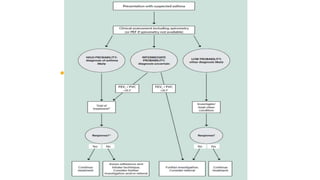
✢Spirometry is the preferred initial test to assess the
presence and severity of airflow obstruction
Obtainan objective measureofmaximalexpiratoryairflowto
assesstheseverityofobstructionwhenever possible (peak expiratory
flow rate [PEFR]orforcedexpiratoryvolumein1 second [FEVl]).
PEFR (or FEV l ) <40% o f baseline is severe obstruction.
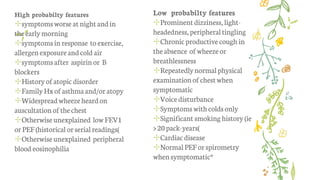
High probabilty features
✢symptomsworse at night andin
theearlymorning
✢symptomsin response to exercise,
allergen exposureandcold air
✢symptomsafter aspirin or B
blockers
✢History ofatopicdisorder
✢FamilyHxofasthmaand/oratopy
✢Widespreadwheezeheardon
auscultation ofthechest
✢Otherwiseunexplained lowFEV1
orPEF(historical orserialreadings)
✢Otherwiseunexplained peripheral
blood eosinophilia
Low probabilty features
✢Prominent dizziness, light-
headedness,peripheraltingling
✢Chronic productive cough in
theabsence of wheezeor
breathlessness
✢Repeatedlynormalphysical
examinationofchestwhen
symptomatic
✢Voice disturbance
✢Symptomswith coldsonly
✢Significant smoking history (ie
>20pack-years)
✢Cardiacdisease
✢NormalPEFor spirometry
whensymptomatic*
Maps
ouroffice
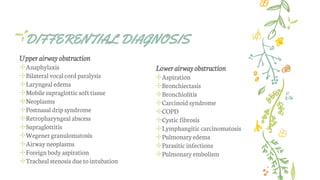
DIFFERENTIAL DIAGNOSIS
Upper airway obstruction
✢Anaphylaxis
✢Bilateral vocalcordparalysis
✢Laryngeal edema
✢Mobile supraglottic softtissue
✢Neoplasms
✢Postnasal drip syndrome
✢Retropharyngeal abscess
✢Supraglottitis
✢Wegener granulomatosis
✢Airway neoplasms
✢Foreignbody aspiration
✢Trachealstenosis due tointubation
Lower airway obstruction
✢Aspiration
✢Bronchiectasis
✢Bronchiolitis
✢Carcinoidsyndrome
✢COPD
✢Cystic fibrosis
✢Lymphangitic carcinomatosis
✢Pulmonaryedema
✢Parasitic infections
✢Pulmonary embolism
3.
ASSESMENT
Theamount of wheezing isapoor waytoassesstheseverity
ofairwayobstruction.
Failure to appreciate leads to
mortality
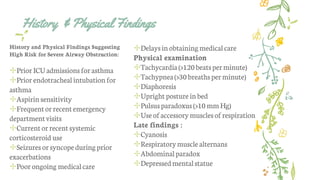
History & Physical Findings
History and Physical Findings Suggesting
High Risk for Severe Airway Obstruction:
✢Prior ICUadmissions forasthma
✢Prior endotrachealintubation for
asthma
✢Aspirin sensitivity
✢Frequentorrecentemergency
departmentvisits
✢Current or recentsystemic
corticosteroid use
✢Seizuresorsyncopeduringprior
exacerbations
✢Poor ongoing medicalcare
✢Delaysinobtaining medicalcare
Physical examination
✢Tachycardia(>120beatsperminute)
✢Tachypnea(>30breathsperminute)
✢Diaphoresis
✢Upright postureinbed
✢Pulsusparadoxus(>10mmHg)

✢Useofaccessorymusclesof respiration
Late findings :
✢Cyanosis
✢Respiratorymusclealternans
✢Abdominalparadox
✢Depressedmentalstatue
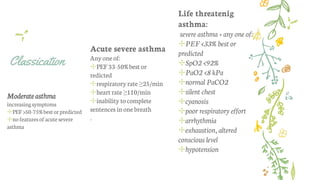
Classication
Moderate asthma
increasingsymptoms
✢PEF>50-75%bestorpredicted
✢nofeaturesofacute severe
asthma
Acute severe asthma
Anyoneof:
✢PEF33-50%best or
redicted
✢respiratory rate ≥25/min
✢heartrate ≥110/min
✢inability tocomplete
sentences inonebreath
.
Life threatenig
asthma:
severe asthma + any one of:
✢PEF <33% best or
predicted
✢SpO2 <92%
✢PaO2 <8 kPa
✢normal PaCO2
✢silent chest
✢cyanosis
✢poor respiratory effort
✢arrhythmia
✢exhaustion, altered
conscious level
✢hypotension
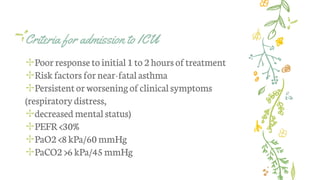
Criteria for admission to ICU
✢Poor responseto initial 1 to 2 hours oftreatment
✢Risk factors fornear-fatalasthma
✢Persistentor worseningof clinicalsymptoms
(respiratory distress,
✢decreased mental status)

✢PEFR<30%
✢PaO2 <8 kPa/60 mmHg
✢PaCO2 >6 kPa/45mmHg
When in doubt, admit the patient: ‘A night
in the ICU is better than a life in the grave’
4.
TREAT M E N T
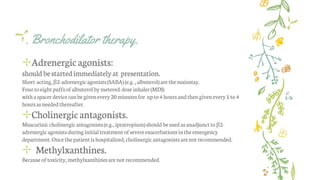
. Bronchodilator therapy.
✢Adrenergic agonists:
should bestartedimmediatelyat presentation.
Short-acting,β2-adrenergicagonists(SABA)(e.g. ,albuterol)arethemainstay.
Fourtoeightpuffsofalbuterolbymetered-doseinhaler(MDI)
withaspacer devicecanbegivenevery20minutesfor upto4 hoursandthengivenevery1 to4
hoursasneededthereafter.
✢Cholinergicantagonists.
Muscariniccholinergicantagonists(e.g., ipratropium)shouldbeusedas anadjunctto β2-
adrenergicagonistsduringinitialtreatmentof severeexacerbationsintheemergency
department.Oncethepatientis hospitalized,cholinergicantagonistsarenotrecommended.
✢ Methylxanthines.
Because of toxicity,methylxanthinesarenotrecommended.
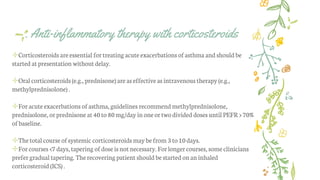
. Anti-inflammatory therapy with corticosteroids
✢Corticosteroids are essential fortreating acute exacerbations ofasthma and should be
started atpresentation without delay.
✢Oral corticosteroids (e.g., prednisone) areas effective as intravenous therapy (e.g.,
methylprednisolone) .
✢Foracute exacerbations ofasthma, guidelines recommendmethylprednisolone,
prednisolone, orprednisone at 40to 80mg/day inoneortwodivided doses until PEFR> 70%
ofbaseline.
✢Thetotal courseofsystemic corticosteroids may befrom 3to 10days.
✢Forcourses <7 days, tapering ofdose is notnecessary. Forlongercourses, someclinicians
prefer gradual tapering. Therecovering patient should bestarted onan inhaled
corticosteroid (ICS) .
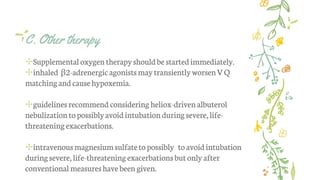
C. Other therapy
✢Supplemental oxygen therapyshouldbe startedimmediately.
✢inhaled β2-adrenergicagonistsmaytransientlyworsenVQ
matchingandcausehypoxemia.
✢guidelinesrecommend considering heliox-drivenalbuterol
nebulizationtopossiblyavoidintubationduringsevere,life-
threateningexacerbations.
✢intravenousmagnesiumsulfatetopossibly toavoidintubation
duringsevere, life-threateningexacerbationsbutonly after
conventional measureshave been given.
Administration ofadjunct measures
should never delaya needed intubation.
Unconventional Measures:
Whensevereairway obstruction isnot responding
to conventional therapyand MV,CONSIDER:
✢helium-oxygen(heliox)
✢generalanesthetics (e.g., halothane),
✢bronchoscopy withtherapeutic lavage,
✢hypothermia,
✢ extracorporeal lifesupport
. Therapies with no established role:
✢fluid administration inexcessof euvolemia,
✢mucolytics, or chestphysicaltherapy.
✢ Sedatives are contraindicated unlessthe patient
ismechanicallyventilated.
✢Antibiotics areused only whenthere isa strong
suspicionof active infection.
5.
Mechanical Ventilation
The aim of ventilatory support is to
givethe respiratory musclesthe opportunity to rest untilthe cause of
exacerbation istreated and the bronchial obstruction and
inflammation has been reversed.
The indications for ventilatory support include
✢ Signsof respiratorydistress (dyspnoea, withuse
of accessory musclesand paradoxical abdominal
motion, tachypnoea)
✢Hypercapnic acidosis (pH <7.35).
Non-invasive ventilatory support
✢Inasthmatic patients, non-invasiveventilation
could have potential benefits suchasoff-settingthe
PEEPi, re-expandingcollapsed lungandreducing
the work of breathing.
✢ An earlynon-invasivemechanical ventilation
trial maybe individually assessed but only inan
ICUenvironment.
✢These benefitshave not beenestablished for
severe asthma
NIV strategy
✢pressure support with PEEP orbilevel positive-pressure ventilation
✢Initial settings:
✢ Inspiratory pressure 6–8 cmH2O
✢ PEEP 3–5 cmH2O, FiO2 to ensure SaO2 ≥88%
✢ Inspiratory trigger set at 0.5 to 1 L/min
✢ Expiratory trigger set in the upper range (40–70% of maximal inspiratory
flow)
✢Pressurisation time set at shorter range (o.1 to 0.2 sec)
✢ Titrate PEEPby steps of 1–2cmH2Oaccording topatient’s comfort
✢(observe and assess ineffective triggering attempts)
✢Titrate pressure support level bysteps of 2 cmH2Oto patient’s
✢comfort,respiratory rate (≤25/min)and tidal volume (6–8mL/kg),
✢avoid total airway pressure above 20cmH2O.
Invasive Ventilation :Indication
✢NO clearly defined criteria
✢Failure of other measures
✢Ingeneral, any patient whorespondspoorlytoinitial
bronchodilatortherapyand hasaninitialPaCO2of40mmHg or
moreinassociationwith moderately severehypoxemia .
✢Inpatients withaPaCO2ofgreaterthan55 to70mm Hg,
increasingPaCO2(greaterthan5mmHg perhour)inassociation
withaPaO2oflessthan60 mmHg or
✢thepresence ofmetabolic acidosis,
Invasive Ventilation:Intubation
✢Oral, rather thannasal,route ofintubation ispreferable.
✢UseanEET with internaldiameter 8 mm or larger,if
possible.
✢Most experiencedhand:minor manipulation of the
larynxandtrachea canprecipitate vagalreflexesthat elicit
laryngospasm andbronchospasm
Invasive Ventilation :GOALS
✢Inasthma, theprimary goalofintubation andmechanicalventilation is to:
✢Maintainoxygen saturationofhemoglobin(>90%; 95% during
pregnancy)
✢Minimizedynamichyperinflation
✢Decrease minuteventilation
✢Increase expiratorytime
✢Accept hypercarbia
✢Monitorcloselyforcomplicationsofmechanical ventilation
.
Invasive Ventilation :Strategy
✢Avoid barotrauma due to dynamic
hyperinflationduring mechanical ventilation.
✢Controlled hypoventilation (or "permissive
hypercapnia'')isthe mainstrategythat should be
used to keep plateau airway
pressures<30 cmH20 .
✢Thecombination ofneuromuscularblocking
agentsand corticosteroids
✢hasbeenassociated withsevere myopathy. When
paralyzing
✢agentsare necessaryforventilatingthe patient,
musclefunction
✢alwaysshould be allowed torecover partially
between repetitive
✢boluses.
Thanks!
Want big impact?
Use big image.
Use charts to explain your ideas
GrayWhite Black
And tables to compare data
A B C
Yellow 10 20 7
Blue 30 15 10
Orange 5 24 16
89,526,124Whoa! That’s abig number, aren’tyou proud?
89,526,124$That’salot of money
100%Total success!
185,244 usersAndalot ofusers
Our process is easy
First Second Last
Let’s review some concepts
Yellow
Isthecolorofgold,butterand
ripelemons. Inthespectrumof
visiblelight,yellow isfound
between green andorange.
Blue
Isthecolouroftheclearsky
andthedeepsea. Itislocated
between violetandgreen on
theopticalspectrum.
Red
Isthecolorofblood,and
becauseofthisithas
historicallybeen associated
withsacrifice,dangerand
courage.
Yellow
Isthecolorofgold,butterand
ripelemons. Inthespectrumof
visiblelight,yellow isfound
between green andorange.
Blue
Isthecolouroftheclearsky
andthedeepsea. Itislocated
between violetandgreen on
theopticalspectrum.
Red
Isthecolorofblood,and
becauseofthisithas
historicallybeen associated
withsacrifice,dangerand
courage.
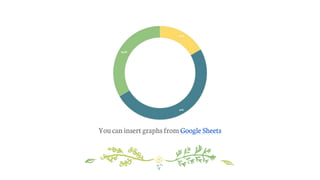
Youcan insert graphsfrom Google Sheets
Android
project
Placeyourscreenshothere
Show andexplain
yourweb,appor
software projects
using thesegadget
templates.
Placeyourscreenshot
here
iPhone
project
Show andexplain
yourweb,appor
software projects
using thesegadget
templates.
Placeyourscreenshothere
Tablet
project
Show andexplain
yourweb,appor
software projects
using thesegadget
templates.
Placeyourscreenshothere
Desktop
project
Show andexplain
yourweb,appor
software projects
using thesegadget
templates.
Credits
Special thanksto allthe people who made and
released theseawesome resources forfree:
✢ Presentationtemplate by SlidesCarnival
✢ Photographsby Unsplash
Presentation design
This presentation uses thefollowingtypographies andcolors:
✢ Titles: Yellowtail
✢ Bodycopy:Neuton
Youcan downloadthefonts onthese pages:
https://www.fontsquirrel.com/fonts/yellowtail
https://www.fontsquirrel.com/fonts/neuton
Gray #666666 /Pastel green #97bfac/Leaf green #bdcc64
You don’t need to keep this slide in your presentation. It’s only here to serve you as a design guide if you need to create
new slides or download the fonts to edit the presentation in PowerPoint®
SlidesCarnival icons are editable shapes.
Thismeans thatyou can:
● Resize themwithoutlosing quality.
● Changefill color andopacity.
Isn’tthat nice? :)
Examples:
Now you can use any emoji as an icon!
Andof course itresizeswithoutlosingqualityandyou canchangethecolor.
How?Follow Google instructionshttps://twitter.com/googledocs/status/730087240156643328
✋👆👉👍👤👦👧👨👩👪💃🏃💑❤😂
😉😋😒😭👶😸🐟🍒🍔💣📌📖🔨🎃🎈
🎨🏈🏰🌏🔌🔑and manymore...
😉

Acute severe asthma

  • 1.
  • 2.
  • 3.
  • 4.
  • 5.
    Definitions. ✢Asthma:isan inflammatorydiseaseoftheairwaysfeaturing reversible airwayobstruction ✢Asthma exacerbations representacuteor subacuteincreasesin airway obstruction thatrequireatemporarychangein treatmentto prevent furtherworsening (moderateexacerbation)or thatrequireurgent action to preventseriousmorbidity ormortality(severeexacerbation). ✢Status asthmaticus (Acute severe asthma) describesan exacerbation of asthmathatfails toimprove rapidly(usuallywithin 1hour)with intensive bronchodilator therapy.
  • 6.
    EPIDEMIOLOGY ✢Mortality from asthmaisalso not negligible:it is estimated at 1.4per 100,000 annually inthe United States. Although most deaths from acute asthma occur outside the hospital, patientswho are admitted tothe emergencydepartment (ED)or ageneralward and failto improve should be admitted to anICUor at least to a high-dependencyunit(HDU),whereventilatory support andappropriate monitoringispossible.
  • 7.
    Pathophysiology ✢The2007 ExpertPanelReport3(EPR-3)oftheNationalAsthma EducationandPreventionProgram(NAEPP)notedseveral keychangesintheunderstandingofthepathophysiology ofasthma[1] ✢Thecritical roleof inflammation hasbeen furthersubstantiated,but evidence is emerging for considerable variability in thepatternof inflammation,thusindicating phenotypic differences thatmay influence treatmentresponses ✢Oftheenvironmentalfactors, allergic reactions remainimportant.Evidence alsosuggestsa keyandexpanding rolefor viral respiratoryinfections in these processes ✢Theonsetof asthmafor mostpatientsbegins early inlife, with thepatternof disease persistencedeterminedby early,recognizable riskfactors including atopic disease,recurrent wheezing,anda parentalhistory of asthma ✢Currentasthmatreatmentwithanti-inflammatory therapydoes notappear toprevent progression oftheunderlying diseaseseverity
  • 8.
    ✢Thepathophysiology ofasthma iscomplexandinvolves the followingcomponents: ✢Airway inflammation ✢Intermittentairflow obstruction ✢Bronchial hyperresponsiveness
  • 9.
  • 10.
    Diagnosis of asthma isbased on the recognition ofa characteristic patternof symptoms andsignsand the absence of an alternative explanation forthem. The key is to takeacareful clinicalhistory.
  • 11.
    ✢Spirometry is thepreferred initial test to assess the presence and severity of airflow obstruction Obtainan objective measureofmaximalexpiratoryairflowto assesstheseverityofobstructionwhenever possible (peak expiratory flow rate [PEFR]orforcedexpiratoryvolumein1 second [FEVl]). PEFR (or FEV l ) <40% o f baseline is severe obstruction.
  • 13.
    High probabilty features ✢symptomsworseat night andin theearlymorning ✢symptomsin response to exercise, allergen exposureandcold air ✢symptomsafter aspirin or B blockers ✢History ofatopicdisorder ✢FamilyHxofasthmaand/oratopy ✢Widespreadwheezeheardon auscultation ofthechest ✢Otherwiseunexplained lowFEV1 orPEF(historical orserialreadings) ✢Otherwiseunexplained peripheral blood eosinophilia Low probabilty features ✢Prominent dizziness, light- headedness,peripheraltingling ✢Chronic productive cough in theabsence of wheezeor breathlessness ✢Repeatedlynormalphysical examinationofchestwhen symptomatic ✢Voice disturbance ✢Symptomswith coldsonly ✢Significant smoking history (ie >20pack-years) ✢Cardiacdisease ✢NormalPEFor spirometry whensymptomatic*
  • 14.
  • 15.
    DIFFERENTIAL DIAGNOSIS Upper airwayobstruction ✢Anaphylaxis ✢Bilateral vocalcordparalysis ✢Laryngeal edema ✢Mobile supraglottic softtissue ✢Neoplasms ✢Postnasal drip syndrome ✢Retropharyngeal abscess ✢Supraglottitis ✢Wegener granulomatosis ✢Airway neoplasms ✢Foreignbody aspiration ✢Trachealstenosis due tointubation Lower airway obstruction ✢Aspiration ✢Bronchiectasis ✢Bronchiolitis ✢Carcinoidsyndrome ✢COPD ✢Cystic fibrosis ✢Lymphangitic carcinomatosis ✢Pulmonaryedema ✢Parasitic infections ✢Pulmonary embolism
  • 16.
    3. ASSESMENT Theamount of wheezingisapoor waytoassesstheseverity ofairwayobstruction.
  • 17.
    Failure to appreciateleads to mortality
  • 18.
    History & PhysicalFindings History and Physical Findings Suggesting High Risk for Severe Airway Obstruction: ✢Prior ICUadmissions forasthma ✢Prior endotrachealintubation for asthma ✢Aspirin sensitivity ✢Frequentorrecentemergency departmentvisits ✢Current or recentsystemic corticosteroid use ✢Seizuresorsyncopeduringprior exacerbations ✢Poor ongoing medicalcare ✢Delaysinobtaining medicalcare Physical examination ✢Tachycardia(>120beatsperminute) ✢Tachypnea(>30breathsperminute) ✢Diaphoresis ✢Upright postureinbed ✢Pulsusparadoxus(>10mmHg) ✢Useofaccessorymusclesof respiration Late findings : ✢Cyanosis ✢Respiratorymusclealternans ✢Abdominalparadox ✢Depressedmentalstatue
  • 19.
    Classication Moderate asthma increasingsymptoms ✢PEF>50-75%bestorpredicted ✢nofeaturesofacute severe asthma Acutesevere asthma Anyoneof: ✢PEF33-50%best or redicted ✢respiratory rate ≥25/min ✢heartrate ≥110/min ✢inability tocomplete sentences inonebreath . Life threatenig asthma: severe asthma + any one of: ✢PEF <33% best or predicted ✢SpO2 <92% ✢PaO2 <8 kPa ✢normal PaCO2 ✢silent chest ✢cyanosis ✢poor respiratory effort ✢arrhythmia ✢exhaustion, altered conscious level ✢hypotension
  • 20.
    Criteria for admissionto ICU ✢Poor responseto initial 1 to 2 hours oftreatment ✢Risk factors fornear-fatalasthma ✢Persistentor worseningof clinicalsymptoms (respiratory distress, ✢decreased mental status) ✢PEFR<30% ✢PaO2 <8 kPa/60 mmHg ✢PaCO2 >6 kPa/45mmHg
  • 21.
    When in doubt,admit the patient: ‘A night in the ICU is better than a life in the grave’
  • 22.
  • 23.
    . Bronchodilator therapy. ✢Adrenergicagonists: should bestartedimmediatelyat presentation. Short-acting,β2-adrenergicagonists(SABA)(e.g. ,albuterol)arethemainstay. Fourtoeightpuffsofalbuterolbymetered-doseinhaler(MDI) withaspacer devicecanbegivenevery20minutesfor upto4 hoursandthengivenevery1 to4 hoursasneededthereafter. ✢Cholinergicantagonists. Muscariniccholinergicantagonists(e.g., ipratropium)shouldbeusedas anadjunctto β2- adrenergicagonistsduringinitialtreatmentof severeexacerbationsintheemergency department.Oncethepatientis hospitalized,cholinergicantagonistsarenotrecommended. ✢ Methylxanthines. Because of toxicity,methylxanthinesarenotrecommended.
  • 24.
    . Anti-inflammatory therapywith corticosteroids ✢Corticosteroids are essential fortreating acute exacerbations ofasthma and should be started atpresentation without delay. ✢Oral corticosteroids (e.g., prednisone) areas effective as intravenous therapy (e.g., methylprednisolone) . ✢Foracute exacerbations ofasthma, guidelines recommendmethylprednisolone, prednisolone, orprednisone at 40to 80mg/day inoneortwodivided doses until PEFR> 70% ofbaseline. ✢Thetotal courseofsystemic corticosteroids may befrom 3to 10days. ✢Forcourses <7 days, tapering ofdose is notnecessary. Forlongercourses, someclinicians prefer gradual tapering. Therecovering patient should bestarted onan inhaled corticosteroid (ICS) .
  • 25.
    C. Other therapy ✢Supplementaloxygen therapyshouldbe startedimmediately. ✢inhaled β2-adrenergicagonistsmaytransientlyworsenVQ matchingandcausehypoxemia. ✢guidelinesrecommend considering heliox-drivenalbuterol nebulizationtopossiblyavoidintubationduringsevere,life- threateningexacerbations. ✢intravenousmagnesiumsulfatetopossibly toavoidintubation duringsevere, life-threateningexacerbationsbutonly after conventional measureshave been given.
  • 26.
    Administration ofadjunct measures shouldnever delaya needed intubation.
  • 27.
    Unconventional Measures: Whensevereairway obstructionisnot responding to conventional therapyand MV,CONSIDER: ✢helium-oxygen(heliox) ✢generalanesthetics (e.g., halothane), ✢bronchoscopy withtherapeutic lavage, ✢hypothermia, ✢ extracorporeal lifesupport
  • 28.
    . Therapies withno established role: ✢fluid administration inexcessof euvolemia, ✢mucolytics, or chestphysicaltherapy. ✢ Sedatives are contraindicated unlessthe patient ismechanicallyventilated. ✢Antibiotics areused only whenthere isa strong suspicionof active infection.
  • 29.
  • 30.
    The aim ofventilatory support is to givethe respiratory musclesthe opportunity to rest untilthe cause of exacerbation istreated and the bronchial obstruction and inflammation has been reversed.
  • 31.
    The indications forventilatory support include ✢ Signsof respiratorydistress (dyspnoea, withuse of accessory musclesand paradoxical abdominal motion, tachypnoea) ✢Hypercapnic acidosis (pH <7.35).
  • 32.
    Non-invasive ventilatory support ✢Inasthmaticpatients, non-invasiveventilation could have potential benefits suchasoff-settingthe PEEPi, re-expandingcollapsed lungandreducing the work of breathing. ✢ An earlynon-invasivemechanical ventilation trial maybe individually assessed but only inan ICUenvironment. ✢These benefitshave not beenestablished for severe asthma
  • 33.
    NIV strategy ✢pressure supportwith PEEP orbilevel positive-pressure ventilation ✢Initial settings: ✢ Inspiratory pressure 6–8 cmH2O ✢ PEEP 3–5 cmH2O, FiO2 to ensure SaO2 ≥88% ✢ Inspiratory trigger set at 0.5 to 1 L/min ✢ Expiratory trigger set in the upper range (40–70% of maximal inspiratory flow) ✢Pressurisation time set at shorter range (o.1 to 0.2 sec) ✢ Titrate PEEPby steps of 1–2cmH2Oaccording topatient’s comfort ✢(observe and assess ineffective triggering attempts) ✢Titrate pressure support level bysteps of 2 cmH2Oto patient’s ✢comfort,respiratory rate (≤25/min)and tidal volume (6–8mL/kg), ✢avoid total airway pressure above 20cmH2O.
  • 34.
    Invasive Ventilation :Indication ✢NOclearly defined criteria ✢Failure of other measures ✢Ingeneral, any patient whorespondspoorlytoinitial bronchodilatortherapyand hasaninitialPaCO2of40mmHg or moreinassociationwith moderately severehypoxemia . ✢Inpatients withaPaCO2ofgreaterthan55 to70mm Hg, increasingPaCO2(greaterthan5mmHg perhour)inassociation withaPaO2oflessthan60 mmHg or ✢thepresence ofmetabolic acidosis,
  • 35.
    Invasive Ventilation:Intubation ✢Oral, ratherthannasal,route ofintubation ispreferable. ✢UseanEET with internaldiameter 8 mm or larger,if possible. ✢Most experiencedhand:minor manipulation of the larynxandtrachea canprecipitate vagalreflexesthat elicit laryngospasm andbronchospasm
  • 36.
    Invasive Ventilation :GOALS ✢Inasthma,theprimary goalofintubation andmechanicalventilation is to: ✢Maintainoxygen saturationofhemoglobin(>90%; 95% during pregnancy) ✢Minimizedynamichyperinflation ✢Decrease minuteventilation ✢Increase expiratorytime ✢Accept hypercarbia ✢Monitorcloselyforcomplicationsofmechanical ventilation .
  • 37.
    Invasive Ventilation :Strategy ✢Avoidbarotrauma due to dynamic hyperinflationduring mechanical ventilation. ✢Controlled hypoventilation (or "permissive hypercapnia'')isthe mainstrategythat should be used to keep plateau airway pressures<30 cmH20 .
  • 38.
    ✢Thecombination ofneuromuscularblocking agentsand corticosteroids ✢hasbeenassociatedwithsevere myopathy. When paralyzing ✢agentsare necessaryforventilatingthe patient, musclefunction ✢alwaysshould be allowed torecover partially between repetitive ✢boluses.
  • 39.
  • 41.
  • 42.
    Use charts toexplain your ideas GrayWhite Black
  • 43.
    And tables tocompare data A B C Yellow 10 20 7 Blue 30 15 10 Orange 5 24 16
  • 44.
    89,526,124Whoa! That’s abignumber, aren’tyou proud?
  • 45.
    89,526,124$That’salot of money 100%Totalsuccess! 185,244 usersAndalot ofusers
  • 46.
    Our process iseasy First Second Last
  • 47.
    Let’s review someconcepts Yellow Isthecolorofgold,butterand ripelemons. Inthespectrumof visiblelight,yellow isfound between green andorange. Blue Isthecolouroftheclearsky andthedeepsea. Itislocated between violetandgreen on theopticalspectrum. Red Isthecolorofblood,and becauseofthisithas historicallybeen associated withsacrifice,dangerand courage. Yellow Isthecolorofgold,butterand ripelemons. Inthespectrumof visiblelight,yellow isfound between green andorange. Blue Isthecolouroftheclearsky andthedeepsea. Itislocated between violetandgreen on theopticalspectrum. Red Isthecolorofblood,and becauseofthisithas historicallybeen associated withsacrifice,dangerand courage.
  • 48.
  • 49.
  • 50.
  • 51.
  • 52.
  • 53.
    Credits Special thanksto allthepeople who made and released theseawesome resources forfree: ✢ Presentationtemplate by SlidesCarnival ✢ Photographsby Unsplash
  • 54.
    Presentation design This presentationuses thefollowingtypographies andcolors: ✢ Titles: Yellowtail ✢ Bodycopy:Neuton Youcan downloadthefonts onthese pages: https://www.fontsquirrel.com/fonts/yellowtail https://www.fontsquirrel.com/fonts/neuton Gray #666666 /Pastel green #97bfac/Leaf green #bdcc64 You don’t need to keep this slide in your presentation. It’s only here to serve you as a design guide if you need to create new slides or download the fonts to edit the presentation in PowerPoint®
  • 55.
    SlidesCarnival icons areeditable shapes. Thismeans thatyou can: ● Resize themwithoutlosing quality. ● Changefill color andopacity. Isn’tthat nice? :) Examples:
  • 56.
    Now you canuse any emoji as an icon! Andof course itresizeswithoutlosingqualityandyou canchangethecolor. How?Follow Google instructionshttps://twitter.com/googledocs/status/730087240156643328 ✋👆👉👍👤👦👧👨👩👪💃🏃💑❤😂 😉😋😒😭👶😸🐟🍒🍔💣📌📖🔨🎃🎈 🎨🏈🏰🌏🔌🔑and manymore... 😉