by Dr. EMMANUEL NIMROD
10/25/2023 1
• Introduction
• Epidemiology
• Risk factors
• Pathophysiology
• Clinical presentation
• Management
• Differentials
• Conclusion
• References
10/25/2023 2
• Asthma is a chronic inflammatory disorder of the
airways, characterised by episodic dyspnoea, cough,
wheezing, and chest tightness that may resolve either
spontaneously or with treatment
• Acute severe asthma is an asthmatic exacerbation
characterised by persistent dyspnoea that is not
relieved by the usual standard therapy with
bronchodilators within 30 mins to 1 hour.
• An acute asthmatic attack that is severe enough to
persist, despite the patient’s optimum use of his/her
conventional medication.
10/25/2023 3
• It also described a clinical pattern of acute
asthmatic attack that requires high dose of
Inhaled corticosteroids and another control
medication for it to remain controlled or any
asthma that persists despite this therapy.
• It is synonymous with, and has largely replaced,
the old term status asthmaticus.
• Medical emergency
• The commonest respiratory emergency in clinical
practice.
10/25/2023 4
• Over 300million individuals are affected
• Global prevalence range between 1 and
18%
• Global mortality rate more than 250,000
annually.
• MR in Nigeria is 4.9% (Erhabor & Adigun)
• More than 75% of hospital admissions and
mortalities due to asthma are potentially
preventable.
10/25/2023 5
Non modifiable
 Age
 Gender
 Genetic and epigenetic factors
 Race
10/25/2023 6
Modifiable
 Occupation
 Obesity
 Smoking
 Infections
Co morbidities e.g severe sinusitis, OM,
GERD
10/25/2023 7
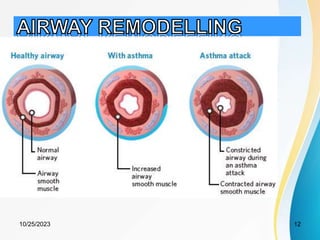
• Bronchospasm
• Edema and inflammation
• Mucus production
10/25/2023 8
• Multifactorial
• Type 1 hypersensitivity reaction that occurs
in two stages:
o exposure to innocuous agents and
sensitization
o Subsequent exposure and reaction
a. Early acute bronchospastic response
b. late inflammatory response
10/25/2023 9
• Both processes have in common air flow
limitation.
• Inspiration is an active process while expiration
is passive (4:1).
• Air trapping: hyperinflation of the lungs
increased intra-alveolar pressure.
• Compartmentalization into slow and fast
• V/Q mismatch
• Compensatory response: increased respiratory
drive, initial respiratory alkalosis and a later
acidosis.
10/25/2023 10
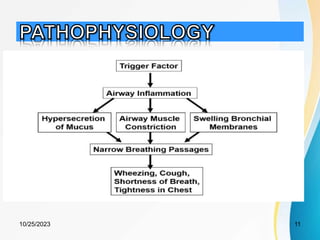
• Bronchospasm
• Edema and inflammation
• Mucus production
10/25/2023 11
10/25/2023 12
Symptoms and signs depend on the severity of the
disease.
In majority of patients
• Prolonged exposure to allergen or respiratory
infection preceding the acute exacerbation
• History of rapid increase in the daily use of
bronchodilators to control acute symptoms.
• Early warning signs of nocturnal symptoms of
cough, wheeze, chest tightness and dyspnoea,
which are progressive and poorly responsive to
bronchodilators.
10/25/2023 13
10/25/2023 14
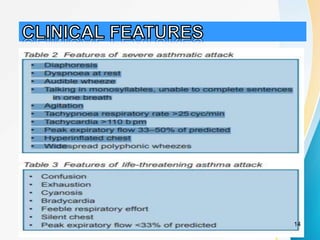
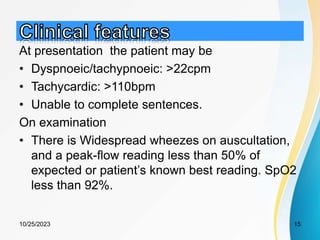
At presentation the patient may be
• Dyspnoeic/tachypnoeic: >22cpm
• Tachycardic: >110bpm
• Unable to complete sentences.
On examination
• There is Widespread wheezes on auscultation,
and a peak-flow reading less than 50% of
expected or patient’s known best reading. SpO2
less than 92%.
10/25/2023 15
Early Patient assessment
The goals of management is
a. To relieving the severe airflow obstruction
b. To restore normal lung function,
c. To correct hypoxaemia, arrest any life-
threatening complications, and prevent
future relapses.
10/25/2023 16
• Acute severe asthma is a medical
emergency, and should be approached
using the ABC of resuscitation.
• Airway
• Breathing
• Circulation
10/25/2023 17
• Oxygen therapy
Oxygen given at high doses and flow rates helps to prevent tissue
hypoxia, corrects pulmonary hypertension, and enhances
bronchodilation. It should be given as 35–60% of O2 by nasal prongs
or face mask until hypoxaemia is corrected
• B2-agonist
Short-acting inhaled B2-agonists are the drugs of choice to treat
acute severe asthma via an oxygen-driven nebuliser which ensures
that large volumes of B2-agonist are delivered directly into the
airways. When not available, a metered dose inhaler with a spacer
device can be used.
(albuterol) It has an onset of action of 5 min and duration of action of
6 h. Other drugs used include terbutaline and fenoterol.
Long-acting drugs are not recommended for emergency treatment.
10/25/2023 18
• Corticosteroids
asthma is an inflammatory disease and the
bronchospasm of acute asthmatic attack is
due to an inflammatory condition, steroids
are central in the management of acute
severe asthma
IV hydrocortisone 100–200 mg every 6
hours and /or prednisolone 30–60 mg
should be started.
10/25/2023 19
• Theophylline/aminophylline
should only be for those patients not responding to
standard therapy. Loading dose of 6 mg/kg over 15–30
min should be followed by an infusion of 0.5 mg/kg/h.
Ipratropium bromide
is a selective bronchodilator with slow onset of action
(1.5–2 h), it is not used as a first-line attack in acute
severe asthma. However, In patients who show marked
side-effects when given maximal doses of B-agonist, or
who do not respond to its therapy, adding ipratropium
bromide is a reasonable option – given in a nebulised
form at a dose of 6-hourly
10/25/2023 20
Antibiotics: in patient whose trigger is
suspected to be bacterial infection.
Oxygen saturation should be monitored
regularly.
10/25/2023 21
• Patients require monitoring closely
throughout the period of admission. This
should include clinical, physiological, and
serial blood gases monitoring. The PEF
should be measured every 15–30 min
after starting treatment until the patient is
stable.
10/25/2023 22
• Patients with evidence of severe airway obstruction who improve
minimally or deteriorate despite therapy should be admitted to an
ICU.
• This includes patients with
a. Worsening respiratory distress/respiratory arrest
b. Altered mental status/coma
c. Low SPO2 <90%,
d. PaO2 < 8 kPa (60 mmHg) and falling,
e. PaCO2 > 6 kPa (45 mmHg) and rising despite oxygen
supplementation or rising hypercabia
f. Hypotension with systolic B.P <90mmHg
10/25/2023 23
• Medical history This will include determining
• the time of onset and severity of symptoms
(especially compared with previous
exacerbations),
• all current medications, prior hospitalizations, and
emergency department admission.
• Medication compliance and symptoms control
• Attempts should be made to uncover the cause of
the recent exacerbations. Common causes include
exposure to extrinsic antigens, severe viral
respiratory infections, inadequate or incorrect
medications, exercise, emotions, drugs (such as
aspirin, NSAIDS, beta-blockers), seasonal
variations, etc.
10/25/2023 24
 Basic investigations
 Blood gas analysis
 Pulse oximetry
 Chest radiography
 Specific investigations
Lung function test
 PEFR
 Spirometry-FEV1, FEV25-75, FVC, FEV/FVC
 Provocation test- Exercise test, methacholine/histamine
 Others: exhaled nitric oxide (FeNO)
10/25/2023 25
Complications in the management of severe
asthma include:
• Respiratory failure
• Pneumothorax due to rupture of bullae
• Hypokalaemia, which can occur as a result
of hyperventilation
• Drug related complications
• Hypotension
10/25/2023 26
• Cardiac failure
• Pneumonia
• Chronic bronchitis
• Gastro esophageal reflux disease
• Foreign body aspiration
10/25/2023 27
• The outcome from acute severe asthma is
generally good.
• Death is fortunately rare but a
considerable number of deaths occur in
young people and many are preventable.
10/25/2023 28
• Acute asthmatic attack is a medical
emergency, which has a good outcome if
treated promptly.
• Failure to recognise the severity of an
attack by the physician or the patient,
contributes to delay in delivering
appropriate therapy and to under-
treatment, which can lead to death.
10/25/2023 29
• Kumar and Clark Clinical Medicine 9th
edition
• Davidson Principle and practice of
medicine 22nd Edition
• Journal of acute severe asthma 2021
• Erhabor Adigun et al 2012 on status
asthmaticus
10/25/2023 30
10/25/2023 31

Acute Severe Asthma.pptx

  • 1.
    by Dr. EMMANUELNIMROD 10/25/2023 1
  • 2.
    • Introduction • Epidemiology •Risk factors • Pathophysiology • Clinical presentation • Management • Differentials • Conclusion • References 10/25/2023 2
  • 3.
    • Asthma isa chronic inflammatory disorder of the airways, characterised by episodic dyspnoea, cough, wheezing, and chest tightness that may resolve either spontaneously or with treatment • Acute severe asthma is an asthmatic exacerbation characterised by persistent dyspnoea that is not relieved by the usual standard therapy with bronchodilators within 30 mins to 1 hour. • An acute asthmatic attack that is severe enough to persist, despite the patient’s optimum use of his/her conventional medication. 10/25/2023 3
  • 4.
    • It alsodescribed a clinical pattern of acute asthmatic attack that requires high dose of Inhaled corticosteroids and another control medication for it to remain controlled or any asthma that persists despite this therapy. • It is synonymous with, and has largely replaced, the old term status asthmaticus. • Medical emergency • The commonest respiratory emergency in clinical practice. 10/25/2023 4
  • 5.
    • Over 300millionindividuals are affected • Global prevalence range between 1 and 18% • Global mortality rate more than 250,000 annually. • MR in Nigeria is 4.9% (Erhabor & Adigun) • More than 75% of hospital admissions and mortalities due to asthma are potentially preventable. 10/25/2023 5
  • 6.
    Non modifiable  Age Gender  Genetic and epigenetic factors  Race 10/25/2023 6
  • 7.
    Modifiable  Occupation  Obesity Smoking  Infections Co morbidities e.g severe sinusitis, OM, GERD 10/25/2023 7
  • 8.
    • Bronchospasm • Edemaand inflammation • Mucus production 10/25/2023 8
  • 9.
    • Multifactorial • Type1 hypersensitivity reaction that occurs in two stages: o exposure to innocuous agents and sensitization o Subsequent exposure and reaction a. Early acute bronchospastic response b. late inflammatory response 10/25/2023 9
  • 10.
    • Both processeshave in common air flow limitation. • Inspiration is an active process while expiration is passive (4:1). • Air trapping: hyperinflation of the lungs increased intra-alveolar pressure. • Compartmentalization into slow and fast • V/Q mismatch • Compensatory response: increased respiratory drive, initial respiratory alkalosis and a later acidosis. 10/25/2023 10
  • 11.
    • Bronchospasm • Edemaand inflammation • Mucus production 10/25/2023 11
  • 12.
  • 13.
    Symptoms and signsdepend on the severity of the disease. In majority of patients • Prolonged exposure to allergen or respiratory infection preceding the acute exacerbation • History of rapid increase in the daily use of bronchodilators to control acute symptoms. • Early warning signs of nocturnal symptoms of cough, wheeze, chest tightness and dyspnoea, which are progressive and poorly responsive to bronchodilators. 10/25/2023 13
  • 14.
  • 15.
    At presentation thepatient may be • Dyspnoeic/tachypnoeic: >22cpm • Tachycardic: >110bpm • Unable to complete sentences. On examination • There is Widespread wheezes on auscultation, and a peak-flow reading less than 50% of expected or patient’s known best reading. SpO2 less than 92%. 10/25/2023 15
  • 16.
    Early Patient assessment Thegoals of management is a. To relieving the severe airflow obstruction b. To restore normal lung function, c. To correct hypoxaemia, arrest any life- threatening complications, and prevent future relapses. 10/25/2023 16
  • 17.
    • Acute severeasthma is a medical emergency, and should be approached using the ABC of resuscitation. • Airway • Breathing • Circulation 10/25/2023 17
  • 18.
    • Oxygen therapy Oxygengiven at high doses and flow rates helps to prevent tissue hypoxia, corrects pulmonary hypertension, and enhances bronchodilation. It should be given as 35–60% of O2 by nasal prongs or face mask until hypoxaemia is corrected • B2-agonist Short-acting inhaled B2-agonists are the drugs of choice to treat acute severe asthma via an oxygen-driven nebuliser which ensures that large volumes of B2-agonist are delivered directly into the airways. When not available, a metered dose inhaler with a spacer device can be used. (albuterol) It has an onset of action of 5 min and duration of action of 6 h. Other drugs used include terbutaline and fenoterol. Long-acting drugs are not recommended for emergency treatment. 10/25/2023 18
  • 19.
    • Corticosteroids asthma isan inflammatory disease and the bronchospasm of acute asthmatic attack is due to an inflammatory condition, steroids are central in the management of acute severe asthma IV hydrocortisone 100–200 mg every 6 hours and /or prednisolone 30–60 mg should be started. 10/25/2023 19
  • 20.
    • Theophylline/aminophylline should onlybe for those patients not responding to standard therapy. Loading dose of 6 mg/kg over 15–30 min should be followed by an infusion of 0.5 mg/kg/h. Ipratropium bromide is a selective bronchodilator with slow onset of action (1.5–2 h), it is not used as a first-line attack in acute severe asthma. However, In patients who show marked side-effects when given maximal doses of B-agonist, or who do not respond to its therapy, adding ipratropium bromide is a reasonable option – given in a nebulised form at a dose of 6-hourly 10/25/2023 20
  • 21.
    Antibiotics: in patientwhose trigger is suspected to be bacterial infection. Oxygen saturation should be monitored regularly. 10/25/2023 21
  • 22.
    • Patients requiremonitoring closely throughout the period of admission. This should include clinical, physiological, and serial blood gases monitoring. The PEF should be measured every 15–30 min after starting treatment until the patient is stable. 10/25/2023 22
  • 23.
    • Patients withevidence of severe airway obstruction who improve minimally or deteriorate despite therapy should be admitted to an ICU. • This includes patients with a. Worsening respiratory distress/respiratory arrest b. Altered mental status/coma c. Low SPO2 <90%, d. PaO2 < 8 kPa (60 mmHg) and falling, e. PaCO2 > 6 kPa (45 mmHg) and rising despite oxygen supplementation or rising hypercabia f. Hypotension with systolic B.P <90mmHg 10/25/2023 23
  • 24.
    • Medical historyThis will include determining • the time of onset and severity of symptoms (especially compared with previous exacerbations), • all current medications, prior hospitalizations, and emergency department admission. • Medication compliance and symptoms control • Attempts should be made to uncover the cause of the recent exacerbations. Common causes include exposure to extrinsic antigens, severe viral respiratory infections, inadequate or incorrect medications, exercise, emotions, drugs (such as aspirin, NSAIDS, beta-blockers), seasonal variations, etc. 10/25/2023 24
  • 25.
     Basic investigations Blood gas analysis  Pulse oximetry  Chest radiography  Specific investigations Lung function test  PEFR  Spirometry-FEV1, FEV25-75, FVC, FEV/FVC  Provocation test- Exercise test, methacholine/histamine  Others: exhaled nitric oxide (FeNO) 10/25/2023 25
  • 26.
    Complications in themanagement of severe asthma include: • Respiratory failure • Pneumothorax due to rupture of bullae • Hypokalaemia, which can occur as a result of hyperventilation • Drug related complications • Hypotension 10/25/2023 26
  • 27.
    • Cardiac failure •Pneumonia • Chronic bronchitis • Gastro esophageal reflux disease • Foreign body aspiration 10/25/2023 27
  • 28.
    • The outcomefrom acute severe asthma is generally good. • Death is fortunately rare but a considerable number of deaths occur in young people and many are preventable. 10/25/2023 28
  • 29.
    • Acute asthmaticattack is a medical emergency, which has a good outcome if treated promptly. • Failure to recognise the severity of an attack by the physician or the patient, contributes to delay in delivering appropriate therapy and to under- treatment, which can lead to death. 10/25/2023 29
  • 30.
    • Kumar andClark Clinical Medicine 9th edition • Davidson Principle and practice of medicine 22nd Edition • Journal of acute severe asthma 2021 • Erhabor Adigun et al 2012 on status asthmaticus 10/25/2023 30
  • 31.