Angioedema
Rosie Stroud
What is angioedema?
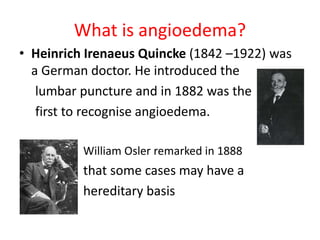
• Heinrich Irenaeus Quincke (1842 –1922) was
a German doctor. He introduced the
lumbar puncture and in 1882 was the
first to recognise angioedema.
William Osler remarked in 1888
that some cases may have a
hereditary basis
What is angioedema?
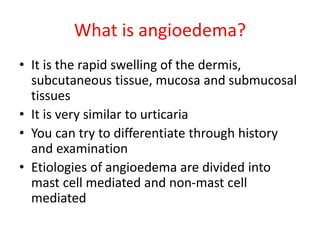
• It is the rapid swelling of the dermis,
subcutaneous tissue, mucosa and submucosal
tissues
• It is very similar to urticaria
• You can try to differentiate through history
and examination
• Etiologies of angioedema are divided into
mast cell mediated and non-mast cell
mediated
What is angioedema?
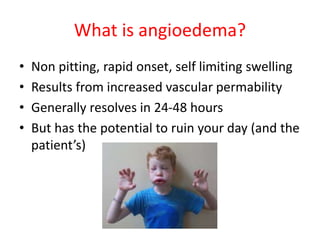
• Non pitting, rapid onset, self limiting swelling
• Results from increased vascular permability
• Generally resolves in 24-48 hours
• But has the potential to ruin your day (and the
patient’s)
What are the types of angioedema?
The causes of angioedema depend on the type
of angioedema a patient has:
1) acute allergic angioedema
2) non-allergic drug reactions
3) idiopathic angioedema
4) hereditary angioedema (HAE) / acquired C1
inhibitor deficiency
Acute allergic angioedema
• Almost always occurs with urticaria within 1-2
hours of exposure to the allergen
• Nuts, shellfish, milk, eggs
• Drugs, e.g. penicillin, NSAIDS, vaccines
• Radiocontrast media
• Natural rubber latex e.g. gloves, catheters
• Reactions will recur with repetitive exposures
or exposure to cross-reactive substances
Non-allergic drug reactions
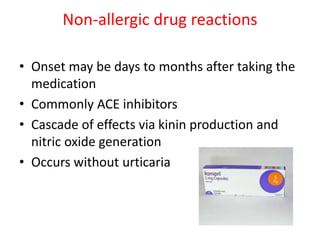
• Onset may be days to months after taking the
medication
• Commonly ACE inhibitors
• Cascade of effects via kinin production and
nitric oxide generation
• Occurs without urticaria
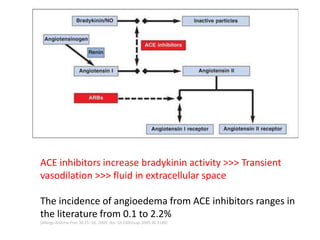
ACE inhibitors increase bradykinin activity >>> Transient
vasodilation >>> fluid in extracellular space
The incidence of angioedema from ACE inhibitors ranges in
the literature from 0.1 to 2.2%
(Allergy Asthma Proc 30:11–16, 2009; doi: 10.2500/aap.2009.30.3188)
Idiopathic angioedema
• Similar to acute allergic but angioedema keeps
on recurring and often no known cause is
found
• Usually occurs with urticaria
• 30-50% of this type of angioedema may be
associated with some types of autoimmune
disorders including SLE
http://www.dermnetnz.org/reactions/angioedema.html
Hereditary angioedema (HAE)
• 3 types:
Type 1 and II mutation of C1NH gene on chromosome 11,
(encoding C1 inhibitor protein)
Type III mutation in F12 gene on chromosome 12,
(encoding coagulation factor XII)
• Type 1 results in low levels and function of circulating C1
inhibitor;
• Type II has normal levels of C1 inhibitor protein but
reduction in function
• Occurs in 1 in 50,000 males and females (rare)
• Decreased C1 inhibitor activity leads to excessive kallikrein,
which in turn produces bradykinin, which we know is a
potent vasodilator
Acquired C1 inhibitor deficiency
• Acquired during life rather than inherited
• May be due to B-cell lymphoma or antibodies
against C1 inhibitor
• Treatment is the same as HAE
Acquired and Hereditary:
• Patients often experience no symptoms until they reach
puberty
• Swellings can occur without any provocation
• Sometimes local trauma, vigorous exercise, emotional
stress, alcohol, and hormonal factors
• Some may get a transitory prodromal non-itchy rash,
headache, visual disturbance or anxiety
• Face, hands, arms, legs, genitals, digestive tract and airway
may be affected; swellings spread slowly
• Abdominal cramps, nausea, vomiting, difficulty breathing
• Urticaria does not usually occur
Treatment
There isn’t much treatment out there…but
AIRWAY!
AIRWAY!
AIRWAY!
HAVE A LOW THRESHOLD FOR INTUBATION
USE CLINICAL EXAMINATION
Investigations
There are no point-of-care tests! Treat what you see and from the patient’s history.
Bedside
Fiberoptic laryngoscopy
Laboratory - Identify underlying cause (help with long term management):
C1 esterase inhibitor (C1-INH) assays (low/ abnormal in HAE)
C4 levels (low in HAE attacks, usually normal between attacks)
serial tryptase levels (may be elevated in anaphylaxis/ mast cell-mediated angioedema)
Imaging
CT abdomen may show evidence of angioedema in patients presenting with abdominal pain:
CT neck primarily has a role in excluding conditions that may mimic angioedema (e.g. soft tissue
infection)
Specific treatments
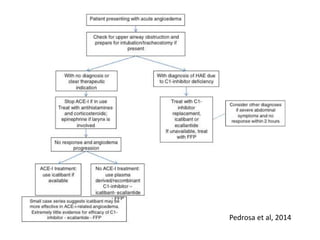
FFP – approx 40 case reports only. Limited evidence.
possible therapy for ACEI-related angioedema
FFP contains ACE, which degrades bradykinin
Therapies for HAE
– icatibant — a bradykinin 2 receptor inhibitor
– ecallantide — a kallikrein inhibitor (kallikrein is the enzyme that produces bradykinin)
– C1-INH concentrate
Role of adrenaline, steroids and antihistamines….
• unlikely to be be effective for ACEI-related angioedema
– this a bradykinin-mediated condition, not related to mast cell degranulation
– many ACEI-related angioedema cases can be managed by observation alone, without
pharmacotherapy or intubation
…..Should be adminstered if the underlying cause of angioedema is uncertain (i.e.
anaphylaxis is possible)
Treatment
• H1 antihistamine e.g IV
chlorpheniramine 10 mg or diphenhydramine
25–50 mg
• Limited evidence for adding in H2 blocker e.g
ranitidine IV 50mg
• Intravenous corticosteroids e.g. hydro-
cortisone 200 mg or methylprednisolone 50–
100 mg
• Adrenaline IM 1:1000
Pedrosa et al, 2014
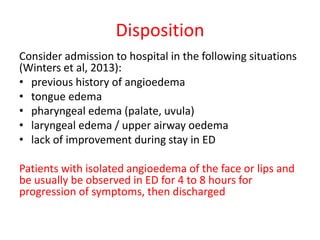
Disposition
Consider admission to hospital in the following situations
(Winters et al, 2013):
• previous history of angioedema
• tongue edema
• pharyngeal edema (palate, uvula)
• laryngeal edema / upper airway oedema
• lack of improvement during stay in ED
Patients with isolated angioedema of the face or lips and
be usually be observed in ED for 4 to 8 hours for
progression of symptoms, then discharged
Conclusion
• 4 main types of angioedema
• Pharmacological treatment is limited
• Early airway management is key
Guidelines:
http://www.aaem.org/em-resources/position-statements/2006/clinical-practice-guidelines
http://lifeinthefastlane.com/ccc/angioedema/
Pedrosa M, Prieto-García A, Sala-Cunill A; Spanish Group for the Study of Bradykinin-Mediated
Angioedema (SGBA) and the Spanish Committee of Cutaneous Allergy (CCA). Management of
angioedema without urticaria in the emergency department. Ann Med. 2014 Dec;46(8):607-18.
doi: 10.3109/07853890.2014.949300. PubMed PMID: 25580506.

Angioedema

  • 1.
  • 2.
    What is angioedema? •Heinrich Irenaeus Quincke (1842 –1922) was a German doctor. He introduced the lumbar puncture and in 1882 was the first to recognise angioedema. William Osler remarked in 1888 that some cases may have a hereditary basis
  • 3.
    What is angioedema? •It is the rapid swelling of the dermis, subcutaneous tissue, mucosa and submucosal tissues • It is very similar to urticaria • You can try to differentiate through history and examination • Etiologies of angioedema are divided into mast cell mediated and non-mast cell mediated
  • 5.
    What is angioedema? •Non pitting, rapid onset, self limiting swelling • Results from increased vascular permability • Generally resolves in 24-48 hours • But has the potential to ruin your day (and the patient’s)
  • 6.
    What are thetypes of angioedema? The causes of angioedema depend on the type of angioedema a patient has: 1) acute allergic angioedema 2) non-allergic drug reactions 3) idiopathic angioedema 4) hereditary angioedema (HAE) / acquired C1 inhibitor deficiency
  • 7.
    Acute allergic angioedema •Almost always occurs with urticaria within 1-2 hours of exposure to the allergen • Nuts, shellfish, milk, eggs • Drugs, e.g. penicillin, NSAIDS, vaccines • Radiocontrast media • Natural rubber latex e.g. gloves, catheters • Reactions will recur with repetitive exposures or exposure to cross-reactive substances
  • 8.
    Non-allergic drug reactions •Onset may be days to months after taking the medication • Commonly ACE inhibitors • Cascade of effects via kinin production and nitric oxide generation • Occurs without urticaria
  • 9.
    ACE inhibitors increasebradykinin activity >>> Transient vasodilation >>> fluid in extracellular space The incidence of angioedema from ACE inhibitors ranges in the literature from 0.1 to 2.2% (Allergy Asthma Proc 30:11–16, 2009; doi: 10.2500/aap.2009.30.3188)
  • 10.
    Idiopathic angioedema • Similarto acute allergic but angioedema keeps on recurring and often no known cause is found • Usually occurs with urticaria • 30-50% of this type of angioedema may be associated with some types of autoimmune disorders including SLE http://www.dermnetnz.org/reactions/angioedema.html
  • 11.
    Hereditary angioedema (HAE) •3 types: Type 1 and II mutation of C1NH gene on chromosome 11, (encoding C1 inhibitor protein) Type III mutation in F12 gene on chromosome 12, (encoding coagulation factor XII) • Type 1 results in low levels and function of circulating C1 inhibitor; • Type II has normal levels of C1 inhibitor protein but reduction in function • Occurs in 1 in 50,000 males and females (rare) • Decreased C1 inhibitor activity leads to excessive kallikrein, which in turn produces bradykinin, which we know is a potent vasodilator
  • 12.
    Acquired C1 inhibitordeficiency • Acquired during life rather than inherited • May be due to B-cell lymphoma or antibodies against C1 inhibitor • Treatment is the same as HAE
  • 13.
    Acquired and Hereditary: •Patients often experience no symptoms until they reach puberty • Swellings can occur without any provocation • Sometimes local trauma, vigorous exercise, emotional stress, alcohol, and hormonal factors • Some may get a transitory prodromal non-itchy rash, headache, visual disturbance or anxiety • Face, hands, arms, legs, genitals, digestive tract and airway may be affected; swellings spread slowly • Abdominal cramps, nausea, vomiting, difficulty breathing • Urticaria does not usually occur
  • 14.
    Treatment There isn’t muchtreatment out there…but AIRWAY! AIRWAY! AIRWAY! HAVE A LOW THRESHOLD FOR INTUBATION USE CLINICAL EXAMINATION
  • 15.
    Investigations There are nopoint-of-care tests! Treat what you see and from the patient’s history. Bedside Fiberoptic laryngoscopy Laboratory - Identify underlying cause (help with long term management): C1 esterase inhibitor (C1-INH) assays (low/ abnormal in HAE) C4 levels (low in HAE attacks, usually normal between attacks) serial tryptase levels (may be elevated in anaphylaxis/ mast cell-mediated angioedema) Imaging CT abdomen may show evidence of angioedema in patients presenting with abdominal pain: CT neck primarily has a role in excluding conditions that may mimic angioedema (e.g. soft tissue infection)
  • 16.
    Specific treatments FFP –approx 40 case reports only. Limited evidence. possible therapy for ACEI-related angioedema FFP contains ACE, which degrades bradykinin Therapies for HAE – icatibant — a bradykinin 2 receptor inhibitor – ecallantide — a kallikrein inhibitor (kallikrein is the enzyme that produces bradykinin) – C1-INH concentrate Role of adrenaline, steroids and antihistamines…. • unlikely to be be effective for ACEI-related angioedema – this a bradykinin-mediated condition, not related to mast cell degranulation – many ACEI-related angioedema cases can be managed by observation alone, without pharmacotherapy or intubation …..Should be adminstered if the underlying cause of angioedema is uncertain (i.e. anaphylaxis is possible)
  • 17.
    Treatment • H1 antihistaminee.g IV chlorpheniramine 10 mg or diphenhydramine 25–50 mg • Limited evidence for adding in H2 blocker e.g ranitidine IV 50mg • Intravenous corticosteroids e.g. hydro- cortisone 200 mg or methylprednisolone 50– 100 mg • Adrenaline IM 1:1000
  • 18.
  • 19.
    Disposition Consider admission tohospital in the following situations (Winters et al, 2013): • previous history of angioedema • tongue edema • pharyngeal edema (palate, uvula) • laryngeal edema / upper airway oedema • lack of improvement during stay in ED Patients with isolated angioedema of the face or lips and be usually be observed in ED for 4 to 8 hours for progression of symptoms, then discharged
  • 20.
    Conclusion • 4 maintypes of angioedema • Pharmacological treatment is limited • Early airway management is key Guidelines: http://www.aaem.org/em-resources/position-statements/2006/clinical-practice-guidelines http://lifeinthefastlane.com/ccc/angioedema/ Pedrosa M, Prieto-García A, Sala-Cunill A; Spanish Group for the Study of Bradykinin-Mediated Angioedema (SGBA) and the Spanish Committee of Cutaneous Allergy (CCA). Management of angioedema without urticaria in the emergency department. Ann Med. 2014 Dec;46(8):607-18. doi: 10.3109/07853890.2014.949300. PubMed PMID: 25580506.