 Description.
the most common tumor of the salivary glands overall, it
accounts for about 60% of all salivary gland tumors. It is
often called
a mixed tumor because it consists of both epithelial and
mesenchymal elements.
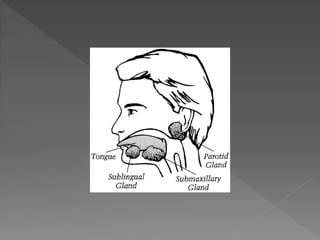
 The majority of these tumors are found in the parotid
glands, with less than 10% in the submandibular,
sublingual, and minor salivary glands
Pleomorphic adenomas may occur at any age, but the
highest incidence is in the fourth to sixth decades of life. It
also represents the most common salivary neoplasm in
children.
Clinical Presentation.
These tumors appear as painless,
firm, and mobile masses that rarely
ulcerate the overlying skin or
mucosa
In the parotid gland
these neoplasms are slow
growing and usually occur in the
posterior inferior aspect of the
superficial lobe
In the submandibular glands
they present as well-defined
palpable masses
It is difficult to distinguish
these tumors from malignant
neoplasms and indurated lymph
nodes Intraorally
pleomorphic adenomas most often
occur on the palate, followed by the
upper lip and buccal mucosa.
Pleomorphic adenomas can vary in
size, depending on the gland in which
they are located.
In the parotid gland, the tumors are
usually several centimeters in diameter
but can reach much larger sizes if left
untreated
. When observed in situ, the tumors
are encased in a pseudocapsule and
exhibit a lobulated appearance
Pathology.
The gross appearance of pleomorphic
adenoma is that of a firm smooth mass
within a pseudocapsule.
Histologically
, the lesion demonstrates both epithelial and
mesenchymal elements. The epithelial cells
make up a trabecular pattern that is
contained within a stroma.
The stroma may be chondroid, myxoid,
osteoid, or fibroid. The presence of these
different elements accounts for the name
pleomorphic tumor or mixed
One characteristic of a pleomorphic
adenoma is the presence of microscopic
projections of tumor outside of the capsule.
Treatment.
1-SURGICAL REMOVAL WITH ADEQUATE
MARGINS IS THE PRINCIPAL TREATMENT.
Because of its microscopic projections
2-this tumor requires a wide resection
to avoid recurrence
3-In spite of the capsule, close excision
should not be attempted
4-A superficial parotidectomy is
sufficient for the majority of these
lesions. A small tumor in the tail of the
parotid gland may be
removed with a wide margin of normal
tissue sparing the remainder of the
superficial lobe
5-lesions that occur in the
submandibular gland are treated by
the removal of the entire gland.
Choice of imaging modality for pleomorphic
adenoma
Computed tomography (CT) is one
of the primary imaging modalities used
to assess tumors of the salivary glands.
It allows the detection of lesions and
assessment
of their extension and characteristics as
well as their relationships to nearby
structures
However, this technique has some
limitations, and higher accuracy levels
might be obtained through magnetic
resonance imaging (MRI).
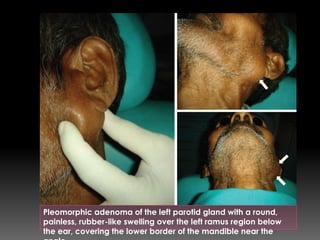
Pleomorphic adenoma of the left parotid gland with a round,
painless, rubber-like swelling over the left ramus region below
the ear, covering the lower border of the mandible near the
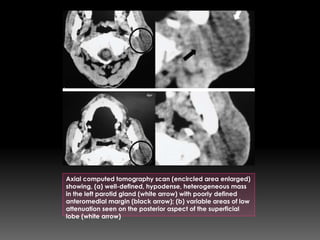
Axial computed tomography scan (encircled area enlarged)
showing, (a) well-defined, hypodense, heterogeneous mass
in the left parotid gland (white arrow) with poorly defined
anteromedial margin (black arrow); (b) variable areas of low
attenuation seen on the posterior aspect of the superficial
lobe (white arrow)
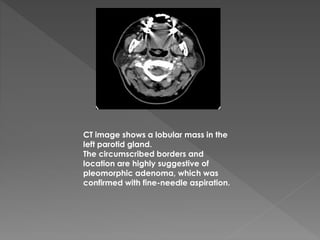
CT image shows a lobular mass in the
left parotid gland.
The circumscribed borders and
location are highly suggestive of
pleomorphic adenoma, which was
confirmed with fine-needle aspiration.
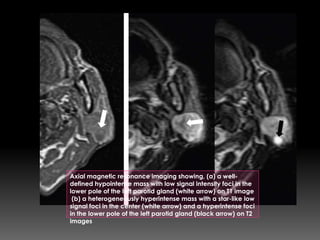
Axial magnetic resonance imaging showing, (a) a well-
defined hypointense mass with low signal intensity foci in the
lower pole of the left parotid gland (white arrow) on T1 image
(b) a heterogeneously hyperintense mass with a star-like low
signal foci in the center (white arrow) and a hyperintense foci
in the lower pole of the left parotid gland (black arrow) on T2
images
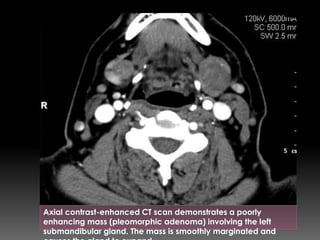
Axial contrast-enhanced CT scan demonstrates a poorly
enhancing mass (pleomorphic adenoma) involving the left
submandibular gland. The mass is smoothly marginated and
Pleomorphic adenoma

Pleomorphic adenoma

  • 4.
     Description. the mostcommon tumor of the salivary glands overall, it accounts for about 60% of all salivary gland tumors. It is often called a mixed tumor because it consists of both epithelial and mesenchymal elements.  The majority of these tumors are found in the parotid glands, with less than 10% in the submandibular, sublingual, and minor salivary glands Pleomorphic adenomas may occur at any age, but the highest incidence is in the fourth to sixth decades of life. It also represents the most common salivary neoplasm in children.
  • 5.
    Clinical Presentation. These tumorsappear as painless, firm, and mobile masses that rarely ulcerate the overlying skin or mucosa In the parotid gland these neoplasms are slow growing and usually occur in the posterior inferior aspect of the superficial lobe In the submandibular glands they present as well-defined palpable masses It is difficult to distinguish these tumors from malignant neoplasms and indurated lymph nodes Intraorally
  • 6.
    pleomorphic adenomas mostoften occur on the palate, followed by the upper lip and buccal mucosa. Pleomorphic adenomas can vary in size, depending on the gland in which they are located. In the parotid gland, the tumors are usually several centimeters in diameter but can reach much larger sizes if left untreated . When observed in situ, the tumors are encased in a pseudocapsule and exhibit a lobulated appearance
  • 7.
    Pathology. The gross appearanceof pleomorphic adenoma is that of a firm smooth mass within a pseudocapsule. Histologically , the lesion demonstrates both epithelial and mesenchymal elements. The epithelial cells make up a trabecular pattern that is contained within a stroma. The stroma may be chondroid, myxoid, osteoid, or fibroid. The presence of these different elements accounts for the name pleomorphic tumor or mixed One characteristic of a pleomorphic adenoma is the presence of microscopic projections of tumor outside of the capsule.
  • 8.
    Treatment. 1-SURGICAL REMOVAL WITHADEQUATE MARGINS IS THE PRINCIPAL TREATMENT. Because of its microscopic projections 2-this tumor requires a wide resection to avoid recurrence 3-In spite of the capsule, close excision should not be attempted 4-A superficial parotidectomy is sufficient for the majority of these lesions. A small tumor in the tail of the parotid gland may be removed with a wide margin of normal tissue sparing the remainder of the superficial lobe 5-lesions that occur in the submandibular gland are treated by the removal of the entire gland.
  • 9.
    Choice of imagingmodality for pleomorphic adenoma Computed tomography (CT) is one of the primary imaging modalities used to assess tumors of the salivary glands. It allows the detection of lesions and assessment of their extension and characteristics as well as their relationships to nearby structures However, this technique has some limitations, and higher accuracy levels might be obtained through magnetic resonance imaging (MRI).
  • 10.
    Pleomorphic adenoma ofthe left parotid gland with a round, painless, rubber-like swelling over the left ramus region below the ear, covering the lower border of the mandible near the
  • 11.
    Axial computed tomographyscan (encircled area enlarged) showing, (a) well-defined, hypodense, heterogeneous mass in the left parotid gland (white arrow) with poorly defined anteromedial margin (black arrow); (b) variable areas of low attenuation seen on the posterior aspect of the superficial lobe (white arrow)
  • 12.
    CT image showsa lobular mass in the left parotid gland. The circumscribed borders and location are highly suggestive of pleomorphic adenoma, which was confirmed with fine-needle aspiration.
  • 13.
    Axial magnetic resonanceimaging showing, (a) a well- defined hypointense mass with low signal intensity foci in the lower pole of the left parotid gland (white arrow) on T1 image (b) a heterogeneously hyperintense mass with a star-like low signal foci in the center (white arrow) and a hyperintense foci in the lower pole of the left parotid gland (black arrow) on T2 images
  • 14.
    Axial contrast-enhanced CTscan demonstrates a poorly enhancing mass (pleomorphic adenoma) involving the left submandibular gland. The mass is smoothly marginated and