

Qualitative Method
Jamal Anwar Taha
PhD student in Linguistics
Sulaimani University
School of Basic Education
Department of English
January 18th 2016
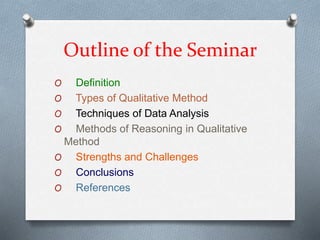
Outline of the Seminar
O Definition
O Types of Qualitative Method
O Techniques of Data Analysis
O Methods of Reasoning in Qualitative
Method
O Strengths and Challenges
O Conclusions
O References
Qualitative Research
“A form of social inquiry that
focuses on the way people
interpret and make sense of
their experiences and the
world in which they live.”
(Myers, 2002)
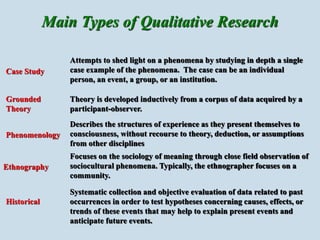
Case Study
Attempts to shed light on a phenomena by studying in depth a single
case example of the phenomena. The case can be an individual
person, an event, a group, or an institution.
Grounded
Theory
Theory is developed inductively from a corpus of data acquired by a
participant-observer.
Phenomenology
Describes the structures of experience as they present themselves to
consciousness, without recourse to theory, deduction, or assumptions
from other disciplines
Ethnography
Focuses on the sociology of meaning through close field observation of
sociocultural phenomena. Typically, the ethnographer focuses on a
community.
Historical
Systematic collection and objective evaluation of data related to past
occurrences in order to test hypotheses concerning causes, effects, or
trends of these events that may help to explain present events and
anticipate future events.
Main Types of Qualitative Research
Main Types of Qualitative Data
Collection & Analysis
O "Those who are not familiar with
qualitative methodology may be surprised
by the sheer volume of data and the
detailed level of analysis that results even
when research is confined to a small
number of subjects" (Myers, 2002).
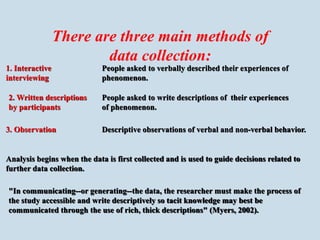
There are three main methods of
data collection:
1. Interactive
interviewing
People asked to verbally described their experiences of
phenomenon.
2. Written descriptions
by participants
People asked to write descriptions of their experiences
of phenomenon.
3. Observation Descriptive observations of verbal and non-verbal behavior.
Analysis begins when the data is first collected and is used to guide decisions related to
further data collection.
"In communicating--or generating--the data, the researcher must make the process of
the study accessible and write descriptively so tacit knowledge may best be
communicated through the use of rich, thick descriptions" (Myers, 2002).
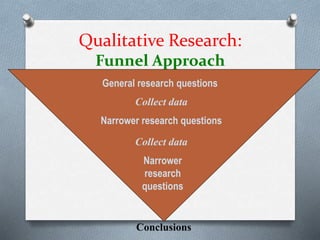
Qualitative Research:
Funnel Approach
General research questions
Collect data
Narrower research questions
Collect data
Narrower
research
questions
Conclusions
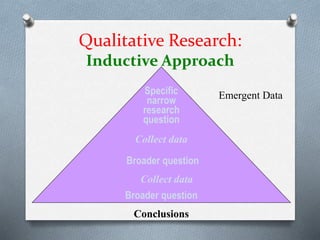
Qualitative Research:
Inductive Approach
Conclusions
Specific
narrow
research
question
Collect data
Broader question
Collect data
Broader question
Emergent Data
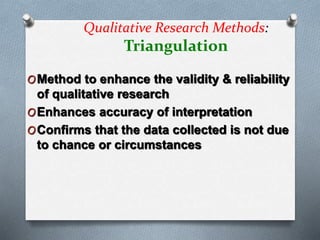
Qualitative Research Methods:
Triangulation
OMethod to enhance the validity & reliability
of qualitative research
OEnhances accuracy of interpretation
OConfirms that the data collected is not due
to chance or circumstances
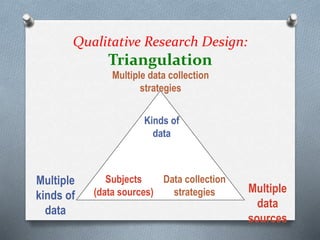
Multiple
data
sources
Multiple
kinds of
data
Multiple data collection
strategies
Subjects
(data sources)
Data collection
strategies
Kinds of
data
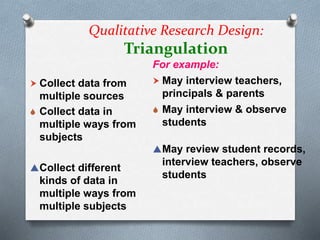
Qualitative Research Design:
Triangulation
Qualitative Research Design:
Triangulation
 Collect data from
multiple sources
 Collect data in
multiple ways from
subjects
Collect different
kinds of data in
multiple ways from
multiple subjects
For example:
 May interview teachers,
principals & parents
 May interview & observe
students
May review student records,
interview teachers, observe
students
Strengths
O aims to understand meaning
O interpretation in particular settings,
situations and conditions
O rigorous and systematic data collection
and analysis often concurrently
O data rich in descriptions
O concepts derived from the data itself
Strengths
O aims to explore and communicate
O hypothesis generation
O need for a reflexive account ‘tell how
the study was done’
O need for triangulation, multiple points
of observation
Challenges
O small scale
O non-representative samples
O bias
O access to samples
O time consuming
O record keeping
O data reduction
Challenges
O relationships between the researcher
and the researched
O subjectivity
O reliability
O verification
O difficulty in studying large populations
Conclusions
O Researcher may only know roughly in
advance what he/she is looking for.
O The design emerges as the study
unfolds.
O Researcher is the data gathering
instrument.
O Data is in the form of words, pictures
or objects.
O Subjective - individuals’ interpretation
of events is important
O Qualitative data is more 'rich', time
consuming, and not generalizable.
O Researcher tends to become
subjectively immersed in the subject
matter.
References
Brown, J. D., & Rodgers, T. S. (2002). Doing second language research.
Oxford: Oxford University Press.
Creswell, J. W. (2007). Qualitative inquiry and research design: Choosing
among five trad- itions (2nd ed.). Thousand Oaks, CA: Sage
Publications.
Creswell, J. W. (2009). Research design: Qualitative, quantitative, and
mixed methods approaches (3rd ed.). Thousand Oaks, CA: Sage
Publications.
Mackey, A., & Gass, S. M. (2005). Second language research:
Methodology and design. Mahwah, NJ: Lawrence Erlbaum
Associates.
Nunan, D. (1992). Research methods in language learning. Cambridge:
Cambridge University Press.
Richards, L., & Morse, J. M. (2007). Readme first for a user’s guide to
qualitative methods (2nd ed.). Thousand Oaks, CA: Sage
Publications.
Schwandt, T. A. (2007). The Sage dictionary of qualitative inquiry (3rd
ed.). Thousand Oaks, CA: Sage Publications.

Qualitative research

  • 1.
    Qualitative Method Jamal AnwarTaha PhD student in Linguistics Sulaimani University School of Basic Education Department of English January 18th 2016
  • 2.
    Outline of theSeminar O Definition O Types of Qualitative Method O Techniques of Data Analysis O Methods of Reasoning in Qualitative Method O Strengths and Challenges O Conclusions O References
  • 3.
    Qualitative Research “A formof social inquiry that focuses on the way people interpret and make sense of their experiences and the world in which they live.” (Myers, 2002)
  • 4.
    Case Study Attempts toshed light on a phenomena by studying in depth a single case example of the phenomena. The case can be an individual person, an event, a group, or an institution. Grounded Theory Theory is developed inductively from a corpus of data acquired by a participant-observer. Phenomenology Describes the structures of experience as they present themselves to consciousness, without recourse to theory, deduction, or assumptions from other disciplines Ethnography Focuses on the sociology of meaning through close field observation of sociocultural phenomena. Typically, the ethnographer focuses on a community. Historical Systematic collection and objective evaluation of data related to past occurrences in order to test hypotheses concerning causes, effects, or trends of these events that may help to explain present events and anticipate future events. Main Types of Qualitative Research
  • 5.
    Main Types ofQualitative Data Collection & Analysis O "Those who are not familiar with qualitative methodology may be surprised by the sheer volume of data and the detailed level of analysis that results even when research is confined to a small number of subjects" (Myers, 2002).
  • 6.
    There are threemain methods of data collection: 1. Interactive interviewing People asked to verbally described their experiences of phenomenon. 2. Written descriptions by participants People asked to write descriptions of their experiences of phenomenon. 3. Observation Descriptive observations of verbal and non-verbal behavior. Analysis begins when the data is first collected and is used to guide decisions related to further data collection. "In communicating--or generating--the data, the researcher must make the process of the study accessible and write descriptively so tacit knowledge may best be communicated through the use of rich, thick descriptions" (Myers, 2002).
  • 7.
    Qualitative Research: Funnel Approach Generalresearch questions Collect data Narrower research questions Collect data Narrower research questions Conclusions
  • 8.
    Qualitative Research: Inductive Approach Conclusions Specific narrow research question Collectdata Broader question Collect data Broader question Emergent Data
  • 9.
    Qualitative Research Methods: Triangulation OMethodto enhance the validity & reliability of qualitative research OEnhances accuracy of interpretation OConfirms that the data collected is not due to chance or circumstances
  • 10.
    Multiple data sources Multiple kinds of data Multiple datacollection strategies Subjects (data sources) Data collection strategies Kinds of data Qualitative Research Design: Triangulation
  • 11.
    Qualitative Research Design: Triangulation Collect data from multiple sources  Collect data in multiple ways from subjects Collect different kinds of data in multiple ways from multiple subjects For example:  May interview teachers, principals & parents  May interview & observe students May review student records, interview teachers, observe students
  • 12.
    Strengths O aims tounderstand meaning O interpretation in particular settings, situations and conditions O rigorous and systematic data collection and analysis often concurrently O data rich in descriptions O concepts derived from the data itself
  • 13.
    Strengths O aims toexplore and communicate O hypothesis generation O need for a reflexive account ‘tell how the study was done’ O need for triangulation, multiple points of observation
  • 14.
    Challenges O small scale Onon-representative samples O bias O access to samples O time consuming O record keeping O data reduction
  • 15.
    Challenges O relationships betweenthe researcher and the researched O subjectivity O reliability O verification O difficulty in studying large populations
  • 16.
    Conclusions O Researcher mayonly know roughly in advance what he/she is looking for. O The design emerges as the study unfolds. O Researcher is the data gathering instrument. O Data is in the form of words, pictures or objects. O Subjective - individuals’ interpretation of events is important O Qualitative data is more 'rich', time consuming, and not generalizable. O Researcher tends to become subjectively immersed in the subject matter.
  • 17.
    References Brown, J. D.,& Rodgers, T. S. (2002). Doing second language research. Oxford: Oxford University Press. Creswell, J. W. (2007). Qualitative inquiry and research design: Choosing among five trad- itions (2nd ed.). Thousand Oaks, CA: Sage Publications. Creswell, J. W. (2009). Research design: Qualitative, quantitative, and mixed methods approaches (3rd ed.). Thousand Oaks, CA: Sage Publications. Mackey, A., & Gass, S. M. (2005). Second language research: Methodology and design. Mahwah, NJ: Lawrence Erlbaum Associates. Nunan, D. (1992). Research methods in language learning. Cambridge: Cambridge University Press. Richards, L., & Morse, J. M. (2007). Readme first for a user’s guide to qualitative methods (2nd ed.). Thousand Oaks, CA: Sage Publications. Schwandt, T. A. (2007). The Sage dictionary of qualitative inquiry (3rd ed.). Thousand Oaks, CA: Sage Publications.