QUANTITATIVE
and
QUALITATIVE
METHODS
https://create.kahoot.it/creator/4cfe4352-7be4-
4f32-b36a-227d76f7bfb9
Distinguish between quantitative and
qualitative research approaches,
outlining the key characteristics, data
collection methods, and analysis
techniques that differentiate these two
methodologies
10
OBJECTIVES
Compare and contrast the data analysis
techniques employed in quantitative
and qualitative research, and
understand the strengths and
limitations of each approach.
QUANTITATIVE
Quantitative Research is used to quantify the problem by way of generating numerical
data or data that can be transformed into usable statistics. It is used to quantify attitudes,
opinions, behaviors, and other defined variables – and generalize results from a larger sample
population. Quantitative data collection methods are much more structured than Qualitative
data collection methods. Quantitative data collection methods include various forms of surveys
– online surveys, paper surveys, mobile surveys and kiosk surveys, face-to-face interviews,
telephone interviews, longitudinal studies, website interceptors, online polls, and systematic
observations.
QUALITATIVE
Qualitative Research is primarily exploratory research. It is used to gain
an understanding of underlying reasons, opinions, and motivations. It helps
to develop ideas or hypotheses for potential quantitative research. Qualitative
data collection methods vary using unstructured or semi-structured
techniques. Some common methods include focus groups
(group discussions), individual interviews, and participation/observations.
The sample size is typically small, and respondents are selected to fulfill a
given quota.
BASIS FOR
COMPARISON
QUALITATIVE RESEARCH QUANTITATIVE RESEARCH
Meaning Qualitative research is a method of inquiry that develops
understanding on human and social sciences, to find the way
people think and feel.
Quantitative research is a research method that is used to
generate numerical data and hard facts, by employing
statistical, logical and mathematical technique.
Nature Holistic Particularistic
Approach Subjective Objective
Research type Exploratory Conclusive
Reasoning Inductive Deductive
Sampling Purposive Random
Data Verbal Measurable
Inquiry Process-oriented Result-oriented
Hypothesis Generated Tested
Elements of analysis Words, pictures and objects Numerical data
Objective To explore and discover ideas used in the ongoing processes. To examine cause and effect relationship between variables.
Methods Non-structured techniques like In-depth interviews, group
discussions etc.
Structured techniques such as surveys, questionnaires and
observations.
Result Develops initial understanding Recommends final course of action
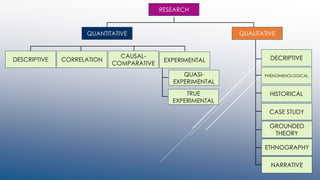
RESEARCH
QUANTITATIVE QUALITATIVE
DESCRIPTIVE CORRELATION
CAUSAL-
COMPARATIVE
EXPERIMENTAL
QUASI-
EXPERIMENTAL
TRUE
EXPERIMENTAL
DECRIPTIVE
PHENOMENOLOGICAL
HISTORICAL
CASE STUDY
GROUNDED
THEORY
ETHNOGRAPHY
NARRATIVE
DESCRIPTIVE
Descriptive research aims to accurately and
systematically describe a population, situation or
phenomenon. It can be answer what, where, when,
how and why.
This is both applicable to QUANTITATIVE and
QUALITATIVE research.
CORRELATION
Correlational research is a type of nonexperimental
research in which the researcher measures two
variables and assess the statistical relationship (i.e.,
the correlation) between them with little or no effort
to control extraneous variables. Focuses on:
Significant Relationship
Example: Academic Burnout and Stress
CAUSAL-COMPARATIVE
Attempts to identify a cause-effect relationship between
two or more groups. In causal-comparative research, the
researcher investigates the effect of an independent
variable by comparing two or more groups of individuals.
Unlike correlational research, both experimental
research and causal-comparative research typically
compare two or more groups of subjects.
Example:
1. How does pre-school attendance affect social
maturity at the end of the first grade?
2. How does having a working mother affect a
child’s school absenteeism?
EXPERIMENTAL
QUASI-EXPERIMENTAL
The prefix quasi means “resembling.” Thus quasi-
experimental research is research that resembles
experimental research but is not true experimental
research. Although the independent variable is
manipulated, participants are not randomly assigned to
conditions or orders of conditions (Cook & Campbell,
1979).
EXPERIMENTAL
TRUE EXPERIMENTAL
A true experiment is a type of experimental
design and is thought to be the most accurate
type of experimental research because of its
main characteristics of random assignment.
PHENOMENOLOGICAL
Phenomenology is a form of qualitative research that
focuses on the study of an individual’s lived
experiences within the world. Understanding the
ontological (theory of knowledge) assumptions
underpinning these approaches is essential for
successfully conducting phenomenological
research.
HISTORICAL
Historical research studies the meaning of past events in
an attempt to interpret the facts and explain the cause of
events. In doing so, researchers rely heavily on primary
historical data (direct accounts of events, archival data –
official documents, personal records or eyewitnesses)
and less frequently on secondary historical data
(information from persons who didn’t witness the event;
e.g. textbooks, newspaper, encyclopedias).
CASE STUDY
A case study is an in-depth study of one person,
group, or event. In a case study, nearly every aspect
of the subject’s life and history is analyzed to seek
patterns and causes of behavior. Case studies can
be used in a variety of fields including psychology,
medicine, education, anthropology, political science
and social work.
GROUNDED THEORY
A research method concerned with the generation of
theory, which is “grounded” in data that has been
systematically collected and analyzed. It is used to
uncover things such as things as social relationships
and behaviors of groups, known as social processes.
It was develop in California, USA by Glaser and
Strauss during their study – “Awareness of Dying”.
ETHNOGRAPHY
A study through direct observation of users in
their natural environment rather than in a lab.
The objective of this type of research is to gain
insights into how users interact with things in
their natural environment.
ETHNOGRAPHY
Ethnography methods include direct observation,
diary studies, video recordings, photography and
artifact analysis such as devices that a person uses
throughout the day. Observations can be made
anywhere from the user’s workplace, their home or
while the are out with family and friends.
NARRATIVE
A literary form of qualitative research, narrative research
is all about collecting and telling a story or stories
chronologically and in detail.
Researchers writes narrative about experiences of
individuals, describe a life experience, and discuss the
meaning of experience with the individual. Usually, a
narrative research design is focused on studying
individual person. The researcher becomes the
interpreter of the individual’s stories, as opposed to a
community.
MIXED METHOD STUDIES
Some studies use mixed methods to
collect and analyze data…both quantitative
and qualitative. For example, a person
might do a quantitative survey and follow
it up with qualitative interviews or focus
groups. Again, the question dictates the
method.
Types of Mixed-Methods
Research Design
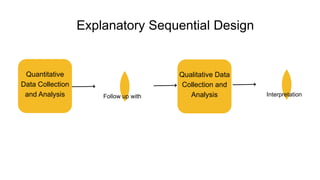
Explanatory Sequential Design
An explanatory sequential mixed method
design consists of first collecting qualitative
data to help explain or elaborate on the
quantitative results.
Purpose: To use qualitative results to assist
the findings of a quantitative study.
Quantitative
Data Collection
and Analysis Follow up with
Explanatory Sequential Design
Qualitative Data
Collection and
Analysis Interpretation
Exploratory Sequential Design
An exploratory sequential mixed method design
involves the procedure of first gathering
qualitative data to explore phenomenon and then
collecting quantitative data to explain relationship
found in the qualitative data.
Purpose: To explore a phenomenon. This
strategy may also be useful when developing and
testing a new instrument.
Qulitative Data
Collection and
Analysis Builds to
Exploratory Sequential Design
Quantitative
Data Collection
and Analysis Interpretation
Convergent Parallel Design
The purpose of this mixed-methods design is to
simultaneously collect both qualitative and
quantitative data, merge the data, and use the
results to understand a research problem.
Qualitative Data
Collection and
Analysis
Convergent Parallel Design
Quantitative
Data Collection
and Analysis
Compare or
relate
Interpretation
Embedded Sequential Design
The embedded sequential Design is to collect
quantitative and qualitative data simultaneously
or sequentially but to have one form of data play
a supportive role to the other form of data.
Quantitative
(or
Qualitative)
Data
Collection
and
Analysis
(before,
during, or
after)
Embedded Design
Interpretation
How To Choose A Research
Design?
Data Type
The first determining factor is naturally the
type of data you plan to be collecting – i.e.,
qualitative or quantitative. This may sound
obvious, but we have to be clear about this –
don’t try to use a quantitative research
design on qualitative data (or vice versa)!
Research Question(s)
As with all methodological decisions, your
research aim and research questions will
heavily influence your research design. For
example, if your research aims involve
developing a theory from qualitative data,
grounded theory would be a strong option.
Similarly, if your research aims involve
identifying and measuring relationships
between variables, one of the experimental
designs would likely be a better option.
Time
It’s essential that you consider any time
constraints you have, as this will impact the
type of research design you can choose. For
example, if you’ve only got a month to
complete your project, a lengthy design such
as ethnography wouldn’t be a good fit.
Resources
Take into account the resources realistically
available to you, as these need to factor into
your research design choice. For example, if
you require highly specialised lab equipment
to execute an experimental design, you
need to be sure that you’ll have access to
that before you make a decision.
Recap: Key Takeaways
ANALYSIS
Back to Agenda
How do you choose which method of
research to use?
Match your approach to
your research problem
Fit the approach to your
audience.
Relate the approach to your
experience.
Resource
Page
(No date) difference between quantitative
and qualitative. Available at:
https://www.scribd.com/document/4413
99700/Difference-between-qualitative-
(Accessed: 29 July 2023).
Maravillas’ Presentation

QUANTITATIVE-AND-QUALITATIVE-METHODS.pptx

  • 1.
  • 2.
  • 3.
    Distinguish between quantitativeand qualitative research approaches, outlining the key characteristics, data collection methods, and analysis techniques that differentiate these two methodologies 10 OBJECTIVES Compare and contrast the data analysis techniques employed in quantitative and qualitative research, and understand the strengths and limitations of each approach.
  • 4.
    QUANTITATIVE Quantitative Research isused to quantify the problem by way of generating numerical data or data that can be transformed into usable statistics. It is used to quantify attitudes, opinions, behaviors, and other defined variables – and generalize results from a larger sample population. Quantitative data collection methods are much more structured than Qualitative data collection methods. Quantitative data collection methods include various forms of surveys – online surveys, paper surveys, mobile surveys and kiosk surveys, face-to-face interviews, telephone interviews, longitudinal studies, website interceptors, online polls, and systematic observations.
  • 5.
    QUALITATIVE Qualitative Research isprimarily exploratory research. It is used to gain an understanding of underlying reasons, opinions, and motivations. It helps to develop ideas or hypotheses for potential quantitative research. Qualitative data collection methods vary using unstructured or semi-structured techniques. Some common methods include focus groups (group discussions), individual interviews, and participation/observations. The sample size is typically small, and respondents are selected to fulfill a given quota.
  • 6.
    BASIS FOR COMPARISON QUALITATIVE RESEARCHQUANTITATIVE RESEARCH Meaning Qualitative research is a method of inquiry that develops understanding on human and social sciences, to find the way people think and feel. Quantitative research is a research method that is used to generate numerical data and hard facts, by employing statistical, logical and mathematical technique. Nature Holistic Particularistic Approach Subjective Objective Research type Exploratory Conclusive Reasoning Inductive Deductive Sampling Purposive Random Data Verbal Measurable Inquiry Process-oriented Result-oriented Hypothesis Generated Tested Elements of analysis Words, pictures and objects Numerical data Objective To explore and discover ideas used in the ongoing processes. To examine cause and effect relationship between variables. Methods Non-structured techniques like In-depth interviews, group discussions etc. Structured techniques such as surveys, questionnaires and observations. Result Develops initial understanding Recommends final course of action
  • 7.
  • 8.
    DESCRIPTIVE Descriptive research aimsto accurately and systematically describe a population, situation or phenomenon. It can be answer what, where, when, how and why. This is both applicable to QUANTITATIVE and QUALITATIVE research.
  • 9.
    CORRELATION Correlational research isa type of nonexperimental research in which the researcher measures two variables and assess the statistical relationship (i.e., the correlation) between them with little or no effort to control extraneous variables. Focuses on: Significant Relationship Example: Academic Burnout and Stress
  • 10.
    CAUSAL-COMPARATIVE Attempts to identifya cause-effect relationship between two or more groups. In causal-comparative research, the researcher investigates the effect of an independent variable by comparing two or more groups of individuals. Unlike correlational research, both experimental research and causal-comparative research typically compare two or more groups of subjects.
  • 11.
    Example: 1. How doespre-school attendance affect social maturity at the end of the first grade? 2. How does having a working mother affect a child’s school absenteeism?
  • 12.
    EXPERIMENTAL QUASI-EXPERIMENTAL The prefix quasimeans “resembling.” Thus quasi- experimental research is research that resembles experimental research but is not true experimental research. Although the independent variable is manipulated, participants are not randomly assigned to conditions or orders of conditions (Cook & Campbell, 1979).
  • 13.
    EXPERIMENTAL TRUE EXPERIMENTAL A trueexperiment is a type of experimental design and is thought to be the most accurate type of experimental research because of its main characteristics of random assignment.
  • 14.
    PHENOMENOLOGICAL Phenomenology is aform of qualitative research that focuses on the study of an individual’s lived experiences within the world. Understanding the ontological (theory of knowledge) assumptions underpinning these approaches is essential for successfully conducting phenomenological research.
  • 15.
    HISTORICAL Historical research studiesthe meaning of past events in an attempt to interpret the facts and explain the cause of events. In doing so, researchers rely heavily on primary historical data (direct accounts of events, archival data – official documents, personal records or eyewitnesses) and less frequently on secondary historical data (information from persons who didn’t witness the event; e.g. textbooks, newspaper, encyclopedias).
  • 16.
    CASE STUDY A casestudy is an in-depth study of one person, group, or event. In a case study, nearly every aspect of the subject’s life and history is analyzed to seek patterns and causes of behavior. Case studies can be used in a variety of fields including psychology, medicine, education, anthropology, political science and social work.
  • 17.
    GROUNDED THEORY A researchmethod concerned with the generation of theory, which is “grounded” in data that has been systematically collected and analyzed. It is used to uncover things such as things as social relationships and behaviors of groups, known as social processes. It was develop in California, USA by Glaser and Strauss during their study – “Awareness of Dying”.
  • 18.
    ETHNOGRAPHY A study throughdirect observation of users in their natural environment rather than in a lab. The objective of this type of research is to gain insights into how users interact with things in their natural environment.
  • 19.
    ETHNOGRAPHY Ethnography methods includedirect observation, diary studies, video recordings, photography and artifact analysis such as devices that a person uses throughout the day. Observations can be made anywhere from the user’s workplace, their home or while the are out with family and friends.
  • 20.
    NARRATIVE A literary formof qualitative research, narrative research is all about collecting and telling a story or stories chronologically and in detail. Researchers writes narrative about experiences of individuals, describe a life experience, and discuss the meaning of experience with the individual. Usually, a narrative research design is focused on studying individual person. The researcher becomes the interpreter of the individual’s stories, as opposed to a community.
  • 21.
    MIXED METHOD STUDIES Somestudies use mixed methods to collect and analyze data…both quantitative and qualitative. For example, a person might do a quantitative survey and follow it up with qualitative interviews or focus groups. Again, the question dictates the method.
  • 22.
  • 23.
    Explanatory Sequential Design Anexplanatory sequential mixed method design consists of first collecting qualitative data to help explain or elaborate on the quantitative results. Purpose: To use qualitative results to assist the findings of a quantitative study.
  • 24.
    Quantitative Data Collection and AnalysisFollow up with Explanatory Sequential Design Qualitative Data Collection and Analysis Interpretation
  • 25.
    Exploratory Sequential Design Anexploratory sequential mixed method design involves the procedure of first gathering qualitative data to explore phenomenon and then collecting quantitative data to explain relationship found in the qualitative data. Purpose: To explore a phenomenon. This strategy may also be useful when developing and testing a new instrument.
  • 26.
    Qulitative Data Collection and AnalysisBuilds to Exploratory Sequential Design Quantitative Data Collection and Analysis Interpretation
  • 27.
    Convergent Parallel Design Thepurpose of this mixed-methods design is to simultaneously collect both qualitative and quantitative data, merge the data, and use the results to understand a research problem.
  • 28.
    Qualitative Data Collection and Analysis ConvergentParallel Design Quantitative Data Collection and Analysis Compare or relate Interpretation
  • 29.
    Embedded Sequential Design Theembedded sequential Design is to collect quantitative and qualitative data simultaneously or sequentially but to have one form of data play a supportive role to the other form of data.
  • 30.
  • 31.
    How To ChooseA Research Design?
  • 32.
    Data Type The firstdetermining factor is naturally the type of data you plan to be collecting – i.e., qualitative or quantitative. This may sound obvious, but we have to be clear about this – don’t try to use a quantitative research design on qualitative data (or vice versa)!
  • 33.
    Research Question(s) As withall methodological decisions, your research aim and research questions will heavily influence your research design. For example, if your research aims involve developing a theory from qualitative data, grounded theory would be a strong option. Similarly, if your research aims involve identifying and measuring relationships between variables, one of the experimental designs would likely be a better option.
  • 34.
    Time It’s essential thatyou consider any time constraints you have, as this will impact the type of research design you can choose. For example, if you’ve only got a month to complete your project, a lengthy design such as ethnography wouldn’t be a good fit.
  • 35.
    Resources Take into accountthe resources realistically available to you, as these need to factor into your research design choice. For example, if you require highly specialised lab equipment to execute an experimental design, you need to be sure that you’ll have access to that before you make a decision.
  • 36.
  • 37.
    ANALYSIS Back to Agenda Howdo you choose which method of research to use? Match your approach to your research problem Fit the approach to your audience. Relate the approach to your experience.
  • 38.
    Resource Page (No date) differencebetween quantitative and qualitative. Available at: https://www.scribd.com/document/4413 99700/Difference-between-qualitative- (Accessed: 29 July 2023). Maravillas’ Presentation

Editor's Notes

  • #7 Qualitative research is a method of inquiry that develops an understanding on human and social sciences, to find the way people think and feel. A scientific and empirical research method that is used to generate numerical data, by employing statistical, logical and mathematical technique is called quantitative research. Qualitative research is holistic in nature while quantitative research is particularistic. The qualitative research follows a subjective approach as the researcher is intimately involved, whereas the approach of quantitative research is objective, as the researcher is uninvolved and attempts to precise the observations and analysis on the topic to answer the inquiry. Qualitative research is exploratory. As opposed to quantitative research which is conclusive. The reasoning used to synthesis data in qualitative research is inductive whereas in the case of quantitative research the reasoning is deductive. Qualitative research is based on purposive sampling, where a small sample size is selected with a view to get a thorough understanding of the target concept. On the other hand, quantitative research relies on random sampling; wherein a large representative sample is chosen in order to extrapolate the results to the whole population. Verbal data are collected in qualitative research. Conversely, in quantitative research measurable data is gathered. Inquiry in qualitative research is a process-oriented, which is not in the case of quantitative research. Elements used in the analysis of qualitative research are words, pictures, and objects while that of quantitative research is numerical data. Qualitative Research is conducted with the aim of exploring and discovering ideas used in the ongoing processes. As opposed to quantitative research the purpose is to examine cause and effect relationship between variables. Lastly, the methods used in qualitative research are in-depth interviews, focus groups, etc. In contrast, the methods of conducting quantitative research are structured interviews and observations. Qualitative Research develops the initial understanding whereas quantitative research recommends a final course of action.