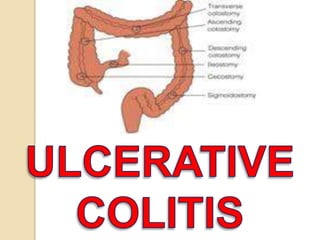
 Ulcerative colitis is a recurrent ulcerative &
inflammatory disease of the mucosal &
submucosal layers of the colon & rectum.
 The peak incidence is between 30 & 50 years
of age.
 10% to 15% of the patients develop carcinoma
of the colon.
ETIOLOGY
 Genetic predisposition.
 Environmental factors may trigger disease (viral
or bacterial pathogens, dietary).
 Immunologic imbalance or disturbances.
 Defect in intestinal barrier causing
hypersensitive mucosa & increased
permeability.
 Defect in repair of mucosal injury, which may
develop into a chronic condition.
Etiological factors
superficial mucosa of colon
diffuse inflammations, or shedding of the colonic
epithelium.
Bleeding occurs
ulcerations.
(The mucosa becomes edematous & inflamed. )
The disease process usually begains in the rectum
& spreads proximally to involve the entire colon.
 Diarrhea
 painful straining
 Increased bowel sounds
 There often is weight loss, fever, dehydration,
hypokalemia, anorexia, nausea & vomiting, iron-
deficiency anemia
 Crampy abdominal pain.
 Anal area may be irritated & reddened; left lower
abdomen may be tender on palpation.
 There is tendency for the patient experience
remissions & exacerbations.
 Increased risk of developing colorectal cancer.
 May inhibit extracolonic manifestations of eye
(irritis), joint (polyarthritis), & skin complaints
(erythema nodosum, pyoderma gangrenosum).
DIAGNOSTIC EVALUATION:-
Diagnosis is based on
a combination of laboratory,
radiologic, endoscopic, & histologic
findings.
Laboratory Tests:-
 Stool examination to rule out
enteral pathogens; fecal analysis
positive for blood during active
disease.
 Complete blood count- hemoglobin
& hematocrit may be low due to
bleeding; WBC may be increased.
 Elevated erythrocyte sedimentation
rate (ESR).
 Decreased serum levels of
potassium, magnesium, & albumin
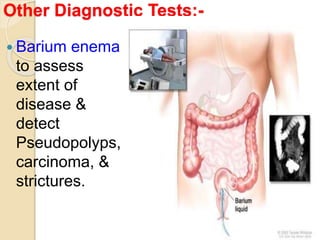
Other Diagnostic Tests:-
 Barium enema
to assess
extent of
disease &
detect
Pseudopolyps,
carcinoma, &
strictures.
 Flexible proctosigmoidoscopy/colonoscopy
findings reveal mucosal erythema & edema,
ulcers, inflammation that begins distally in the
rectum & spreads proximally for variable
distances.
 CT scan can identify complications such as
toxic megacolon.
 Rectal biopsy –
differentiates from other inflammatory
diseases or cancer.
General Measures:-
 Bed rest, I.V. fluid replacement, clear liquid diet.
 For patients with severe dehydration &
excessive diarrhea, fluid may be recommended
to rest the intestinal tract & restore nitrogen
balance.
 Treatment of anemia- iron supplements for
chronic bleeding, blood replacement for
massive bleeding.
Drug Therapy
 Sulfasalazine (Azulfidine)- mainstay drug for acute &
maintenance therapy. Given orally & is systemically
absorbed.
 Oral salicylates, such as mesalamine (Pentasa),
olsalazine (Dipentum
 Mesalamineenema available for protosigmoiditis;
suppository for proctitis.
 Corticosteroids- treated with 5-aminosalicylic acid
preparations to benefit from their potential steroid-
sparing effects.
 Immunosuppressive drugs- purine analogues, 6-
mercaptopurine, azathioprine may be indicated when
patient is refractory or dependent on corticosteroids.
 Antidiarrheal medications may be prescribed to control
diarrhea, rectal urgency & cramping, abdominal pain;
I. Noncurative approaches (possible
curative, reconstructive procedure at later
date):
a)Temporary loop colostomy for
decompression if toxic megacolon present
without perforation.
b)Subtotal colectomy, ileostomy, &
Hartmann’s pouch.
c)Colectomy with ileorectal anastomosis.
Loop colostomy Colostomy
Hartmann’s pouch
. Reconstructive procedures –
curative:
II. Reconstructive procedures – curative:
a)Total proctocolectomy with permanent end-
ileostomy.
b)Total proctocolectomy with continent
ileostomy
c) Total colectomy with ileal reservoir- anal (or
ileal reservoir-distal rectal) anastomosis –
procedure of choice. Multiple reservoir
shapes can be surgically created; however,
the J-shaped pouch (reservoir) is the easiest
to construct.
d)The ultimate surgical goal is to remove the
entire colon & rectum to cure patient of
COMPLICATIONS
 Perforation, hemorrhage
 Toxic megacolon- fever, tachycardia, abdominal
distention, peritonitis, leukocytosis, dilated colon
on abdominal X-ray – life-threatening
 Abscess formation, stricture, anal fistula
 Malnutrition, anemia, electrolyte imbalance
 Skin lesions (erythema nodosum, pyoderma
gangrenosum)
 Arthritis, ankylosing spondylitis
 Colon malignancy
 Liver disease (sclerosing colagitis)
 Eye lesions (conjunctivitis)
 Growth retardation in prepubertal children
 Possible infertility in females.
NURSING MANAGEMENT
Assessment
Nursing
Diagnosis
Planning
Implementation
Evaluation
Assessment
 Review nursing history for patterns of fatigue &
over-work, tension, family problems that may
exacerbate symptoms.
 Assess food habits & use of any dietary or herbal
supplements used as alternative therapies that
may have a bearing on triggering symptoms (milk
intake may be a problem). Many patient use
vitamins, herbs & homeopathic remedies without
realizing the effect on bowel function.
 Determine number & consistency of bowel
movements, any rectal bleeding present.
 Listen for hyperactive bowel sounds; assess
weight.
Nursing Diagnoses
 Chronic pain r/t disease process
 Imbalanced Nutrition: less than body
requirement r/t diarrhea, nausea & vomiting
 Deficient fluid volume r/t diarrhea & loss of fluid
& electrolytes
 Risk for infection r/t disease process, surgical
procedures
 Ineffective coping r/t fatigue, felling of
helplessness, & lack of support system.
Nursing Intervention
Promoting Comfort:-
 Follow prescribe treatment of reducing or eliminating
food & fluid & instituting parenteral feeding or low reside
diets to the intestinal tract.
 Give sedatives & tranquilizers, as prescribed, not only to
provide general rest , but also to slow peristalsis.
 Be aware of skin breakdown around anus.
 Cleanse the skin gently after each bowel movement.
 Apply a protective emollient such as petroleum jelly etc.
 Relieve painful rectal spasms
 Report any evidence of sudden abdominal distention
 Reduce physical activity
 Provide commode or bathroom next to bed because
urgency of movement may be problem.
Achieving Nutritional Requirements:-
 Maintain acutely ill patient on parenteral
replacement of vitamins, fluids, & electrolytes.
 When resuming oral fluids & food, select those
that are nonirritating to the mucosa.
 Avoid dairy products if patient is lactose
intolerant.
 Provide a well-balanced, low-residue, high
protein diet to correct malnutrition.
 Determine which foods the patient can tolerate,
& modify diet plan accordingly.
 Possible avoids cold fluids, which may increase
intestinal motility.
 Administer prescribed medications for
symptomatic relief of diarrhea.
Maintain fluid Balance:-
 Maintain accurate intake & output records
 Check weight daily
 Monitor serum electrolytes, & report
abnormalities.
 Observer for decrease skin turgor, dry
skin, oliguria, decreased temperature,
weakness, increase hemoglobin,
hematocrit, BUN, & specific gravity, which
all are signs of fluid loss leading to
dehydration.
Minimizing Infection & Complications:-
 Give antibacterial drugs as prescribed.
 Administer corticosteroids as prescribed.
 Provide conscientious skin care after
severe diarrhea.
 Administer prescribed therapy to correct
existing anemia.
 Observe for signs of colonic perforation &
hemorrhage – abdominal rigidity,
distention, hypotension, tachycardia.
Providing Supportive Care:-
 Recognise psychological needs of the patient.
- Fear, anxiety, & discouragement.
- Hypersensitivity may be evident.
 Acknowledge patient’s complaints.
 Encourage the patient to talk; listen & offer
psychological support.
 Answer questions about the permanent or temporary
ostomy, if appropriate.
 Initiate patient education about living with chronic
disease.
 Include the patient as a part of the health care team to
provide continuity of care.
 Offer educational & emotional support to family
members
 Refer for psychological counseling, as needed.
Home Care Considerations:-
Pouchitis:-
 Patient undergoing one of the continent restorative
procedure (Kock, or ileal reservoir & anal
anastomosis) must be alert for a common late
postopaerative complication called pouchitis.
 The symptoms include increased stool output,
cramps & malaise.
 It is thought to be related to stasis within the
pouch/ reservoir & usually responds to
metronidazole .
 Assess for these symptoms & notify health care
Food Blockage:-
 Patient with a temporary or permanent ileostomy must
be alert for signs & symptoms of a food blockage.
- This is a mechanical blockage of undigested foodstuffs
at the level of the fascia.
- It is most likely to occur in the first 6 weeks
postoperatively when the bowel is edematous.
 Symptoms may include spurty, watery stoolwith strong
odor, decreased or no stool output, abdominal
discomfort, cramping or bloating, & stomal swelling.
Nausea & vomiting are late symptoms & requires
immediate attention.
 Treatment includes:
- Avoiding solid foods & drinking clear liquids when
symptoms occur. Patient with ileostomies must never
take laxatives.
- Applying a pouching system with a larger opening to
- Gently massaging the abdomen around the stoma
& pulling the knees to chest & rocking the body
back & forth.
- A warm shower or bath may help with relaxation.
- If the blockage lasts for more than 2 to 3 hours or if
nausea/vomiting occurs, seek medical attention
immediately
 It is best to instruct the patient how to prevent a
food blockage by limiting certain foods the first
few months after surgery – Chinese vegetables,
skins & seeds, fatty meats, been hulls, popcorn &
other foods that do not digest well.
 Instruct the patient to avoid problem foods, chew
food well, drink plenty of fluids while eating, eat
possible problem foods in small amounts, &
reintroduce problem foods slowly into the diet.
Patient Education & Health
Maintenance:-
 Teach patient about chronic aspect of ulcerative
colitis & each component of care prescribed.
 Encourage self-care in monitoring symptoms,
seeking annual checkup, & maintaining health.
 Alert patient to possible postoperative problems
with skin care, aesthetic difficulties, & surgical
revisions.
 Encourage patient to share experiences with
others undergoing similar procedures.
ASSIGNMENT
Q. Write the Nursing Care Plan of Patient with
ulcerative colitis?
BIBLIOGRAPHY
1. Richard Hatchett & David thompson.med-surg.
nursing.first edition(2002); publish by churchil
Livingstone sydney P.N 552-560.
2. Shaffer’s.Medical-Surgical.seven editions. BI
publications New Delhi (2002). P.N. 439-444.
3. Lippincott. Manual of nursing practice. Eight edition
(2006). P.N. 673-677.
4. Brunner & Suddarth’s.Medical-Surgical nursing.10th
edition.Lippincott williams & wilkins publication (2004).
P.N. 1042-1054.
5. www.google.com.
6. www.pubmed.com.
Ulcerative Colitis

Ulcerative Colitis

  • 2.
     Ulcerative colitisis a recurrent ulcerative & inflammatory disease of the mucosal & submucosal layers of the colon & rectum.  The peak incidence is between 30 & 50 years of age.  10% to 15% of the patients develop carcinoma of the colon.
  • 3.
    ETIOLOGY  Genetic predisposition. Environmental factors may trigger disease (viral or bacterial pathogens, dietary).  Immunologic imbalance or disturbances.  Defect in intestinal barrier causing hypersensitive mucosa & increased permeability.  Defect in repair of mucosal injury, which may develop into a chronic condition.
  • 4.
    Etiological factors superficial mucosaof colon diffuse inflammations, or shedding of the colonic epithelium. Bleeding occurs ulcerations. (The mucosa becomes edematous & inflamed. ) The disease process usually begains in the rectum & spreads proximally to involve the entire colon.
  • 5.
     Diarrhea  painfulstraining  Increased bowel sounds  There often is weight loss, fever, dehydration, hypokalemia, anorexia, nausea & vomiting, iron- deficiency anemia  Crampy abdominal pain.  Anal area may be irritated & reddened; left lower abdomen may be tender on palpation.  There is tendency for the patient experience remissions & exacerbations.  Increased risk of developing colorectal cancer.  May inhibit extracolonic manifestations of eye (irritis), joint (polyarthritis), & skin complaints (erythema nodosum, pyoderma gangrenosum).
  • 6.
    DIAGNOSTIC EVALUATION:- Diagnosis isbased on a combination of laboratory, radiologic, endoscopic, & histologic findings. Laboratory Tests:-  Stool examination to rule out enteral pathogens; fecal analysis positive for blood during active disease.  Complete blood count- hemoglobin & hematocrit may be low due to bleeding; WBC may be increased.  Elevated erythrocyte sedimentation rate (ESR).  Decreased serum levels of potassium, magnesium, & albumin
  • 7.
    Other Diagnostic Tests:- Barium enema to assess extent of disease & detect Pseudopolyps, carcinoma, & strictures.
  • 8.
     Flexible proctosigmoidoscopy/colonoscopy findingsreveal mucosal erythema & edema, ulcers, inflammation that begins distally in the rectum & spreads proximally for variable distances.  CT scan can identify complications such as toxic megacolon.  Rectal biopsy – differentiates from other inflammatory diseases or cancer.
  • 9.
    General Measures:-  Bedrest, I.V. fluid replacement, clear liquid diet.  For patients with severe dehydration & excessive diarrhea, fluid may be recommended to rest the intestinal tract & restore nitrogen balance.  Treatment of anemia- iron supplements for chronic bleeding, blood replacement for massive bleeding.
  • 10.
    Drug Therapy  Sulfasalazine(Azulfidine)- mainstay drug for acute & maintenance therapy. Given orally & is systemically absorbed.  Oral salicylates, such as mesalamine (Pentasa), olsalazine (Dipentum  Mesalamineenema available for protosigmoiditis; suppository for proctitis.  Corticosteroids- treated with 5-aminosalicylic acid preparations to benefit from their potential steroid- sparing effects.  Immunosuppressive drugs- purine analogues, 6- mercaptopurine, azathioprine may be indicated when patient is refractory or dependent on corticosteroids.  Antidiarrheal medications may be prescribed to control diarrhea, rectal urgency & cramping, abdominal pain;
  • 11.
    I. Noncurative approaches(possible curative, reconstructive procedure at later date): a)Temporary loop colostomy for decompression if toxic megacolon present without perforation. b)Subtotal colectomy, ileostomy, & Hartmann’s pouch. c)Colectomy with ileorectal anastomosis.
  • 12.
  • 13.
    . Reconstructive procedures– curative: II. Reconstructive procedures – curative: a)Total proctocolectomy with permanent end- ileostomy. b)Total proctocolectomy with continent ileostomy c) Total colectomy with ileal reservoir- anal (or ileal reservoir-distal rectal) anastomosis – procedure of choice. Multiple reservoir shapes can be surgically created; however, the J-shaped pouch (reservoir) is the easiest to construct. d)The ultimate surgical goal is to remove the entire colon & rectum to cure patient of
  • 14.
    COMPLICATIONS  Perforation, hemorrhage Toxic megacolon- fever, tachycardia, abdominal distention, peritonitis, leukocytosis, dilated colon on abdominal X-ray – life-threatening  Abscess formation, stricture, anal fistula  Malnutrition, anemia, electrolyte imbalance  Skin lesions (erythema nodosum, pyoderma gangrenosum)  Arthritis, ankylosing spondylitis  Colon malignancy  Liver disease (sclerosing colagitis)  Eye lesions (conjunctivitis)  Growth retardation in prepubertal children  Possible infertility in females.
  • 15.
  • 16.
    Assessment  Review nursinghistory for patterns of fatigue & over-work, tension, family problems that may exacerbate symptoms.  Assess food habits & use of any dietary or herbal supplements used as alternative therapies that may have a bearing on triggering symptoms (milk intake may be a problem). Many patient use vitamins, herbs & homeopathic remedies without realizing the effect on bowel function.  Determine number & consistency of bowel movements, any rectal bleeding present.  Listen for hyperactive bowel sounds; assess weight.
  • 17.
    Nursing Diagnoses  Chronicpain r/t disease process  Imbalanced Nutrition: less than body requirement r/t diarrhea, nausea & vomiting  Deficient fluid volume r/t diarrhea & loss of fluid & electrolytes  Risk for infection r/t disease process, surgical procedures  Ineffective coping r/t fatigue, felling of helplessness, & lack of support system.
  • 18.
    Nursing Intervention Promoting Comfort:- Follow prescribe treatment of reducing or eliminating food & fluid & instituting parenteral feeding or low reside diets to the intestinal tract.  Give sedatives & tranquilizers, as prescribed, not only to provide general rest , but also to slow peristalsis.  Be aware of skin breakdown around anus.  Cleanse the skin gently after each bowel movement.  Apply a protective emollient such as petroleum jelly etc.  Relieve painful rectal spasms  Report any evidence of sudden abdominal distention  Reduce physical activity  Provide commode or bathroom next to bed because urgency of movement may be problem.
  • 19.
    Achieving Nutritional Requirements:- Maintain acutely ill patient on parenteral replacement of vitamins, fluids, & electrolytes.  When resuming oral fluids & food, select those that are nonirritating to the mucosa.  Avoid dairy products if patient is lactose intolerant.  Provide a well-balanced, low-residue, high protein diet to correct malnutrition.  Determine which foods the patient can tolerate, & modify diet plan accordingly.  Possible avoids cold fluids, which may increase intestinal motility.  Administer prescribed medications for symptomatic relief of diarrhea.
  • 20.
    Maintain fluid Balance:- Maintain accurate intake & output records  Check weight daily  Monitor serum electrolytes, & report abnormalities.  Observer for decrease skin turgor, dry skin, oliguria, decreased temperature, weakness, increase hemoglobin, hematocrit, BUN, & specific gravity, which all are signs of fluid loss leading to dehydration.
  • 21.
    Minimizing Infection &Complications:-  Give antibacterial drugs as prescribed.  Administer corticosteroids as prescribed.  Provide conscientious skin care after severe diarrhea.  Administer prescribed therapy to correct existing anemia.  Observe for signs of colonic perforation & hemorrhage – abdominal rigidity, distention, hypotension, tachycardia.
  • 22.
    Providing Supportive Care:- Recognise psychological needs of the patient. - Fear, anxiety, & discouragement. - Hypersensitivity may be evident.  Acknowledge patient’s complaints.  Encourage the patient to talk; listen & offer psychological support.  Answer questions about the permanent or temporary ostomy, if appropriate.  Initiate patient education about living with chronic disease.  Include the patient as a part of the health care team to provide continuity of care.  Offer educational & emotional support to family members  Refer for psychological counseling, as needed.
  • 23.
    Home Care Considerations:- Pouchitis:- Patient undergoing one of the continent restorative procedure (Kock, or ileal reservoir & anal anastomosis) must be alert for a common late postopaerative complication called pouchitis.  The symptoms include increased stool output, cramps & malaise.  It is thought to be related to stasis within the pouch/ reservoir & usually responds to metronidazole .  Assess for these symptoms & notify health care
  • 24.
    Food Blockage:-  Patientwith a temporary or permanent ileostomy must be alert for signs & symptoms of a food blockage. - This is a mechanical blockage of undigested foodstuffs at the level of the fascia. - It is most likely to occur in the first 6 weeks postoperatively when the bowel is edematous.  Symptoms may include spurty, watery stoolwith strong odor, decreased or no stool output, abdominal discomfort, cramping or bloating, & stomal swelling. Nausea & vomiting are late symptoms & requires immediate attention.  Treatment includes: - Avoiding solid foods & drinking clear liquids when symptoms occur. Patient with ileostomies must never take laxatives. - Applying a pouching system with a larger opening to
  • 25.
    - Gently massagingthe abdomen around the stoma & pulling the knees to chest & rocking the body back & forth. - A warm shower or bath may help with relaxation. - If the blockage lasts for more than 2 to 3 hours or if nausea/vomiting occurs, seek medical attention immediately  It is best to instruct the patient how to prevent a food blockage by limiting certain foods the first few months after surgery – Chinese vegetables, skins & seeds, fatty meats, been hulls, popcorn & other foods that do not digest well.  Instruct the patient to avoid problem foods, chew food well, drink plenty of fluids while eating, eat possible problem foods in small amounts, & reintroduce problem foods slowly into the diet.
  • 27.
    Patient Education &Health Maintenance:-  Teach patient about chronic aspect of ulcerative colitis & each component of care prescribed.  Encourage self-care in monitoring symptoms, seeking annual checkup, & maintaining health.  Alert patient to possible postoperative problems with skin care, aesthetic difficulties, & surgical revisions.  Encourage patient to share experiences with others undergoing similar procedures.
  • 28.
    ASSIGNMENT Q. Write theNursing Care Plan of Patient with ulcerative colitis?
  • 29.
    BIBLIOGRAPHY 1. Richard Hatchett& David thompson.med-surg. nursing.first edition(2002); publish by churchil Livingstone sydney P.N 552-560. 2. Shaffer’s.Medical-Surgical.seven editions. BI publications New Delhi (2002). P.N. 439-444. 3. Lippincott. Manual of nursing practice. Eight edition (2006). P.N. 673-677. 4. Brunner & Suddarth’s.Medical-Surgical nursing.10th edition.Lippincott williams & wilkins publication (2004). P.N. 1042-1054. 5. www.google.com. 6. www.pubmed.com.