GIT Medical Nursing
by :
Dr. Alshazaly abdoalghfar
BSN, RN, MSN, CNE PhD.
Inflammatory Bowel Disease
(IBD)
Lecture 8
10/29/2023 shazalyhran@yahoo.com 2
Objectives
By the end of this lecture all of us well be able to
 Understand Inflammatory Bowel Disease and the
pathophysiology (UC).
 Identify the assessment and diagnostic test used to
confirm Inflammatory Bowel Disease (UC).
 Formulate the nursing process as a framework for care
of patients with Inflammatory Bowel Disease (CD, UC).
ULCERATIVE COLITIS
10/29/2023 shazalyhran@yahoo.com 4
ULCERATIVE COLITIS
 Is a recurrent ulcerative and inflammatory disease of the mucosal
and submucosal layers of the colon and rectum.
 The incidence is between 30 and 50 years of age.
 It is a serious disease, accompanied by systemic complications
and a high mortality rate.
 Eventually, 10% to 15% of the patients develop carcinoma of the
colon.
Pathophysiology
 UC affects the superficial mucosa of the colon and is
characterized by multiple ulcerations, diffuse inflammations, and
Bleeding occurs as a result of the ulcerations, The mucosa
becomes edematous and inflammed.
 Abscesses form
 The disease process usually begins in the rectum and spreads
proximally to involve the entire colon.
 Eventually, the bowel narrows, shortens, and thickens .
Clinical Manifestations
The predominant symptoms of ulcerative colitis are
1. lower left quadrant abdominal pain.
2. Diarrhea, anorexia, weight loss, fever, vomiting, and dehydration.
3. Rectal bleeding
6. Cramping and feeling of an urgent need to defecate (passage of
10 to 20 liquid stools each day).
7. Hypocalcaemia and anemia
8. Others:
 skin lesions (erythema nodosum), eye lesions (uveitis), joint abnormalities
(arthritis), and liver disease
9. Rebound tenderness may occur in the right lower quadrant.
Diagnostic test :-
1. Stool analysis is positive for blood.
2. CBC
3. Abdominal x-ray studies are useful for determining the cause
of symptoms.
4. Sigmoidoscopy or colonoscopy (Endoscopy may reveal friable,
inflamed mucosa with exudate and ulcerations.)
5. Barium enema
6. CT scanning
10/29/2023
11
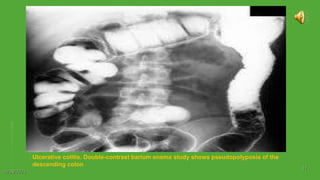
Ulcerative colitis. Double-contrast barium enema study shows pseudopolyposis of the
descending colon
Complications
Complications of ulcerative colitis include
1. toxic mega colon
2. Colonic perforation associated with a high mortality rate (15% to
50%)
3. Osteoporotic fractures
Medical management:-
Aim of medical treatment:
 Reducing inflammation
 suppressing inappropriate immune responses
 providing rest for a diseased bowel so that healing may take place,
 improving quality of life
 preventing or minimizing complications.
9/12/2023 14
shazalyhran@yahoo.com
NUTRITIONAL THERAPY
 Provide high-protein, high-calorie diet with vitamin and iron
supplements.
 Balance fluid and electrolyte.
 Avoid exacerbate diarrhea food.
 Cold foods and smoking are avoided (increase intestinal
motility).
 Parenteral nutrition (PN) may be indicated.
9/12/2023 15
shazalyhran@yahoo.com
Parenteral nutrition (PN)
 Is a ready and mixed IV nutrients to improve nutritional status,
maintain muscle mass, promote weight gain, and enhance the
healing process.
 Components:
1. water 30-40 ml/kg/day.
2. amino acid 1-2 g/kg/day.
3. carbohydrate 4-5 mg /kg/min.
4. fatty acid 20-30 total calories.
5. minerals such as ( calcium 15mcg, magnesium 20meq, potassium
100meq , sodium 100meq).
6. vitamins such as (Vitamin A 4000iu, thiamin 3mg, vitamin K 200mcg)
9/12/2023 16
shazalyhran@yahoo.com
PHARMACOLOGIC THERAPY
1. Sedation and antidiarrheal medications such as:
 loperamide
 cholestyramine powder, 3 times per day.
 Side effect: constipation.
2. Anti-inflammatory drug such as:
 Aminosalicylate formulations such as sulfasalazine
3. Corticosteroids are used to treat severe disease such as:
 Prednisone, orally, topically and injections.
4. Immunosuppressive Agents such as:
 Methotrexate tab 1,5 mg/kg/day, cyclosporine tab 2,5-5
mg/kg/day
5. Surgery.
9/12/2023 17
shazalyhran@yahoo.com
INDICATIONS FOR SURGERY
 Obstruction, severe perianal disease unresponsive to medical
therapy, difficult fistulas, major bleeding, severe disability
 30 % relapse rate
NURSING PROCESS
Assessment
 Takes a health history
 Discuss dietary patterns, including the amounts of alcohol,
caffeine, and nicotine containing products used daily and
weekly.
 Assess patterns of bowel elimination
 Note allergies and food intolerance
 Observe skin and stool
 Examine the abdomen for pain, tenderness, distention and rectal
bleeding.
 Auscultating the abdomen for bowel sounds and their
characteristics
ND 1:
Acute abdominal pain related to increased peristalsis and GI inflammation.
Goal:
 The client will be free from pain
Intervention:
 Assess the pain level and character
 Position changes, local application of heat
 Administers anticholinergic medications as prescribed 30 minutes before
meal.
 Administers analgesics as prescribed for pain
ND 2:
 Impaired bowel elimination pattern ( Diarrhea ) related to the
inflammatory process
Goal:
 Maintain normal bowel elimination pattern .
Intervention:
 Determines if there is a relationship between diarrhea and certain
foods, activity, or emotional stress.
 Identifying precipitating factors, the frequency of bowel movements,
and the character, consistency, and amount of stool passed is
important.
 Provide safe and ready access to a bathroom
 Administer antidiarrheal medications as prescribed
ND 3:
 Fluid volume deficit related to anorexia, nausea, and diarrhea
secondary to infection.
Goal:
 To maintain normal fluid status
Intervention:
 Keeps an accurate record of intake ,output .
 Monitors daily weights for fluid gains or losses and assesses the
patient for signs of fluid volume deficit.
 Encourage oral intake of fluids and to monitor the intravenous flow
rate.
 initiates measures to decrease diarrhea (e.g. dietary restrictions,
stress reduction, antidiarrheal agents).
 Give small frequent meals in attractive way
ND 4:
 Imbalanced nutrition less than body requirements, related to dietary
restrictions, nausea, and malabsorption evidence by low HB, decrease
Weight
Goals:
 Maintenance of optimal nutrition and weight
Intervention:
 Parenteral nutrition (PN) is used when the symptoms of IBD are severe.
 Elemental feedings high in protein and low in fat and residue are
instituted after PN therapy.
 If oral foods are tolerated, small, frequent, low-residue feedings are
given.
 Restrict activity to conserve energy, reduce peristalsis, and reduce
calorie requirements
ND 5:
Activity intolerance related to low intake evidence by fatigue
Goal:
 Avoidance of fatigue
Intervention:
 Recommends intermittent rest periods during the day.
 Encourage activity within the limits of the patient’s capacity.
 Bed rest for a patient who is febrile, has frequent diarrheal stools, or is
bleeding.
 perform active exercises to maintain muscle tone and prevent
thromboembolic complications
 Performs passive exercises and joint range of motion if the pt unable to
perform active exercise.
ND 6:
 Ineffective coping related to repeated episodes of diarrhea.
Goal:
 promoting effective coping
Intervention:
 Pt may feel isolated, helpless, and out of control, understanding and
emotional support are essential.
 Develop a relationship with the patient that supports all attempts to cope
with these stresses
 encouraging the patient to talk and express his or her feelings and to
discuss any concerns
 Used stress relaxation techniques
 Professional counseling
ND 7:
 Risk for impaired skin integrity related to malnutrition and diarrhea
Goals:
 To maintain normal skim integrity.
Intervention:
 Examines the patient’s skin frequently, especially the perianal skin.
 Perianal care, including the use of a skin barrier, is important after each
bowel movement.
 Gives immediate attention to reddened or irritated areas over a bony
prominence and uses pressure-relieving devices to prevent skin
breakdown.
 Avoid dryness by lubricate patient body.
ND 8:
 Risk for ineffective therapeutic regimen management related to insufficient
knowledge concerning the process and management of the disease.
Goals:
 learning about the disease process and therapeutic regimen, and
avoidance of complications.
Intervention:
 Serum electrolyte levels are monitored daily, and electrolyte
replacements are administered as prescribed.
 It is important to monitor the blood pressure for hypotension and to obtain
coagulation and hematocrit and hemoglobin profiles frequently.
 Vitamin K may be prescribed to increase clotting factors.
 Monitors the patient for indications of perforation and obstruction and
toxic mega colon.
Thank you
8/26/2022 shazalyhran@yahoo.com
29

GIT LECTURE 8 UC.pptx

  • 1.
    GIT Medical Nursing by: Dr. Alshazaly abdoalghfar BSN, RN, MSN, CNE PhD.
  • 2.
    Inflammatory Bowel Disease (IBD) Lecture8 10/29/2023 shazalyhran@yahoo.com 2
  • 3.
    Objectives By the endof this lecture all of us well be able to  Understand Inflammatory Bowel Disease and the pathophysiology (UC).  Identify the assessment and diagnostic test used to confirm Inflammatory Bowel Disease (UC).  Formulate the nursing process as a framework for care of patients with Inflammatory Bowel Disease (CD, UC).
  • 4.
  • 5.
    ULCERATIVE COLITIS  Isa recurrent ulcerative and inflammatory disease of the mucosal and submucosal layers of the colon and rectum.  The incidence is between 30 and 50 years of age.  It is a serious disease, accompanied by systemic complications and a high mortality rate.  Eventually, 10% to 15% of the patients develop carcinoma of the colon.
  • 6.
    Pathophysiology  UC affectsthe superficial mucosa of the colon and is characterized by multiple ulcerations, diffuse inflammations, and Bleeding occurs as a result of the ulcerations, The mucosa becomes edematous and inflammed.  Abscesses form  The disease process usually begins in the rectum and spreads proximally to involve the entire colon.  Eventually, the bowel narrows, shortens, and thickens .
  • 8.
    Clinical Manifestations The predominantsymptoms of ulcerative colitis are 1. lower left quadrant abdominal pain. 2. Diarrhea, anorexia, weight loss, fever, vomiting, and dehydration. 3. Rectal bleeding 6. Cramping and feeling of an urgent need to defecate (passage of 10 to 20 liquid stools each day). 7. Hypocalcaemia and anemia 8. Others:  skin lesions (erythema nodosum), eye lesions (uveitis), joint abnormalities (arthritis), and liver disease 9. Rebound tenderness may occur in the right lower quadrant.
  • 9.
    Diagnostic test :- 1.Stool analysis is positive for blood. 2. CBC 3. Abdominal x-ray studies are useful for determining the cause of symptoms. 4. Sigmoidoscopy or colonoscopy (Endoscopy may reveal friable, inflamed mucosa with exudate and ulcerations.) 5. Barium enema 6. CT scanning
  • 11.
    10/29/2023 11 Ulcerative colitis. Double-contrastbarium enema study shows pseudopolyposis of the descending colon
  • 12.
    Complications Complications of ulcerativecolitis include 1. toxic mega colon 2. Colonic perforation associated with a high mortality rate (15% to 50%) 3. Osteoporotic fractures
  • 14.
    Medical management:- Aim ofmedical treatment:  Reducing inflammation  suppressing inappropriate immune responses  providing rest for a diseased bowel so that healing may take place,  improving quality of life  preventing or minimizing complications. 9/12/2023 14 shazalyhran@yahoo.com
  • 15.
    NUTRITIONAL THERAPY  Providehigh-protein, high-calorie diet with vitamin and iron supplements.  Balance fluid and electrolyte.  Avoid exacerbate diarrhea food.  Cold foods and smoking are avoided (increase intestinal motility).  Parenteral nutrition (PN) may be indicated. 9/12/2023 15 shazalyhran@yahoo.com
  • 16.
    Parenteral nutrition (PN) Is a ready and mixed IV nutrients to improve nutritional status, maintain muscle mass, promote weight gain, and enhance the healing process.  Components: 1. water 30-40 ml/kg/day. 2. amino acid 1-2 g/kg/day. 3. carbohydrate 4-5 mg /kg/min. 4. fatty acid 20-30 total calories. 5. minerals such as ( calcium 15mcg, magnesium 20meq, potassium 100meq , sodium 100meq). 6. vitamins such as (Vitamin A 4000iu, thiamin 3mg, vitamin K 200mcg) 9/12/2023 16 shazalyhran@yahoo.com
  • 17.
    PHARMACOLOGIC THERAPY 1. Sedationand antidiarrheal medications such as:  loperamide  cholestyramine powder, 3 times per day.  Side effect: constipation. 2. Anti-inflammatory drug such as:  Aminosalicylate formulations such as sulfasalazine 3. Corticosteroids are used to treat severe disease such as:  Prednisone, orally, topically and injections. 4. Immunosuppressive Agents such as:  Methotrexate tab 1,5 mg/kg/day, cyclosporine tab 2,5-5 mg/kg/day 5. Surgery. 9/12/2023 17 shazalyhran@yahoo.com
  • 18.
    INDICATIONS FOR SURGERY Obstruction, severe perianal disease unresponsive to medical therapy, difficult fistulas, major bleeding, severe disability  30 % relapse rate
  • 19.
  • 20.
    Assessment  Takes ahealth history  Discuss dietary patterns, including the amounts of alcohol, caffeine, and nicotine containing products used daily and weekly.  Assess patterns of bowel elimination  Note allergies and food intolerance  Observe skin and stool  Examine the abdomen for pain, tenderness, distention and rectal bleeding.  Auscultating the abdomen for bowel sounds and their characteristics
  • 21.
    ND 1: Acute abdominalpain related to increased peristalsis and GI inflammation. Goal:  The client will be free from pain Intervention:  Assess the pain level and character  Position changes, local application of heat  Administers anticholinergic medications as prescribed 30 minutes before meal.  Administers analgesics as prescribed for pain
  • 22.
    ND 2:  Impairedbowel elimination pattern ( Diarrhea ) related to the inflammatory process Goal:  Maintain normal bowel elimination pattern . Intervention:  Determines if there is a relationship between diarrhea and certain foods, activity, or emotional stress.  Identifying precipitating factors, the frequency of bowel movements, and the character, consistency, and amount of stool passed is important.  Provide safe and ready access to a bathroom  Administer antidiarrheal medications as prescribed
  • 23.
    ND 3:  Fluidvolume deficit related to anorexia, nausea, and diarrhea secondary to infection. Goal:  To maintain normal fluid status Intervention:  Keeps an accurate record of intake ,output .  Monitors daily weights for fluid gains or losses and assesses the patient for signs of fluid volume deficit.  Encourage oral intake of fluids and to monitor the intravenous flow rate.  initiates measures to decrease diarrhea (e.g. dietary restrictions, stress reduction, antidiarrheal agents).  Give small frequent meals in attractive way
  • 24.
    ND 4:  Imbalancednutrition less than body requirements, related to dietary restrictions, nausea, and malabsorption evidence by low HB, decrease Weight Goals:  Maintenance of optimal nutrition and weight Intervention:  Parenteral nutrition (PN) is used when the symptoms of IBD are severe.  Elemental feedings high in protein and low in fat and residue are instituted after PN therapy.  If oral foods are tolerated, small, frequent, low-residue feedings are given.  Restrict activity to conserve energy, reduce peristalsis, and reduce calorie requirements
  • 25.
    ND 5: Activity intolerancerelated to low intake evidence by fatigue Goal:  Avoidance of fatigue Intervention:  Recommends intermittent rest periods during the day.  Encourage activity within the limits of the patient’s capacity.  Bed rest for a patient who is febrile, has frequent diarrheal stools, or is bleeding.  perform active exercises to maintain muscle tone and prevent thromboembolic complications  Performs passive exercises and joint range of motion if the pt unable to perform active exercise.
  • 26.
    ND 6:  Ineffectivecoping related to repeated episodes of diarrhea. Goal:  promoting effective coping Intervention:  Pt may feel isolated, helpless, and out of control, understanding and emotional support are essential.  Develop a relationship with the patient that supports all attempts to cope with these stresses  encouraging the patient to talk and express his or her feelings and to discuss any concerns  Used stress relaxation techniques  Professional counseling
  • 27.
    ND 7:  Riskfor impaired skin integrity related to malnutrition and diarrhea Goals:  To maintain normal skim integrity. Intervention:  Examines the patient’s skin frequently, especially the perianal skin.  Perianal care, including the use of a skin barrier, is important after each bowel movement.  Gives immediate attention to reddened or irritated areas over a bony prominence and uses pressure-relieving devices to prevent skin breakdown.  Avoid dryness by lubricate patient body.
  • 28.
    ND 8:  Riskfor ineffective therapeutic regimen management related to insufficient knowledge concerning the process and management of the disease. Goals:  learning about the disease process and therapeutic regimen, and avoidance of complications. Intervention:  Serum electrolyte levels are monitored daily, and electrolyte replacements are administered as prescribed.  It is important to monitor the blood pressure for hypotension and to obtain coagulation and hematocrit and hemoglobin profiles frequently.  Vitamin K may be prescribed to increase clotting factors.  Monitors the patient for indications of perforation and obstruction and toxic mega colon.
  • 29.

Editor's Notes

  • #7 because of muscular hypertrophy and fat deposits.
  • #13 In toxic megacolon, the inflammatory process extends into the muscularis, inhibiting its ability to contract and resulting in colonic distention
  • #24  (ie, dry skin and mucous membranes, decreased skin turgor, oliguria, exhaustion, decreased temperature, increased hematocrit, elevated urine spe- cific gravity, and hypotension).
  • #25 With PN, the nurse maintains an accurate record of fluid intake and output as well as the patient’s daily weight. The patient should gain 0.5 kg daily during PN therapy. Because PN is very high in glucose and can cause hyperglycemia, blood glucose levels are monitored every 6 hours.