T- 1-855-694-8886
Email- info@iTutor.com
T- 1-855-694-8886
Email- info@iTutor.com
By iTutor.com
Hyperbola
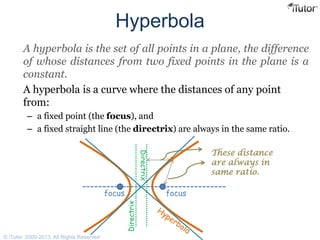
A hyperbola is the set of all points in a plane, the difference
of whose distances from two fixed points in the plane is a
constant.
A hyperbola is a curve where the distances of any point
from:
– a fixed point (the focus), and
– a fixed straight line (the directrix) are always in the same ratio.
focus
Directrix
These distance
are always in
same ratio.
focus
Directrix
© iTutor. 2000-2013. All Rights Reserved
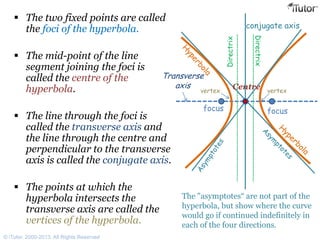
 The two fixed points are called
the foci of the hyperbola.
 The mid-point of the line
segment joining the foci is
called the centre of the
hyperbola.
 The line through the foci is
called the transverse axis and
the line through the centre and
perpendicular to the transverse
axis is called the conjugate axis.
 The points at which the
hyperbola intersects the
transverse axis are called the
vertices of the hyperbola.
focus
Directrix
focus
Directrix
vertex vertex
conjugate axis
Transverse
axis Centre
The "asymptotes“ are not part of the
hyperbola, but show where the curve
would go if continued indefinitely in
each of the four directions.
© iTutor. 2000-2013. All Rights Reserved
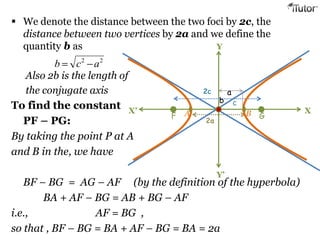
 We denote the distance between the two foci by 2c, the
distance between two vertices by 2a and we define the
quantity b as
Also 2b is the length of
the conjugate axis
To find the constant
PF – PG:
By taking the point P at A
and B in the, we have
BF – BG = AG – AF (by the definition of the hyperbola)
BA + AF – BG = AB + BG – AF
i.e., AF = BG ,
so that , BF – BG = BA + AF – BG = BA = 2a
22
acb
2c
2a
a
XX’
Y
Y’
F GA B
b c
Standard equation of Hyperbola
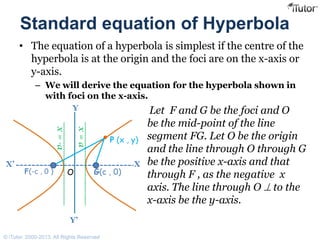
• The equation of a hyperbola is simplest if the centre of the
hyperbola is at the origin and the foci are on the x-axis or
y-axis.
– We will derive the equation for the hyperbola shown in
with foci on the x-axis.
Let F and G be the foci and O
be the mid-point of the line
segment FG. Let O be the origin
and the line through O through G
be the positive x-axis and that
through F , as the negative x
axis. The line through O to the
x-axis be the y-axis.
G(c , 0)F(-c , 0 )
P (x , y)
x=-a
x=a
O
XX’
Y
Y’
© iTutor. 2000-2013. All Rights Reserved
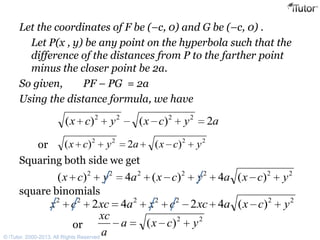
Let the coordinates of F be (–c, 0) and G be (–c, 0) .
Let P(x , y) be any point on the hyperbola such that the
difference of the distances from P to the farther point
minus the closer point be 2a.
So given, PF – PG = 2a
Using the distance formula, we have
Squaring both side we get
square binomials
aycxycx 2)()( 2222
2222
)(2)( ycxaycxor
2222222
)(4)(4)( ycxaycxaycx
2222222
)(4242 ycxaxccxaxccx
22
)( ycxa
a
xc
or
© iTutor. 2000-2013. All Rights Reserved
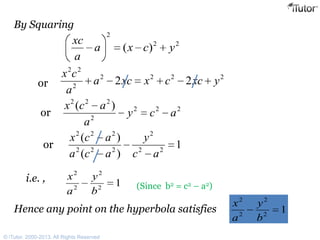
By Squaring
i.e. ,
Hence any point on the hyperbola satisfies
22
2
)( ycxa
a
xc
2222
2
22
22 yxccxxca
a
cx
or
222
2
222
)(
acy
a
acx
or
1
)(
)(
22
2
222
222
ac
y
aca
acx
or
12
2
2
2
b
y
a
x
(Since b2 = c2 – a2)
12
2
2
2
b
y
a
x
© iTutor. 2000-2013. All Rights Reserved
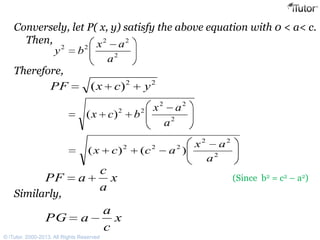
Conversely, let P( x, y) satisfy the above equation with 0 < a< c.
Then,
Therefore,
Similarly,
2
22
22
a
ax
by
22
)( ycxPF
2
22
22
)(
a
ax
bcx
2
22
222
)()(
a
ax
accx
(Since b2 = c2 – a2)x
a
c
aPF
x
c
a
aPG
© iTutor. 2000-2013. All Rights Reserved
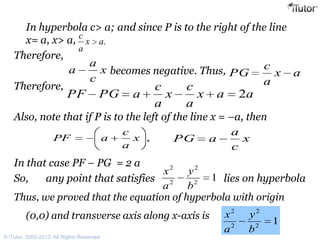
In hyperbola c> a; and since P is to the right of the line
x= a, x> a,
Therefore,
becomes negative. Thus,
Therefore,
Also, note that if P is to the left of the line x = –a, then
In that case PF – PG = 2 a
So, any point that satisfies lies on hyperbola
Thus, we proved that the equation of hyperbola with origin
(0,0) and transverse axis along x-axis is
.ax
a
c
x
c
a
a ax
a
c
PG
aax
a
c
x
a
c
aPGPF 2
,x
a
c
aPF x
c
a
aPG
12
2
2
2
b
y
a
x
12
2
2
2
b
y
a
x
© iTutor. 2000-2013. All Rights Reserved
222
2
2
2
2
where,1 acb
b
y
a
x
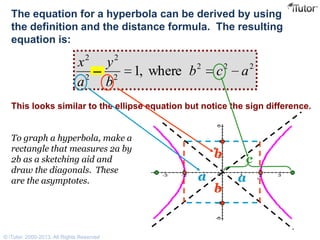
The equation for a hyperbola can be derived by using
the definition and the distance formula. The resulting
equation is:
aa
cb
b
This looks similar to the ellipse equation but notice the sign difference.
To graph a hyperbola, make a
rectangle that measures 2a by
2b as a sketching aid and
draw the diagonals. These
are the asymptotes.
© iTutor. 2000-2013. All Rights Reserved
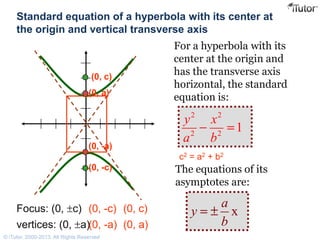
Standard equation of a hyperbola with its center at
the origin and vertical transverse axis
For a hyperbola with its
center at the origin and
has the transverse axis
horizontal, the standard
equation is:
c2 = a2 + b2
2 2
2 2
1
y x
a b
The equations of its
asymptotes are:
x
a
y
b
Focus: (0, c) (0, -c) (0, c)
vertices: (0, a)(0, -a) (0, a)
(0, -c)
(0, c)
(0, -a)
(0, a)
© iTutor. 2000-2013. All Rights Reserved
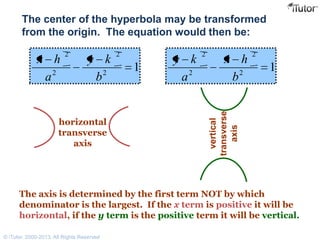
The center of the hyperbola may be transformed
from the origin. The equation would then be:
horizontal
transverse
axis
12
2
2
2
b
ky
a
hx
12
2
2
2
b
hx
a
ky
vertical
transverse
axis
The axis is determined by the first term NOT by which
denominator is the largest. If the x term is positive it will be
horizontal, if the y term is the positive term it will be vertical.
© iTutor. 2000-2013. All Rights Reserved
Eccentricity
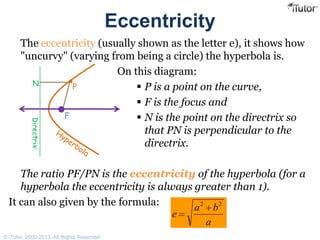
The eccentricity (usually shown as the letter e), it shows how
"uncurvy" (varying from being a circle) the hyperbola is.
On this diagram:
 P is a point on the curve,
 F is the focus and
 N is the point on the directrix so
that PN is perpendicular to the
directrix.
The ratio PF/PN is the eccentricity of the hyperbola (for a
hyperbola the eccentricity is always greater than 1).
It can also given by the formula:
F
PN
Directrix
a
ba
e
22
© iTutor. 2000-2013. All Rights Reserved
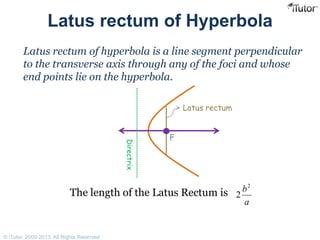
Latus rectum of Hyperbola
Latus rectum of hyperbola is a line segment perpendicular
to the transverse axis through any of the foci and whose
end points lie on the hyperbola.
Directrix
F
Latus rectum
The length of the Latus Rectum is
a
b2
2
© iTutor. 2000-2013. All Rights Reserved
The End
Call us for more
Information:
www.iTutor.com
Visit
1-855-694-8886

Equation of Hyperbola

  • 1.
    T- 1-855-694-8886 Email- info@iTutor.com T-1-855-694-8886 Email- info@iTutor.com By iTutor.com
  • 2.
    Hyperbola A hyperbola isthe set of all points in a plane, the difference of whose distances from two fixed points in the plane is a constant. A hyperbola is a curve where the distances of any point from: – a fixed point (the focus), and – a fixed straight line (the directrix) are always in the same ratio. focus Directrix These distance are always in same ratio. focus Directrix © iTutor. 2000-2013. All Rights Reserved
  • 3.
     The twofixed points are called the foci of the hyperbola.  The mid-point of the line segment joining the foci is called the centre of the hyperbola.  The line through the foci is called the transverse axis and the line through the centre and perpendicular to the transverse axis is called the conjugate axis.  The points at which the hyperbola intersects the transverse axis are called the vertices of the hyperbola. focus Directrix focus Directrix vertex vertex conjugate axis Transverse axis Centre The "asymptotes“ are not part of the hyperbola, but show where the curve would go if continued indefinitely in each of the four directions. © iTutor. 2000-2013. All Rights Reserved
  • 4.
     We denotethe distance between the two foci by 2c, the distance between two vertices by 2a and we define the quantity b as Also 2b is the length of the conjugate axis To find the constant PF – PG: By taking the point P at A and B in the, we have BF – BG = AG – AF (by the definition of the hyperbola) BA + AF – BG = AB + BG – AF i.e., AF = BG , so that , BF – BG = BA + AF – BG = BA = 2a 22 acb 2c 2a a XX’ Y Y’ F GA B b c
  • 5.
    Standard equation ofHyperbola • The equation of a hyperbola is simplest if the centre of the hyperbola is at the origin and the foci are on the x-axis or y-axis. – We will derive the equation for the hyperbola shown in with foci on the x-axis. Let F and G be the foci and O be the mid-point of the line segment FG. Let O be the origin and the line through O through G be the positive x-axis and that through F , as the negative x axis. The line through O to the x-axis be the y-axis. G(c , 0)F(-c , 0 ) P (x , y) x=-a x=a O XX’ Y Y’ © iTutor. 2000-2013. All Rights Reserved
  • 6.
    Let the coordinatesof F be (–c, 0) and G be (–c, 0) . Let P(x , y) be any point on the hyperbola such that the difference of the distances from P to the farther point minus the closer point be 2a. So given, PF – PG = 2a Using the distance formula, we have Squaring both side we get square binomials aycxycx 2)()( 2222 2222 )(2)( ycxaycxor 2222222 )(4)(4)( ycxaycxaycx 2222222 )(4242 ycxaxccxaxccx 22 )( ycxa a xc or © iTutor. 2000-2013. All Rights Reserved
  • 7.
    By Squaring i.e. , Henceany point on the hyperbola satisfies 22 2 )( ycxa a xc 2222 2 22 22 yxccxxca a cx or 222 2 222 )( acy a acx or 1 )( )( 22 2 222 222 ac y aca acx or 12 2 2 2 b y a x (Since b2 = c2 – a2) 12 2 2 2 b y a x © iTutor. 2000-2013. All Rights Reserved
  • 8.
    Conversely, let P(x, y) satisfy the above equation with 0 < a< c. Then, Therefore, Similarly, 2 22 22 a ax by 22 )( ycxPF 2 22 22 )( a ax bcx 2 22 222 )()( a ax accx (Since b2 = c2 – a2)x a c aPF x c a aPG © iTutor. 2000-2013. All Rights Reserved
  • 9.
    In hyperbola c>a; and since P is to the right of the line x= a, x> a, Therefore, becomes negative. Thus, Therefore, Also, note that if P is to the left of the line x = –a, then In that case PF – PG = 2 a So, any point that satisfies lies on hyperbola Thus, we proved that the equation of hyperbola with origin (0,0) and transverse axis along x-axis is .ax a c x c a a ax a c PG aax a c x a c aPGPF 2 ,x a c aPF x c a aPG 12 2 2 2 b y a x 12 2 2 2 b y a x © iTutor. 2000-2013. All Rights Reserved
  • 10.
    222 2 2 2 2 where,1 acb b y a x The equationfor a hyperbola can be derived by using the definition and the distance formula. The resulting equation is: aa cb b This looks similar to the ellipse equation but notice the sign difference. To graph a hyperbola, make a rectangle that measures 2a by 2b as a sketching aid and draw the diagonals. These are the asymptotes. © iTutor. 2000-2013. All Rights Reserved
  • 11.
    Standard equation ofa hyperbola with its center at the origin and vertical transverse axis For a hyperbola with its center at the origin and has the transverse axis horizontal, the standard equation is: c2 = a2 + b2 2 2 2 2 1 y x a b The equations of its asymptotes are: x a y b Focus: (0, c) (0, -c) (0, c) vertices: (0, a)(0, -a) (0, a) (0, -c) (0, c) (0, -a) (0, a) © iTutor. 2000-2013. All Rights Reserved
  • 12.
    The center ofthe hyperbola may be transformed from the origin. The equation would then be: horizontal transverse axis 12 2 2 2 b ky a hx 12 2 2 2 b hx a ky vertical transverse axis The axis is determined by the first term NOT by which denominator is the largest. If the x term is positive it will be horizontal, if the y term is the positive term it will be vertical. © iTutor. 2000-2013. All Rights Reserved
  • 13.
    Eccentricity The eccentricity (usuallyshown as the letter e), it shows how "uncurvy" (varying from being a circle) the hyperbola is. On this diagram:  P is a point on the curve,  F is the focus and  N is the point on the directrix so that PN is perpendicular to the directrix. The ratio PF/PN is the eccentricity of the hyperbola (for a hyperbola the eccentricity is always greater than 1). It can also given by the formula: F PN Directrix a ba e 22 © iTutor. 2000-2013. All Rights Reserved
  • 14.
    Latus rectum ofHyperbola Latus rectum of hyperbola is a line segment perpendicular to the transverse axis through any of the foci and whose end points lie on the hyperbola. Directrix F Latus rectum The length of the Latus Rectum is a b2 2 © iTutor. 2000-2013. All Rights Reserved
  • 15.
    The End Call usfor more Information: www.iTutor.com Visit 1-855-694-8886