International Research Journal of Engineering and Technology (IRJET) e-ISSN: 2395-0056
Volume: 10 Issue: 04 | Apr 2023 www.irjet.net p-ISSN: 2395-0072
© 2023, IRJET | Impact Factor value: 8.226 | ISO 9001:2008 Certified Journal | Page 534
PXE Boot Server Using AIO Boot Creater (Pre Boot Execution)
---------------------------------------------------------------------***---------------------------------------------------------------------
Abstract:
A PXE (Preboot Execution Environment) boot server is a
network protocol that allows a computer to boot and install
an operating system over a network. It is a powerful tool that
simplifies the installation process and reduces the risk of
errors and inconsistencies, particularly in largeorganizations
where multiple computers need to be provisioned with the
same operating system and software. To set up a PXE boot
server, a DHCP server and a TFTP server are required. Once
the server is configured, the client computers need to be setup
to boot from the network. A PXE boot server can save time,
reduce costs, and improve the overall efficiency of the IT
infrastructure.
Key Words: PXE boot server, network protocol,
installation process, operating system, DHCP server,
TFTP server, client computers, IT infrastructure, large
organizations.
1. INTRODUCTION
PXE (Preboot Execution Environment)isa network protocol
that allows a computer to boot and install an operating
system over a network. A PXE boot server is a server that
stores the necessary files and software for PXE booting. In a
PXE boot environment, the client computer sends a
broadcast message to the network requesting a boot image.
The PXE boot server responds to the request by sending the
necessary files to the client, including the boot loader,
operating system, and configuration files. The client then
boots up and installs the operating systemoverthe network.
A PXE boot server can be useful in many situations, such as
in large organizations where a large number of computers
need to be provisioned with the same operating system and
applications. It can also be useful in cases where a computer
does not have a CD/DVD drive or the installation media is
not available.
1.1 Background
PXE was designed for use in large-scale corporate
environments to simplify the process of deploying new
computers with standardized system images. PXE booting
allowed administrators to configure a single image for
deployment across the entire organization, ensuring that
each computer was set up consistently and efficiently.
Over time, PXE has become a widely-used standard for
network booting in various environments, including data
centers, academicinstitutions,andgovernmentagencies.PXE
booting is commonly used to boot a variety of operating
systems, including Windows, Linux, and macOS, as well as
diagnostic and recovery tools.
The use of PXE boot servers has becomeincreasinglypopular
due to their ability to streamline the installation process,
reduce costs, and minimize the risk of errors during
deployment. As a result, many organizations now utilize PXE
boot servers as a standard part of their IT infrastructure.
2.Development
The development of PXE boot server technology beganinthe
late 1990s when Intel Corporation designed the Preboot
ExecutionEnvironment(PXE)protocol.Theprimarygoalwas
to provide a standardized method for booting computers
over a network, enabling remote installation of operating
systems and other software.
PXE booting was initially designedforlargecorporationsthat
required a reliable, scalable way to deploy new systems. In
the early days, PXE booting was accomplished through
complex and often proprietary solutionsthatwereexpensive
to implement and maintain.
As technology has advanced, so too has the range of
applications for PXE boot servers. Today, PXE boot servers
are used in a wide range of settings, from data centers and
academic institutions to government agencies and small
businesses. They provide a powerful tool for administrators
to streamline the installation process, reduce costs, and
ensure consistency across large numbers of systems.
Overall, the development of PXE boot server technology has
transformedtheprocessofinstallinganddeployingoperating
systems, making it faster, easier, and more efficientthanever
before.
3. Methodology
 Install and configure a DHCP server: The DHCP
server assigns IP addresses to thecomputerson
the network. Configure the DHCP server to
assign the IP address of the PXE boot server as
Author 1: Omkar Somnath Satpute Author 2: Yogesh Kailas Khandode
Author 3: Tejas Prashant More Author 4:
Mr. V. A. Sonawane HOD Matoshri Aasarabai Polytechnic Nashik
International Research Journal of Engineering and Technology (IRJET) e-ISSN: 2395-0056
Volume: 10 Issue: 04 | Apr 2023 www.irjet.net p-ISSN: 2395-0072
© 2023, IRJET | Impact Factor value: 8.226 | ISO 9001:2008 Certified Journal | Page 535
the default gateway and provide the address of
the boot server as the next-server address.
 Install and configure a TFTP server: The TFTP
server is used to transfer files between the PXE
boot server and the client computers. Install a
TFTP server on the PXE boot server and
configureit to listenontheappropriatenetwork
interface.
 Install and configure a web server: The web
server is used to host the boot imagesand other
files required for PXE booting. Install a web
server on the PXE boot server and configure it
to host the required files.
 Createthe boot images: The boot imagesarethe
files that the client computers will download
and execute during thePXEbootprocess.Create
the boot images using a tool such as Syslinux or
GRUB.
 Configure the PXE boot server: Configure the
PXE boot server to point to the location of the
boot images on the web server. You may also
need to configure othersettingssuchastheboot
menu.
 Test the PXE boot server: Test the PXE boot
server by booting a client computer over the
network. Ensurethat the clientcomputerisable
to download and execute the boot image
correctly.
 By following this methodology, you can set up a
PXE boot server thatallowsyoutobootmultiple
computers over the network.
4. TESTING
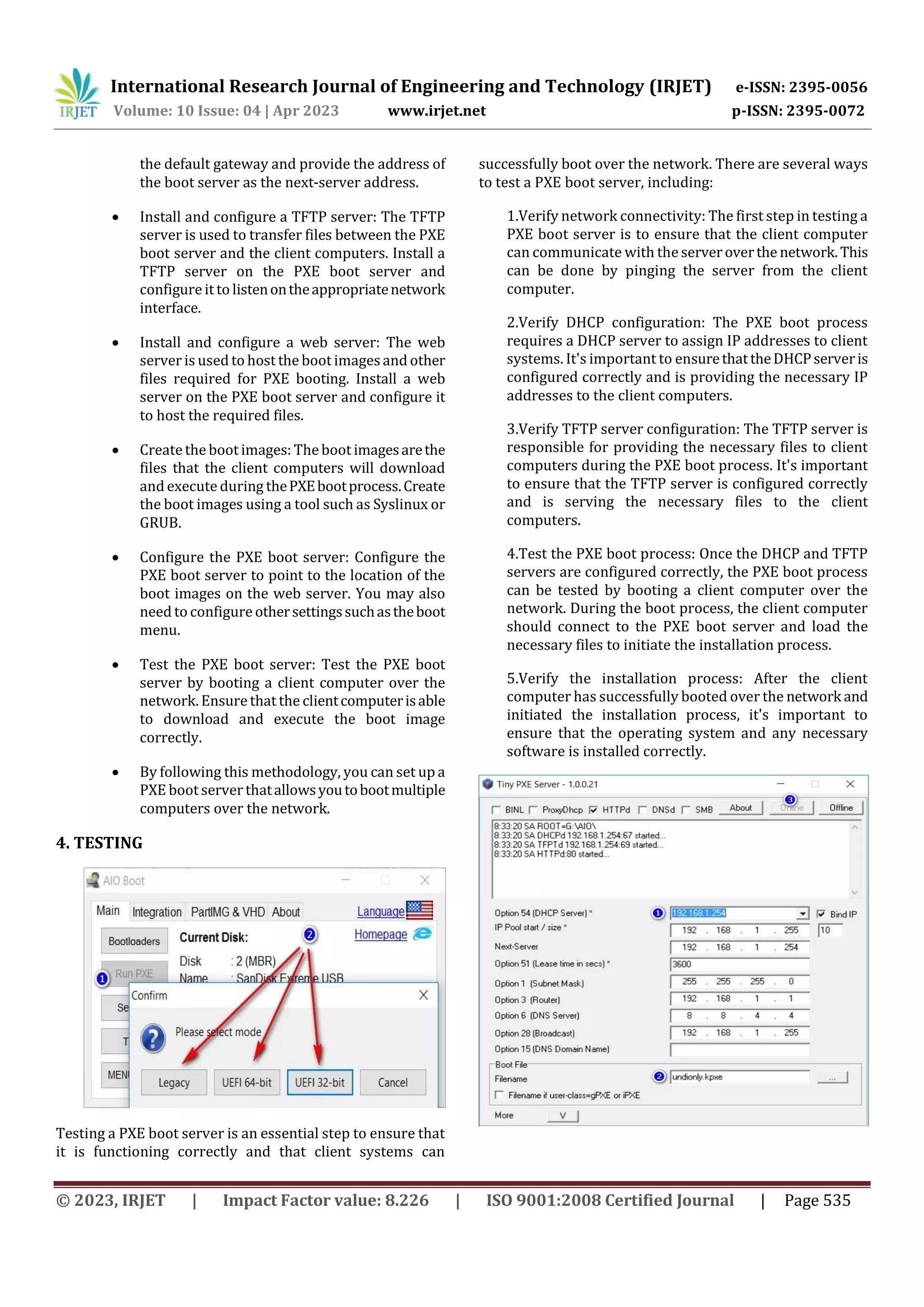
Testing a PXE boot server is an essential step to ensure that
it is functioning correctly and that client systems can
successfully boot over the network. There are several ways
to test a PXE boot server, including:
1.Verify network connectivity: The first step in testing a
PXE boot server is to ensure that the client computer
can communicate with the serveroverthe network.This
can be done by pinging the server from the client
computer.
2.Verify DHCP configuration: The PXE boot process
requires a DHCP server to assign IP addresses to client
systems. It's important to ensurethattheDHCPserveris
configured correctly and is providing the necessary IP
addresses to the client computers.
3.Verify TFTP server configuration: The TFTP server is
responsible for providing the necessary files to client
computers during the PXE boot process. It's important
to ensure that the TFTP server is configured correctly
and is serving the necessary files to the client
computers.
4.Test the PXE boot process: Once the DHCP and TFTP
servers are configured correctly, the PXE boot process
can be tested by booting a client computer over the
network. During the boot process, the client computer
should connect to the PXE boot server and load the
necessary files to initiate the installation process.
5.Verify the installation process: After the client
computer has successfully booted over the network and
initiated the installation process, it's important to
ensure that the operating system and any necessary
software is installed correctly.
International Research Journal of Engineering and Technology (IRJET) e-ISSN: 2395-0056
Volume: 10 Issue: 04 | Apr 2023 www.irjet.net p-ISSN: 2395-0072
© 2023, IRJET | Impact Factor value: 8.226 | ISO 9001:2008 Certified Journal | Page 536
5. USE CASE
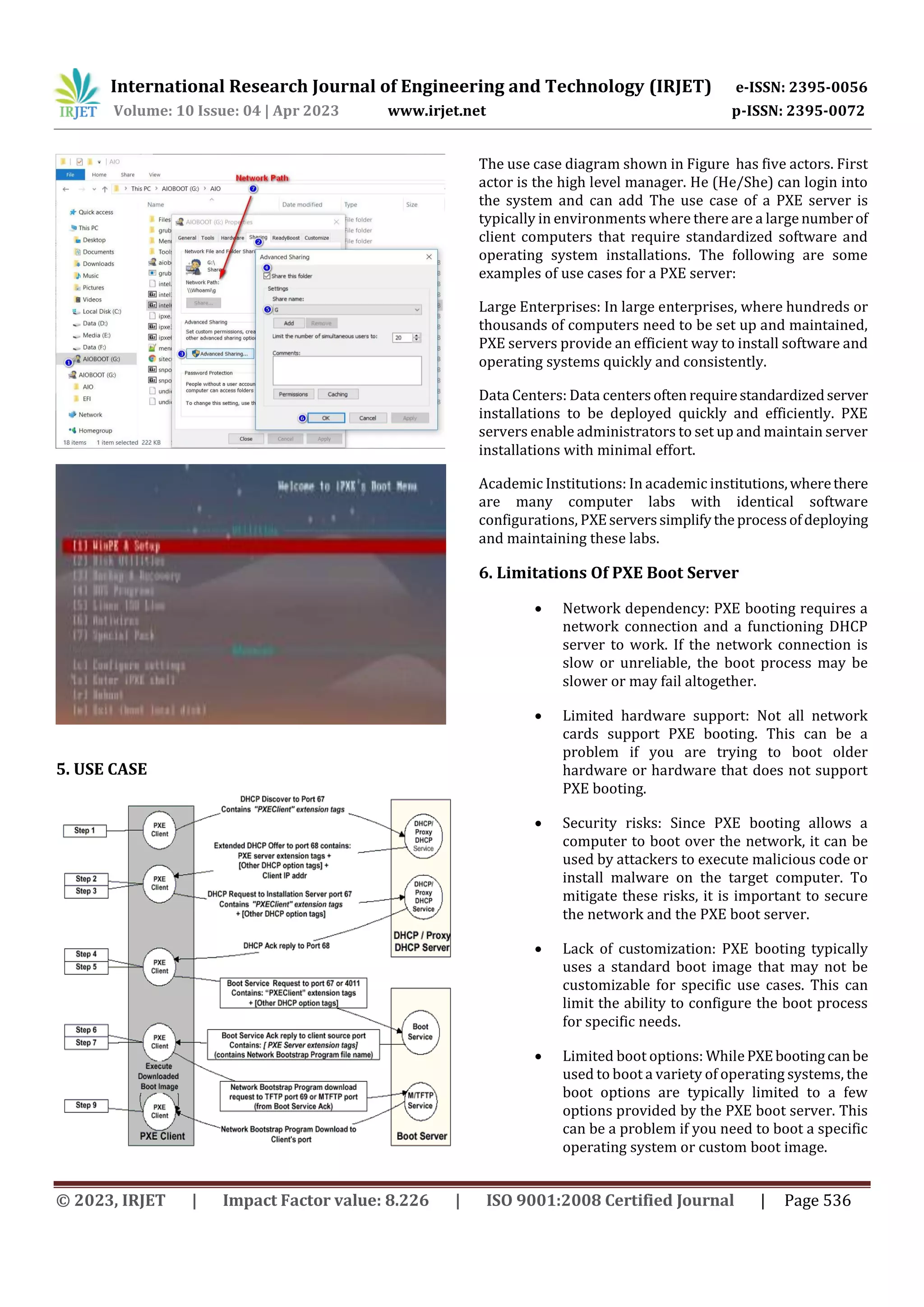
The use case diagram shown in Figure has five actors. First
actor is the high level manager. He (He/She) can login into
the system and can add The use case of a PXE server is
typically in environments where there are a large numberof
client computers that require standardized software and
operating system installations. The following are some
examples of use cases for a PXE server:
Large Enterprises: In large enterprises, where hundreds or
thousands of computers need to be set up and maintained,
PXE servers provide an efficient way to install software and
operating systems quickly and consistently.
Data Centers: Data centersoften requirestandardizedserver
installations to be deployed quickly and efficiently. PXE
servers enable administrators to set up and maintain server
installations with minimal effort.
Academic Institutions: In academic institutions,wherethere
are many computer labs with identical software
configurations, PXEserverssimplifythe processofdeploying
and maintaining these labs.
6. Limitations Of PXE Boot Server
 Network dependency: PXE booting requires a
network connection and a functioning DHCP
server to work. If the network connection is
slow or unreliable, the boot process may be
slower or may fail altogether.
 Limited hardware support: Not all network
cards support PXE booting. This can be a
problem if you are trying to boot older
hardware or hardware that does not support
PXE booting.
 Security risks: Since PXE booting allows a
computer to boot over the network, it can be
used by attackers to execute malicious code or
install malware on the target computer. To
mitigate these risks, it is important to secure
the network and the PXE boot server.
 Lack of customization: PXE booting typically
uses a standard boot image that may not be
customizable for specific use cases. This can
limit the ability to configure the boot process
for specific needs.
 Limited boot options: While PXEbootingcan be
used to boot a variety of operating systems, the
boot options are typically limited to a few
options provided by the PXE boot server. This
can be a problem if you need to boot a specific
operating system or custom boot image.
International Research Journal of Engineering and Technology (IRJET) e-ISSN: 2395-0056
Volume: 10 Issue: 04 | Apr 2023 www.irjet.net p-ISSN: 2395-0072
© 2023, IRJET | Impact Factor value: 8.226 | ISO 9001:2008 Certified Journal | Page 537
 Overall, while PXE booting can be a useful
technology for booting computers over a
network, it is important to be aware of its
limitations and to carefully consider whetherit
is the best solution for your needs.
7. RESULTS
8. FUTURE WORK
One potential area for future work in the development of
PXE boot servers is in improving security. As PXE boot
servers allow computers to boot from the network, they can
potentially be vulnerabletosecuritythreatssuchasmalware
or unauthorized access. Improving the security features of
PXE boot servers, such as implementing secure boot or
encryption protocols, can help mitigate these risks.
Another area for future work is in improving the user
experience and making the installation process more
streamlined and user-friendly.Thiscouldincludedeveloping
more intuitive user interfaces or automated installation
scripts to simplify the installation process and reduce the
potential for user errors.
9. CONCLUSIONS
In conclusion, PXE boot servers are a powerful tool for
organizations that need to deploy and maintain large
numbers of computers with standardized software and
operating system configurations. By enabling computers to
boot over the network, PXEbootserverssimplifytheprocess
of deploying new installationsandmaintainingexistingones,
reducing the need for manual configuration and minimizing
the potential for errors. While PXE boot servers have been
around for many years, there is still room for improvement
in areas such as security and user experience. As
organizations continuetorelyontechnologytosupporttheir
operations, PXE boot servers will remainan essential tool for
managing large-scale computing environments.
10. REFERENCES
[1] PXEBooting
(https://wiki.archlinux.org/title/PXE_booting)
[2] Introduction to PXE
(https://www.linuxjournal.com/content/introduction-
pxe)
[3] PXE Boot Server Configuration Steps in Linux
(https://www.tecmint.com/install-pxe-network-boot-
server-in-centos-7/)
[4] Network booting with PXE (https://netboot.xyz/)
10.BIOGRAPHIES
Name – Omkar Somnath Satpute
CollegeName-MatoshriAasarabai
Polytechnic Nashik
Name – Yogesh Kailas Khandode
CollegeName-MatoshriAasarabai
Polytechnic Nashik
Name – Tejas Prashant More
CollegeName-MatoshriAasarabai
Polytechnic Nashik
Name – Vasudev Sanjay sawkare
CollegeName-MatoshriAasarabai
Polytechnic Nashik

PXE Boot Server Using AIO Boot Creater (Pre Boot Execution)

  • 1.
    International Research Journalof Engineering and Technology (IRJET) e-ISSN: 2395-0056 Volume: 10 Issue: 04 | Apr 2023 www.irjet.net p-ISSN: 2395-0072 © 2023, IRJET | Impact Factor value: 8.226 | ISO 9001:2008 Certified Journal | Page 534 PXE Boot Server Using AIO Boot Creater (Pre Boot Execution) ---------------------------------------------------------------------***--------------------------------------------------------------------- Abstract: A PXE (Preboot Execution Environment) boot server is a network protocol that allows a computer to boot and install an operating system over a network. It is a powerful tool that simplifies the installation process and reduces the risk of errors and inconsistencies, particularly in largeorganizations where multiple computers need to be provisioned with the same operating system and software. To set up a PXE boot server, a DHCP server and a TFTP server are required. Once the server is configured, the client computers need to be setup to boot from the network. A PXE boot server can save time, reduce costs, and improve the overall efficiency of the IT infrastructure. Key Words: PXE boot server, network protocol, installation process, operating system, DHCP server, TFTP server, client computers, IT infrastructure, large organizations. 1. INTRODUCTION PXE (Preboot Execution Environment)isa network protocol that allows a computer to boot and install an operating system over a network. A PXE boot server is a server that stores the necessary files and software for PXE booting. In a PXE boot environment, the client computer sends a broadcast message to the network requesting a boot image. The PXE boot server responds to the request by sending the necessary files to the client, including the boot loader, operating system, and configuration files. The client then boots up and installs the operating systemoverthe network. A PXE boot server can be useful in many situations, such as in large organizations where a large number of computers need to be provisioned with the same operating system and applications. It can also be useful in cases where a computer does not have a CD/DVD drive or the installation media is not available. 1.1 Background PXE was designed for use in large-scale corporate environments to simplify the process of deploying new computers with standardized system images. PXE booting allowed administrators to configure a single image for deployment across the entire organization, ensuring that each computer was set up consistently and efficiently. Over time, PXE has become a widely-used standard for network booting in various environments, including data centers, academicinstitutions,andgovernmentagencies.PXE booting is commonly used to boot a variety of operating systems, including Windows, Linux, and macOS, as well as diagnostic and recovery tools. The use of PXE boot servers has becomeincreasinglypopular due to their ability to streamline the installation process, reduce costs, and minimize the risk of errors during deployment. As a result, many organizations now utilize PXE boot servers as a standard part of their IT infrastructure. 2.Development The development of PXE boot server technology beganinthe late 1990s when Intel Corporation designed the Preboot ExecutionEnvironment(PXE)protocol.Theprimarygoalwas to provide a standardized method for booting computers over a network, enabling remote installation of operating systems and other software. PXE booting was initially designedforlargecorporationsthat required a reliable, scalable way to deploy new systems. In the early days, PXE booting was accomplished through complex and often proprietary solutionsthatwereexpensive to implement and maintain. As technology has advanced, so too has the range of applications for PXE boot servers. Today, PXE boot servers are used in a wide range of settings, from data centers and academic institutions to government agencies and small businesses. They provide a powerful tool for administrators to streamline the installation process, reduce costs, and ensure consistency across large numbers of systems. Overall, the development of PXE boot server technology has transformedtheprocessofinstallinganddeployingoperating systems, making it faster, easier, and more efficientthanever before. 3. Methodology  Install and configure a DHCP server: The DHCP server assigns IP addresses to thecomputerson the network. Configure the DHCP server to assign the IP address of the PXE boot server as Author 1: Omkar Somnath Satpute Author 2: Yogesh Kailas Khandode Author 3: Tejas Prashant More Author 4: Mr. V. A. Sonawane HOD Matoshri Aasarabai Polytechnic Nashik
  • 2.
    International Research Journalof Engineering and Technology (IRJET) e-ISSN: 2395-0056 Volume: 10 Issue: 04 | Apr 2023 www.irjet.net p-ISSN: 2395-0072 © 2023, IRJET | Impact Factor value: 8.226 | ISO 9001:2008 Certified Journal | Page 535 the default gateway and provide the address of the boot server as the next-server address.  Install and configure a TFTP server: The TFTP server is used to transfer files between the PXE boot server and the client computers. Install a TFTP server on the PXE boot server and configureit to listenontheappropriatenetwork interface.  Install and configure a web server: The web server is used to host the boot imagesand other files required for PXE booting. Install a web server on the PXE boot server and configure it to host the required files.  Createthe boot images: The boot imagesarethe files that the client computers will download and execute during thePXEbootprocess.Create the boot images using a tool such as Syslinux or GRUB.  Configure the PXE boot server: Configure the PXE boot server to point to the location of the boot images on the web server. You may also need to configure othersettingssuchastheboot menu.  Test the PXE boot server: Test the PXE boot server by booting a client computer over the network. Ensurethat the clientcomputerisable to download and execute the boot image correctly.  By following this methodology, you can set up a PXE boot server thatallowsyoutobootmultiple computers over the network. 4. TESTING Testing a PXE boot server is an essential step to ensure that it is functioning correctly and that client systems can successfully boot over the network. There are several ways to test a PXE boot server, including: 1.Verify network connectivity: The first step in testing a PXE boot server is to ensure that the client computer can communicate with the serveroverthe network.This can be done by pinging the server from the client computer. 2.Verify DHCP configuration: The PXE boot process requires a DHCP server to assign IP addresses to client systems. It's important to ensurethattheDHCPserveris configured correctly and is providing the necessary IP addresses to the client computers. 3.Verify TFTP server configuration: The TFTP server is responsible for providing the necessary files to client computers during the PXE boot process. It's important to ensure that the TFTP server is configured correctly and is serving the necessary files to the client computers. 4.Test the PXE boot process: Once the DHCP and TFTP servers are configured correctly, the PXE boot process can be tested by booting a client computer over the network. During the boot process, the client computer should connect to the PXE boot server and load the necessary files to initiate the installation process. 5.Verify the installation process: After the client computer has successfully booted over the network and initiated the installation process, it's important to ensure that the operating system and any necessary software is installed correctly.
  • 3.
    International Research Journalof Engineering and Technology (IRJET) e-ISSN: 2395-0056 Volume: 10 Issue: 04 | Apr 2023 www.irjet.net p-ISSN: 2395-0072 © 2023, IRJET | Impact Factor value: 8.226 | ISO 9001:2008 Certified Journal | Page 536 5. USE CASE The use case diagram shown in Figure has five actors. First actor is the high level manager. He (He/She) can login into the system and can add The use case of a PXE server is typically in environments where there are a large numberof client computers that require standardized software and operating system installations. The following are some examples of use cases for a PXE server: Large Enterprises: In large enterprises, where hundreds or thousands of computers need to be set up and maintained, PXE servers provide an efficient way to install software and operating systems quickly and consistently. Data Centers: Data centersoften requirestandardizedserver installations to be deployed quickly and efficiently. PXE servers enable administrators to set up and maintain server installations with minimal effort. Academic Institutions: In academic institutions,wherethere are many computer labs with identical software configurations, PXEserverssimplifythe processofdeploying and maintaining these labs. 6. Limitations Of PXE Boot Server  Network dependency: PXE booting requires a network connection and a functioning DHCP server to work. If the network connection is slow or unreliable, the boot process may be slower or may fail altogether.  Limited hardware support: Not all network cards support PXE booting. This can be a problem if you are trying to boot older hardware or hardware that does not support PXE booting.  Security risks: Since PXE booting allows a computer to boot over the network, it can be used by attackers to execute malicious code or install malware on the target computer. To mitigate these risks, it is important to secure the network and the PXE boot server.  Lack of customization: PXE booting typically uses a standard boot image that may not be customizable for specific use cases. This can limit the ability to configure the boot process for specific needs.  Limited boot options: While PXEbootingcan be used to boot a variety of operating systems, the boot options are typically limited to a few options provided by the PXE boot server. This can be a problem if you need to boot a specific operating system or custom boot image.
  • 4.
    International Research Journalof Engineering and Technology (IRJET) e-ISSN: 2395-0056 Volume: 10 Issue: 04 | Apr 2023 www.irjet.net p-ISSN: 2395-0072 © 2023, IRJET | Impact Factor value: 8.226 | ISO 9001:2008 Certified Journal | Page 537  Overall, while PXE booting can be a useful technology for booting computers over a network, it is important to be aware of its limitations and to carefully consider whetherit is the best solution for your needs. 7. RESULTS 8. FUTURE WORK One potential area for future work in the development of PXE boot servers is in improving security. As PXE boot servers allow computers to boot from the network, they can potentially be vulnerabletosecuritythreatssuchasmalware or unauthorized access. Improving the security features of PXE boot servers, such as implementing secure boot or encryption protocols, can help mitigate these risks. Another area for future work is in improving the user experience and making the installation process more streamlined and user-friendly.Thiscouldincludedeveloping more intuitive user interfaces or automated installation scripts to simplify the installation process and reduce the potential for user errors. 9. CONCLUSIONS In conclusion, PXE boot servers are a powerful tool for organizations that need to deploy and maintain large numbers of computers with standardized software and operating system configurations. By enabling computers to boot over the network, PXEbootserverssimplifytheprocess of deploying new installationsandmaintainingexistingones, reducing the need for manual configuration and minimizing the potential for errors. While PXE boot servers have been around for many years, there is still room for improvement in areas such as security and user experience. As organizations continuetorelyontechnologytosupporttheir operations, PXE boot servers will remainan essential tool for managing large-scale computing environments. 10. REFERENCES [1] PXEBooting (https://wiki.archlinux.org/title/PXE_booting) [2] Introduction to PXE (https://www.linuxjournal.com/content/introduction- pxe) [3] PXE Boot Server Configuration Steps in Linux (https://www.tecmint.com/install-pxe-network-boot- server-in-centos-7/) [4] Network booting with PXE (https://netboot.xyz/) 10.BIOGRAPHIES Name – Omkar Somnath Satpute CollegeName-MatoshriAasarabai Polytechnic Nashik Name – Yogesh Kailas Khandode CollegeName-MatoshriAasarabai Polytechnic Nashik Name – Tejas Prashant More CollegeName-MatoshriAasarabai Polytechnic Nashik Name – Vasudev Sanjay sawkare CollegeName-MatoshriAasarabai Polytechnic Nashik