Indra P Sharma
B.Optom, M.Optom
The magnified tour of the eye with
SLIT-LAMP
BIOMICROSCOPE
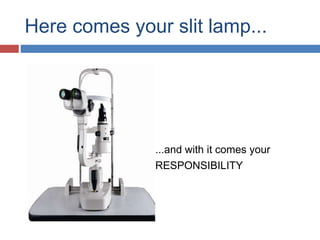
Here comes your slit lamp...
...and with it comes your
RESPONSIBILITY
Background
 The name
SLIT : A narrow slit beam of very bright light
LAMP : produced by a lamp (illumination
system)
BIO : to view the biological structure (of
eye)
MICROSCOPE : under magnification with a
microscope
Overview
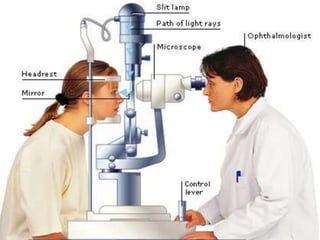
 Instrument uniquely designed to give a magnified
three dimensional view of the eye and its structures
for quantitative measurements for documentation.
 Because the slit lamp provides a binocular view, the
location of abnormalities can be determined with great
precision.
 The instrument combines variable magnification with
controlled illumination.
 In simple, to make a magnified tour of the eye.
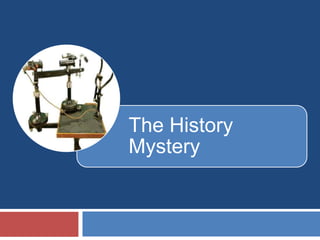
The History
Mystery
History Mystery
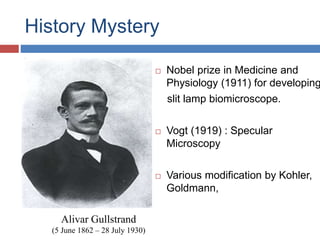
Alivar Gullstrand
(5 June 1862 – 28 July 1930)
 Nobel prize in Medicine and
Physiology (1911) for developing
slit lamp biomicroscope.
 Vogt (1919) : Specular
Microscopy
 Various modification by Kohler,
Goldmann,
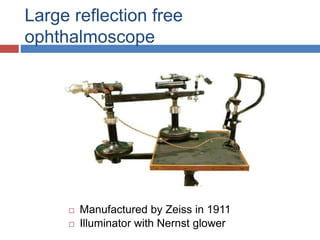
Large reflection free
ophthalmoscope
 Manufactured by Zeiss in 1911
 Illuminator with Nernst glower
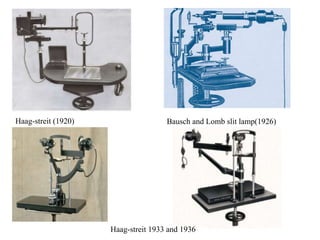
Haag-streit (1920) Bausch and Lomb slit lamp(1926)
Haag-streit 1933 and 1936
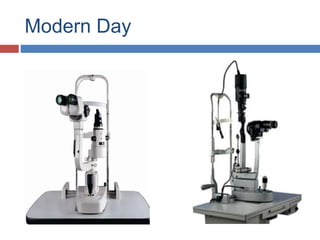
Modern Day
The types
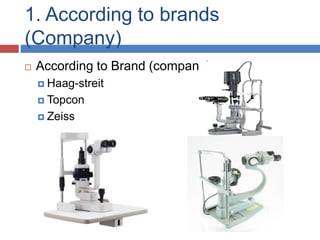
1. According to brands
(Company)
 According to Brand (company)
 Haag-streit
 Topcon
 Zeiss
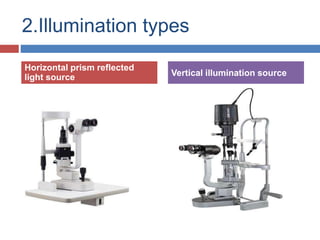
2.Illumination types
Horizontal prism reflected
light source Vertical illumination source
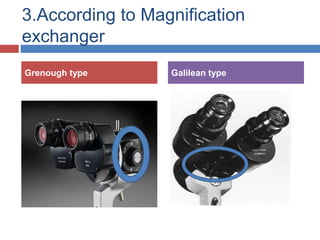
3.According to Magnification
exchanger
Grenough type Galilean type
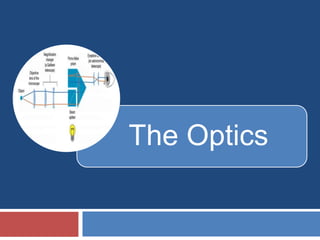
The Optics
Optics
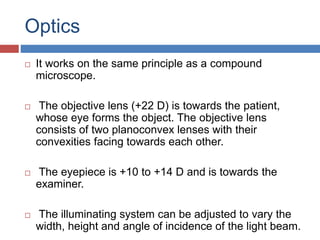
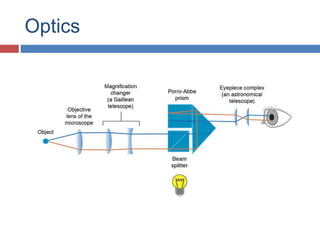
 It works on the same principle as a compound
microscope.
 The objective lens (+22 D) is towards the patient,
whose eye forms the object. The objective lens
consists of two planoconvex lenses with their
convexities facing towards each other.
 The eyepiece is +10 to +14 D and is towards the
examiner.
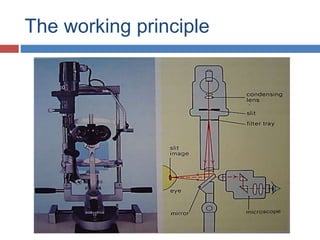
 The illuminating system can be adjusted to vary the
width, height and angle of incidence of the light beam.
The working principle
Optics
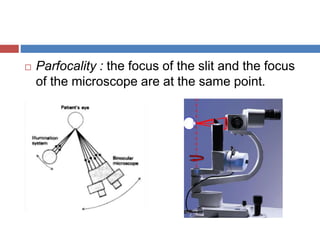
 Parfocality : the focus of the slit and the focus
of the microscope are at the same point.
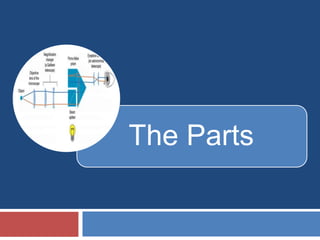
The Parts
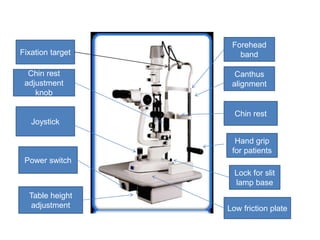
Fixation target
Chin rest
adjustment
knob
Joystick
Power switch
Table height
adjustment
Forehead
band
Canthus
alignment
Chin rest
Hand grip
for patients
Lock for slit
lamp base
Low friction plate
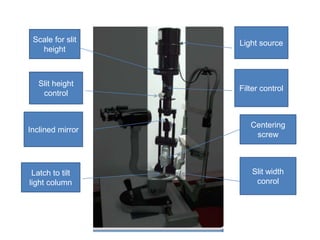
Scale for slit
height
Slit height
control
Inclined mirror
Latch to tilt
light column
Light source
Filter control
Centering
screw
Slit width
conrol
Parts of Slit-lamp
 1. Illumination system
 2. Observation system
 3. Mechanical system
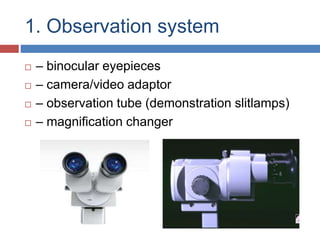
1. Observation system
 – binocular eyepieces
 – camera/video adaptor
 – observation tube (demonstration slitlamps)
 – magnification changer
2. Illumination system
 lamp housing unit
 slit width and height control
 neutral density filter
 cobalt blue light
 red-free (green) filter
 field size control
 diffuser
 prism.
3. Mechanical system
 Motorized table (Base)
 Patient positioning frame
 Joystick
 forehead rest
 chin rest
 fixation target
 power supply unit
 locking controls.
Magnification ranges
 Low magnification:
 7X - 10X : general eye
(Lids, bulbarconjunctiva/sclera,cornea/limbus,tears, anterior
chamber/iris/crystalline lens)
 Medium magnification:
 20X - 25X : structure of individual layers.
(Epithelium/epithelial breakdown, Stroma, Endothelium,
contact lens fit/lens condition)
 High magnification:
 30X - 40X : details.
(epithelial changes, stromal striae, folds, endothelial folds,
polymegethism)
Illumination System: Features
1. Variable light intensity
 – low
 – medium
 – high.
2. Filters
 – cobalt blue light
 – red-free (green)
 – neutral density filter.
3. Width
 – optic section
 – parallelepiped of Vogt
 narrow beam
 broad beam
 – conical beam.
4. Height
 – adjustable slit height
5. Angle
 – variable angle formed with the observation
 system
 – rotation of the prism or mirror enables
 observation with an alternate illumination
 technique (especially an indirect method).
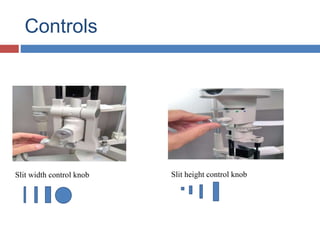
Controls
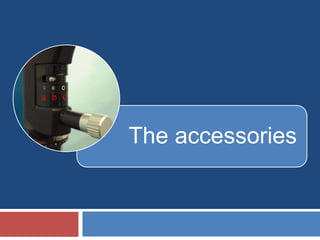
Slit width control knob Slit height control knob
The examination
procedure
What the Patient Needs to
Know
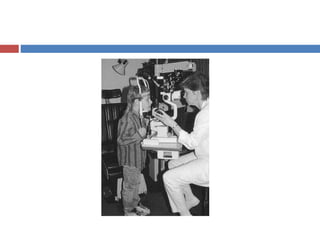
 Instruction to patients:
 This instrument is a microscope used to magnify the
structures of the eye.
 Please keep your chin in the cup with your teeth
together and your forehead against the bar. Try not to
lean back. The microscope comes close to your face
but will not touch your eye.
 Sometimes the light is bright. Unless specifically told
not to, you may blink at any time.
 Try to keep both eyes open.
 This is just a light, not a laser or a camera.
How to start?
 Focus the eye piece
 Adjust the headrest
 Position the fixation target
 Decrease the room illumination
 Start with diffuse illumination
Order of Examination
 Tears
 Lid margins/Lashes
 Conjunctiva
 Cornea
 Anterior chamber
 Iris
 Lens
 Anterior vitreous
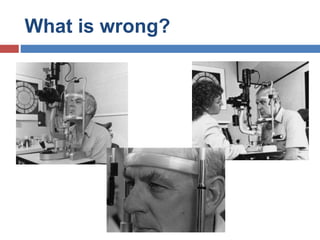
What is wrong?
Keypoints
 Patient education is an important aspect of the slit lamp
exam.
 A comfortable patient is a more cooperative patient.
 Before beginning, adjust the ocular power and pupillary
distance
(PD).
 Using lower voltage settings preserves bulb life.
 Manipulate the microscope with one hand on the light
source
and the other hand on the joystick.
 Developing and following an examination protocol will help
ensure quality patient care.
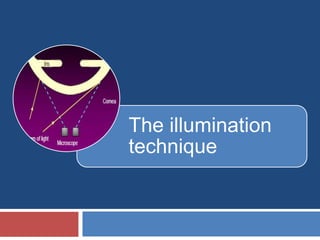
The illumination
technique
Illumination Techniques
 1. Diffuse.
 2. Direct.
 3. Indirect.
 4. Retro-illumination.
 5. Specular reflection.
 6. Sclerotic scatter.
 7. Tangential.
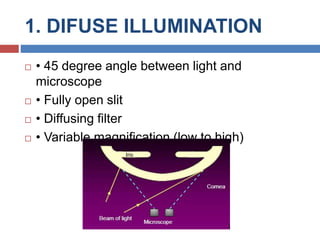
1. DIFUSE ILLUMINATION
 • 45 degree angle between light and
microscope
 • Fully open slit
 • Diffusing filter
 • Variable magnification (low to high)
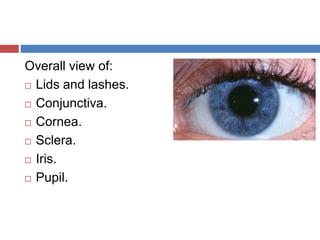
Overall view of:
 Lids and lashes.
 Conjunctiva.
 Cornea.
 Sclera.
 Iris.
 Pupil.
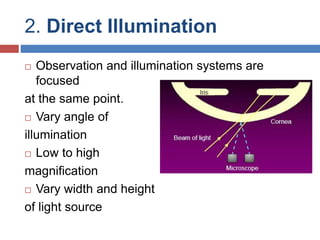
2. Direct Illumination
 Observation and illumination systems are
focused
at the same point.
 Vary angle of
illumination
 Low to high
magnification
 Vary width and height
of light source
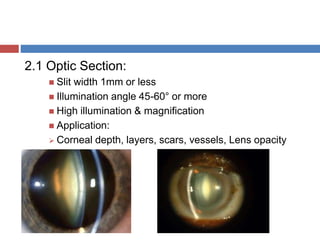
2.1 Optic Section:
 Slit width 1mm or less
 Illumination angle 45-60° or more
 High illumination & magnification
 Application:
 Corneal depth, layers, scars, vessels, Lens opacity
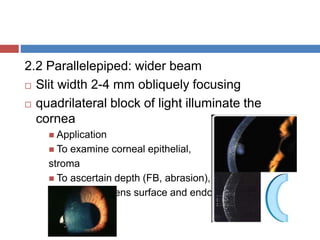
2.2 Parallelepiped: wider beam
 Slit width 2-4 mm obliquely focusing
 quadrilateral block of light illuminate the
cornea
 Application
 To examine corneal epithelial,
stroma
 To ascertain depth (FB, abrasion),
 breakdown, lens surface and endothelium.
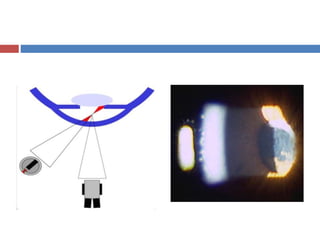
2.3 Conical Beam:
 Narrow, short & bright slit of light
 45°-60° light source directed to pupil
 Magnification 16x-25x
 Application :
 Inflammatory cells, flare, pigmented cells, metabolic
wastes
 Assessment of particles floating in the A/C
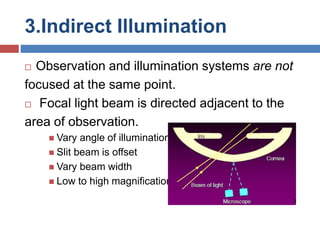
3.Indirect Illumination
 Observation and illumination systems are not
focused at the same point.
 Focal light beam is directed adjacent to the
area of observation.
 Vary angle of illumination
 Slit beam is offset
 Vary beam width
 Low to high magnification
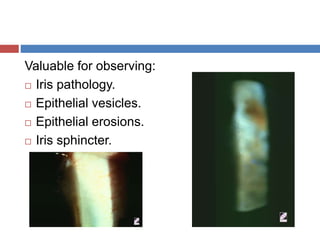
Valuable for observing:
 Iris pathology.
 Epithelial vesicles.
 Epithelial erosions.
 Iris sphincter.
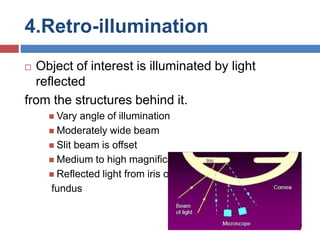
4.Retro-illumination
 Object of interest is illuminated by light
reflected
from the structures behind it.
 Vary angle of illumination
 Moderately wide beam
 Slit beam is offset
 Medium to high magnification
 Reflected light from iris or
fundus
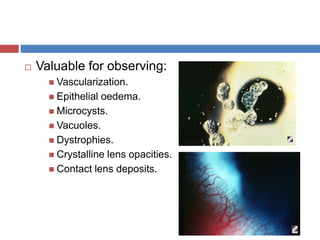
 Valuable for observing:
 Vascularization.
 Epithelial oedema.
 Microcysts.
 Vacuoles.
 Dystrophies.
 Crystalline lens opacities.
 Contact lens deposits.
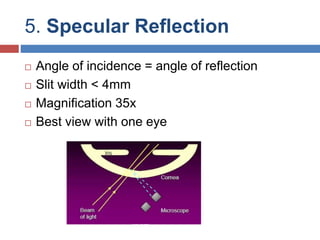
5. Specular Reflection
 Angle of incidence = angle of reflection
 Slit width < 4mm
 Magnification 35x
 Best view with one eye
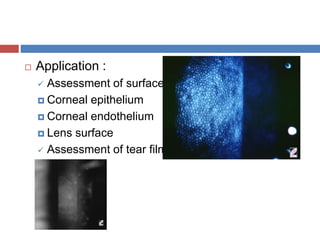
 Application :
 Assessment of surfaces
 Corneal epithelium
 Corneal endothelium
 Lens surface
 Assessment of tear film
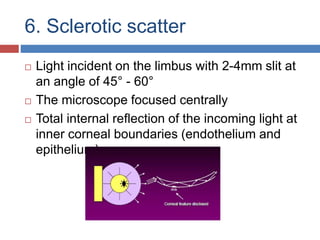
6. Sclerotic scatter
 Light incident on the limbus with 2-4mm slit at
an angle of 45° - 60°
 The microscope focused centrally
 Total internal reflection of the incoming light at
inner corneal boundaries (endothelium and
epithelium)
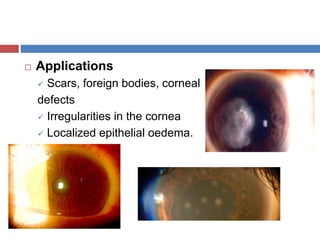
 Applications
 Scars, foreign bodies, corneal
defects
 Irregularities in the cornea
 Localized epithelial oedema.
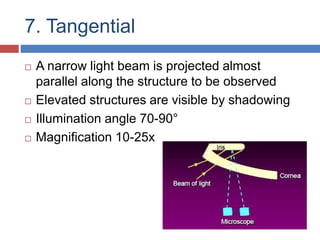
7. Tangential
 A narrow light beam is projected almost
parallel along the structure to be observed
 Elevated structures are visible by shadowing
 Illumination angle 70-90°
 Magnification 10-25x
 Application :
 Elevated abnormities or changes in the iris
 Tumors, cysts
Key Points
 An appreciation of what is normal is necessary
before one can identify that which is abnormal.
 Documenting that a structure is normal is just
as important as notating irregularities.
 There are variations of normal that you will
learn as you continue to examine eyes with
the slit lamp.
The accessories
Filters
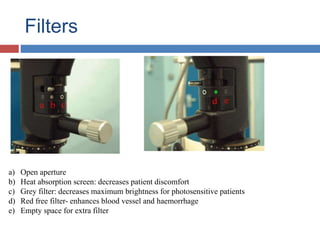
a) Open aperture
b) Heat absorption screen: decreases patient discomfort
c) Grey filter: decreases maximum brightness for photosensitive patients
d) Red free filter- enhances blood vessel and haemorrhage
e) Empty space for extra filter
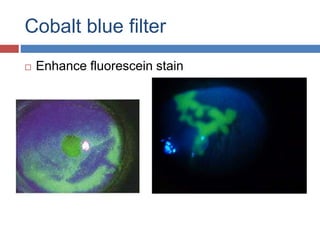
Cobalt blue filter
 Enhance fluorescein stain
Associated instrument
 Goldmann applanation tonometry
 Lenses
 Laser delivery system
 Slit lamp is the an important instrument for an
eye health personnel (treat it as an asset)
 User level care & maintenance is very much
important to get optimum performance & long
life from it.
 An careful eye examination can make a
difference in someones life.
 Slit lamp examination is an artof
science.....Practice, practice practice
6/17/2017
indrapsharma@gmail.com
optomindra.blogspot.in
6/17/2017

Slit lamp in Ophthalmology

  • 1.
    Indra P Sharma B.Optom,M.Optom The magnified tour of the eye with SLIT-LAMP BIOMICROSCOPE
  • 3.
    Here comes yourslit lamp... ...and with it comes your RESPONSIBILITY
  • 4.
    Background  The name SLIT: A narrow slit beam of very bright light LAMP : produced by a lamp (illumination system) BIO : to view the biological structure (of eye) MICROSCOPE : under magnification with a microscope
  • 5.
    Overview  Instrument uniquelydesigned to give a magnified three dimensional view of the eye and its structures for quantitative measurements for documentation.  Because the slit lamp provides a binocular view, the location of abnormalities can be determined with great precision.  The instrument combines variable magnification with controlled illumination.  In simple, to make a magnified tour of the eye.
  • 6.
  • 7.
    History Mystery Alivar Gullstrand (5June 1862 – 28 July 1930)  Nobel prize in Medicine and Physiology (1911) for developing slit lamp biomicroscope.  Vogt (1919) : Specular Microscopy  Various modification by Kohler, Goldmann,
  • 8.
    Large reflection free ophthalmoscope Manufactured by Zeiss in 1911  Illuminator with Nernst glower
  • 9.
    Haag-streit (1920) Bauschand Lomb slit lamp(1926) Haag-streit 1933 and 1936
  • 10.
  • 11.
  • 12.
    1. According tobrands (Company)  According to Brand (company)  Haag-streit  Topcon  Zeiss
  • 13.
    2.Illumination types Horizontal prismreflected light source Vertical illumination source
  • 14.
  • 15.
  • 16.
    Optics  It workson the same principle as a compound microscope.  The objective lens (+22 D) is towards the patient, whose eye forms the object. The objective lens consists of two planoconvex lenses with their convexities facing towards each other.  The eyepiece is +10 to +14 D and is towards the examiner.  The illuminating system can be adjusted to vary the width, height and angle of incidence of the light beam.
  • 17.
  • 18.
  • 19.
     Parfocality :the focus of the slit and the focus of the microscope are at the same point.
  • 20.
  • 21.
    Fixation target Chin rest adjustment knob Joystick Powerswitch Table height adjustment Forehead band Canthus alignment Chin rest Hand grip for patients Lock for slit lamp base Low friction plate
  • 22.
    Scale for slit height Slitheight control Inclined mirror Latch to tilt light column Light source Filter control Centering screw Slit width conrol
  • 23.
    Parts of Slit-lamp 1. Illumination system  2. Observation system  3. Mechanical system
  • 24.
    1. Observation system – binocular eyepieces  – camera/video adaptor  – observation tube (demonstration slitlamps)  – magnification changer
  • 25.
    2. Illumination system lamp housing unit  slit width and height control  neutral density filter  cobalt blue light  red-free (green) filter  field size control  diffuser  prism.
  • 26.
    3. Mechanical system Motorized table (Base)  Patient positioning frame  Joystick  forehead rest  chin rest  fixation target  power supply unit  locking controls.
  • 27.
    Magnification ranges  Lowmagnification:  7X - 10X : general eye (Lids, bulbarconjunctiva/sclera,cornea/limbus,tears, anterior chamber/iris/crystalline lens)  Medium magnification:  20X - 25X : structure of individual layers. (Epithelium/epithelial breakdown, Stroma, Endothelium, contact lens fit/lens condition)  High magnification:  30X - 40X : details. (epithelial changes, stromal striae, folds, endothelial folds, polymegethism)
  • 28.
    Illumination System: Features 1.Variable light intensity  – low  – medium  – high. 2. Filters  – cobalt blue light  – red-free (green)  – neutral density filter. 3. Width  – optic section  – parallelepiped of Vogt  narrow beam  broad beam  – conical beam.
  • 29.
    4. Height  –adjustable slit height 5. Angle  – variable angle formed with the observation  system  – rotation of the prism or mirror enables  observation with an alternate illumination  technique (especially an indirect method).
  • 30.
    Controls Slit width controlknob Slit height control knob
  • 31.
  • 33.
    What the PatientNeeds to Know  Instruction to patients:  This instrument is a microscope used to magnify the structures of the eye.  Please keep your chin in the cup with your teeth together and your forehead against the bar. Try not to lean back. The microscope comes close to your face but will not touch your eye.  Sometimes the light is bright. Unless specifically told not to, you may blink at any time.  Try to keep both eyes open.  This is just a light, not a laser or a camera.
  • 34.
    How to start? Focus the eye piece  Adjust the headrest  Position the fixation target  Decrease the room illumination  Start with diffuse illumination
  • 35.
    Order of Examination Tears  Lid margins/Lashes  Conjunctiva  Cornea  Anterior chamber  Iris  Lens  Anterior vitreous
  • 36.
  • 38.
    Keypoints  Patient educationis an important aspect of the slit lamp exam.  A comfortable patient is a more cooperative patient.  Before beginning, adjust the ocular power and pupillary distance (PD).  Using lower voltage settings preserves bulb life.  Manipulate the microscope with one hand on the light source and the other hand on the joystick.  Developing and following an examination protocol will help ensure quality patient care.
  • 39.
  • 40.
    Illumination Techniques  1.Diffuse.  2. Direct.  3. Indirect.  4. Retro-illumination.  5. Specular reflection.  6. Sclerotic scatter.  7. Tangential.
  • 41.
    1. DIFUSE ILLUMINATION • 45 degree angle between light and microscope  • Fully open slit  • Diffusing filter  • Variable magnification (low to high)
  • 42.
    Overall view of: Lids and lashes.  Conjunctiva.  Cornea.  Sclera.  Iris.  Pupil.
  • 43.
    2. Direct Illumination Observation and illumination systems are focused at the same point.  Vary angle of illumination  Low to high magnification  Vary width and height of light source
  • 44.
    2.1 Optic Section: Slit width 1mm or less  Illumination angle 45-60° or more  High illumination & magnification  Application:  Corneal depth, layers, scars, vessels, Lens opacity
  • 45.
    2.2 Parallelepiped: widerbeam  Slit width 2-4 mm obliquely focusing  quadrilateral block of light illuminate the cornea  Application  To examine corneal epithelial, stroma  To ascertain depth (FB, abrasion),  breakdown, lens surface and endothelium.
  • 46.
    2.3 Conical Beam: Narrow, short & bright slit of light  45°-60° light source directed to pupil  Magnification 16x-25x  Application :  Inflammatory cells, flare, pigmented cells, metabolic wastes  Assessment of particles floating in the A/C
  • 48.
    3.Indirect Illumination  Observationand illumination systems are not focused at the same point.  Focal light beam is directed adjacent to the area of observation.  Vary angle of illumination  Slit beam is offset  Vary beam width  Low to high magnification
  • 49.
    Valuable for observing: Iris pathology.  Epithelial vesicles.  Epithelial erosions.  Iris sphincter.
  • 50.
    4.Retro-illumination  Object ofinterest is illuminated by light reflected from the structures behind it.  Vary angle of illumination  Moderately wide beam  Slit beam is offset  Medium to high magnification  Reflected light from iris or fundus
  • 51.
     Valuable forobserving:  Vascularization.  Epithelial oedema.  Microcysts.  Vacuoles.  Dystrophies.  Crystalline lens opacities.  Contact lens deposits.
  • 52.
    5. Specular Reflection Angle of incidence = angle of reflection  Slit width < 4mm  Magnification 35x  Best view with one eye
  • 53.
     Application : Assessment of surfaces  Corneal epithelium  Corneal endothelium  Lens surface  Assessment of tear film
  • 54.
    6. Sclerotic scatter Light incident on the limbus with 2-4mm slit at an angle of 45° - 60°  The microscope focused centrally  Total internal reflection of the incoming light at inner corneal boundaries (endothelium and epithelium)
  • 55.
     Applications  Scars,foreign bodies, corneal defects  Irregularities in the cornea  Localized epithelial oedema.
  • 56.
    7. Tangential  Anarrow light beam is projected almost parallel along the structure to be observed  Elevated structures are visible by shadowing  Illumination angle 70-90°  Magnification 10-25x
  • 57.
     Application : Elevated abnormities or changes in the iris  Tumors, cysts
  • 58.
    Key Points  Anappreciation of what is normal is necessary before one can identify that which is abnormal.  Documenting that a structure is normal is just as important as notating irregularities.  There are variations of normal that you will learn as you continue to examine eyes with the slit lamp.
  • 59.
  • 60.
    Filters a) Open aperture b)Heat absorption screen: decreases patient discomfort c) Grey filter: decreases maximum brightness for photosensitive patients d) Red free filter- enhances blood vessel and haemorrhage e) Empty space for extra filter
  • 61.
    Cobalt blue filter Enhance fluorescein stain
  • 62.
    Associated instrument  Goldmannapplanation tonometry  Lenses  Laser delivery system
  • 63.
     Slit lampis the an important instrument for an eye health personnel (treat it as an asset)  User level care & maintenance is very much important to get optimum performance & long life from it.  An careful eye examination can make a difference in someones life.  Slit lamp examination is an artof science.....Practice, practice practice
  • 64.
  • 65.